How Much Down Payment for Second Home?
A conventional second home can start at 10% down, but the minimum is not always the smartest amount. See how 10%, 20%, and 25% down change monthly costs, cash at closing, reserves, and mortgage approval.
If you are buying a second home in the US, the first number to know is 10%.
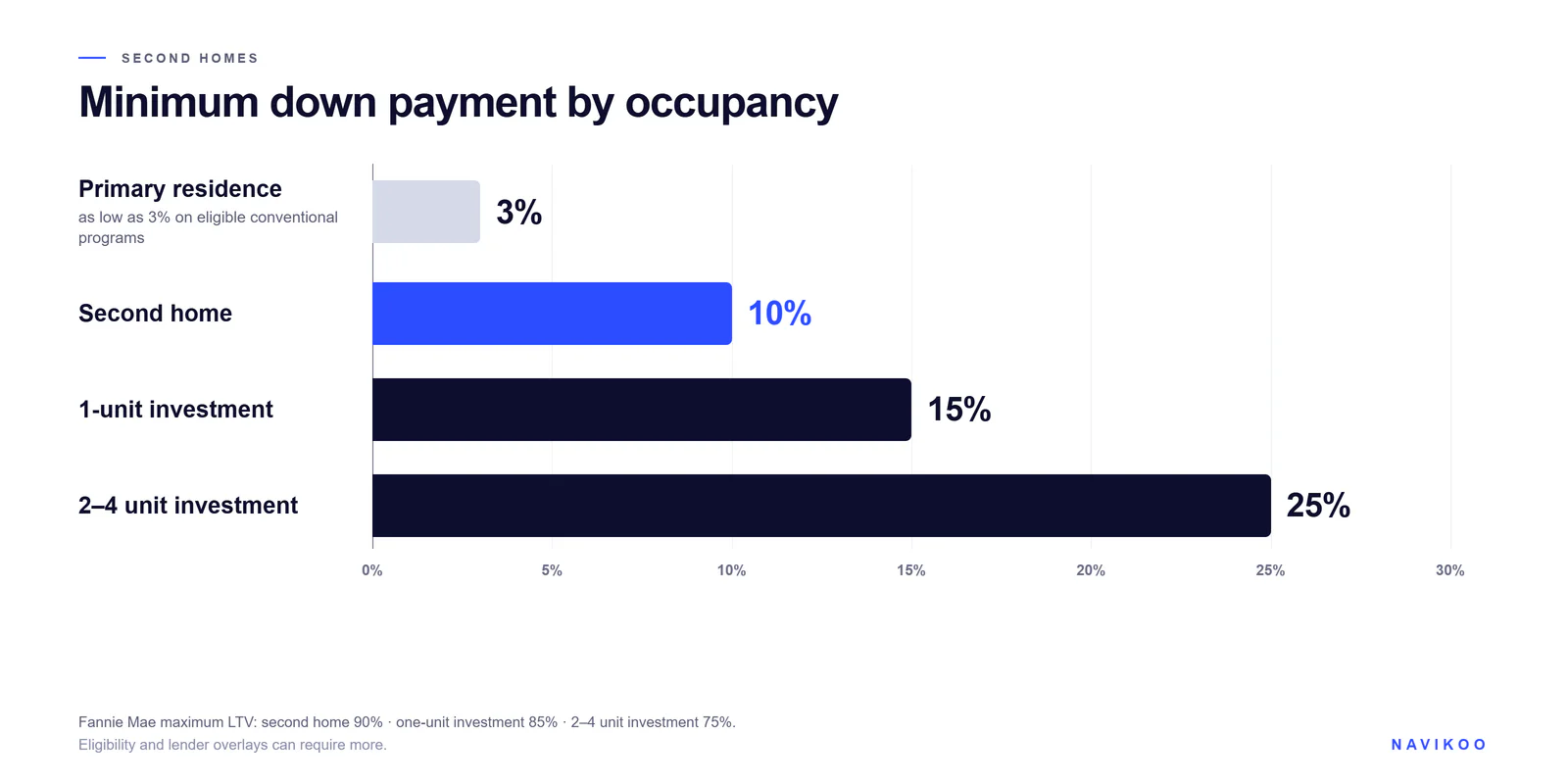
With a conventional loan, the minimum down payment for an eligible one-unit second home is usually 10% of the purchase price because Fannie Mae's current eligibility matrix allows financing up to 90% of value. Many buyers still put down 20% or more, because a larger down payment can remove mortgage insurance, lower the monthly cost, and make approval easier.
That is the short answer to how much down payment for second home loans is required. The more useful answer comes down to three considerations: whether the property really qualifies as a second home rather than an investment property, how much total money and upfront costs the purchase will take, and how the new mortgage fits alongside the one you already carry.
What Counts as a Second Home?
Lenders define a second home more narrowly than many buyers expect, and that definition affects how much you must put down.
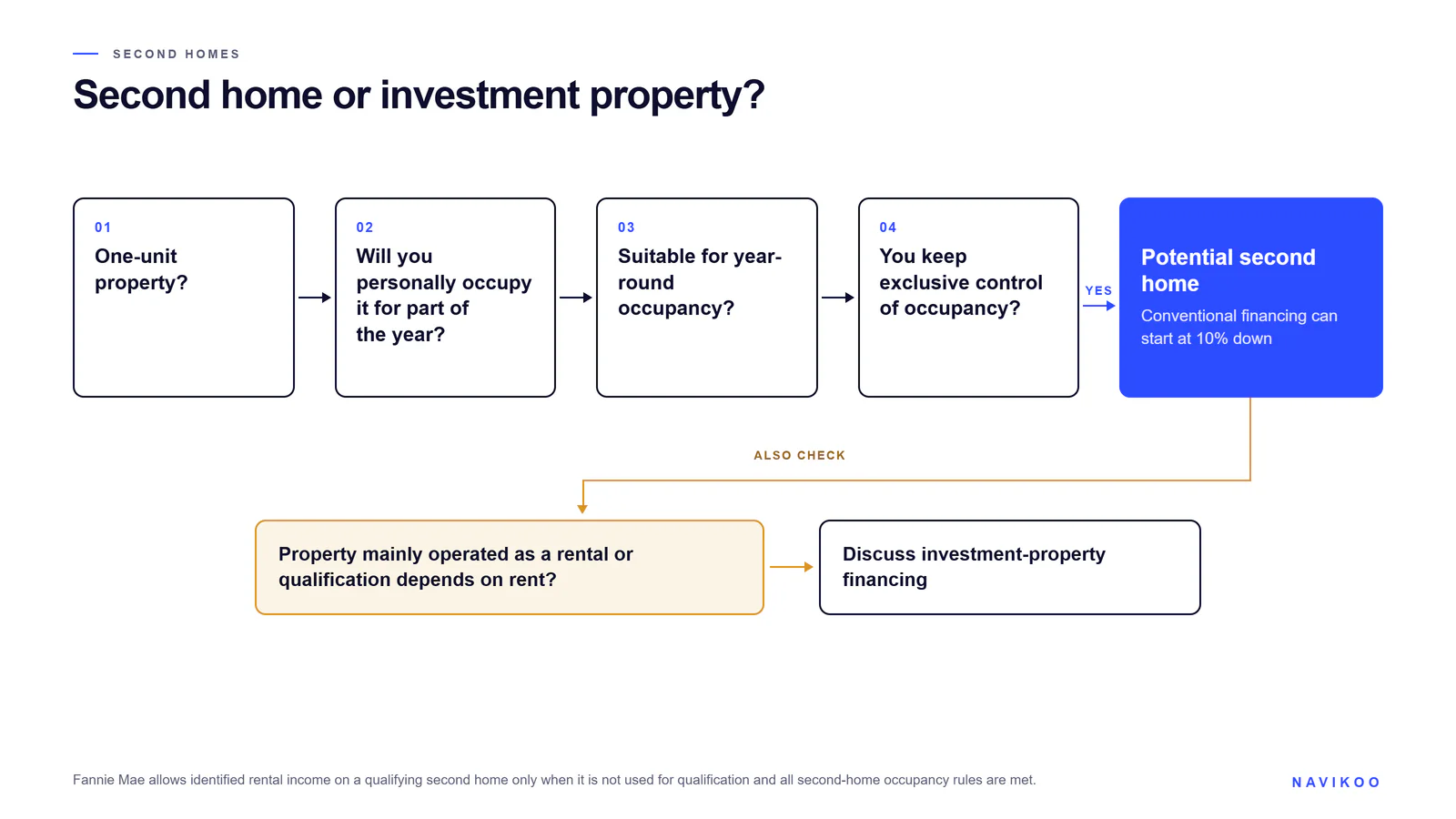
Under Fannie Mae's occupancy rules, the property must be a one-unit dwelling that the borrower occupies for some portion of the year, it must be suitable for year-round use, and it must stay under the borrower's exclusive control.
It also cannot be a timeshare or sit under a management agreement that controls who stays there. A vacation home at the lake or a condo near family can fit. A property bought mainly to rent out is a different story, even if the owner plans to visit occasionally.
Second Home vs. Investment Property
The distinction matters because investment property loans usually require larger down payments and can come with higher pricing. Fannie Mae allows up to 85% financing on a one-unit investment property, meaning at least 15% down, and up to 75% on two- to four-unit buildings. Individual lenders can still set stricter terms.
If renting the place out is central to the plan, expect investment terms rather than second home terms. Fannie Mae can still allow some rental activity on a qualifying second home, but rental income generally cannot be used to qualify. Misstating occupancy to get better terms is mortgage fraud, so the honest path is an investment loan.
How Much Down Payment Is Needed for a Second Home?
Conventional Financing
A conventional home loan is the standard route for most buyers.
Here is the easiest way to compare typical down payment requirements by type of loan and occupancy:
Occupancy and loan program | Typical minimum down payment |
|---|---|
Primary residence, conventional | 3% to 5% |
Second home, conventional | 10% |
One-unit investment, conventional | 15% |
Two- to four-unit investment | 25% |
Jumbo, second home | Often 10% to 20% or more |
These are minimum requirements, not promises for every property. A lender can still ask for more based on credit, existing obligations, reserves, or the house itself.
Jumbo Financing
If the amount borrowed on the property exceeds the conforming limit, the buyer may need a jumbo loan. The Federal Housing Finance Agency set the 2026 baseline conforming limit for one-unit homes at $832,750, rising to as much as $1,249,125 in high-cost areas. Jumbo programs set their own equity, credit, and reserve rules, which are usually stricter and vary by lender.
What About FHA and VA Loans?
An FHA loan is mainly designed for a primary residence. FHA has a narrow secondary-residence exception for certain hardship situations, but its rules specifically exclude a vacation property. A VA loan also requires personal occupancy and does not treat a seasonal vacation home as an eligible use. For a normal vacation-home deal, buyers therefore rely mostly on conventional or jumbo mortgage options.
How Much Deposit Do I Need for a Second House?
The easiest way to see the trade-off is with numbers. The figures below are hypothetical. They assume a 6.75% rate, $450 a month in taxes, $200 a month for homeowners insurance, $250 a month in homeowners association fees, mortgage insurance of 0.5% a year when less than 20% is put down, and closing expenses of 3% of the purchase price. The purchase price is $450,000.
10% down | 20% down | 25% down | |
|---|---|---|---|
Down payment | $45,000 | $90,000 | $112,500 |
Amount borrowed | $405,000 | $360,000 | $337,500 |
Principal and interest | $2,627 | $2,335 | $2,189 |
Mortgage insurance | $169 | $0 | $0 |
Taxes, insurance, HOA | $900 | $900 | $900 |
Total monthly cost | $3,696 | $3,235 | $3,089 |
Due at closing: down + assumed 3% costs | $58,500 | $103,500 | $126,000 |
Moving from 10% to 20% down takes $45,000 more cash, but it lowers the monthly cost by $461 and removes mortgage insurance in this example. Going from 20% to 25% saves only another $146 a month. For many buyers, 20% is where extra money up front buys the most without tying up as much cash as 25%. Conventional PMI is generally not required once the down payment reaches 20%.
The initial payments at closing are larger than the down payment alone. Closing expenses, prepaid taxes and insurance, and lender fees can all come due at once. So when you budget, focus on the "due at closing" line, not just the headline percentage.
Reserves After Closing
Cash reserves matter because the lender wants to see that you still have money after closing. For Fannie Mae loans underwritten through Desktop Underwriter, a second home transaction generally requires two months of reserves, and additional requirements can apply when you own other financed properties. Two months on the 10%-down scenario would be about $7,391.
Can I Afford to Buy a Second Home?
Debt-to-Income Ratio
Affordability for buying a second home usually turns on debt-to-income ratio, not the down payment alone. Lenders compare the full housing cost of both homes, plus car loans, cards, and other obligations, with gross monthly income. Fannie Mae currently allows up to 50% DTI for many files approved through automated underwriting, while manually underwritten loans generally have lower limits.
Using the example, a buyer earning $15,000 a month with a $2,600 housing bill on the current home and $500 of other monthly obligations would sit at about 45.3% with 10% down and 42.2% with 20% down. The larger deposit does more than cut expenses; it gives the application more breathing room.
Costs Beyond the Mortgage
Second home expenses include property taxes, insurance, HOA fees, utilities, maintenance, and travel.
A vacation home that sits empty much of the year still costs money every month, and those bills arrive whether or not you visit.
Building a full annual budget before buying is probably the most useful piece of financial planning in the process. It shows whether the second property fits comfortably or only fits on paper.
Is It Hard to Get Approved for a Second Mortgage?
Approval for buying a second home can be a little harder than for a primary residence because lenders are looking at the cost of carrying two homes at once. A strong application and a straightforward property can still make the process very manageable.
Credit Score Requirements
Lenders generally expect stronger scores for second homes, especially with smaller down payments. A stronger credit score can also improve pricing, because second home loans can carry price adjustments compared with a primary residence.
Interest Rates
Mortgage rates for second homes can differ from those on a primary residence with the same credit score and equity stake. Comparing interest rates across several banks is worthwhile because pricing can vary meaningfully from one lender to another.
Documentation
Expect lenders to verify income, assets, and existing obligations and to confirm that the property meets second home occupancy rules before the purchase closes. A home lending advisor can explain which documents a specific lender will want before you apply.
Can I Use a Home Equity Loan for a Down Payment on Another House?
Yes. Many owners tap the home equity in their primary residence to fund a second home purchase. The three common options are:
Home equity loan: a fixed amount borrowed against the current house, repaid on a fixed schedule.
Home equity line of credit: a revolving line, often interest-only during the draw period, with a variable rate.
Cash-out refinance: replacing the current mortgage with a larger one and taking the difference. This can make sense when it does not raise the rate on the existing balance, but it resets the loan.
Borrowed Home Equity Is Still Borrowed
Using home equity does not make the down payment free. The new obligation still counts in the debt-to-income ratio, and the house you live in now secures more borrowing. In the example, borrowing $90,000 on a line of credit at an assumed 8% to put 20% down adds about $600 a month in interest. That pushes the buyer's ratio to about 46.2%, higher than simply putting 10% down from savings.
A home equity loan can work well for a down payment when the owner has substantial equity, a comfortable ratio, and a clear plan to repay it. Lenders will also look at the current loan balance and combined loan-to-value on the primary home before approving the line.
If the math only works after adding more borrowing against your existing home, a smaller down payment from savings may be the safer choice. A reverse mortgage is generally not a practical source for most buyers because its rules limit how proceeds and the home can be used.
Other Financing Options for the Down Payment
Beyond home equity, a few other routes exist. Cash savings and brokerage accounts are the simplest source, though selling holdings can create taxes. Fannie Mae allows eligible personal gift funds for a second home, but when the LTV is above 80%, the borrower generally needs to contribute at least 5% from their own funds before gifts supplement the transaction.
Owners with a real estate portfolio sometimes sell or refinance an existing real estate investment to raise the money. Each of these options changes the buyer's financial position differently, so the right choice depends on the full financial picture, not only the size of the down payment.
Second Home vs. Rental: Income and Taxes
A second home can sometimes be rented, but lending and tax rules need to be separated. For lending, a qualifying second home can have some rental income as long as that income is not used to qualify and the occupancy rules are still met. For taxes, if you use the home as a home and rent it for fewer than 15 days during the year, the IRS generally does not require that rental income to be reported on Schedule E. Longer rental periods bring different treatment depending on personal use. IRS Publication 527 explains the tax implications.
If projected rent is necessary to qualify for the second home mortgage, you are moving toward a rental strategy rather than a true second-home purchase, and an investment loan is usually the better fit.
Pros and Cons of a Larger Down Payment
A larger down payment brings lower monthly payments, less interest over the life of the loan, usually no conventional mortgage insurance at 20% or more, easier approval, and more equity from day one, which helps if values fall.
The drawbacks are real too: less money available for reserves, repairs, or other opportunities, and more money tied up in a property that may be slow to sell.
Two buyers with the same salary can reasonably choose differently depending on how much else they have set aside.
Financial Tips Before Buying
Get preapproved before buying seriously so you are comparing real pricing for down payment mortgages, not online estimates. Price the full monthly cost, including association dues and insurance, rather than principal and interest alone. Keep reserves after closing instead of putting every dollar down.
Work with a real estate agent who knows the local market and the type of home that holds value there. In real estate, different types of properties, from condos to lake houses, can carry very different insurance, HOA, and resale factors that affect how much you should put down.
Buyers comparing down payment amounts can run the numbers with a down payment calculator. A Loan Calculator is the better fit for comparing the mortgage itself, while the Rental Property Calculator can be useful if occasional rental use is part of the plan.
The Practical Answer
The minimum down payment for a second home is typically 10%, but the right amount is the one that keeps both mortgage payments comfortable, leaves reserves intact, and qualifies the loan with room to spare. For many people buying a second home, that still lands closer to 20%.
Treat the down payment as one part of a purchase plan that includes credit, existing obligations, reserves, and the ongoing costs of owning two homes. If those numbers still feel comfortable after closing, the second home is much more likely to stay enjoyable instead of becoming a financial stretch.