Bonus Depreciation in Real Estate: Who Actually Gains From a 100% Write-Off
Bonus depreciation can accelerate deductions on shorter-lived assets inside and around a rental property, but the building itself usually remains on its normal recovery schedule. Learn the current 2026 federal rules, how cost segregation changes depreciation timing, when passive-loss limits can suspend the benefit, and what recapture can mean at sale.

Bonus depreciation lets an owner deduct the full cost of certain qualified property in the year it is placed in service instead of spreading that cost over its normal recovery period. For property acquired and placed in service after January 19, 2025, the federal bonus rate is 100%, and the 2025 tax law made that rate permanent rather than temporary.
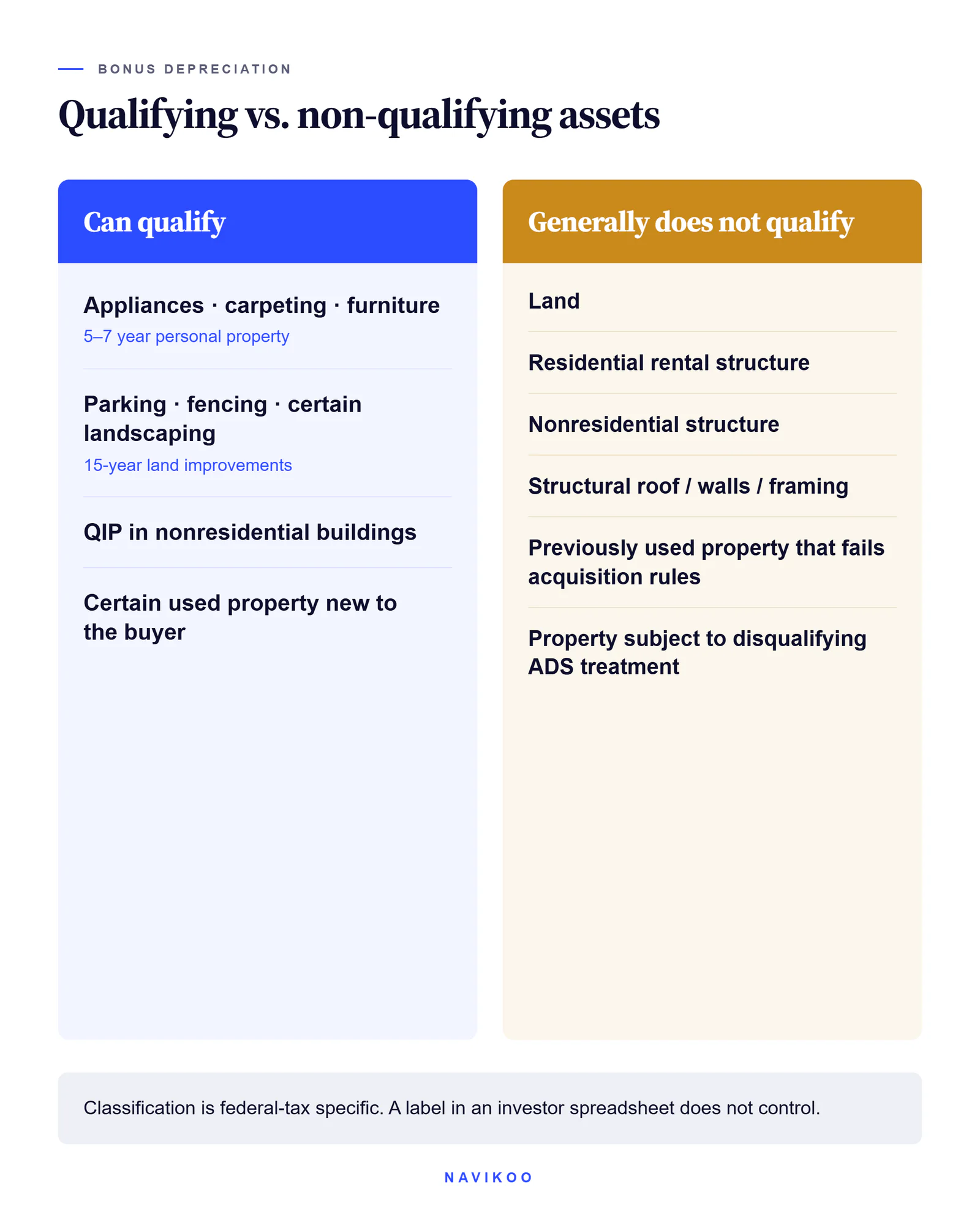
For real estate investors, though, the headline hides a constraint. Under ordinary Section 168(k), the residential or commercial building itself generally does not qualify; the separate qualified production property rule is narrow and generally does not apply to landlords. A residential rental is depreciated over 27.5 years and a commercial building over 39. What qualifies are shorter-lived components inside and around the building: appliances, carpet, certain nonstructural cabinetry, parking areas, fencing, landscaping, and certain interior improvements to commercial space.
That makes bonus depreciation in real estate a two-part question. First, how much of the purchase price can legitimately be moved into short-lived asset classes? Second, can the owner actually use a large first-year deduction, or will it sit suspended under the passive loss rules?
What Is Bonus Depreciation?
Bonus depreciation is an additional first-year depreciation deduction under Section 168(k) of the tax code.
It works inside the Modified Accelerated Cost Recovery System, the depreciation schedule that assigns every business asset a recovery period. Regular depreciation spreads cost across that period; bonus depreciation front-loads it, making it the most aggressive form of accelerated depreciation available.
How It Changes the Timing
Under standard depreciation, a $10,000 appliance package in a rental is recovered over five years. With 100% bonus treatment, the whole $10,000 is deducted immediately, and nothing remains for later years. Total depreciation over the life of the asset is identical. Only the timing moves.
Bonus depreciation does not create a new deduction. It borrows deductions from future years and spends them now, which is valuable only if a dollar of deduction today is worth more to the owner than the same dollar later.
The Bonus Depreciation Rules in Effect Now
The rate has changed several times since the Tax Cuts and Jobs Act, so investors should check which version of the law governs their property rather than relying on older articles. Material written before mid-2025 often describes a phase-down that no longer applies to most new purchases.
Property Acquired After January 19, 2025
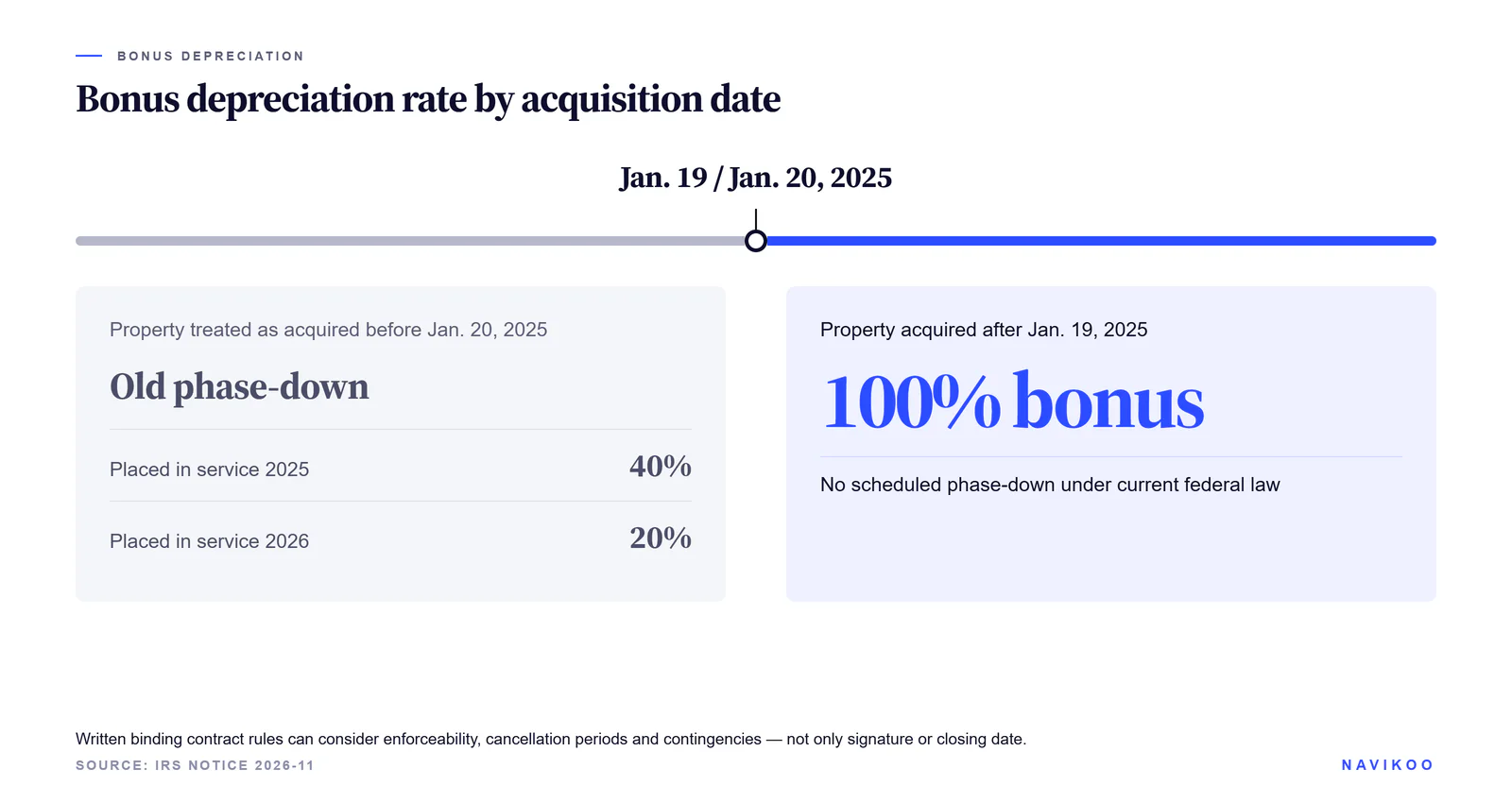
Public Law 119-21, enacted in July 2025, permanently restored 100% bonus depreciation for qualified property acquired and placed in service after January 19, 2025. In January 2026 the IRS issued Notice 2026-11, interim guidance confirming that the existing bonus regulations still determine eligibility, with updated dates.
Property Under Earlier Binding Contracts
Acquisition date matters as much as closing date. Under Notice 2026-11, a written binding contract can set the acquisition date based on enforceability, cancellation periods, and contingencies—not merely the closing date. A purchase treated as acquired on or before January 19, 2025 stays on the older phase-down schedule, which allowed 40% bonus for property placed in service in 2025 and 20% in 2026.
Elections That Change the Result
Owners can elect out of bonus depreciation entirely for any class of qualified property, such as all 5-year property placed in service that year. For the first tax year ending after January 19, 2025, the law also allows an election to use 40% instead of 100% for property placed in service that year. Both elections are made on a timely filed return, and both can be the better choice for an owner whose income this year is unusually low.
What Qualifies for 100% Bonus Depreciation in 2026?
In general, qualified property is tangible property with a recovery period of 20 years or less, plus certain software and interior improvements to commercial buildings, acquired and placed in service after January 19, 2025.
Used property can also be eligible for bonus depreciation, provided the buyer did not previously use it, did not acquire it from a related party, and meets other requirements in the regulations.
Asset class | Recovery period | Real estate examples |
|---|---|---|
Personal property | 5 or 7 years | Appliances, carpet, certain nonstructural cabinetry, furniture in a furnished rental, some dedicated wiring |
Land improvements | 15 years | Parking lots, sidewalks, fencing, landscaping, exterior lighting |
Qualified improvement property | 15 years | Interior improvements to nonresidential buildings after they are placed in service |
Building structure | 27.5 or 39 years | Not eligible |
Qualified Improvement Property
This category covers interior improvements to a nonresidential building, such as new interior walls, ceilings, or lighting in an office or retail space. It excludes enlargements, elevators and escalators, and the internal structural framework. Because it applies only to nonresidential property, interior renovations to an apartment building do not fall into this category, even though parts of the same improvement project, such as new appliances or flooring, may qualify as personal property on their own.
What Assets Do Not Qualify for Bonus Depreciation?
Several categories are excluded, and most of them are large:
Land, which is never depreciable
Residential buildings held for rent, and their structural components
Nonresidential buildings and their structural components
Property the taxpayer used before, or bought from a related party
Property used predominantly outside the United States
An electing real property trade or business under Section 163(j) must use the Alternative Depreciation System for certain building property and QIP. That can remove bonus depreciation eligibility for those items, so the interest limitation election should be reviewed with depreciation planning.
The 2025 law also created a separate 100% allowance for “qualified production property,” meaning certain new nonresidential buildings used in manufacturing and production. It is narrow: the owner must use the building in qualifying production, and space leased to a tenant does not count. Landlords should not read it as a new way to expense buildings.
Can You Take Bonus Depreciation on Rental Property?
Yes, on the parts of a rental property that fall into short-lived asset classes. A landlord who buys new appliances, replaces carpet, or adds a fence can generally expense those costs under bonus depreciation when eligibility requirements are met. The building and its structural components continue on the 27.5-year or 39-year schedule; a full roof or furnace replacement in a residential building generally does not become eligible merely because it was paid for separately.
The real opportunity for rental property owners is at acquisition, which is why any bonus depreciation real estate strategy starts with the purchase. Every purchase price contains short-lived assets, but on a closing statement they are buried inside one number labeled “building.”
Where Cost Segregation Comes In
A cost segregation study is an engineering-based analysis that separates a building’s cost into its component asset classes. It identifies which portion of the price represents 5-, 7-, and 15-year property, documents that allocation, and supports the depreciation claimed on the tax return. A formal study is not required to classify every asset, but broad unsupported percentages are hard to defend. The qualifying assets in a major acquisition should be supported by a defensible allocation.
How much a cost segregation study reclassifies depends heavily on the building. A furnished short-term rental, a garden-style apartment complex with large parking areas, and a plain urban fourplex will produce very different allocations, which is why generic percentages are a poor substitute for a real study. The IRS Cost Segregation Audit Techniques Guide describes the documentation examiners expect.
A Worked Example: One Building, Three Depreciation Schedules
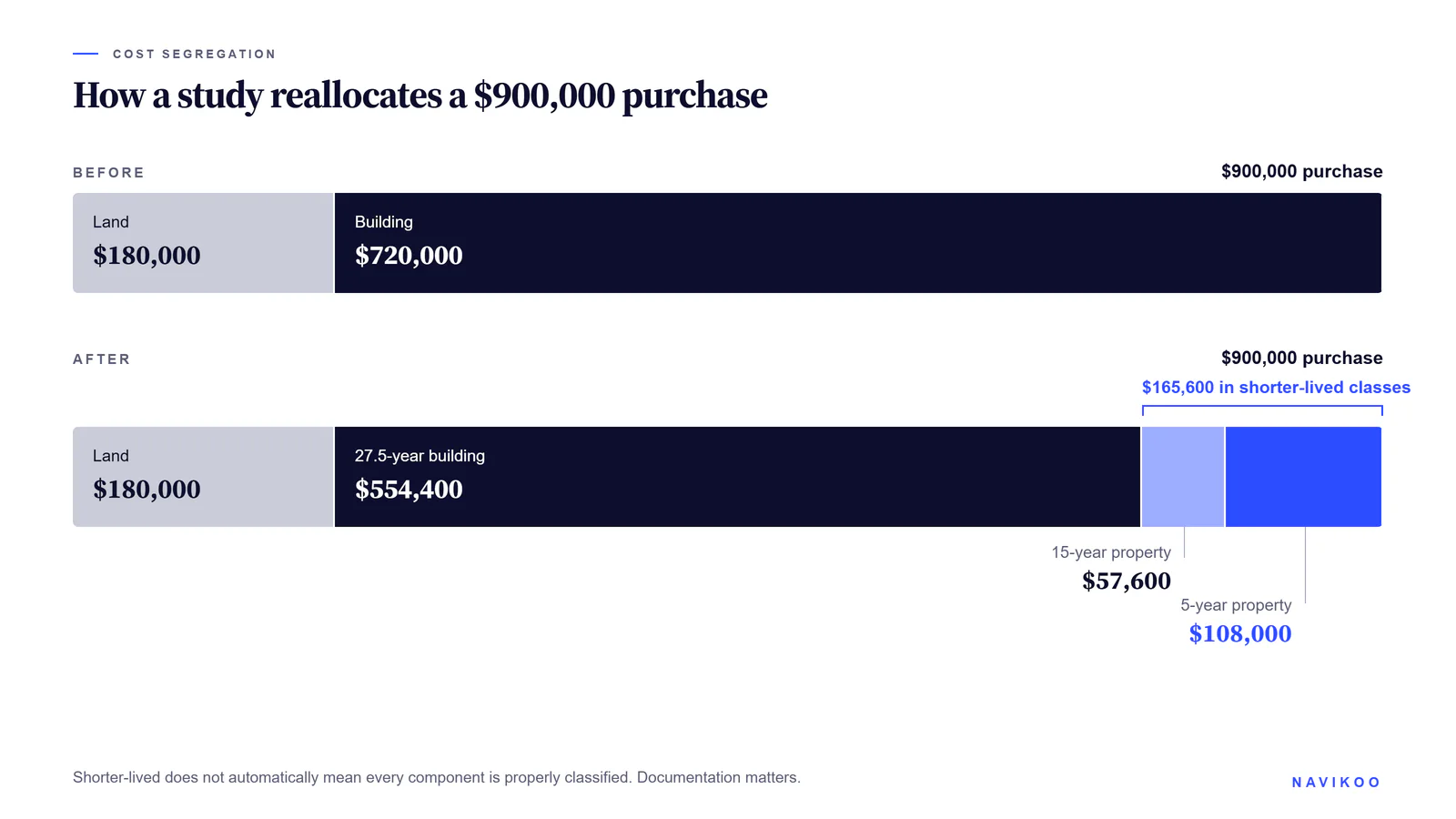
The figures below are hypothetical teaching assumptions, not tax advice or typical study results. An investor buys a small apartment building in 2026 for $900,000, well after the January 2025 date. The land is valued at $180,000, leaving $720,000 of depreciable cost. The property produces $16,000 of profit after operating expenses and mortgage interest, before depreciation.
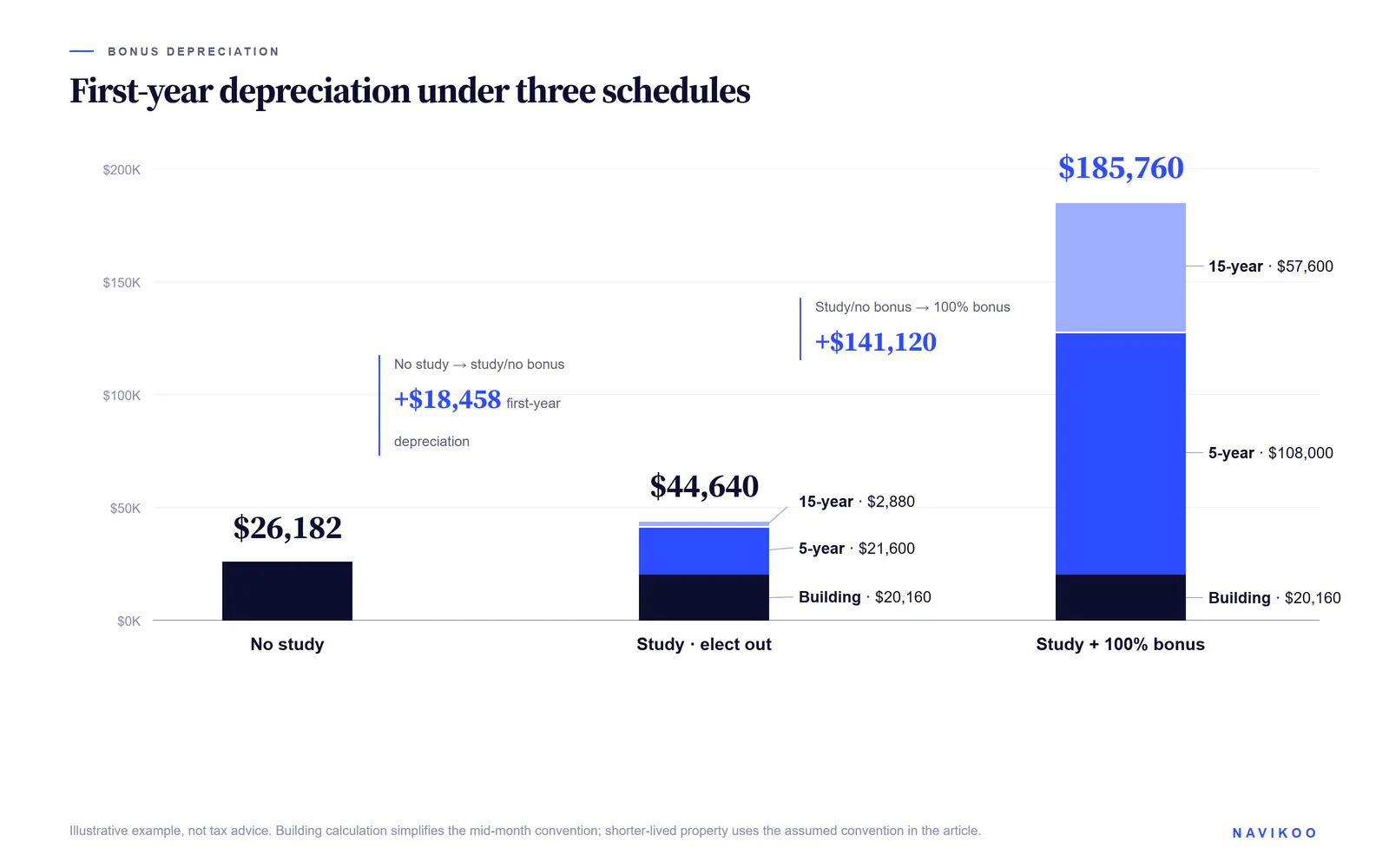
Assume a study reclassifies $108,000 as 5-year personal property and $57,600 as 15-year land improvements, a combined $165,600 of qualifying property. The remaining $554,400 stays on the 27.5-year schedule. For simplicity, the building figures ignore the mid-month convention and the personal property uses the half-year convention.
Year-one depreciation | No study | Study, elect out of bonus | Study with 100% bonus |
|---|---|---|---|
Building (27.5 years) | $26,182 | $20,160 | $20,160 |
5-year property | — | $21,600 | $108,000 |
15-year site improvements | — | $2,880 | $57,600 |
Total depreciation | $26,182 | $44,640 | $185,760 |
Tax result after $16,000 of profit | −$10,182 | −$28,640 | −$169,760 |
The middle column is worth noticing. Electing out of bonus depreciation does not send the reclassified assets back to the 27.5-year schedule. They keep their shorter lives and still produce accelerated depreciation. In this example, reclassification raises first-year depreciation by about $18,458 versus the no-study column, and bonus treatment adds another $141,120.
Same Deduction, Three Different Investors
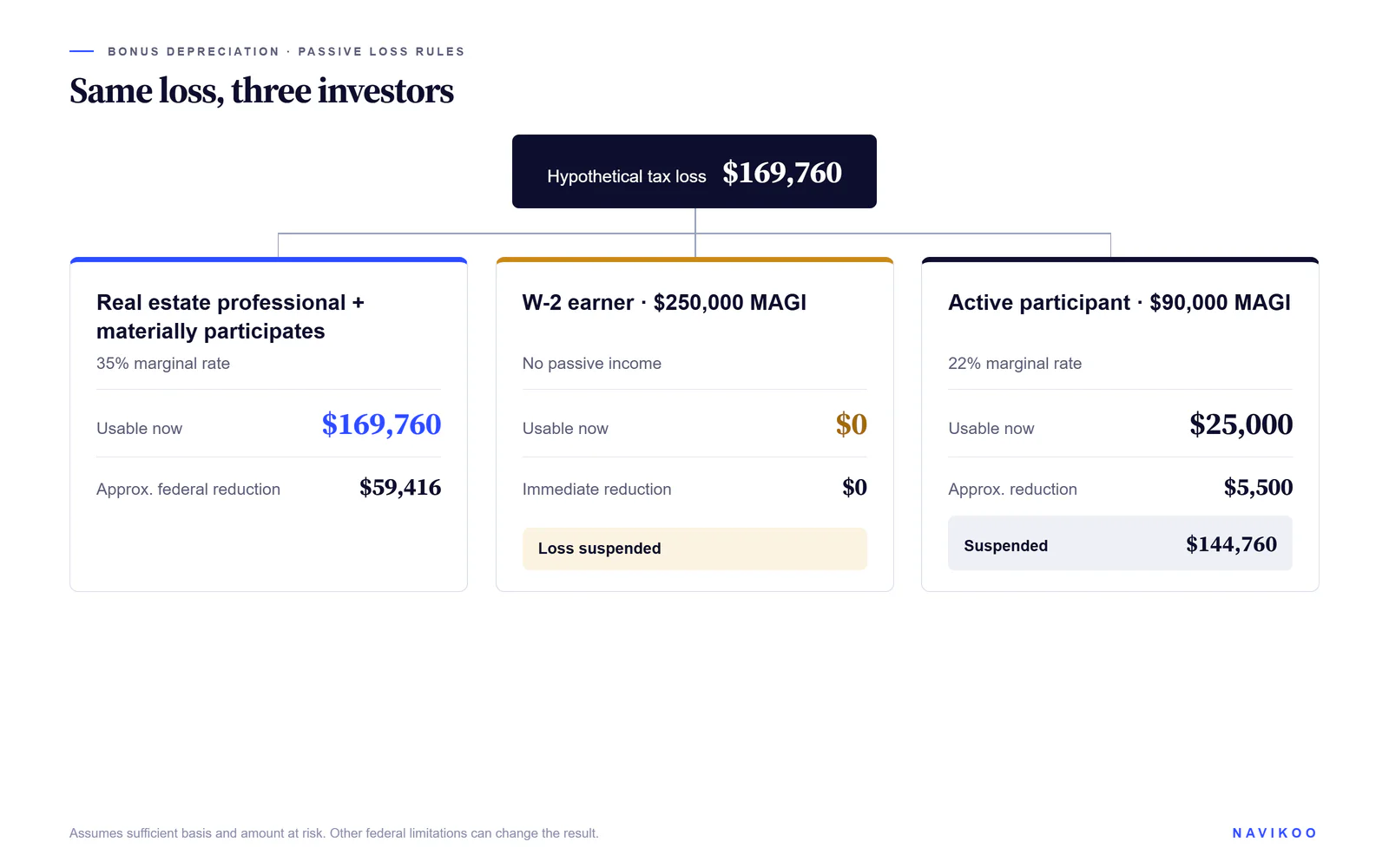
The $169,760 loss in the last column, driven mostly by the bonus depreciation deduction, looks like a large tax benefit. Whether it is depends entirely on who owns the building. Leasing activities are generally passive under the passive activity rules, and passive losses can usually offset only passive income.
Owner profile (hypothetical) | Loss usable now | Immediate tax reduction |
|---|---|---|
A: Real estate professional who materially participates, 35% bracket | $169,760 | $59,416 |
B: W-2 earner, $250,000 modified AGI, not a real estate professional | $0 | $0 |
C: Active participant, $90,000 modified AGI, 22% bracket | $25,000 | $5,500 |
Investor A can treat the rental loss as non-passive only if the owner qualifies as a real estate professional and materially participates, taking any valid grouping election into account. In this simplified example, the loss reduces tax liability on other income. Any net operating loss result still comes after basis, at-risk, passive activity, and excess business loss limits.
Investor B earns too much to use the special $25,000 allowance for active participants, which phases out between $100,000 and $150,000 of modified adjusted gross income. The entire loss is suspended. It carries forward to offset future passive income and is generally released when the entire activity is disposed of in a fully taxable transaction to an unrelated person, so the study and the bonus deduction deliver little in year one.
Investor C gets the $25,000 allowance and suspends the remaining $144,760.
Three owners, one building, one engineering report, and immediate tax savings that range from $59,416 to nothing. This is the number to model before ordering a study, and it is the step most promotional material leaves out.
Short-Term Rentals and Vacation Homes
A property where the average guest stay is seven days or less is generally not treated as a rental activity under the passive loss rules. If the activity is a trade or business and the owner materially participates, losses from bonus depreciation on furniture and fixtures may be non-passive; the seven-day test alone does not produce that result. The details are fact-specific, and a vacation property the owner also uses personally faces separate limits on deductions, so this structure belongs with a real estate CPA rather than a template.
Bonus Depreciation vs. Section 179
Section 179 expensing is the other way to deduct asset costs immediately, and investors often confuse the two. The 2025 law raised the maximum Section 179 expense to $2.5 million, with the deduction phasing out once qualifying purchases exceed $4 million. Both figures are indexed for inflation; for 2026 the IRS set them at $2,560,000 and $4,090,000.
Bonus depreciation | Section 179 | |
|---|---|---|
Limit | No dollar cap | Annual deduction limit and phase-out |
Can create a tax loss | Yes | No, limited to business taxable income |
Residential rental property | Eligible short-lived assets qualify | Some tangible personal property may qualify, but trade-or-business and noncorporate-lessor limits apply |
Nonresidential improvements | Interior improvements to commercial space | Also roofs, HVAC, fire protection, alarm and security systems |
Election | Applies automatically unless elected out by class | Must be elected, asset by asset |
For many residential landlords, Section 179 is more constrained than bonus depreciation, but current law does not categorically exclude every lodging-related item. Certain tangible personal property can qualify when the trade-or-business requirement is met, while Section 179 noncorporate-lessor restrictions can limit property leased to others. Section 179 can also cover specified roofs, HVAC, fire/alarm, and security improvements to nonresidential property. Section 179 also remains subject to its dollar phase-out. Where available, Section 179 lets the owner choose qualifying property asset by asset, while bonus depreciation generally applies by class unless elected out.
What Are the Downsides of Bonus Depreciation?
Depreciation Recapture When You Sell
Depreciation reduces the property’s basis, and sale treatment varies by asset class. Gain attributable to reclassified Section 1245 personal property is generally recaptured as ordinary income up to prior depreciation, including bonus depreciation. Real-property components can follow different Section 1250 treatment, so every component should not be assigned the same recapture rate.
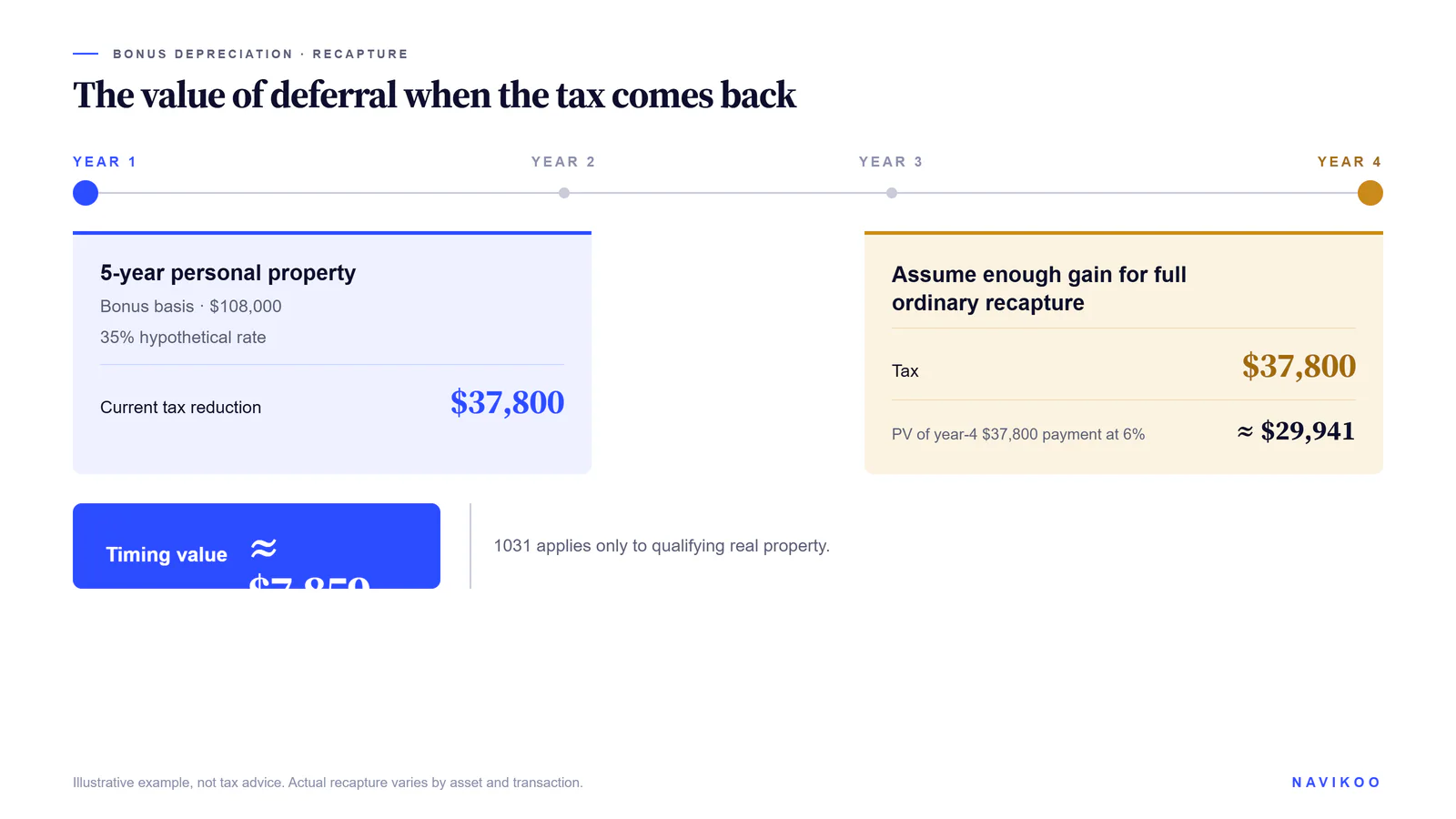
Isolate the $108,000 of 5-year personal property. At a hypothetical 35% federal rate, a fully usable write-off reduces current tax by $37,800. If a sale four years later produces enough gain for full ordinary recapture at the same 35% rate, the later tax is also $37,800. Discounted at 6%, that payment is worth about $29,941 today, leaving roughly $7,859 of timing value before the study fee and other tax effects.
The example is not a prediction of a real sale. Holding period, tax rates, sale allocation, basis, and asset character all matter. Section 1031 applies only to qualifying real property; personal property from the analysis generally cannot simply ride into a like-kind exchange.
Smaller Deductions in Later Years
Every dollar expensed now through bonus depreciation is a dollar unavailable later. An owner whose income is expected to rise, perhaps because a property is still leasing up or because the owner plans to leave a W-2 job, may get more value from deductions in later years, when each dollar offsets income taxed at a higher rate. That is the case for the elections described earlier.
State Taxes
Not every state follows federal bonus depreciation. Several decouple from it, including California, which requires owners to keep separate state depreciation records. The federal deduction and the state deduction can differ substantially, and the state tax savings may be a fraction of the federal figure.
Study Cost and Audit Exposure
A detailed cost segregation study has a fee, and on a smaller property that fee can consume much of the deferral value calculated above. Aggressive allocations also increase audit risk. A defensible cost segregation study traces each component to source documentation; one that applies broad percentages to the purchase price is harder to support.
How to Claim Bonus Depreciation
Real estate bonus depreciation is reported on Form 4562, Depreciation and Amortization, filed with the tax return for the year the asset is placed in service. It applies automatically to eligible property unless the owner elects out for a class, so an owner who does nothing receives it by default. Section 179, by contrast, must be elected on the same form. Owners who missed the analysis at purchase can often address missed depreciation through an accounting method change and a Section 481(a) adjustment rather than amending every prior return; that commonly involves Form 3115 and a tax strategist familiar with the filing.
Before You Count the Deduction
The key takeaways for an investor underwriting a deal are less about the 100% bonus depreciation rate than about the conditions around it. Check the contract date first, because it determines whether the current rules or the old phase-down apply. Then estimate how much of the price a study could reasonably reclassify, and decide whether the resulting loss will be usable this year, suspended, or released only at sale. Finally, compare the deferral value over the expected hold against the study fee and the recapture at exit.
An investor whose loss would be fully suspended, who plans a short hold, or who expects a higher tax rate at sale may be better served by the normal schedule, or by electing out for certain classes. An investor who qualifies as a real estate professional, materially participates, holds for many years, and buys a property with substantial short-lived components may capture more of the tax incentive, but the result still depends on the owner's full tax profile.
A deal’s returns on investment should stand without the tax benefits. Investors can model the rental investment on pre-tax cash flow first in Navikoo’s rental property calculator, then treat bonus depreciation as an after-tax adjustment to be confirmed with a CPA, not as the reason the deal works.