Mid-term Rentals: The Furnished Middle Ground Between Airbnb and an Annual Lease
A mid term rental is a furnished property rented for an intermediate period, commonly about one to six months. It sits between short term vacation rentals and long-term leases that usually run a year or more. “Mid-term”
A mid term rental is a furnished property rented for an intermediate period, commonly about one to six months. It sits between short term vacation rentals and long-term leases that usually run a year or more. “Mid-term” is an industry description, not one nationwide legal category, so the exact threshold can differ by platform and jurisdiction.
Midterm rentals serve people who need a real home for a defined period. They want a kitchen, a workspace, and working internet from day one, without signing up for a full year.
For landlords, the appeal is higher rent than an unfurnished lease, with less turnover than nightly bookings. For renters, it is a flexible option that feels like home rather than a hotel room.
The catch is that the premium is not free money. It pays for furniture, operating bills, gaps between bookings, and more of the owner's time. Whether a midterm rental beats a long-term rental depends mostly on how full the calendar remains.
What Is a Mid-Term Rental?
The practical definition of a mid-term rental is a furnished, ready-to-live-in home rented on a monthly basis, commonly for about one to six months. Some operators start at 30 days, while major booking platforms may use 28 nights for their monthly-booking features.
Some operators stretch the range to nine months. The core idea remains the same: a booking long enough to feel like housing, short enough to need flexibility. In practice, a mid-term rental offers flexible lease terms in exchange for a premium.
The Typical Length of Occupancy
Many bookings run one to three months, which lines up with common work contracts. A standard travel-nursing assignment, for example, is often 13 weeks, although shorter and longer contracts also exist. Platform thresholds are not identical: Airbnb and Vrbo use 28 nights for monthly or extended-booking features, while Furnished Finder currently requires a 30-day minimum stay. Local rental regulations may use still another definition.
What Is a Medium-Term Lease?
A medium-term lease is the written rental lease used for a mid-term rental. It is a descriptive label, not a special nationwide legal instrument. In practice the agreement sets the rental period, price, inclusions, deposits, extension rules, and house rules under applicable law.
Operationally, it is closer to residential leases than to a weekend booking, but legal treatment depends on location and structure. A month lease, month-to-month arrangement, or 12-month agreement can carry different renewal and termination rules.
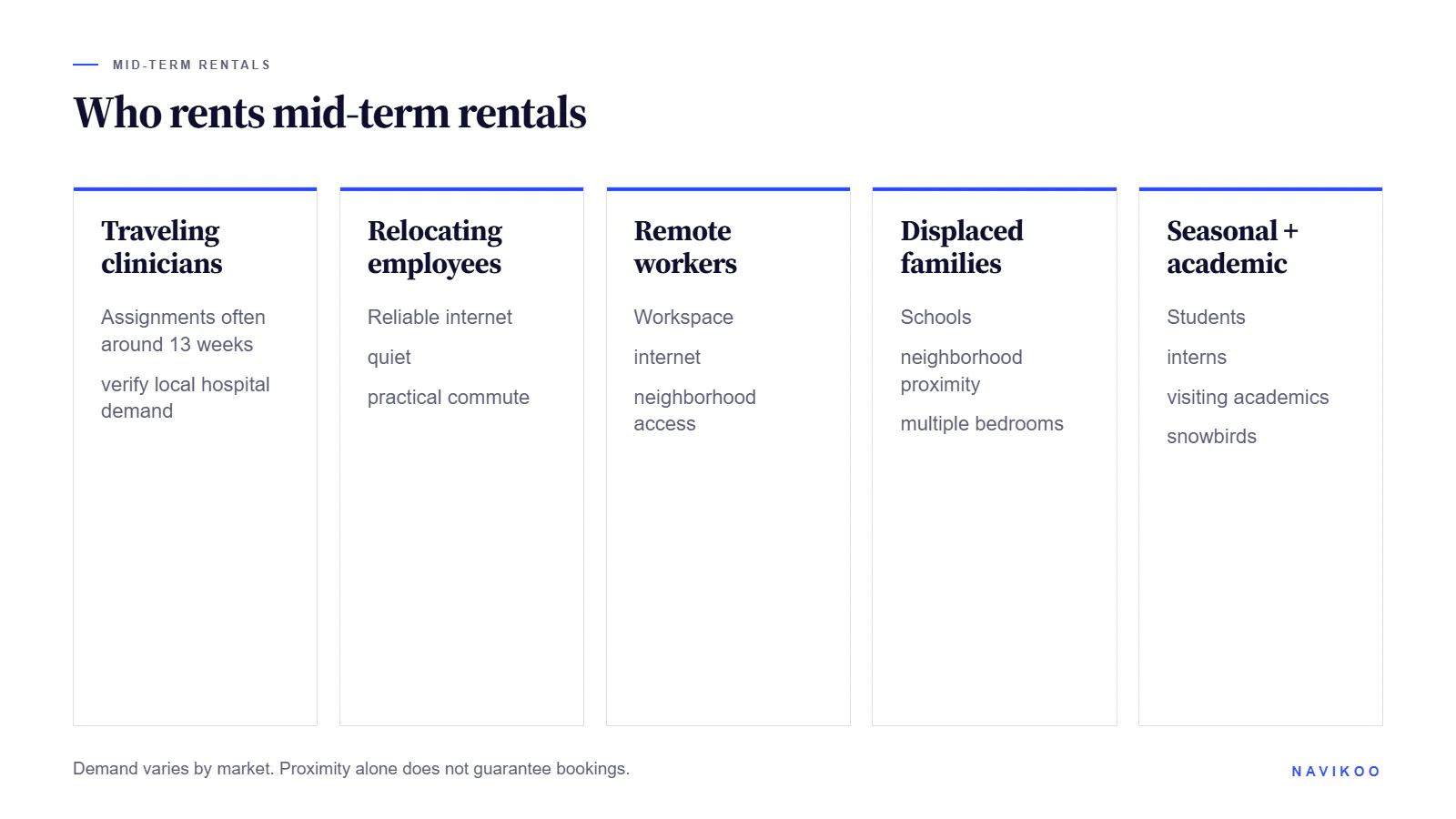
Who Rents Mid-Term?
Midterm rentals depend on a steady supply of people who need temporary housing for a month or more. Knowing which tenant type dominates your rental market shapes how you furnish, price, and advertise each property.
Traveling Nurses and Medical Staff
Travel-nursing assignments commonly run about 13 weeks, although contracts can be shorter or longer. Many traveling clinicians want a furnished property within a practical commute of the hospital, with reliable services and useful features to live normally between shifts.
Medical centers can create useful demand, but landlords should verify local contract volume and furnished competition rather than assume proximity guarantees bookings. The contract length often fits the approach.
Corporate Relocations and Temporary Job Assignments
Employees on temporary assignments, project work, or a relocation need a place while they find a permanent place to live. Some book directly; others go through relocation companies.
These business tenants value quiet, reliable internet and a short commute more than décor.
Digital Nomads and Remote Workers
Digital nomads move between cities every month or two. They care about fast internet, a real desk, and walkable streets or good transportation options more than a large footprint.
Families Displaced by Renovations or Insurance Claims
A family living elsewhere during major home renovations, or after a fire or flood, needs a furnished place for weeks or months.
Insurance-related bookings can be steady, though families usually need a property close to their original neighborhood and schools.
Students, Interns, and Snowbirds
Interns, visiting academics, and seasonal residents fill another slice of the market. Snowbird rentals, where retirees spend winter months in warmer states, are a seasonal form of mid-term rental.
Short-Term vs. Mid-Term vs. Long-Term Rentals
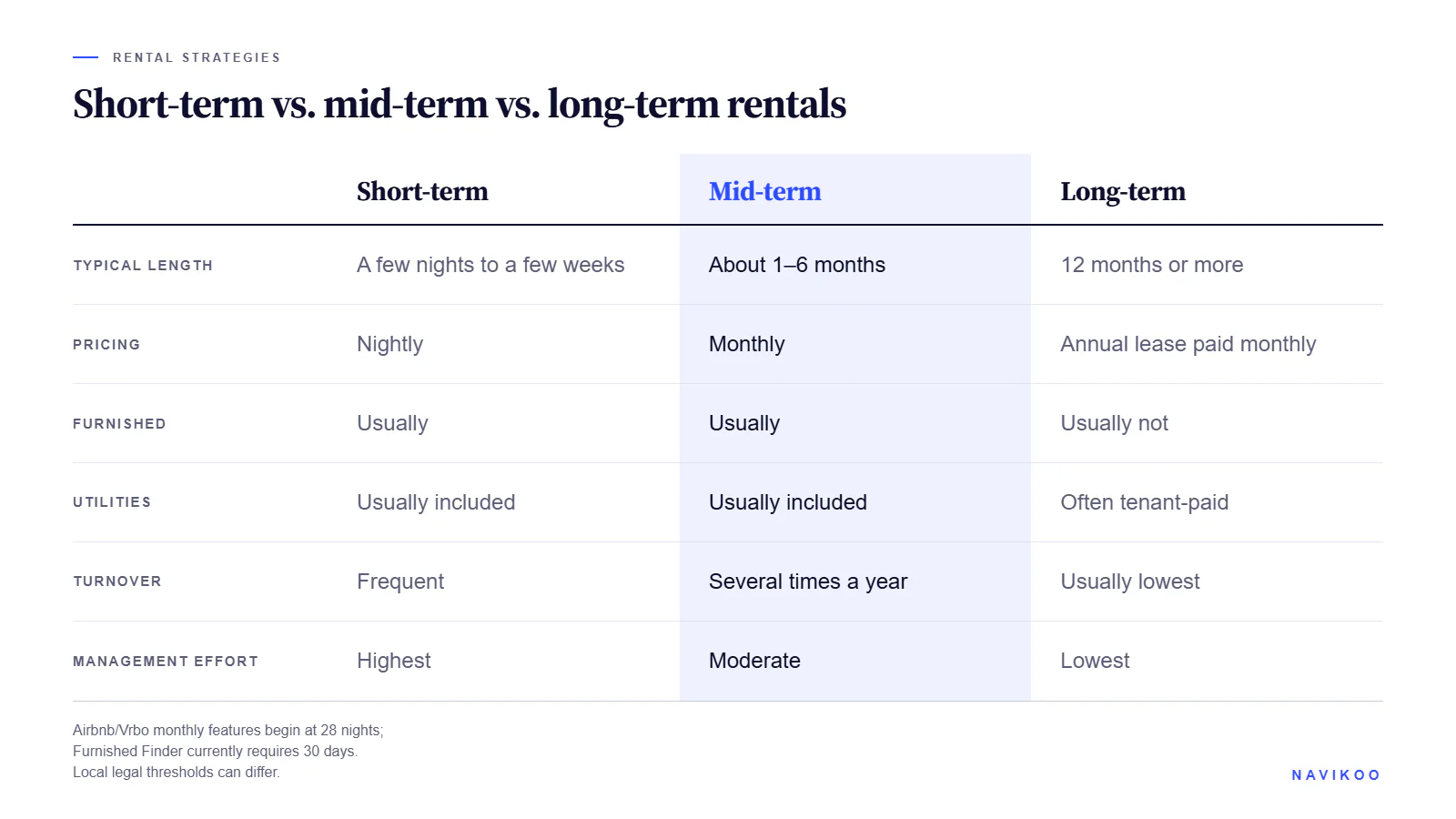
The three rental types differ in more than length. Each changes how rent is set, who pays the bills, how much management the unit needs, and which laws apply.
Short-term rentals | Midterm rentals | Long-term rentals | |
|---|---|---|---|
Typical length | A few nights to a few weeks | 1 to 6 months | 12 months or more |
Pricing | Nightly rate | Monthly rates | Annual lease, paid monthly |
Furnished | Yes | Yes | Usually no |
Utilities | Included | Usually included | Usually paid by the tenant |
Turnover | Constant | Several times a year | About once a year or less |
Management effort | Highest | Moderate | Lowest |
Length and Turnover
Short-term rentals turn over constantly, often weekly. Long-term rentals turn over once a year or less.
Midterm rentals sit between them, with perhaps four to eight bookings a year. That means fewer cleanings than nightly hosting, but far more tenant turnover than with a long term rental.
Pricing: Nightly, Monthly, and Annual
Nightly properties charge by the night and swing with season. Midterm rentals charge monthly, usually at a premium to unfurnished rental rates, because the rent includes furniture and utilities.
Long-term rent is lowest per month but the most predictable.
Furniture, Amenities, and Bills
Mid-term occupants expect a home they can live in on day one: a stocked kitchen, linens, a workspace, laundry, and internet. Those amenities are part of what they pay for.
Utilities and internet are usually bundled into the price, so owners carry those costs every month, including empty ones.
Regulation and Tenant Rights
Some US short term rental ordinances focus on stays shorter than 30 days, while others use different thresholds or regulate furnished rentals more broadly. A midterm rental may fall outside a particular short-term rule, but landlords should not assume that 30 days automatically removes licensing, zoning, HOA, occupancy-tax, or business requirements.
Longer stays can also shift the relationship toward a residential rental relationship. Airbnb itself warns hosts that guests may establish tenant rights after about a month in some jurisdictions, but there is no single nationwide 30-day rule. Tenant laws, eviction procedures, notice requirements, and security deposit rules come largely from state and local law, so landlords should verify the rules that apply to the home before advertising the unit.
Running the Numbers: One Property, Two Strategies
The figures below are illustrative teaching assumptions, not market data. They compare one hypothetical two-bedroom US rental property operated two ways.
Mortgage, property taxes, and insurance are the same either way, so they are left out to keep the comparison clear.
The Long-Term Baseline
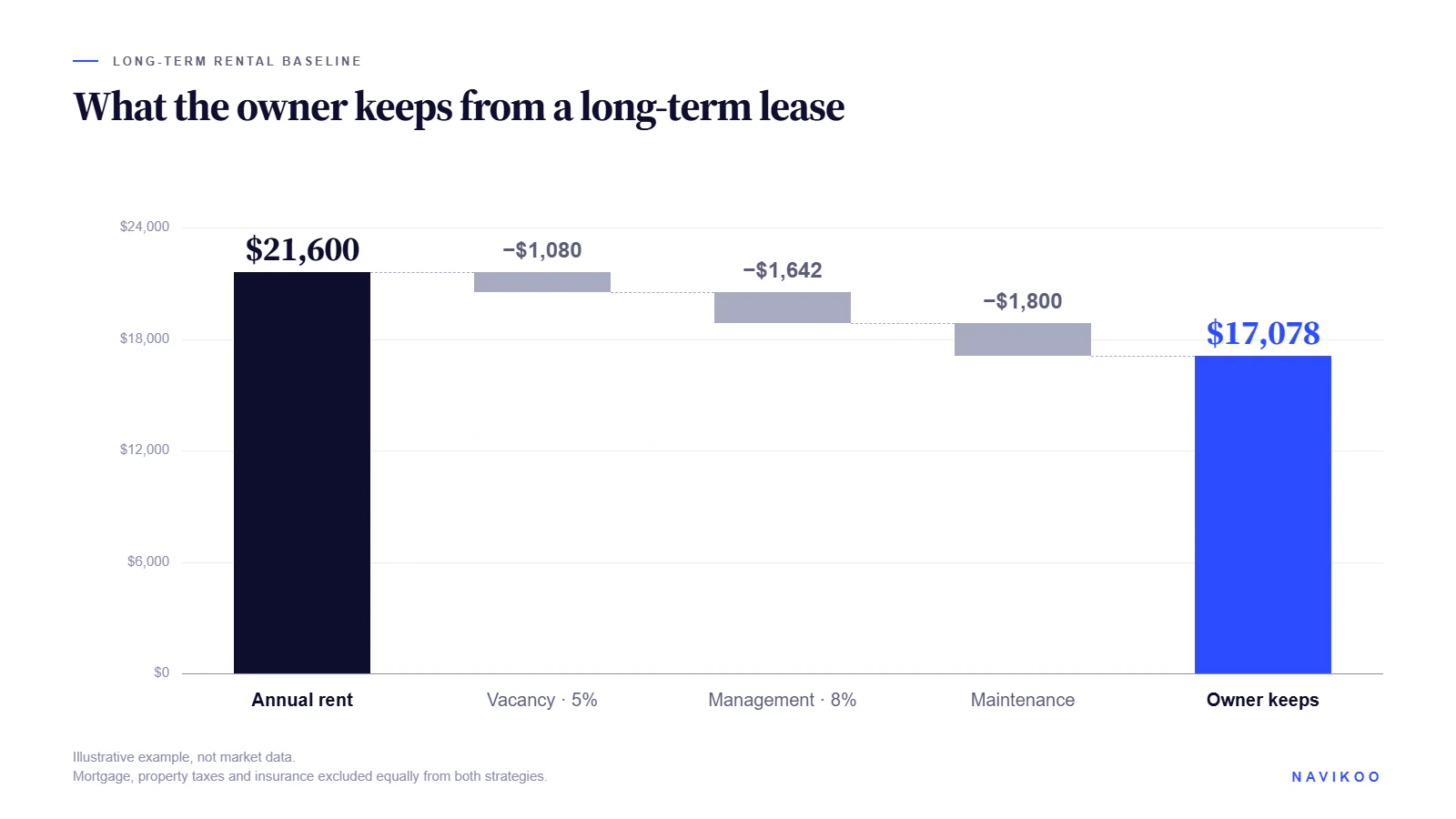
Unfurnished, the home rents for $1,800 a month, or $21,600 a year, with the tenant paying their own bills.
After 5% vacancy ($1,080), 8% property management on collections ($1,642), and $1,800 of maintenance, the landlord keeps $17,078 a year.
The Mid-Term Version
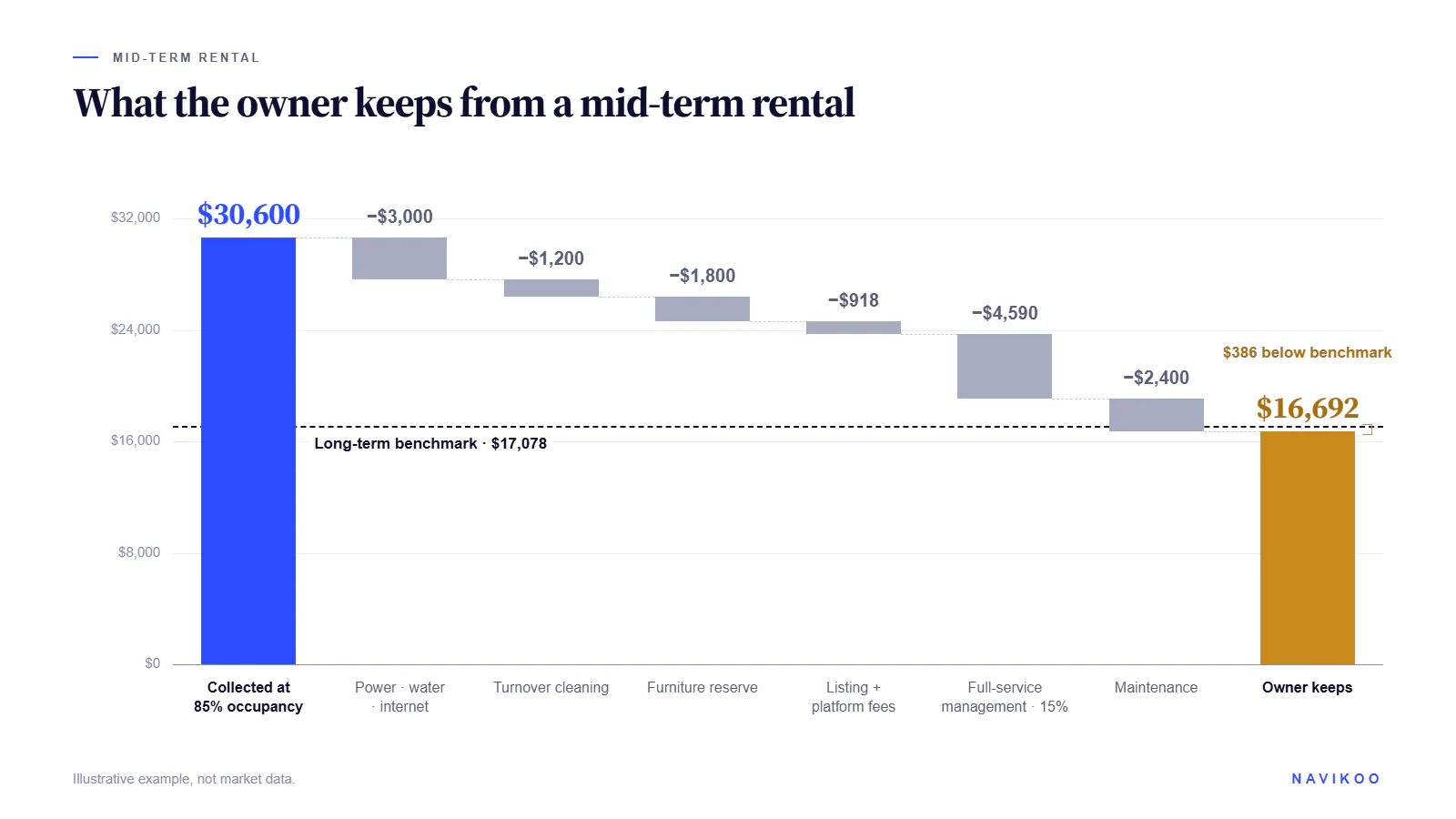
Furnished, with power, water, and internet included, the same home rents for $3,000 a month, or $36,000 a year if fully occupied. At 85% occupancy, it collects $30,600 of rental income.
Annual item | Amount |
|---|---|
Collected at 85% occupancy | $30,600 |
Power, water, and internet, all 12 months | −$3,000 |
Turnover cleaning, 8 bookings at $150 | −$1,200 |
Furniture reserve ($9,000 over five years) | −$1,800 |
Listing and platform fees, 3% | −$918 |
Full-service management, 15% | −$4,590 |
Maintenance | −$2,400 |
Owner keeps | $16,692 |
The mid-term version brings in $9,000 more in gross income but keeps $386 less than the long-term baseline once the extra costs are counted.
Occupancy Is the Whole Game
Change one assumption at a time and the picture moves quickly.
Scenario | Owner keeps |
|---|---|
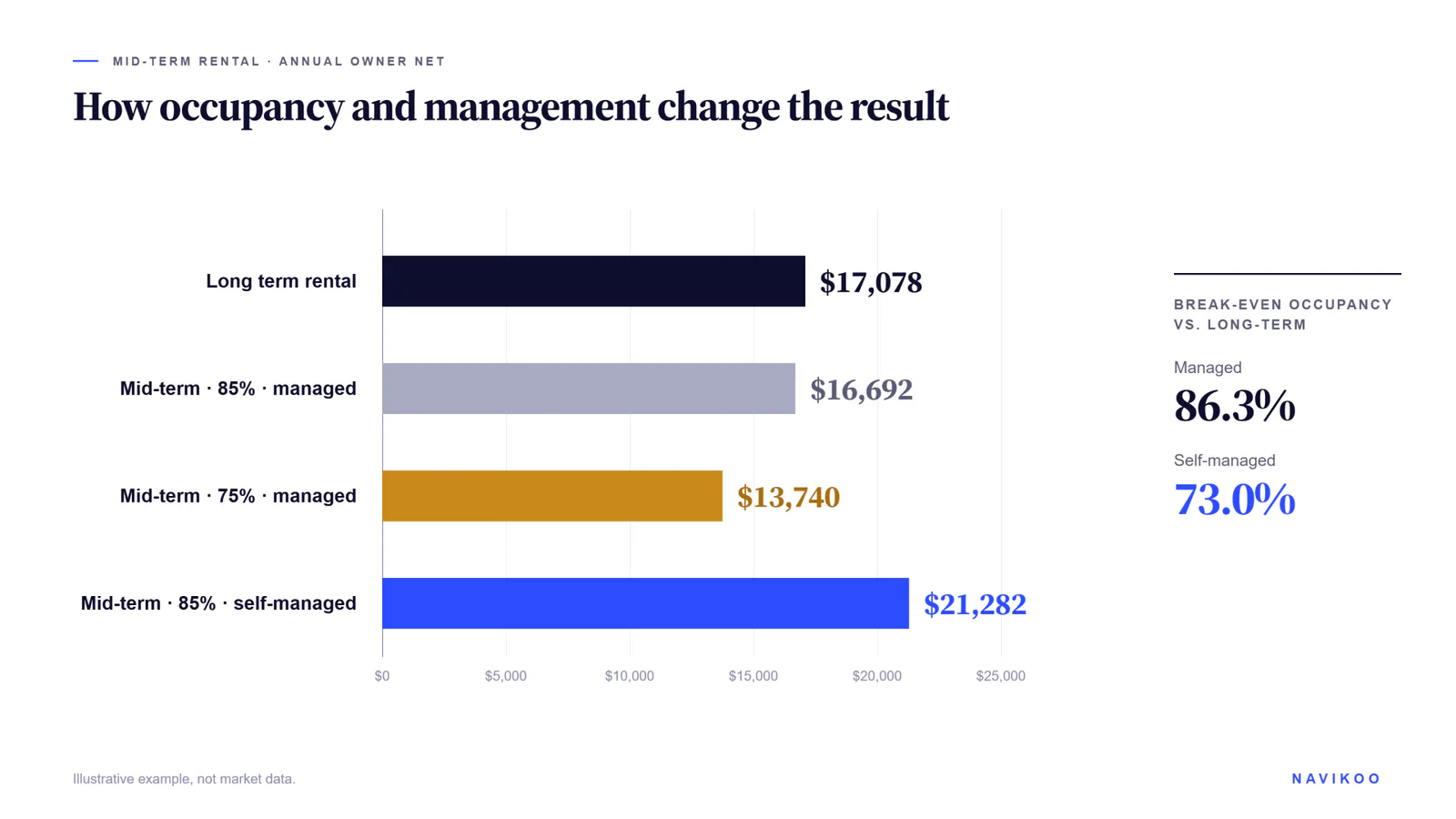
Long term rental | $17,078 |
Mid-term, 85% occupancy, managed | $16,692 |
Mid-term, 75% occupancy, managed | $13,740 |
Mid-term, 85% occupancy, self-managed | $21,282 |
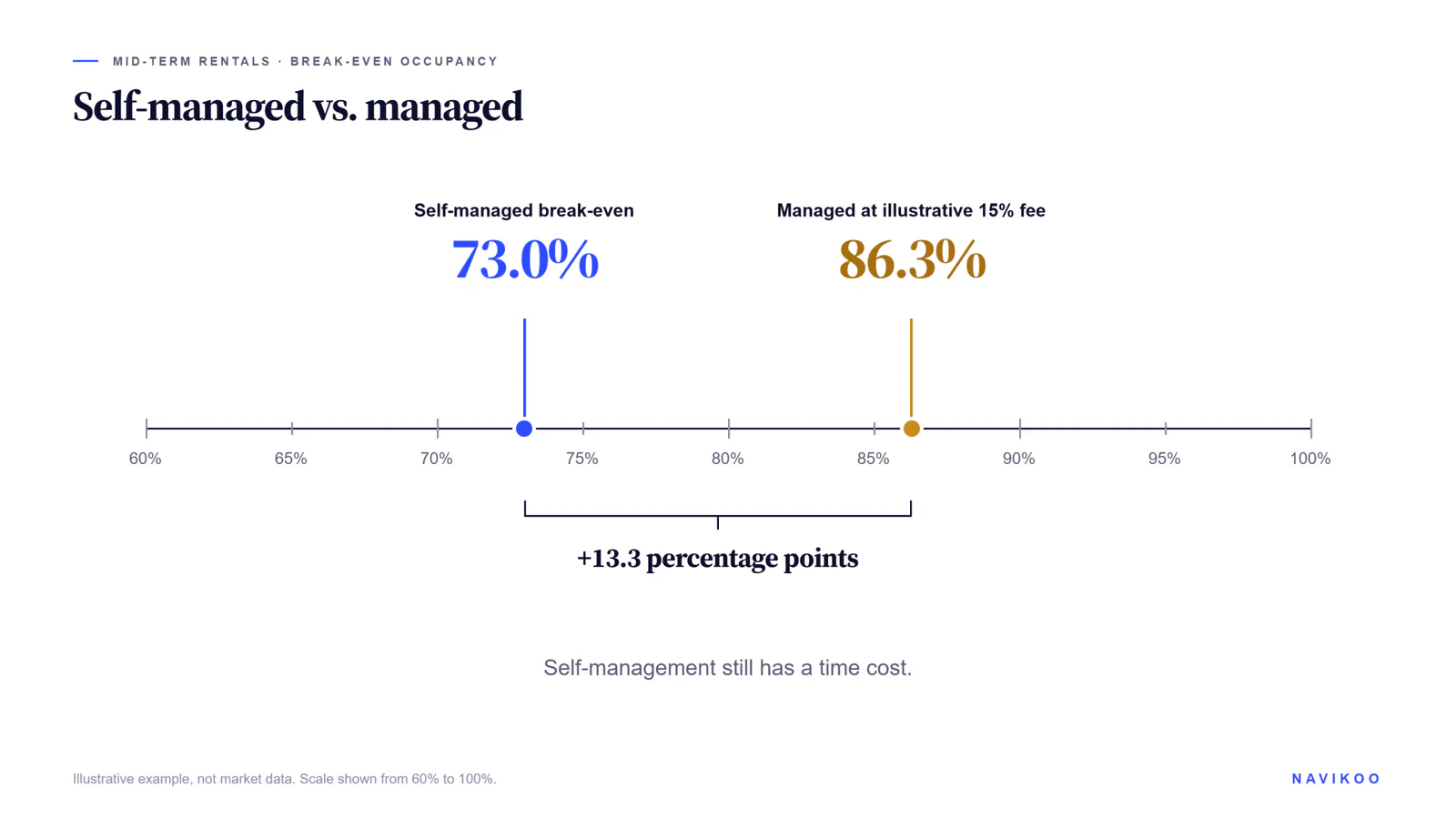
With full-service management, the mid-term rental needs about 86.3% occupancy just to match the long-term rental. Self-managed, the break-even falls to about 73.0%.
What the Comparison Shows
The premium in a mid-term rental mostly pays for work and inventory. It is a different rental model, not simply higher rent on the same property.
Owners who self-manage, keep occupancy high, and furnish sensibly can earn meaningfully more. Owners who hand everything to a manager and accept long gaps may earn less than with a plain annual lease, with more effort and more risk.
Navikoo's rental calculator makes it easy to test your own rent, occupancy, and cost assumptions before furnishing a unit, and to compare the result with a long term rental on the same property and with any alternative term rental approach.
Pros and Cons of Mid-Term Rentals
Key Advantages for Landlords
The first advantage is rent. Furnished monthly bookings usually command more than comparable unfurnished leases.
Turnover is lower than with nightly guests, so cleanings and messages drop sharply. And because some jurisdictions regulate shorter stays differently from month-long occupancy, midterm rentals may remain viable where nightly rentals are restricted. That advantage is location-specific rather than automatic.
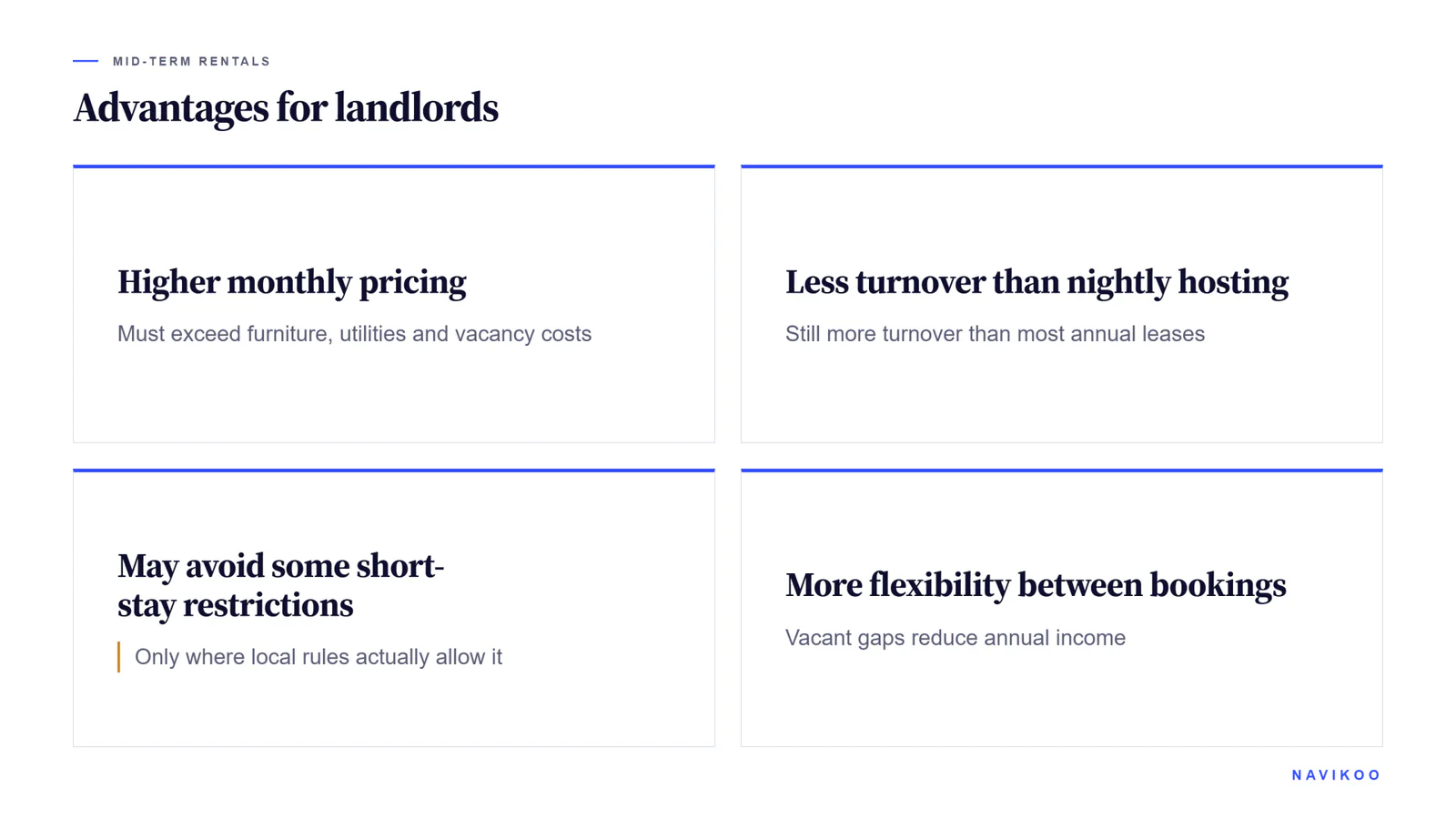
Gaps between bookings let owners use these homes, renovate, or prepare to sell without waiting out a yearlong lease.
That flexibility suits landlords who want to keep options open rather than accept a long term commitment from a single occupant, and it makes a midterm rental easier to convert back to a long term rental later.
Disadvantages for Landlords
Vacancy between bookings can erase the premium, as the numbers show. Furniture must be bought upfront and replaced over time.
Landlords pay the bills every month, booked or not, and management takes more time than with long-term leases. Fixed term leases also require clear start and end dates.
Legal and Tenancy Risk
An occupancy of roughly a month can cross an important legal threshold in some jurisdictions, but the threshold and legal consequences vary. Depending on state and local law, the occupant may acquire residential tenant protections, making termination, notice, deposits, entry, and eviction subject to landlord-tenant procedures rather than hospitality rules.
Use a proper lease, consistent screening, and clear procedures rather than assuming a booking platform overrides local law. If a third-party screening or credit report is used, Fair Credit Reporting Act requirements can apply, and screening should remain consistent with the Fair Housing Act.
What Renters Get
For renters, mid term rentals offer flexible lease durations, a fully furnished home, and one monthly payment covering rent and utilities. The trade-off is higher rent than an unfurnished lease and fewer rental options in some neighborhoods, so the term rental premium must justify the added service.
How to Set Up a Mid-Term Rental
Check Local Rules First
Confirm zoning, any short-term ordinance, occupancy tax rules, and state tenant protections before buying furniture.
Some HOAs and condo associations also restrict leases under a set length, which can rule out mid term rentals in a building entirely. A short term rental may be restricted even where longer mid-term rentals are allowed.
Furnish for a Month, Not a Weekend
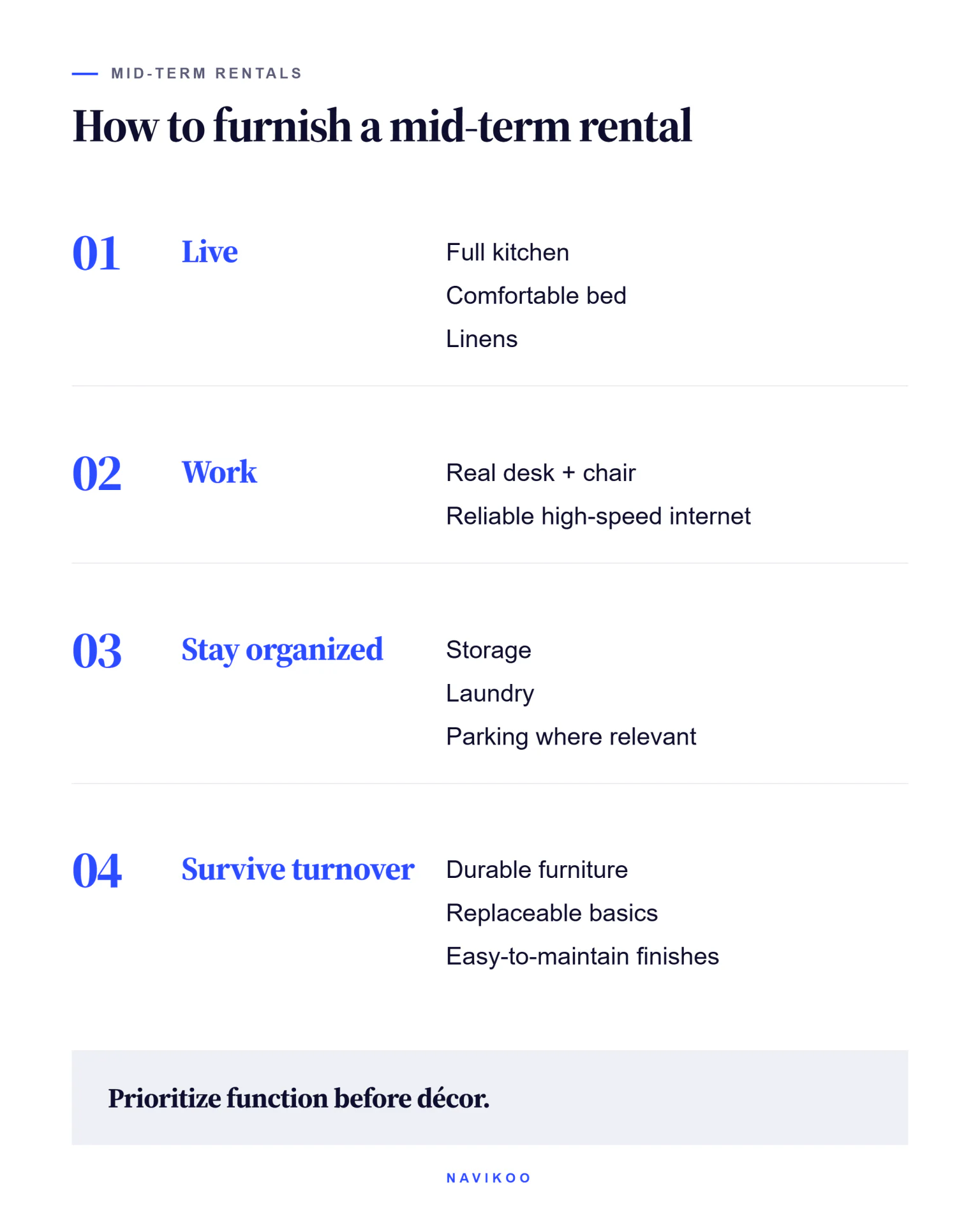
Mid-term guests cook, work, and do laundry. Prioritize a full kitchen, a comfortable bed, a real desk and chair, ample storage, and durable furnishings that survive frequent turnover.
Rooms should feel like a home, not a hotel. Amenities such as in-unit laundry and parking often matter more than design touches.
Price Monthly With Clear Inclusions
Set clear pricing with utilities, internet, and basic amenities included, and state any cleaning fee up front.
Compare against furnished competitors, not unfurnished long-term rentals, and adjust for season if your market niche is seasonal. The local market for furnished housing sets the ceiling, not the owner's costs.
Write a Proper Lease
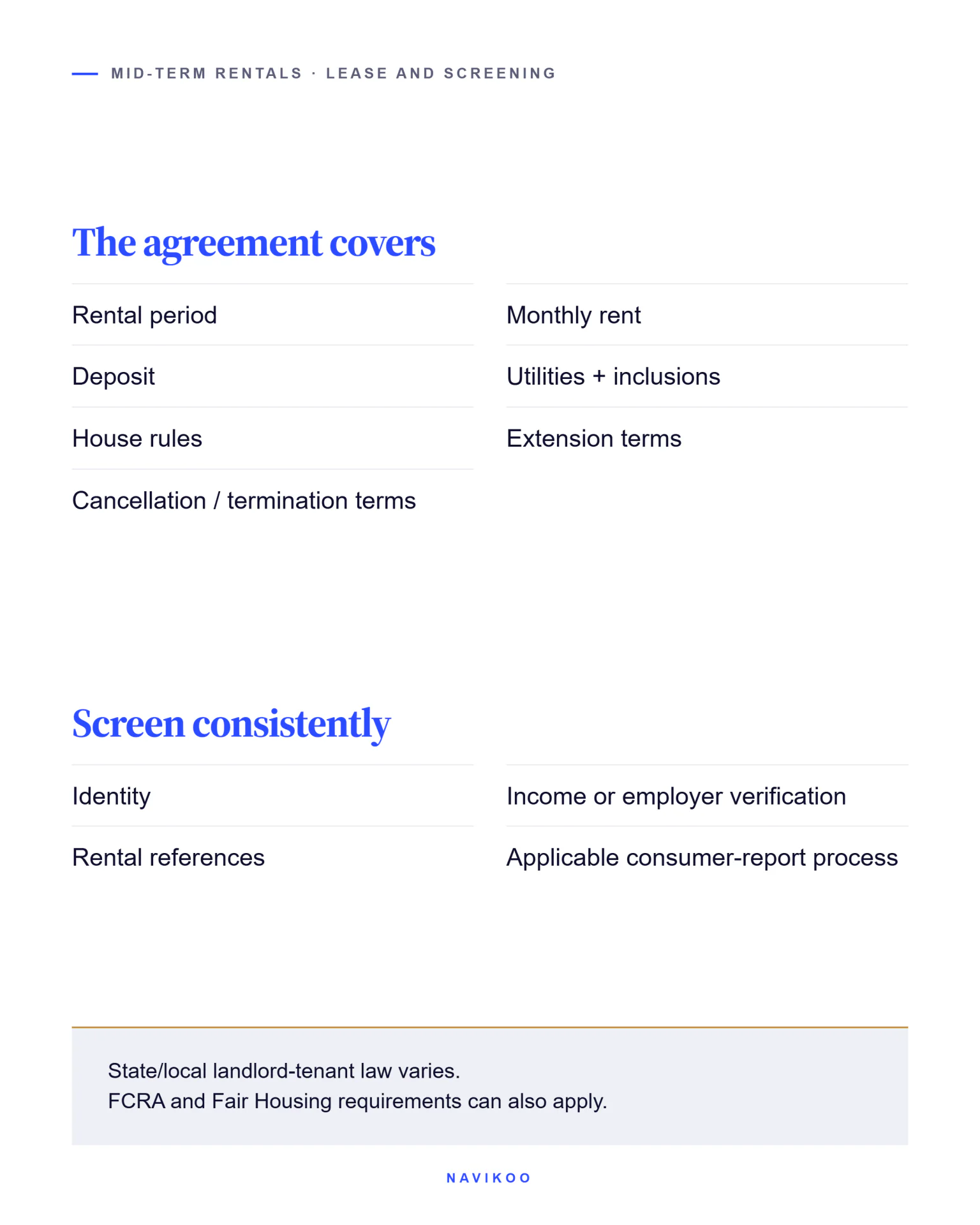
Use written lease agreements and rental agreements rather than relying only on a platform booking. A clear term rental agreement covers the rental period, monthly rent, deposit, inclusions, house rules, and terms for flexible extensions.
Platform booking terms and term agreements signed directly should be reviewed together so they do not conflict on deposits, cancellations, payment timing, extensions, or house rules. A platform reservation does not eliminate whatever tenancy rights state or local law creates.
Screen Every Applicant
Screen as you would for any rental: identity, income or employer verification, and references. Many mid-term renters can provide a contract or employer letter, which makes verification easier.
The rental process should be clear enough that applicants know what to submit before they book.
Where to List Mid-Term Rentals
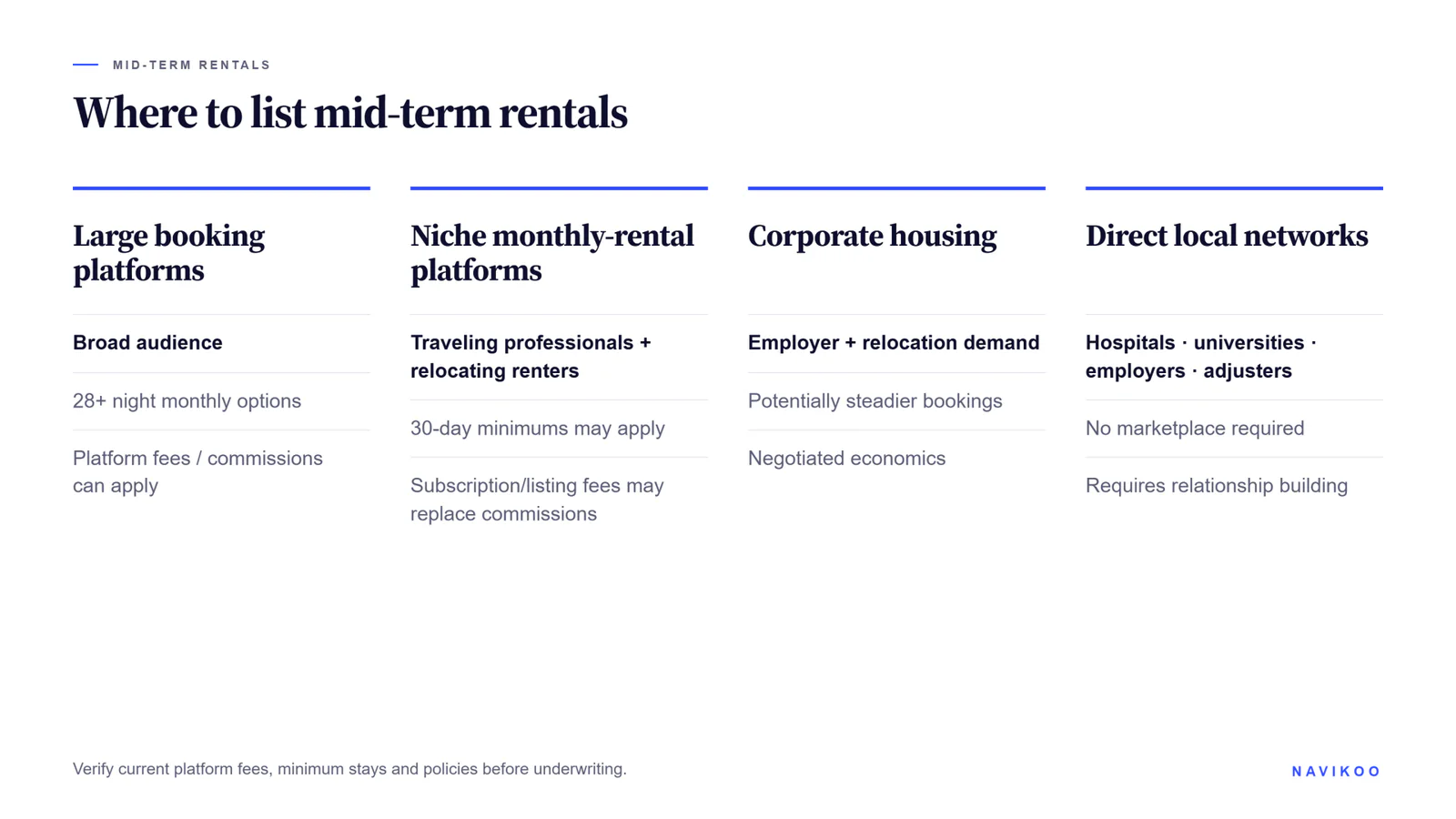
Where landlords list a property shapes who books it. Most landlords combine rental platforms with direct outreach, and the right mix depends on the tenant you want. Furnished rentals near hospitals fill differently from homes near universities or corporate campuses, so listings that work in one market may not work in another.
Airbnb Monthly Stays
Airbnb treats reservations of 28 nights or more as monthly stays. Hosts can enable longer stays and offer monthly discounts, while the platform collects payments in monthly installments for qualifying reservations. The platform brings a large audience, but Airbnb listings still compete with nightly short-term rentals and other listings for attention.
Booking commissions reduce net income, so factor them into pricing. Some owners use Airbnb mainly to fill gaps between longer direct bookings.
Vrbo and Similar Sites
Vrbo lets hosts set minimum and maximum stays and offers monthly discounts for reservations of 28 nights or more. That makes the platform usable for longer bookings as well as short stays, although the competitive set and guest mix vary by location and property type.
As with Airbnb, check how each platform handles deposits, cancellations, and stays that cross the 30-day line.
Furnished Finder and Niche Sites
Furnished Finder and similar rental platforms focus on renters seeking furnished monthly rentals. As of September 2026, Furnished Finder requires a 30-day minimum stay and charges landlords an annual property-listing subscription rather than a booking commission; platform pricing can change, so landlords should confirm the current terms before underwriting the cost.
Rental listings on these sites are designed around term housing and can attract healthcare professionals, corporate travelers, relocating families, military members, students, and other occupants planning a month or more.
Corporate Housing Providers
These companies lease furnished units for business travelers and relocating employees, sometimes under a master lease.
This can reduce vacancy and paperwork, usually at a lower net price than direct bookings. It suits owners who prefer predictable income over maximum income. Corporate housing providers often favor rentals close to major employers and transit.
Direct Bookings and Local Networks
Hospitals, universities, insurance adjusters, and local business employers often need temporary housing solutions. Building relationships with them can produce repeat bookings without platform fees and steadier demand for midterm rentals.
Managing Mid-Term Rentals
Turnover and Maintenance
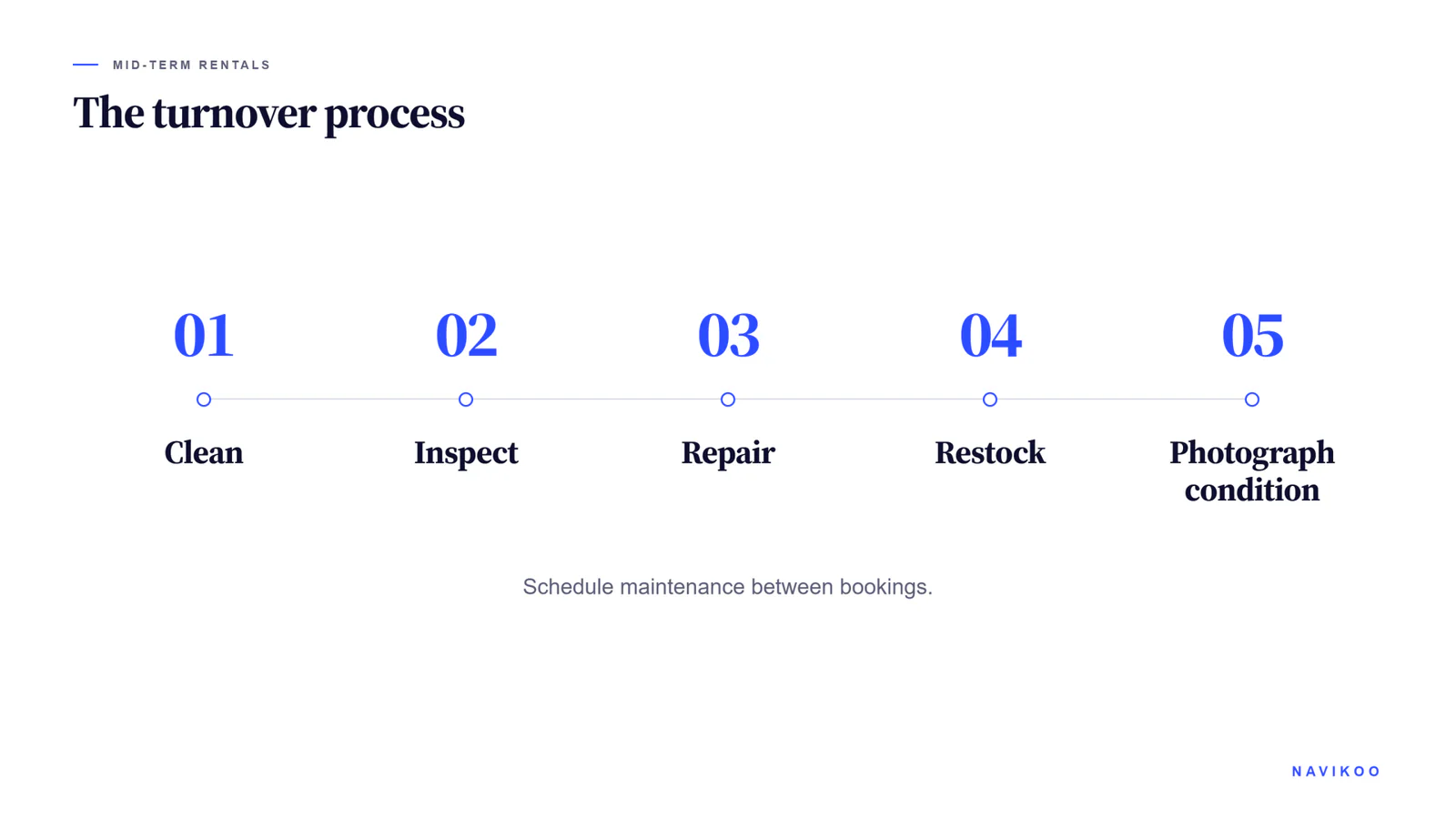
Each turnover needs cleaning, inspection, restocking, and repairs. Schedule maintenance between bookings so small issues don't reach the next occupant.
Keep spare linens and essentials on hand, and photograph the property's condition before and after each booking.
Mid term tenants contact landlords less often than nightly guests, but their requests matter more because they live there. Respond quickly to maintenance issues and set expectations for response times in the lease.
Self-Manage or Hire Help
Self-managing keeps the economics strongest but takes time. Property management software can handle calendars, payments, and messages across platforms.
Owners managing several furnished units can use free portfolio trackers to compare occupancy, income, expenses, and performance across properties.
If you hire a manager, confirm the fee and model whether occupancy can support it. As the numbers show, a 15% fee can decide whether the strategy works.
Mid-Term Rentals vs. Hotels and Extended-Stay Hotels
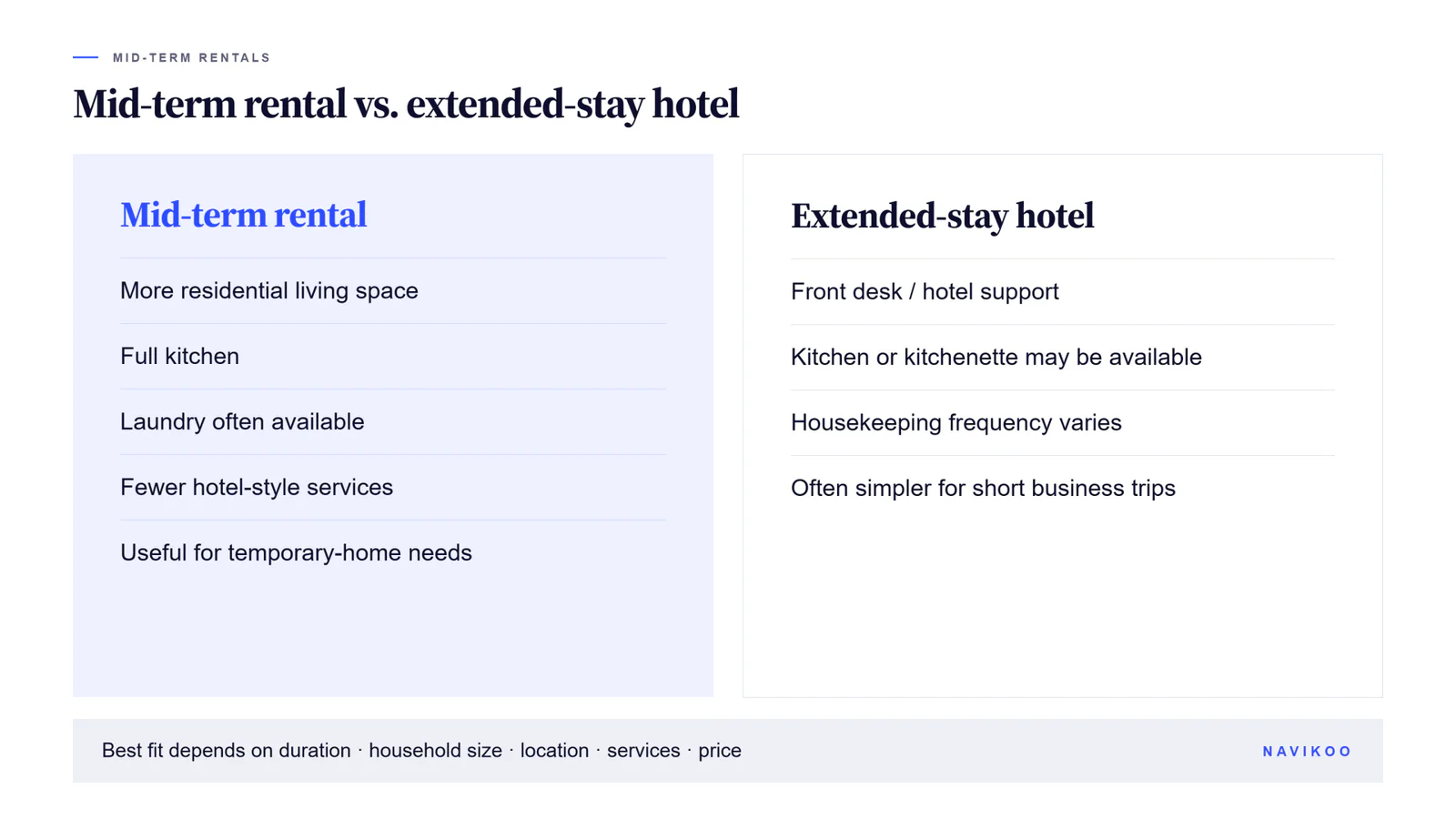
Midterm rentals compete with extended-stay hotels as well as with other furnished rentals. These hotels can offer front-desk support and hotel-style services, with housekeeping frequency varying by brand and property. Mid-term rentals often compete by offering more living space, full kitchens, laundry, and a residential feel.
Entire apartments or houses may suit occupants needing separate sleeping areas, cooking, or laundry, while hotels can be convenient for short business trips. The better product depends on booking length, household size, location, and price.
For landlords, that means the competitive set includes extended accommodations, not just other furnished rentals on the same sites. Temporary lodging for business travelers is a different product from mid-term housing for people who need a temporary home.
Is a Mid-Term Rental Strategy Right for Your Property?
When It Works
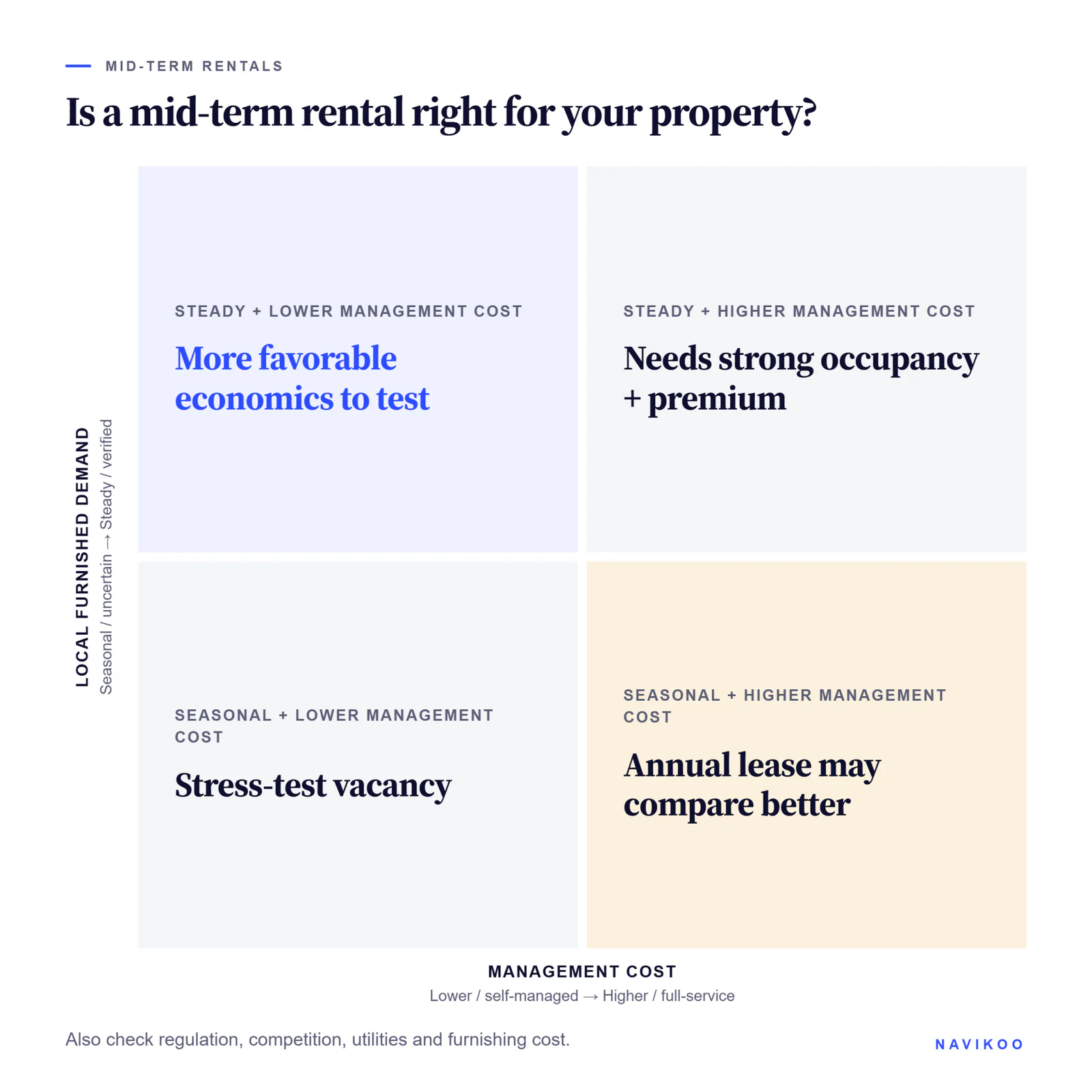
This approach fits properties near steady demand, such as hospitals, universities, large employers, or military bases, in markets where short stays are restricted and furnished supply is thin.
It works best for owners willing to self-manage, or who can keep occupancy well above the break-even. Amenities such as in-unit laundry, parking, storage, a real workspace, and reliable internet can make a home more competitive for month-long occupants than furnishings designed mainly for weekend guests. Investors should validate which amenities occupants actually filter for in the local market rather than assume they guarantee occupancy.
When to Stay Long-Term
If bookings are seasonal, nearby competition is heavy, or you'd rely on a full-service manager, the numbers may favor long-term rentals and traditional leases.
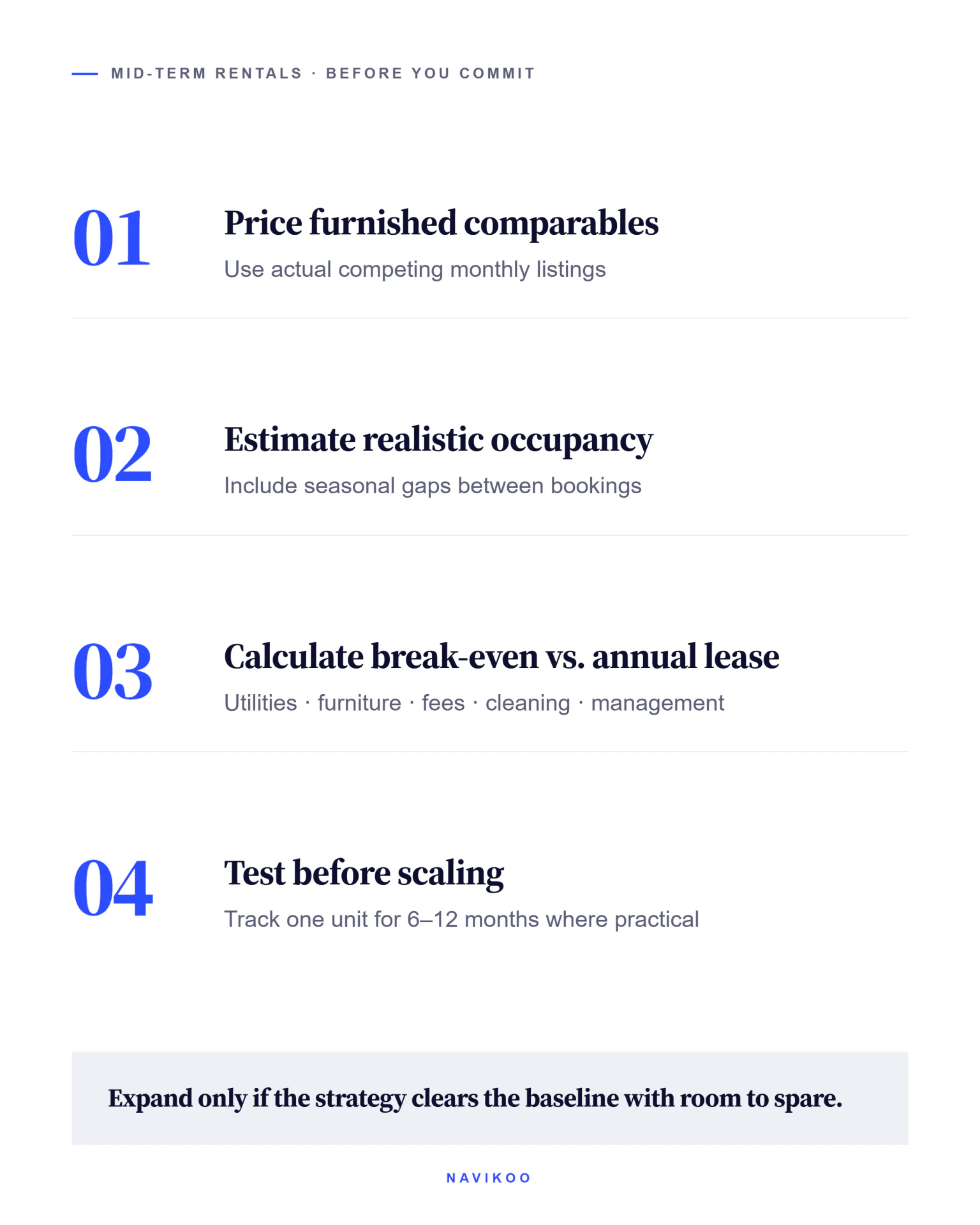
Before furnishing anything, price comparable furnished rentals, estimate realistic occupancy, and calculate the break-even against a plain annual lease on the same property. That one number tells you whether the extra work is worth it.
A Practical Test Before You Commit
Some owners test the approach with one unit before converting more. Track occupancy, average booking length, lead source, operating bills, turnover frequency, cleaning, replacement costs, and true management time for six to twelve months.
If the numbers clear the break-even with room to spare, expand. If not, return to annual leases with useful real estate data in hand rather than a guess about the rental market.