Assessed Value in Real Estate: How US Property Taxes Are Calculated
Assessed value helps determine property taxes, but it can differ substantially from market value and appraised value under local tax rules. Learn how assessed value is calculated, why it can change after a purchase, how exemptions and reassessment affect investors, and what to verify before relying on the seller's current property-tax bill.

Assessed value is the dollar amount a local government assigns to real property for tax purposes under its state and local rules. It can influence the annual property-tax charge, but it is not automatically the same as market value, a sale price, a listing price, or what a licensed appraiser concludes in a mortgage value opinion.
That distinction matters to homeowners and investors.
A home's current annual tax reflects the present owner's taxable situation: the local system, any legal limitations, exemption status, and prior ownership history. After a purchase, some of those inputs can change. In parts of the United States, an ownership transfer can cause property to be reappraised or reset under state law. In others, the tax value follows a different schedule. A rental may also lose an owner-occupant benefit that applied to the seller. For an investor, the safest approach is to underwrite the property taxes expected after closing rather than copying the seller's historical expense from a listing.
What Is Meant by Assessed Value?
Assessed value is the value assigned to a property within a local property-tax system. The Investopedia — assessed value overview provides the basic definition, while IAAO's assessed-value primer and technical standards describe professional practices used by assessors and tax offices in mass appraisal. The terminology is not perfectly uniform across the country. A jurisdiction may first estimate fair market value, current market value, or another statutory amount; apply an assessment ratio or legal limitation; and then subtract qualifying exemptions to reach taxable value. The tax assessor maintains the figure used in that process, while the taxing authorities generally set the levies.
Assessors also work within different state statutes and local market conventions. The figure usually applies to real property—the land and the home or other improvements. Some jurisdictions separately assess personal property, particularly business equipment.
How Is Assessed Value Calculated?
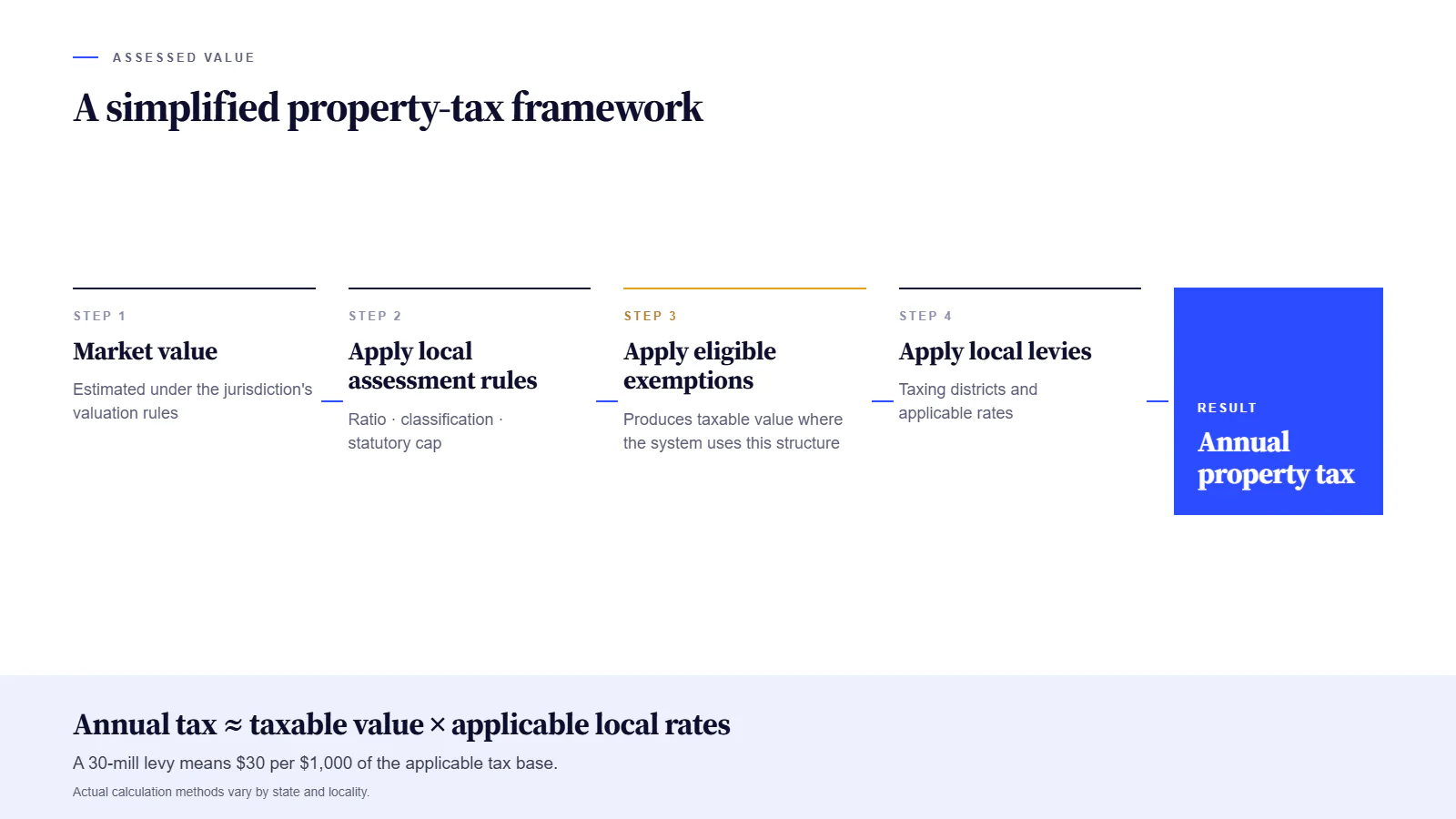
A simplified framework has three parts. First, assessors estimate the market value of the property using mass-appraisal models, comparable home sales, cost data, income information when relevant, and property characteristics such as size, age, condition, location, and additions. Second, state or local law may apply an assessment rate, classification rule, or annual cap. Third, an exemption can reduce the amount subject to tax for eligible homeowners.
A useful simplified formula is Annual tax ≈ taxable value × applicable local rates and, where the local system works this way, Taxable value ≈ assessed value − applicable exemptions. A local tax rate may be expressed in mills. A mill rate means $1 of tax for each $1,000 of the tax base. A 30-mill levy therefore represents $30 per $1,000. Actual bills can involve several taxing districts, special charges, or exemption rules that do not apply identically to every levy, so the local tax authority is the final source for the calculation.
A Worked Property-Tax Example
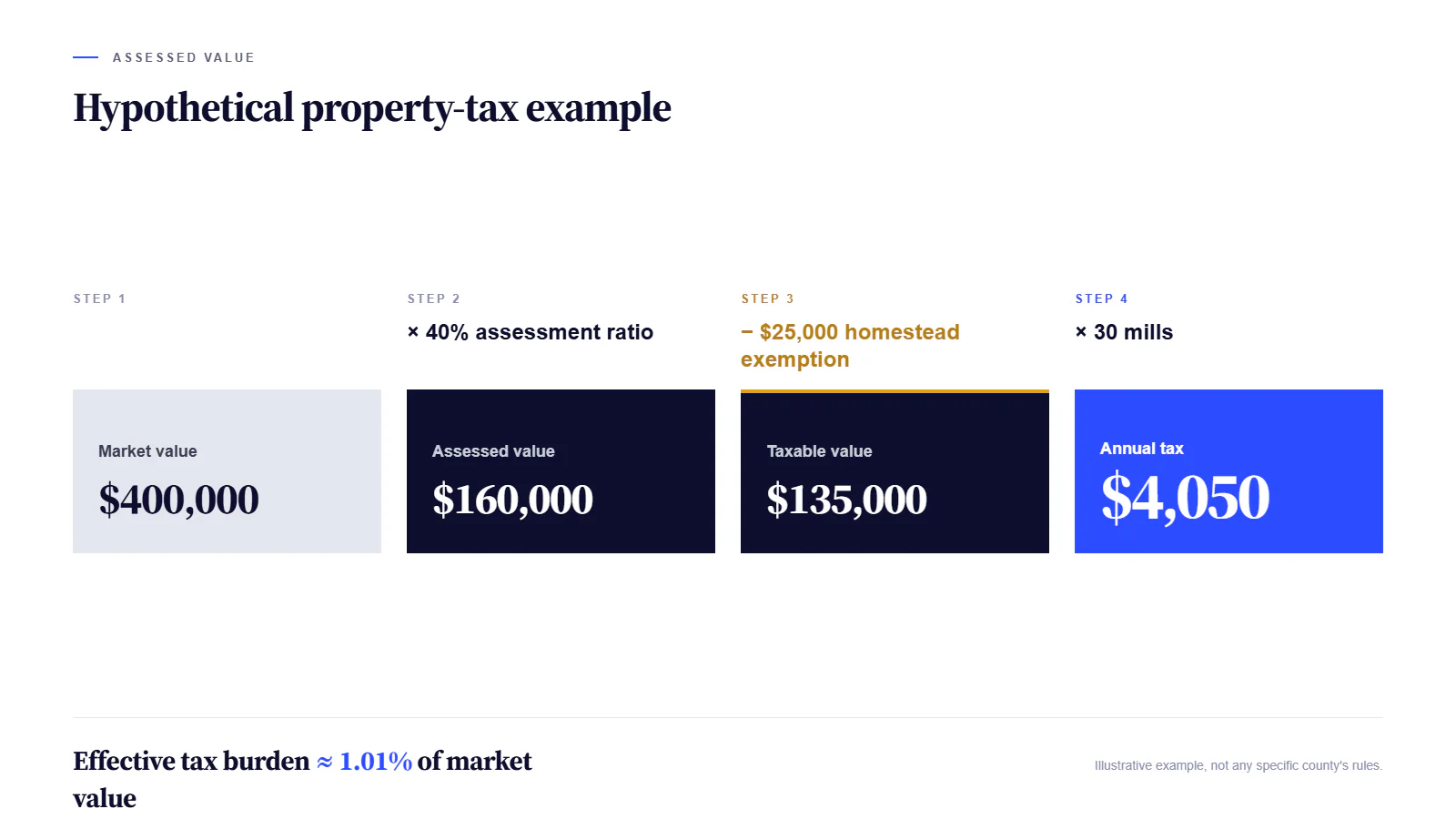
The figures below are illustrative teaching assumptions rather than any specific county's rules. Assume a home has a market value of $400,000 in a jurisdiction that uses a 40% assessment ratio. Its assessed value would be $160,000. If the homeowner qualifies for a $25,000 homestead exemption, the simplified taxable value becomes $135,000. At 30 mills, the annual tax is $4,050.
That equals about 1.01% of the home's market value. An effective tax burden measured against market value can be useful when comparing locations because statutory ratios and local levies vary, but it still should not replace the actual rules and property tax bill for the home.
Is Assessed Value the Same as Appraised Value?
No—the numbers serve different purposes.
Assessed value | Appraised value | |
|---|---|---|
Who develops it | Local assessor or property appraiser | Appraiser |
Main purpose | Property taxation | Lending, transaction, estate, or other value needs |
Typical method | Mass appraisal across many parcels | Individual analysis of a specific property |
Timing | Annual or periodic under local law | When an individual value opinion is ordered |
Relationship to the market | Can equal, approximate, or differ from market value under local law | Usually addresses a defined value standard as of a specific date |
For a mortgage application, a lender commonly orders an appraisal from an appraiser to support its collateral analysis. Property appraisals are not the same process as property assessments. Zillow estimates, asking prices, and the final selling price can provide market information, but none of them becomes assessed value merely because it exists.
How Close Is Assessed Value to Actual Value?
Sometimes the numbers are close; sometimes they are far apart. The gap often comes from statutory rules rather than an error.
Assessment Ratios and Classification
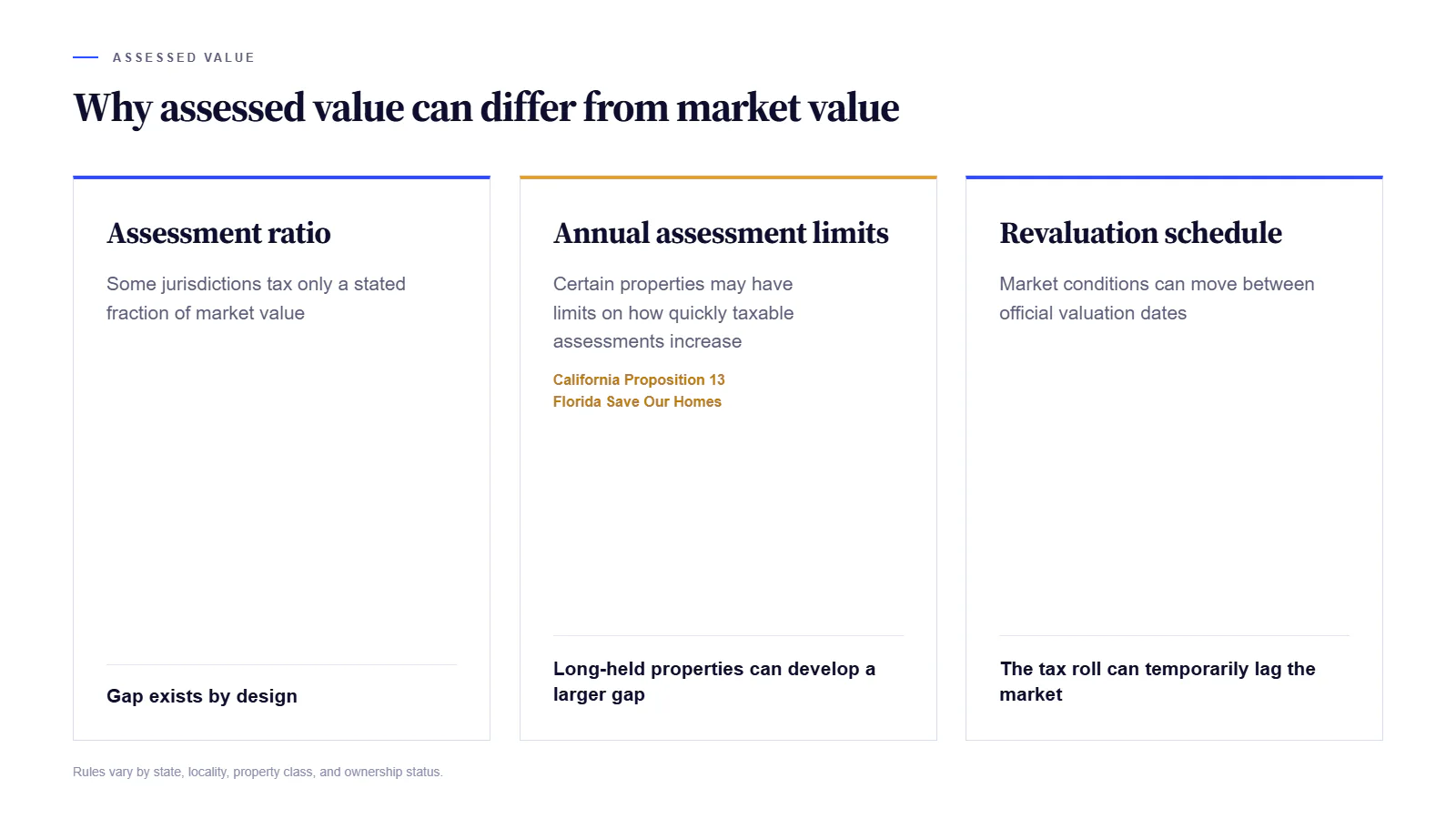
A state or locality may assess only a fraction of market value or apply different rules to different classes of property. In that system, assessed value can sit below fair market value by design, even when the home is worth much more in an open-market transaction.
Caps on Annual Increases
Some states limit how quickly certain tax values can rise. California's Proposition 13 generally constrains increases in a property's factored base-year value while allowing reassessment after a qualifying change in ownership. Florida's Save Our Homes system limits annual increases for homestead property, while Florida also has a separate limitation for many nonhomestead properties.
These rules can create a large gap between assessed value and what a buyer would pay in the current housing market, even when market value is rising.
Revaluation Cycles
Other jurisdictions regularly update property on an annual or multi-year cycle. A fast-moving market can therefore move ahead of the tax roll for a period, while a falling market can create the opposite problem.
A low assessed value does not prove a home is cheap or tell you exactly what it is worth. A high number does not prove it is overpriced. It tells you how that jurisdiction's tax system has treated the property as of its effective date.
Why Assessed Value Matters to Real Estate Investors
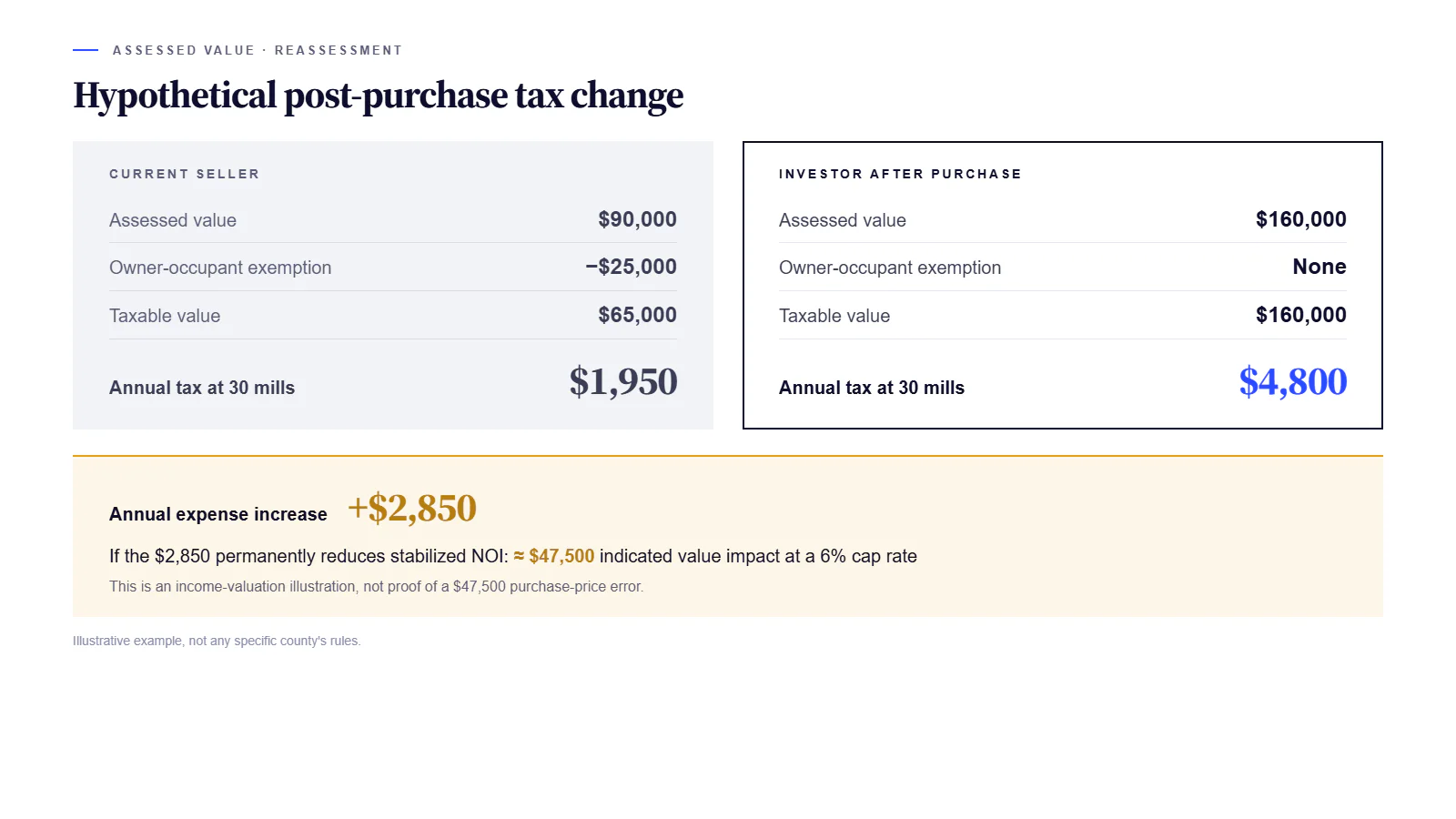
The seller's tax bill is a historical fact about what the property was worth for local tax administration, not necessarily your future expense. That is where assessed value becomes an underwriting issue. Suppose a long-time homeowner has an assessed value of $90,000. With a $25,000 owner-occupant exemption and a 30-mill levy, the simplified taxable value is $65,000 and the annual tax is $1,950.
Now assume an investor buys the same house for $400,000 in a hypothetical jurisdiction that, after a qualifying transfer, establishes a new assessed value at 40% of market value. The new assessed value is $160,000. If the rental does not qualify for the seller's exemption, taxable value is $160,000 and the modeled tax becomes $4,800.
Seller | Investor after purchase | |
|---|---|---|
Assessed value | $90,000 | $160,000 |
Owner-occupant exemption | −$25,000 | None |
Taxable value | $65,000 | $160,000 |
Annual tax at 30 mills | $1,950 | $4,800 |
The annual difference is $2,850. If that recurring expense reduces stabilized NOI dollar for dollar, a 6% capitalization rate implies about $47,500 of indicated value impact:
$2,850 ÷ 0.06 = $47,500
That is not proof that the buyer overpaid by $47,500. It is an income approach illustration showing why the post-purchase tax assumption can materially affect a rental's economics.
How to Underwrite Property Tax Before Purchase
Start with the current assessed value, but do not stop there. Check whether the seller has a homestead or other exemption, whether a purchase can trigger a reset, when the new figure becomes effective, and which local rates apply. Then model the expected post-closing property taxes in the property's cash flow. For a rental, use that expense when calculating NOI, cap rate, and cash flow rather than relying on the previous owner's number.
How to Find the Assessed Value of a Property
Most US counties or municipalities make parcel information available online. Search the official assessor, property appraiser, or equivalent office by address or parcel number. A property record card commonly shows the assessed value, land and improvement values, exemption status, history, and basic characteristics.
Also review the latest tax statement and notice of assessment. If a treasurer, tax collector, or separate billing office issues it, compare that information with the assessor's record.
History is especially useful to an investor. A jump after a prior transaction may suggest the local system responds to transfers. A value that changed slowly for many years may point to a statutory cap. Confirm the rule with the local office instead of inferring it from one parcel alone.
Can You Challenge or Appeal Assessed Value?
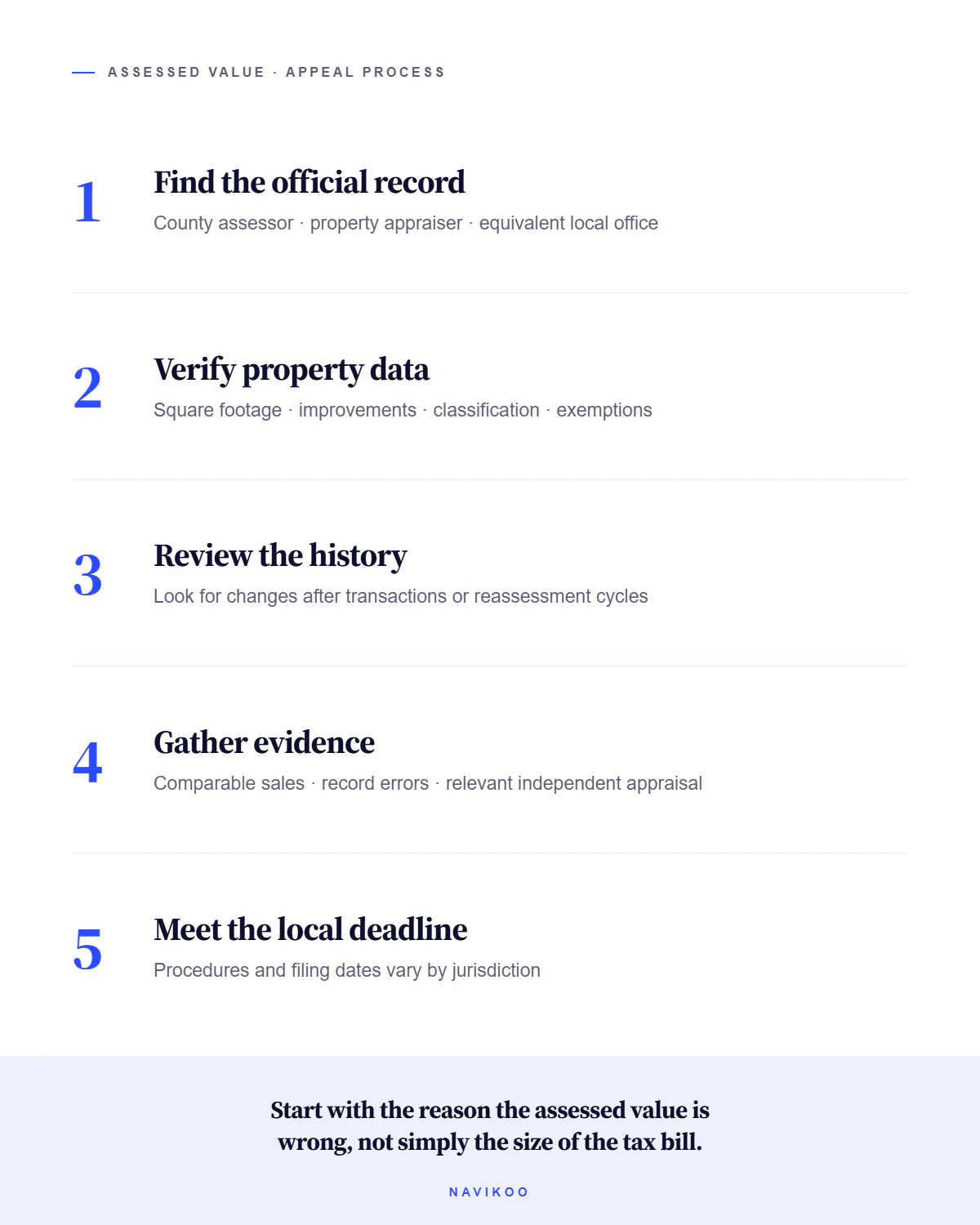
Property owners generally have a process to contest the figure, but the procedure and deadline are established by state and local law. The notice of assessment usually explains how and when to file an appeal.
A stronger appeal relies on evidence: incorrect square footage, a nonexistent improvement, the wrong property classification, or comparable sales that support a lower market estimate. A recent independent appraisal may also help when it addresses the relevant date and standard of value.
For homeowners and investors with multiple properties, an annual review can catch errors early. Local property values do not move uniformly, and checking assessor records can prevent a mistake from remaining in the tax base for years or carrying into the marketing process when selling.
Investors managing several rentals can use Navikoo's portfolio management tools to track property-level income, expenses, units, and performance as tax costs change over time.
Assessed Value, Property Taxes, and Your Mortgage
When a lender escrows property taxes, a higher bill can increase the monthly escrow portion of the mortgage payment even if mortgage rates and the loan's principal-and-interest payment do not change. It can also reduce the cash flow available to build home equity.
Assessed value is generally a property-tax concept, while lenders use a collateral value opinion and their underwriting rules to evaluate loan terms. The tax record can still appear in the lender's file or affect affordability through the projected property-tax expense; it simply is not a substitute for the lender's collateral review.
For a personal home, deductible state and local real estate taxes are subject to federal rules and limits. IRS Publication 530 explains the homeowner rules. For a rental property, IRS guidance generally treats qualifying real estate taxes as rental expenses, subject to the facts and applicable federal rules.
What to Check Before Buying a Property
Before relying on a listing's tax figure, verify the current assessed value, exemption status, and history with the official source. Find out whether the jurisdiction resets value after a transfer, uses periodic updates, or applies an annual limitation.
Then calculate the property taxes expected under your ownership. The seller's annual amount describes the seller's tax position. Your investment analysis should use the local rules, exemption status, and rates expected to apply to you after closing.