Net Operating Income (NOI) in Real Estate: Formula, Example & How to Calculate It
Net operating income is what a property earns before financing and taxes. The NOI formula, a full worked example, and why small expense changes move value.

Every rental building tells two stories. One is the story the seller tells, built on full occupancy and optimistic repair budgets. The other is what the building actually produces after paying its own bills. Net operating income is the second story, expressed as a single figure.
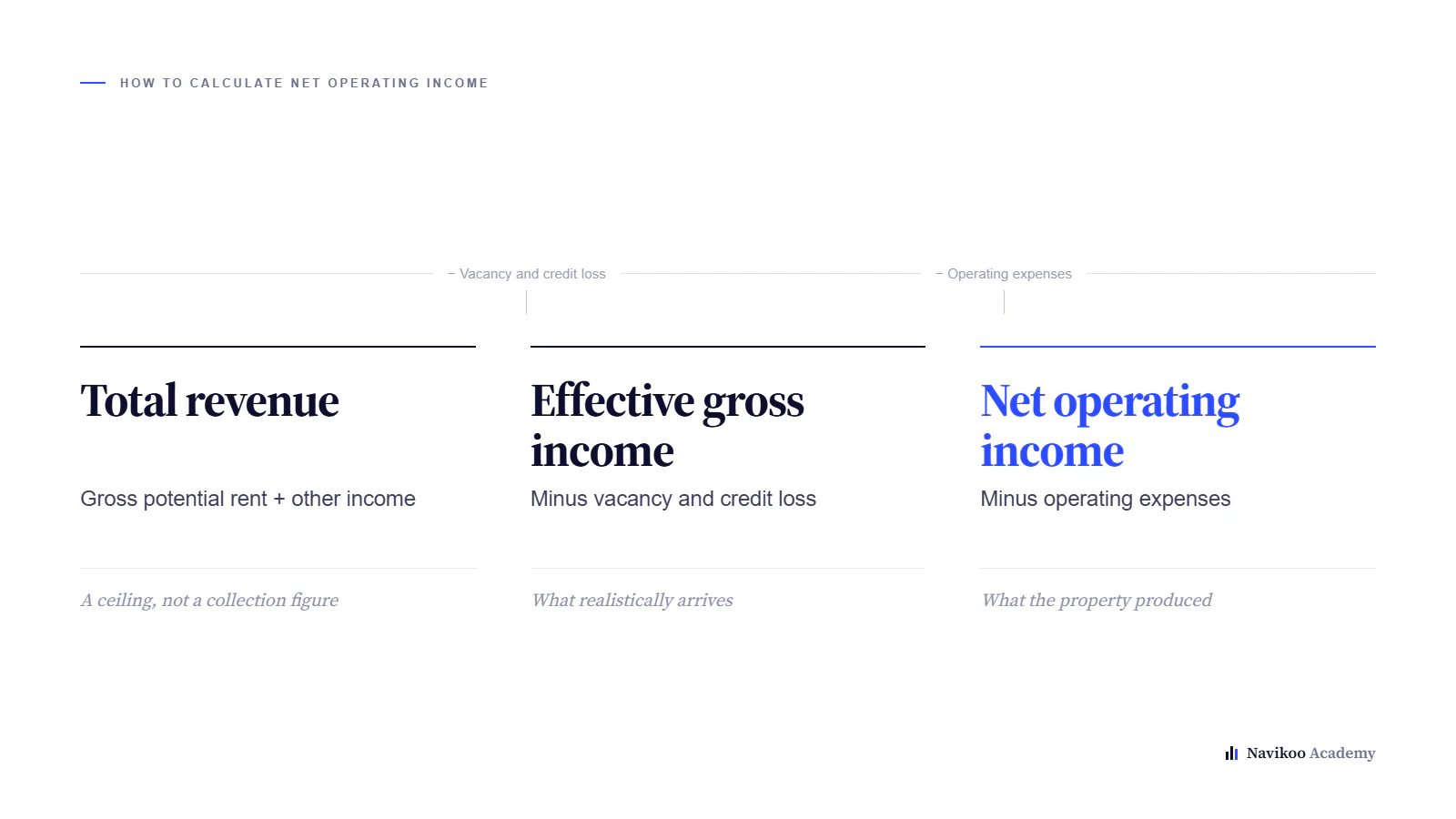
Net operating income (NOI) in real estate is the income a property generates after subtracting vacancy and operating expenses from its effective gross income, but before mortgage payments, income taxes, depreciation, and most capital expenditures.
Net Operating Income = Effective Gross Income − Operating Expenses
The NOI meaning is narrower than most beginners expect. It measures profitability at the property level, before financing, before non-cash charges, and before the owner's tax situation enters the picture. Two buyers looking at the same building compute the same net operating income even if one pays cash and the other borrows 80%.
That neutrality is why it matters. Net operating income drives value in commercial real estate, sets the ceiling on what a lender will finance, and determines whether a deal produces cash flow or consumes it. Get it wrong and every downstream number is wrong with it.
How Do You Calculate Net Operating Income? Here's the Formula:
The formula runs in three steps. The discipline lives in the details of each one.
Step 1: Start With Total Revenue - Gross Potential Income
Begin with gross potential rent, meaning what the property would collect with every unit leased at market rental rates. Then add the additional revenue most beginners forget: laundry, parking, storage, pet fees.
The result is gross revenue, sometimes called total income. It is a theoretical ceiling rather than a collection figure, and treating it as real money is the most common early error in the NOI calculation.
Step 2: Subtract Vacancy and Credit Loss
No building stays fully leased forever, and not every tenant pays. A vacancy and credit loss allowance converts that ceiling into effective gross income, the money realistically expected to arrive.
That allowance should reflect the specific submarket and the specific building rather than a habit. A stabilized property with long-term tenants and a property in a soft market with monthly turnover do not deserve the same assumption.
Step 3: Subtract Operating Expenses
Operating expenses are the costs of keeping a property running and rentable. Subtract those expenses and what remains is income from operations.
What Expenses Are Included in NOI?
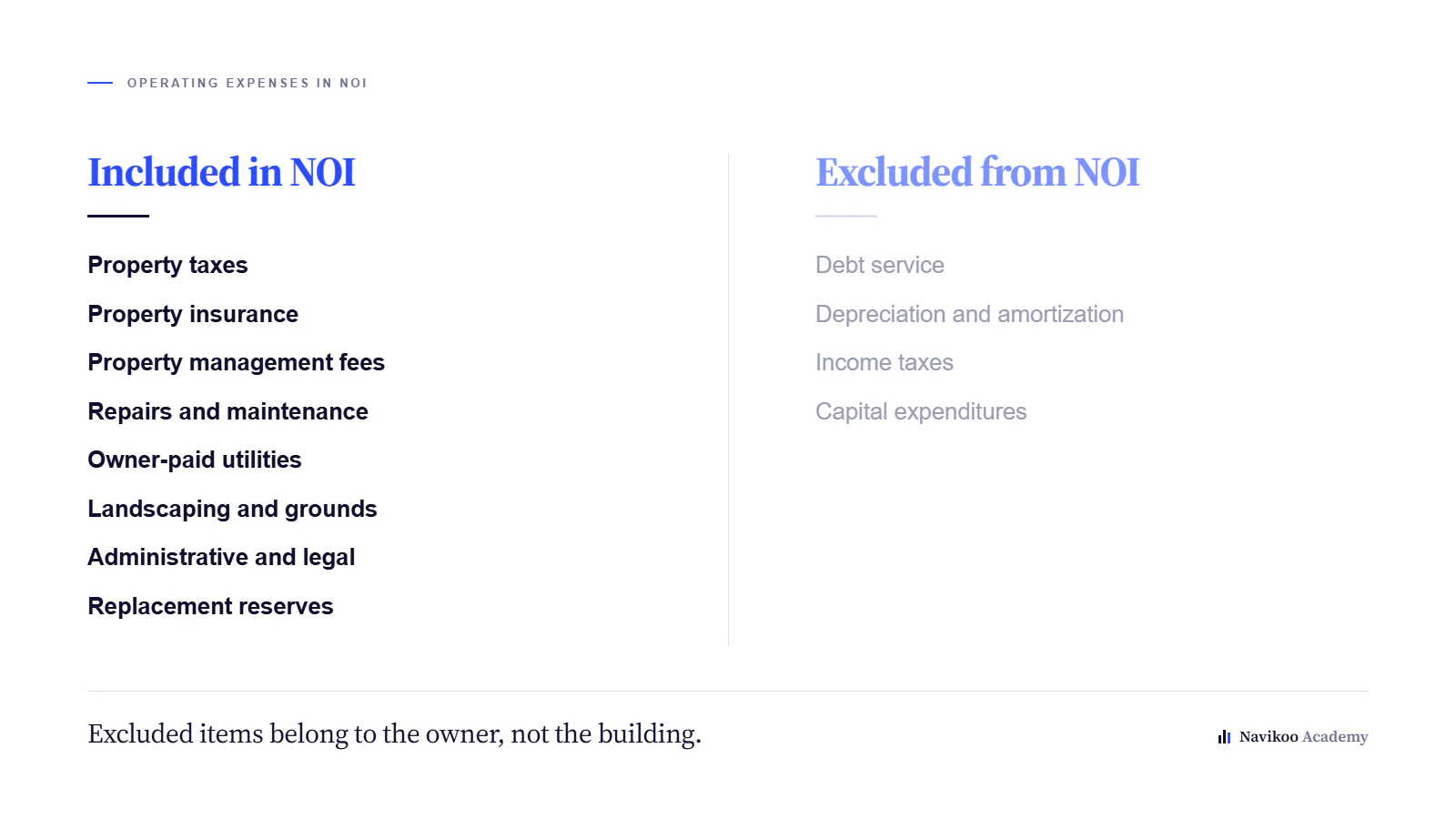
The included list covers everything required to operate the asset, regardless of who owns it or how they financed it:
Property taxes
Property insurance
Property management fees
Repairs and maintenance costs
Owner-paid utilities such as water, sewer, and trash
Landscaping, snow removal, and common area upkeep
Administrative, legal, and accounting expenses
Replacement reserves for items that wear out
Lease structure changes this list more than most investors anticipate. A gross lease leaves the owner absorbing most operating costs, while a net lease pushes those costs onto the tenant. Gross leases and net structures produce very different results from the same rent roll, which is why comparing two commercial properties on rent alone is close to meaningless.
What Expenses Are Not Included in NOI?
Four categories stay out, and each exclusion has a purpose.
Debt service. Mortgage payments are a function of the buyer's financing, not the building's performance. Excluding them keeps the metric comparable across buyers.
Depreciation and amortization. These are accounting entries, not cash leaving the property. Amortization spreads a cost across time on paper, while the money either already moved or never moved at all. Depreciation rules for residential rental property appear in IRS Publication 527, and they shape an owner's tax position rather than the building's performance.
Income taxes. Two owners in different brackets holding identical assets would otherwise report different operating results for the same property. Anyone with a finance background will recognize the pattern: this figure is real estate's close cousin to earnings before interest and taxes.
Capital expenditures. A new roof, a boiler replacement, a full unit renovation. These are investment activities that extend an asset's life rather than recurring costs of running it. The distinction matters and gets abused, which is worth returning to.
A Net Operating Income Example
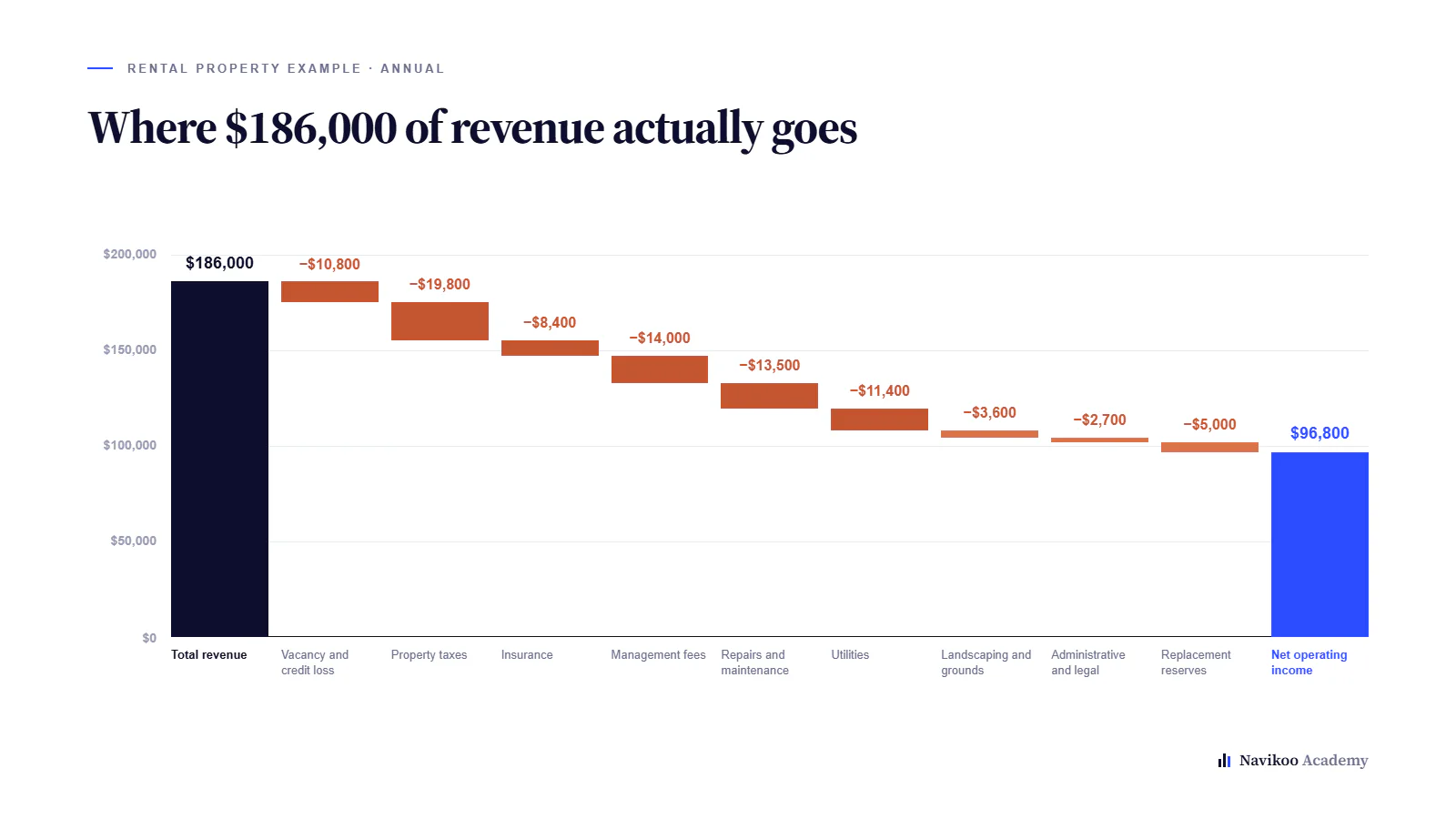
Consider a ten-unit apartment building leased at $1,500 per unit, with modest additional revenue from laundry and parking.
Line item | Annual amount |
|---|---|
Gross potential rent (10 × $1,500 × 12) | $180,000 |
Other income | $6,000 |
Total revenue | $186,000 |
Vacancy and credit loss (6% of rent) | −$10,800 |
Effective gross income | $175,200 |
Property taxes | −$19,800 |
Insurance | −$8,400 |
Management fees (8%) | −$14,000 |
Repairs and maintenance | −$13,500 |
Utilities | −$11,400 |
Landscaping and grounds | −$3,600 |
Administrative and legal | −$2,700 |
Replacement reserves | −$5,000 |
Total operating expenses | −$78,400 |
Net operating income | $96,800 |
Reading the Result
The building generates $96,800 a year of net operating income. That figure belongs to the property, not to any particular owner.
What it does not say is whether the deal works. A cash buyer keeps all $96,800. A buyer financing 75% at an illustrative 6.5% over thirty years owes roughly $68,830 in annual debt service, leaving about $27,970 pre-tax. Same property, same operating income, two very different outcomes for the person holding the keys.
It also says nothing about the roof. If that building needs $45,000 of work in year two, net operating income barely moves, because capex sits outside the equation, while the owner's bank account moves a great deal.
How Is NOI Formula Different From Cash Flow?
The two get used interchangeably in conversation and measure different things.
Net operating income | Cash flow | |
|---|---|---|
Includes debt payments | No | Yes |
Includes capital expenditures | No | Yes |
Belongs to | The property | The owner |
Changes with leverage | No | Yes |
Used for | Valuation, lending, comparison | Distributions, personal returns |
Net operating income is a property-level measure. A cash flow calculation is an owner-level measure. In the example above, the entire gap between $96,800 and $27,970 is the loan payment, and that gap widens or narrows with every change to financing costs without the building performing any differently.
The distinction also separates NOI from net income, which sits further down the statement after interest, depreciation, and income taxes. NOI is not gross profit and not net income. It is one specific slice: what operations produced, cleanly.
How Does NOI Affect Cap Rates in Real Estate?
The capitalization rate connects operating income to property value through one formula:
Property Value = Net Operating Income ÷ Cap Rate
If comparable buildings in that submarket trade at an 8% cap rate, the ten-unit example supports a property valuation near $1,210,000. Change either input and the number moves.
Why Small Income Gains Move Value So Much
Here is the part that reshapes how investors think about operations. Cutting $5,000 of annual operating expenses raises NOI by $5,000. At an 8% capitalization rate, that adds roughly $62,500 of property value.
The same logic runs in reverse. A carrier renewal costing $6,000 more, absorbed quietly, removes about $75,000 of value at the same rate. Nothing about the building changed. The income statement did.

This multiplier is why experienced operators treat expense discipline as value creation rather than housekeeping, and why any effort to increase revenue through better rents, reduced turnover, or new revenue sources gets judged by what it adds to the capitalized figure rather than to monthly cash.
What Is a Good NOI Percentage?
There is no universal answer, and the honest version of this question is really about the operating expense ratio.
Divide total operating expenses by effective income. In the example, $78,400 ÷ $175,200 produces about 44.7%, leaving a profitability margin near 55.3%.
Whether that is strong depends on variables the ratio cannot show. Expense ratios shift with building age, since older properties carry heavier expenses. They shift with lease structure. They shift with local tax bills and coverage costs, both of which vary enormously by state and by year. And they shift with property type, since a self-storage facility and a 1960s apartment building have almost nothing in common operationally.
A ratio is most useful measured against similar buildings in the same market, or against the same property's own history. Benchmarks borrowed from a different property type or a different region tend to mislead more than they help.

How Is NOI Used in Real Estate?
Four uses, in rough order of how often investors meet them.
Valuation. Appraisers and buyers capitalize operating income to estimate what a property is worth. This is the foundation of commercial real estate valuation and the reason the figure receives more scrutiny than any other line in a deal package.
Comparison. Because net operating income ignores financing, real estate investors can compare two rental properties with different capital structures directly. Real estate investment trusts and large real estate companies report it for the same reason: it isolates operational financial performance from balance sheet decisions.
Lending. Commercial lenders size loans against operating income rather than borrower optimism, and they build their financial solutions around what the investment demonstrably earns.
Asset management. After closing, actual results get measured against underwriting, and the variance teaches more about accurate assumptions than any model built before the purchase.
Lenders and Debt Service Coverage
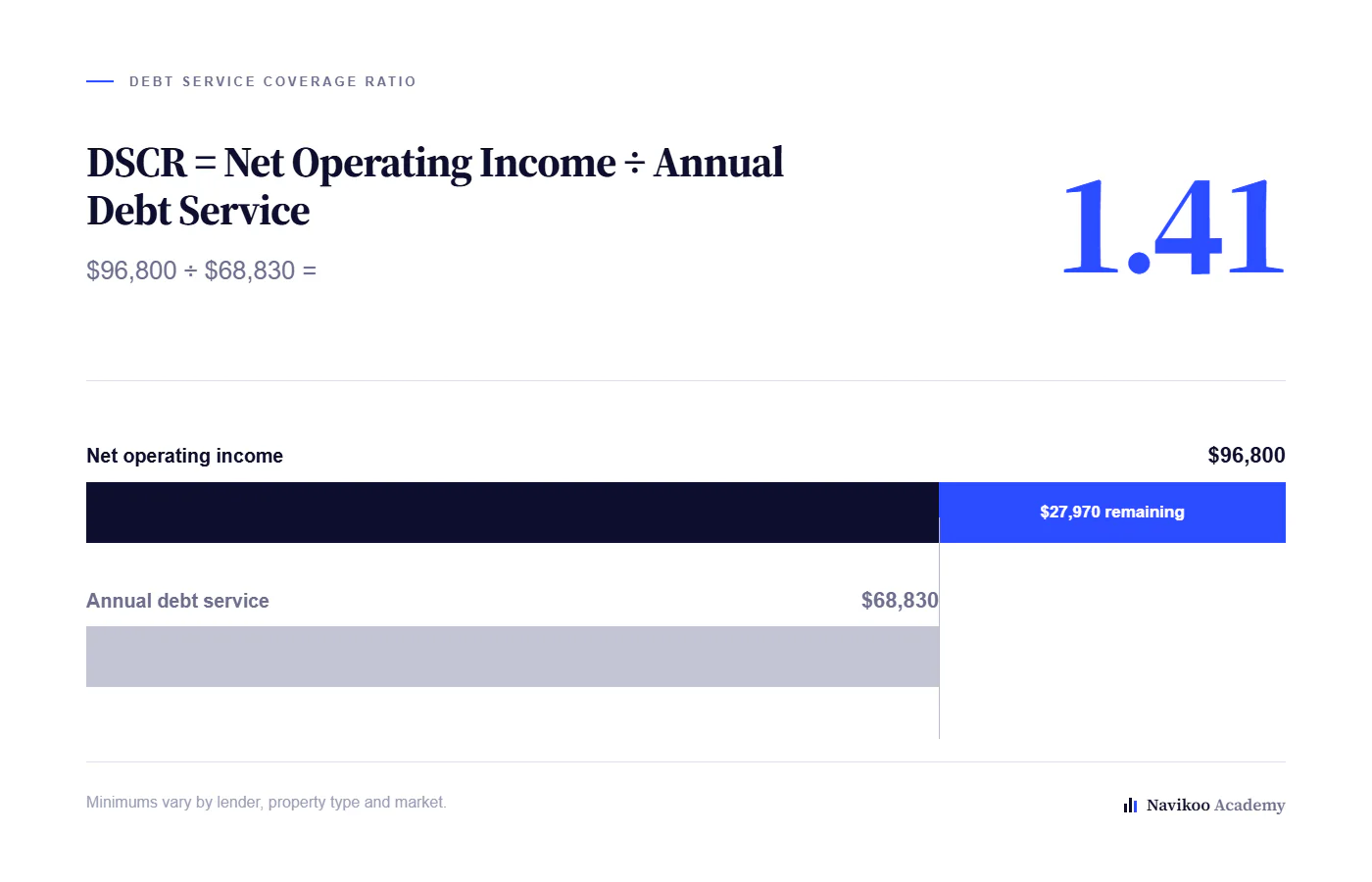
The debt coverage ratio divides net operating income by the annual loan payment. In the worked example, $96,800 ÷ $68,830 gives about 1.41, meaning net operating income covers debt service roughly 1.4 times over. Coverage is among the first financial ratios a lender calculates.
Minimums vary by lender, property type, and market. What stays constant is the mechanism: lower operating income supports a smaller loan, so every dollar of overstated real estate income eventually collides with an underwriter running the math independently.
Can NOI Be Negative?
Yes, and it happens more often than textbooks suggest.
Negative net operating income means operating expenses exceeded effective income before a single loan payment. Heavy vacancy in a distressed building, a property carrying deferred repairs that finally came due, a repositioning with half the units offline, or a market where taxes and interest costs climbed faster than rental income.
A negative figure is not automatically disqualifying. Value-add investors buy precisely because current performance is broken and fixable. What it does mean is that the property cannot support debt on present performance, so the investment opportunity has to rest on a credible path to stable income rather than on what exists today.
Where the Number Gets Manipulated
Because net operating income drives valuation, it attracts pressure. Two patterns account for most of it.
Seller Pro Formas
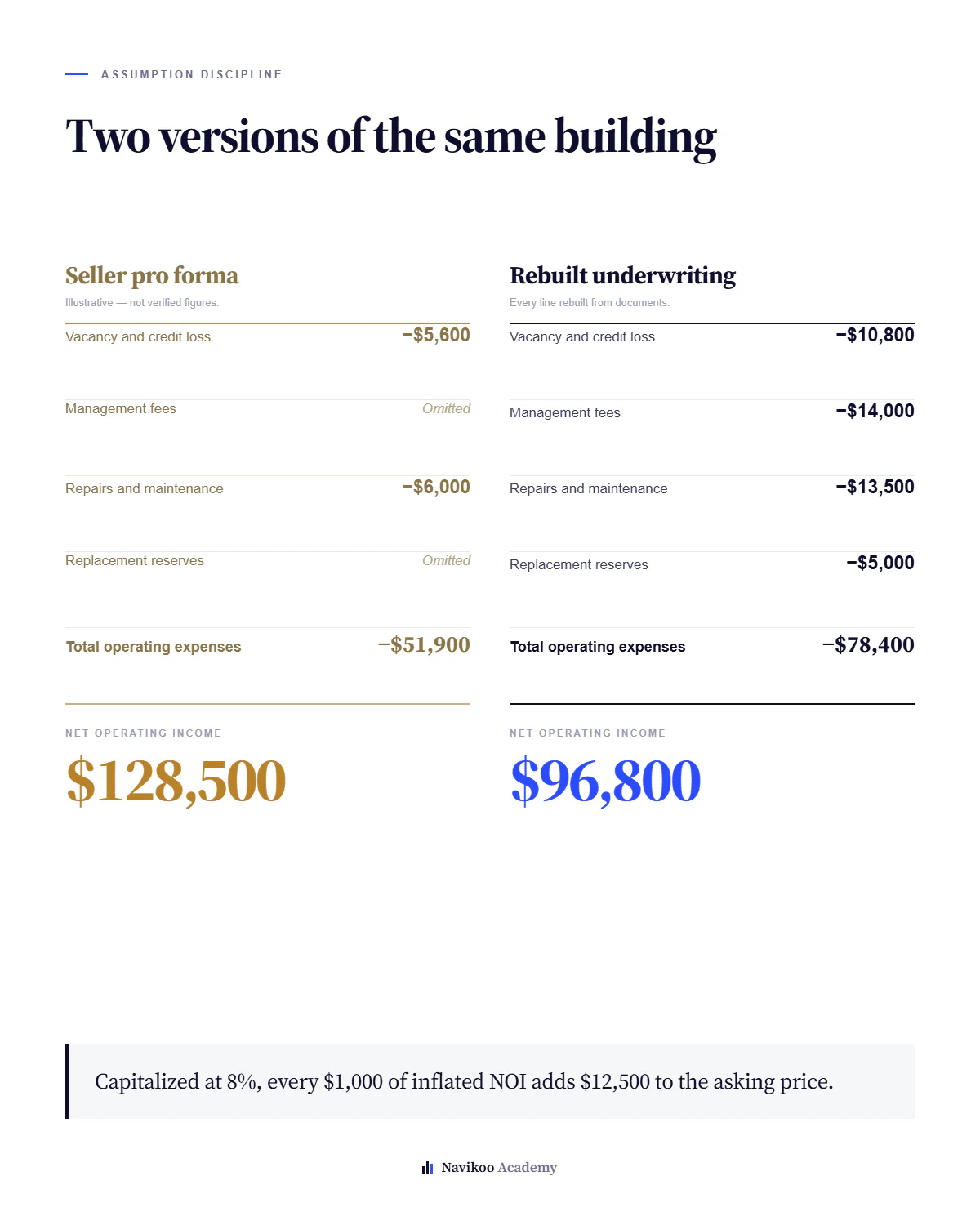
Marketing packages routinely present profitability under favorable assumptions. Vacancy modeled at 3% in a market running 8%. Lease rates assumed above what the submarket supports. The management fee omitted because the owner self-manages. Upkeep budgeted at a figure no ten-unit building has ever achieved. Reserves and realistic operating expenses left out entirely.
None of it is necessarily dishonest, and all of it understates operating expenses. Rebuilding them independently, using tax records, real quotes, and repair assumptions appropriate to the building's age, frequently moves NOI by five figures on a property this size. Few skills in real estate investing pay better than reconstructing a seller's expense column. A buyer who intends to hire a property manager should price that fee in even when the seller did not.
Capital Expenditures Disguised as Nothing
The line between a repair and a capital expenditure is genuinely blurry, and the ambiguity gets exploited. Classifying recurring maintenance as capital expenditures pushes costs out of operating expenses and lifts reported profitability, which lifts the asking price through the cap rate multiplier.
An owner replacing individual appliances every year as units turn is describing a recurring cost, whatever the accounting says. Reviewing several years of expense history usually reveals which items are genuinely episodic and which are ordinary costs wearing a different label.
Key Takeaways Before Underwriting a Deal
The NOI formula takes ten seconds. The assumptions underneath decide whether the output is worth anything, and five deserve independent verification on every property investment.
Confirm rental income against actual leases and payment history rather than a rent roll or a market survey. Rebuild operating expenses from tax bills, real quotes, and repair figures suited to the building's age and systems. Set vacancy from the submarket rather than from the seller. Add a management fee even when self-managing, because the next buyer will price one in. Separate genuine capital items from ordinary expenses by reviewing several years of history rather than one.
Once those inputs hold up, net operating income becomes the anchor for nearly everything else in a real estate investment: the valuation, the loan sizing, the comparison across a market, and the cash flow projection that follows. Investors modeling how rents, vacancy, expenses, and financing interact can test those assumptions together in Navikoo's Rental Property Calculator rather than adjusting one variable at a time.
Worth remembering is that this figure measures a single year of a building's operations. Total returns on real estate investments also depend on appreciation, principal paydown, and the eventual exit, which is why metrics like the equity multiple and return on investment sit alongside it in any serious investment analysis. For investors using property in longer-horizon wealth planning, the next number to understand is what remains after the lender is paid, since that is where an owner's total return actually begins.
Frequently Asked Questions About Net Operating Income
Does NOI include property taxes?
Yes. Property taxes are generally treated as an operating expense because they are a recurring cost of owning and operating the property. That means they reduce net operating income.
Does NOI include mortgage payments?
No. Mortgage payments are excluded from NOI because financing depends on the individual owner's capital structure, not the property's operating performance, but they become essential when calculating the debt service coverage ratio (DSCR).
Does NOI include interest expense?
No. Interest expense is excluded from NOI because it is related to financing rather than the property's day-to-day operations.
Does NOI include depreciation?
No. Depreciation is generally excluded from NOI because it is a non-cash accounting expense rather than an operating cash expense.
Depreciation affects taxable income, but it does not represent money leaving the property each month for operations.
Does NOI include capital expenditures?
Usually no. Major capital expenditures such as replacing a roof, installing a new HVAC system, or completing a major renovation are generally excluded from NOI because they are long-term investments rather than recurring operating expenses.
Investors should evaluate capital expenditures separately from operating expenses, especially when estimating renovation needs with a rehab cost estimator.
Is NOI calculated before or after debt service?
NOI is calculated before debt service. The usual order is:
Effective Gross Income → Operating Expenses → NOI → Debt Service → Cash Flow
That is why NOI is useful for comparing properties with different financing structures.
Can net operating income be negative?
Yes. NOI becomes negative when operating expenses exceed effective gross income before mortgage payments are considered.
This can happen because of high vacancy, unusually high property expenses, major operational problems, or a property that is still being stabilized.
A negative NOI does not necessarily mean an investment can never work, but it means the property is not currently generating enough operating income to support itself.
What is the difference between NOI and cash flow?
NOI measures the property's operating performance before financing. Cash flow measures what remains for the owner after expenses such as debt service and other owner-level costs are considered.
For example, two investors purchasing the same building should calculate the same NOI, but they can have very different cash flow if one uses significantly more debt.
How does NOI affect property value?
For income-producing real estate, NOI is commonly used together with a capitalization rate to estimate property value:
Property Value = NOI ÷ Cap Rate
If a property's NOI increases while the market cap rate stays the same, the implied property value rises.
For example, increasing NOI by $5,000 at an 8% cap rate increases the implied value by approximately $62,500.
How is NOI used to calculate DSCR?
DSCR compares a property's NOI with its annual debt service:
DSCR = NOI ÷ Annual Debt Service
For example, a property producing $100,000 in NOI with $80,000 in annual debt service has a DSCR of 1.25.
This tells a lender that the property generates $1.25 of operating income for every $1.00 of debt payments.