The BRRRR Method in Real Estate
Discover how to use the BRRRR method to grow your real estate portfolio! Learn how to buy, renovate, rent, refinance, and repeat for success. Dive in now!

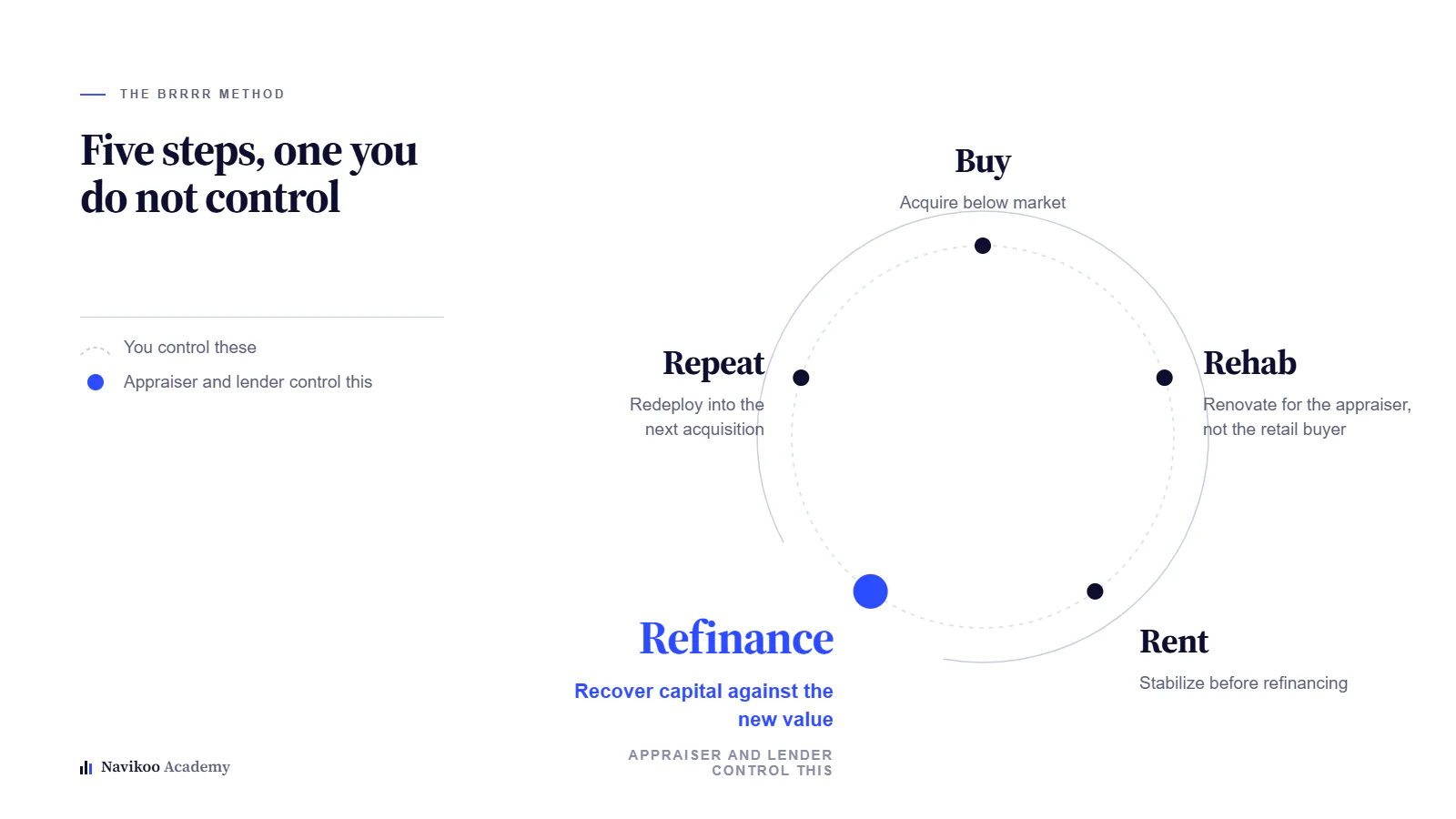
Most explanations of the BRRRR method spend their energy on the acronym. Buy, rehab, rent, refinance, repeat. Five words, one diagram, and a promise that an investor can recycle the same capital indefinitely.
The acronym is the easy part of the BRRRR strategy. What separates a BRRRR strategy that compounds a real estate portfolio from one that traps capital in a property producing nothing is a single comparison most investors never run: whether the property's yield on total cost exceeds the constant on the refinance loan.
That comparison decides everything downstream. Get it right and pulling capital out raises the return. Get it wrong and every dollar recovered makes the rental worse. That is the difference between real estate investing that compounds and a single deal that stops moving.
What the BRRRR Method Actually Is
The BRRRR method is a real estate investment strategy for converting a distressed property into a stabilized rental while recovering most of the capital used to acquire it. Recovery happens through cash-out refinancing against the improved value rather than through a sale.
That distinction matters more than beginners expect. Flipping converts a home into cash by selling it. The BRRRR method converts a property into cash by borrowing against it, so the investor keeps the asset, keeps the tenants, and keeps the debt.
Buy
Acquire below market, usually a distressed property that conventional buyers cannot finance or will not tolerate. The purchase price sets the ceiling on everything downstream, because the new loan is measured against appraised value rather than against spending.
Rehab
Rehab here serves a different master than in house flipping. A flip often optimizes renovations for a retail buyer. A BRRRR project has a different constraint: improvements need to support both the appraised value and the rent the finished property can actually command. Curb appeal matters less; durable systems and defensible square footage matter more.
Rent
Place tenants before the refinance step. Many lenders treat stabilized, tenant-occupied properties differently from vacant or transitional assets, depending on the loan program and underwriting guidelines. Rent estimator from Navikoo can help you understand what your property could generate and factor that income into your refinance analysis.
Refinance
The new mortgage pays off acquisition debt and returns the investor's money. Refinancing through a cash-out structure is the mechanism, and it is the only step in the sequence the investor does not control.
Repeat
Recovered money funds the next acquisition, and rental income covers the debt left behind. The compounding that makes this real estate strategy attractive comes from repetition, which is also why one failed exit stalls an entire pipeline. Each completed cycle should leave the portfolio larger than the last.
What Is the 70% Rule for BRRRR?
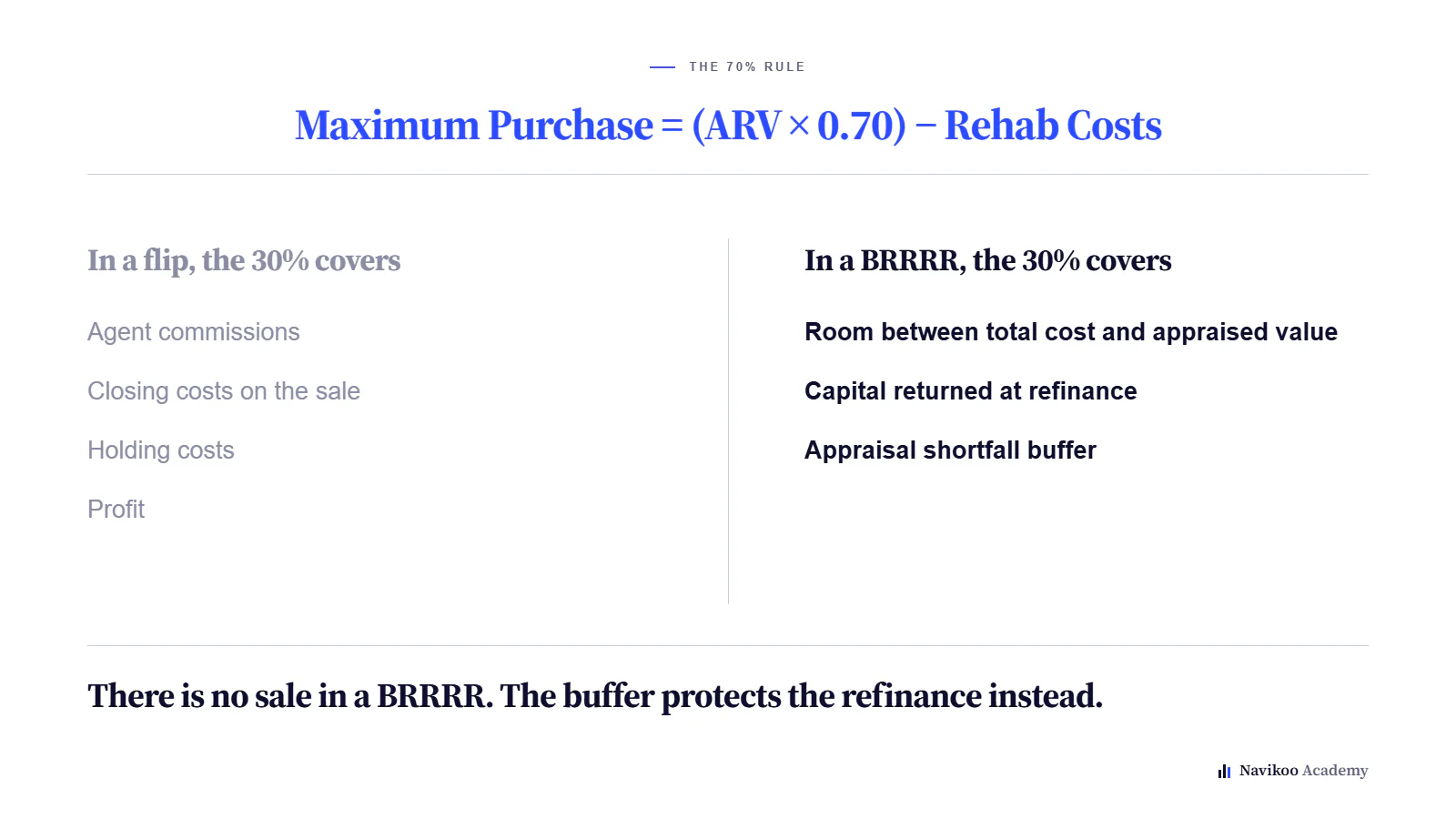
A commonly cited 70% heuristic sets a maximum purchase price at:
Maximum Purchase = (ARV × 0.70) − Rehab Costs
On a property with a $310,000 appraised value after the work and $55,000 of planned renovations, that permits $162,000.
Why the BRRRR Version Is Not the Flip Version
In a flip, the 30% withheld covers agent commissions, closing on the sale, holding, and profit. There is no sale in the BRRRR method, so those selling costs never occur.
The buffer does something different here. It creates room between total cost and property value so a new loan at 70% to 75% of that value brings back most of the investment. An investor who pays close to the after-repair figure has not lost profit on a sale that never happens. They have guaranteed that capital stays trapped.
A Worked Example
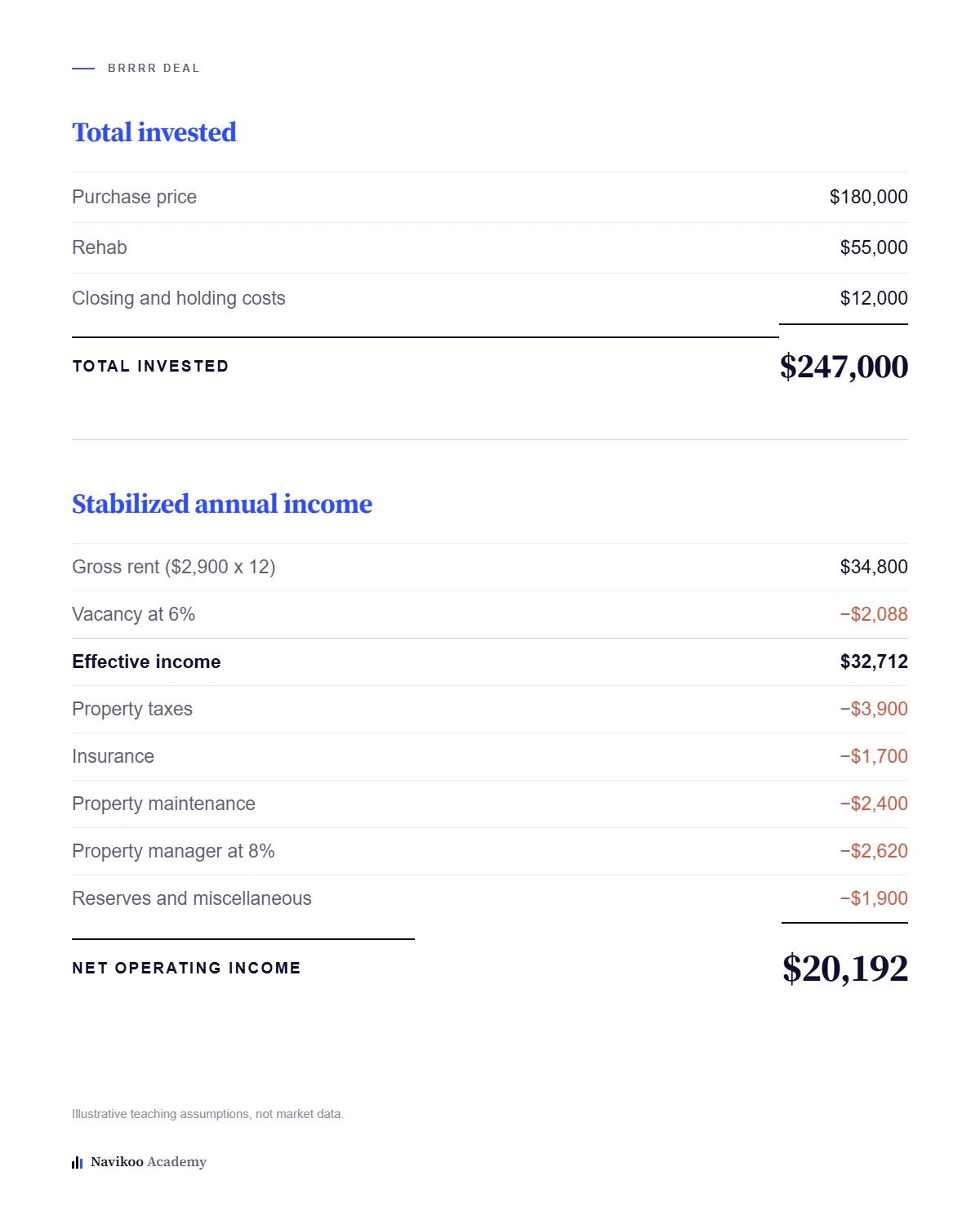
The figures below are illustrative teaching assumptions rather than current market data.
Item | Amount |
|---|---|
Purchase price | $180,000 |
Rehab | $55,000 |
Closing and holding costs | $12,000 |
Total invested | $247,000 |
After the work, comparable sales support a property appraisal of $310,000.
The Stabilized Rental
Item | Annual |
|---|---|
Gross rent ($2,900 × 12) | $34,800 |
Vacancy at 6% | −$2,088 |
Effective income | $32,712 |
Property taxes | −$3,900 |
Insurance | −$1,700 |
Property maintenance | −$2,400 |
Property manager at 8% | −$2,620 |
Reserves and miscellaneous | −$1,900 |
Net operating income | $20,192 |
Coming Out
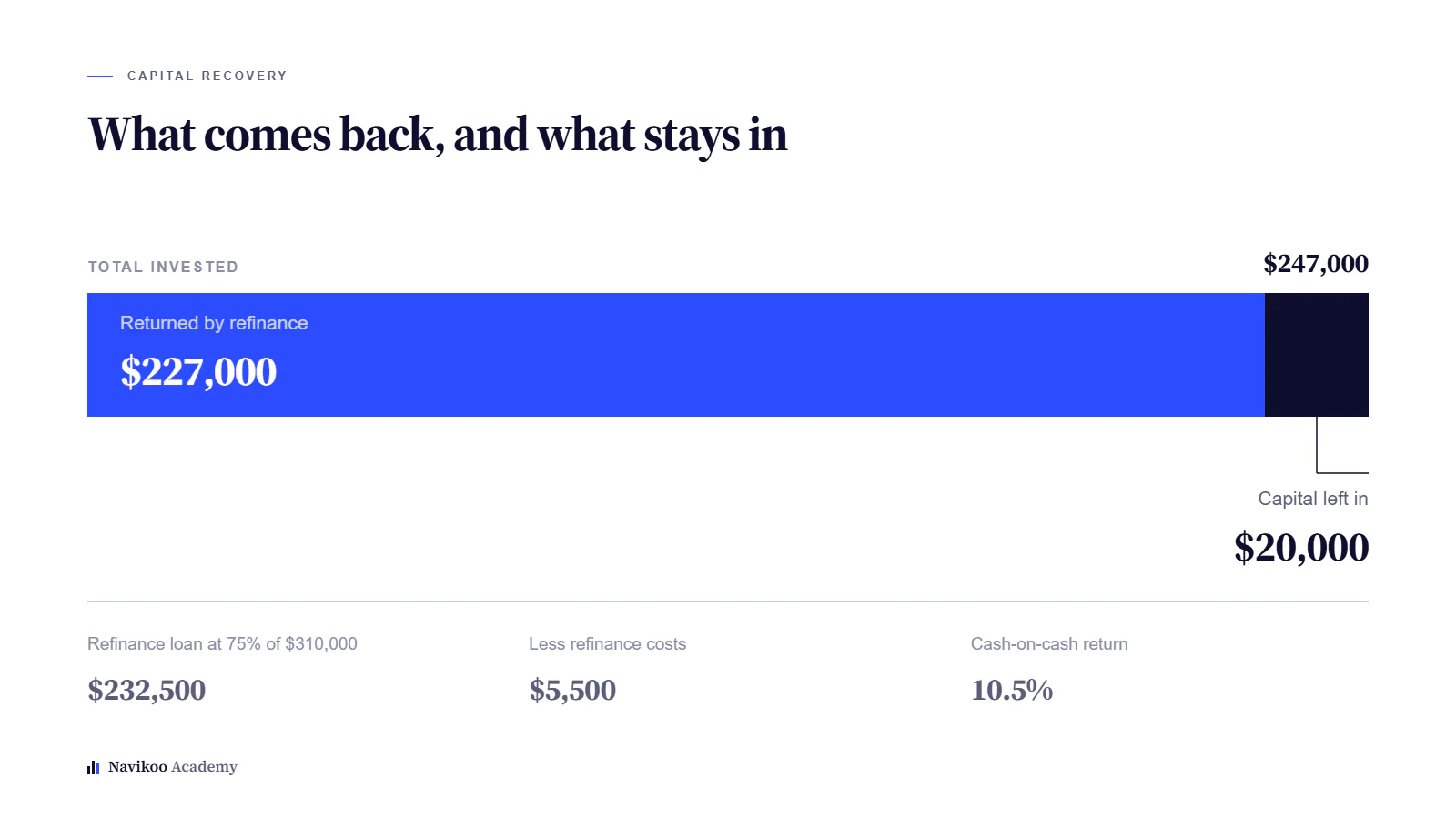
Refinancing at 75% of the $310,000 valuation produces a $232,500 loan. After roughly $5,500 in costs, $227,000 comes back to the investor.
Capital remaining in the deal: $247,000 − $227,000 = $20,000.
At an illustrative 6.75% over thirty years, annual debt service runs about $18,096. Against $20,192 of net operating income, the property throws off $2,096 of surplus and covers its payment 1.12 times over. Rental income, not the appraisal, is what services the new debt from here on.
That is the version of the story everyone tells. A home worth $310,000, generating steady cash flow, with only $20,000 of the investor's money still inside. Cash-on-cash return of roughly 10.5%.
The Calculation Almost Nobody Runs
Before celebrating the $20,000, run one more number.
Yield on cost is net operating income divided by everything spent: $20,192 ÷ $247,000, or 8.17%. That is what the property earns before financing.
The loan constant is annual debt service divided by the balance: $18,096 ÷ $232,500, or 7.78%. That is what borrowed money costs.
Yield on Cost Against the Loan Constant
When yield on cost exceeds the loan constant, borrowed dollars earn more than they cost, and pulling capital out raises the return. When the loan constant exceeds yield on cost, additional leverage no longer improves the return on the investor's remaining equity. Cash flow falls and cash-on-cash return begins moving in the wrong direction.
This single comparison explains the entire cash-out tradeoff, and it produces a result most investors running this strategy find counterintuitive.
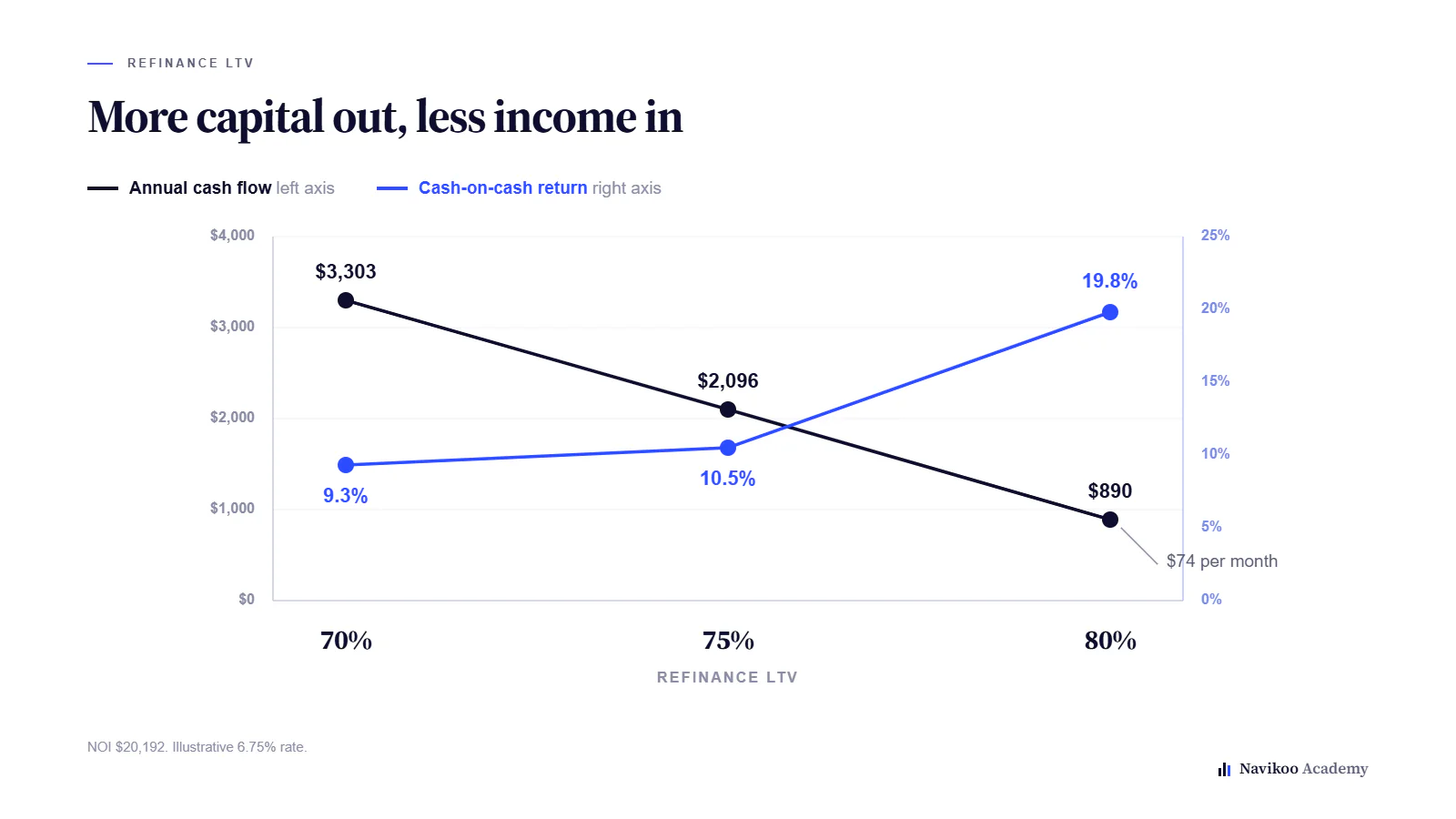
Refinance LTV | Loan | Capital left in | Annual cash flow | Cash-on-cash |
|---|---|---|---|---|
70% | $217,000 | $35,500 | $3,303 | 9.3% |
75% | $232,500 | $20,000 | $2,096 | 10.5% |
80% | $248,000 | $4,500 | $890 | 19.8% |
More leverage produces less income and a higher percentage, because the shrinking denominator outruns the shrinking numerator. Both columns are accurate. Neither is the whole picture, and an investor optimizing for the last one can end up owning a rental that generates $74 a month.
The Same Deal at a Higher Interest Rate
Hold the property, the rent, and the renovations constant, and move the exit loan to an illustrative 8.25%. The loan constant rises to 9.02%, above the 8.17% yield on cost.
Refinance LTV | Loan | Capital left in | Annual cash flow | DSCR |
|---|---|---|---|---|
70% | $217,000 | $35,500 | $629 | 1.03 |
75% | $232,500 | $20,000 | −$768 | 0.96 |
80% | $248,000 | $4,500 | −$2,166 | 0.90 |
Nothing about the property changed. Same work, same tenants, same valuation. Yet the approach that recovered $227,000 and produced positive cash flow now recovers $227,000 and produces a home losing money monthly, and one most underwriters would decline to finance at all.
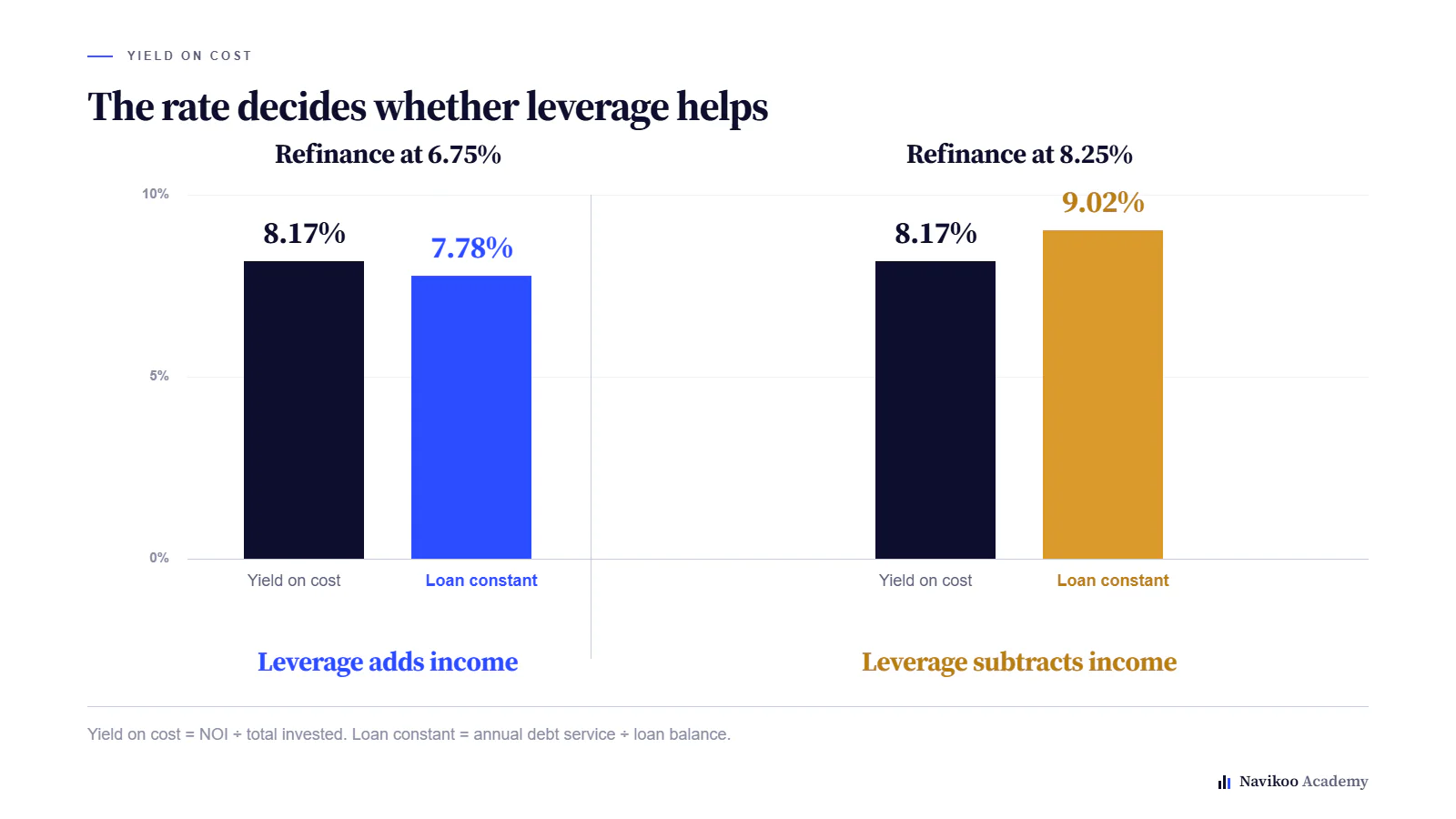
This is the honest answer to whether the BRRRR method is effective. It works when the spread between yield on cost and the loan constant is positive and wide enough to survive a rate move. It becomes a capital trap when that spread is thin or negative, and the acronym gives no warning either way.
Who Determines the Value Everything Depends On
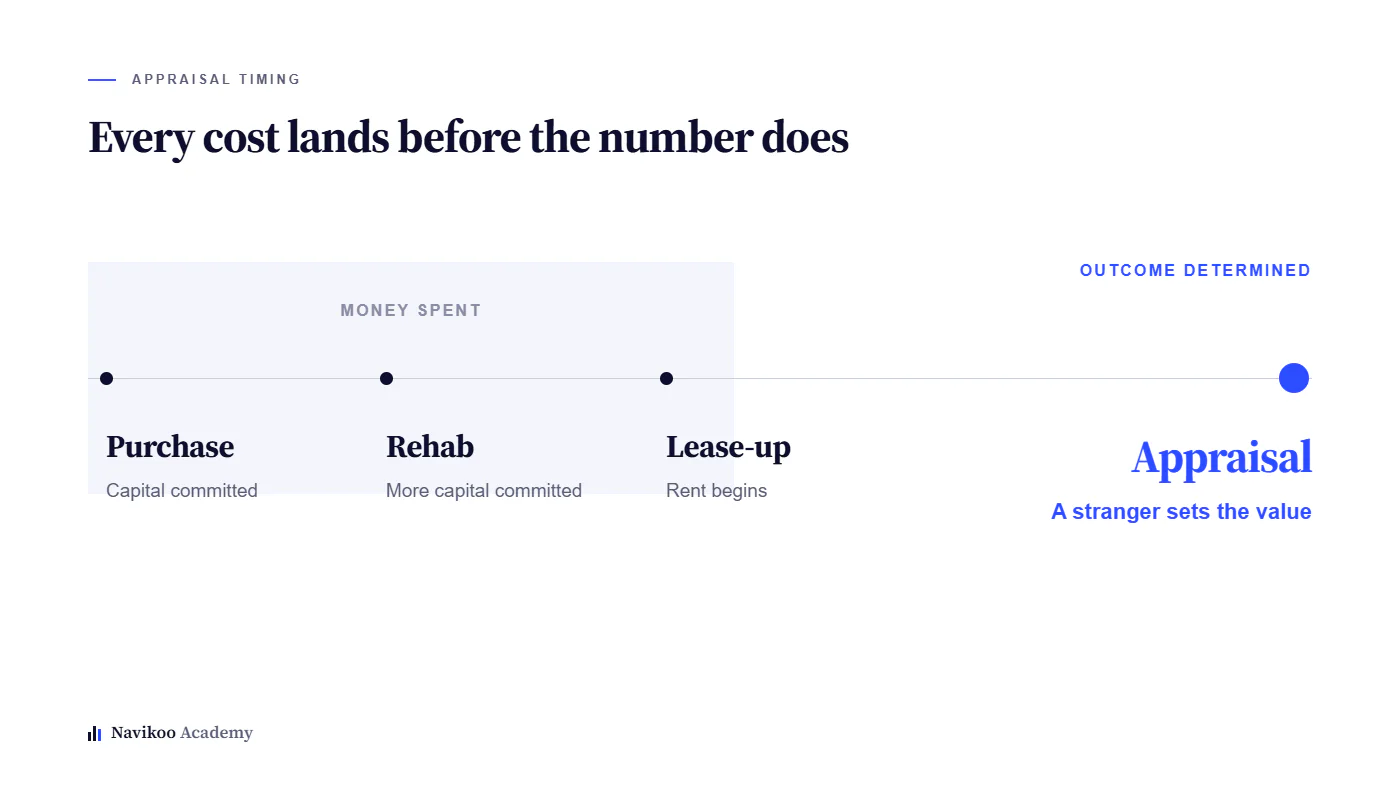
An appraiser does, months after the investor committed. Real estate appraisers work from comparable sales, so the estimate real estate investors build during due diligence is a prediction of what someone else will conclude later.
That prediction improves with better real estate data and honest comp selection, and it never becomes certain. Building an entire BRRRR investment on an optimistic figure means the most consequential input in the deal is the one furthest outside the investor's control.
How Much Money Do You Need to Start a BRRRR Deal?
Two different numbers answer this, and conflating them causes real problems.
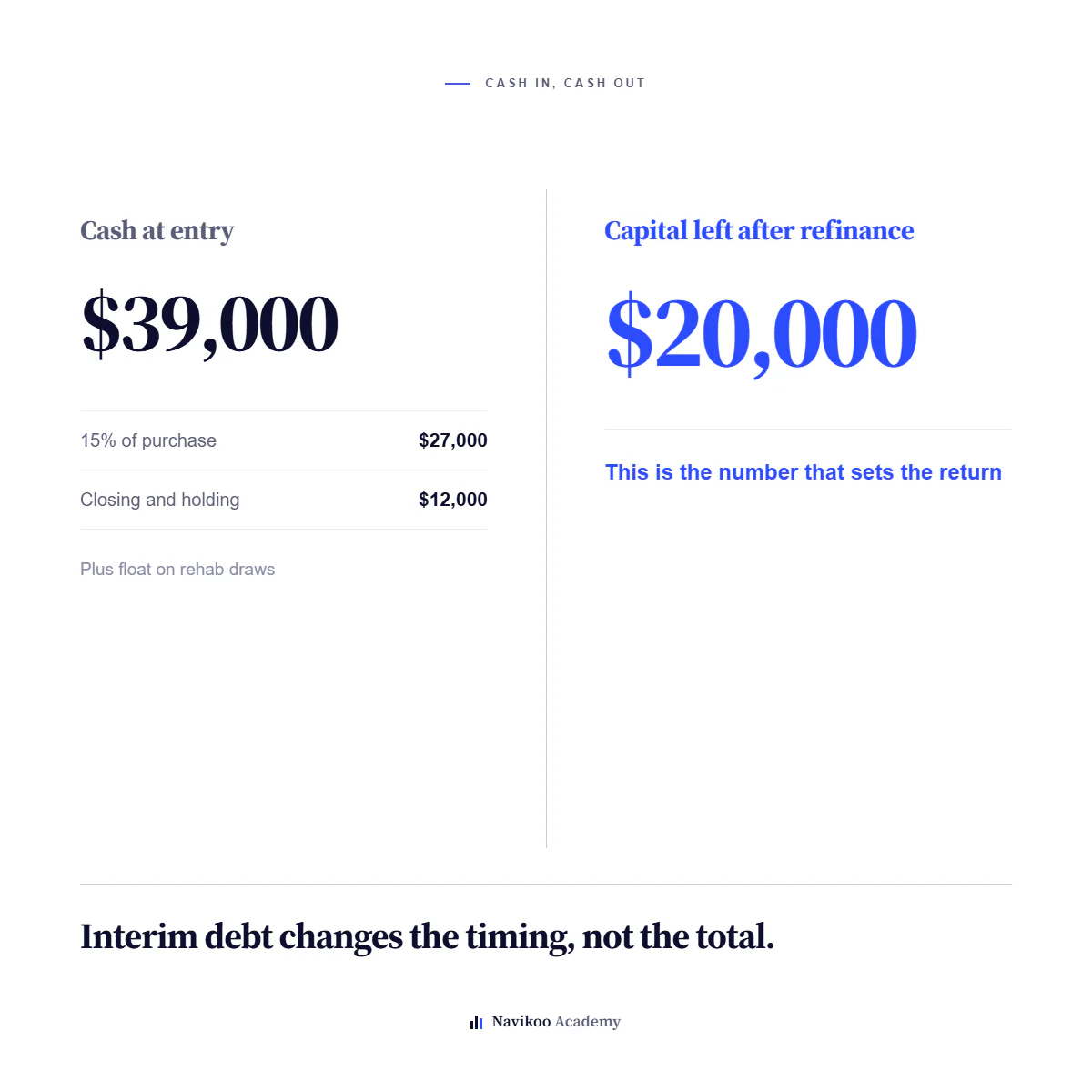
The first is money at entry. With interim funding solutions advancing a portion of the purchase and covering the work in draws, an investor might bring 15% of the purchase price plus closing and holding costs. On this deal that is roughly $27,000 plus $12,000, or $39,000, before accounting for the float between paying contractors and receiving draws.
The second is investment left in after the refinance, which was $20,000. That figure determines the return on investment.
Interim debt changes when money is required, not how much ends up in the property. An investor borrowing aggressively during construction still has the same $20,000 committed once the new loan closes. What debt buys is the ability to start the BRRRR method with a smaller initial investment, which matters enormously for anyone building a portfolio and not at all for the eventual performance.
How Do You Finance a BRRRR?
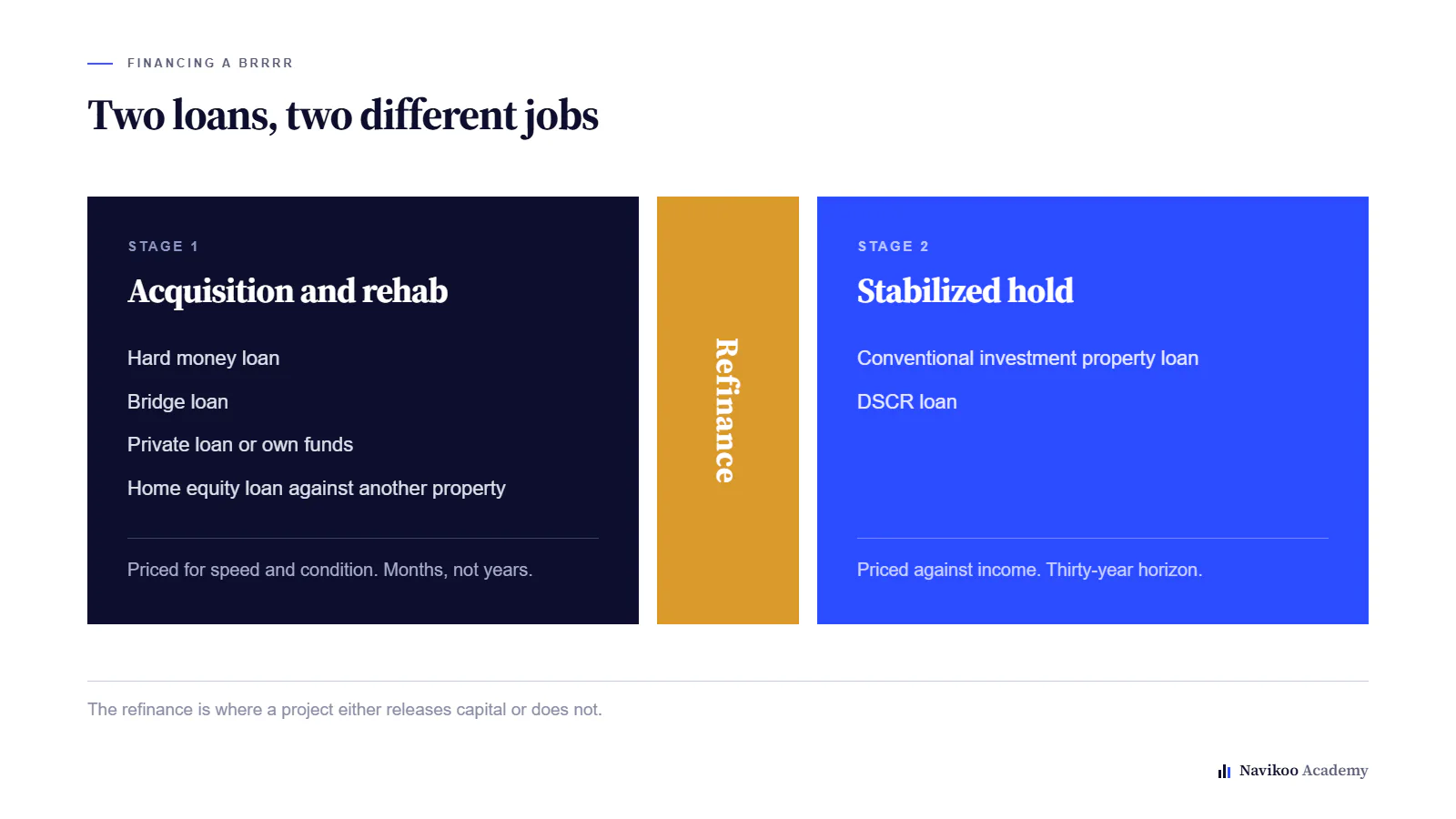
Financing arrives in two stages with different logic behind each.
Can You BRRRR With a Mortgage?
Conventional mortgage products generally require a property to be habitable at closing, which most distressed acquisitions are not. That is the practical obstacle rather than any prohibition.
Investors sometimes acquire with their own money or a private loan, complete the work, and then place conventional debt on the stabilized rental. Renovation mortgage products exist as well, and home equity loans against an existing property fund some acquisitions outright. Terms and eligibility vary considerably, so specifics belong on a term sheet rather than in any step guide.
Hard Money and Bridge Loans
Short-term lenders price for speed and condition rather than for income documentation. Hard money loans and a bridge loan carry higher rates and fees, and they are usually structured for repayment within months.
The cost is real but often misjudged. Six months of expensive interest matters far less than an appraisal that comes in $20,000 short, because the first is a known expense and the second is permanent trapped equity. Experienced mortgage brokers who place these regularly are worth consulting before the acquisition rather than after.
The Refinance Itself
Common exit options include conventional investment-property financing and DSCR loans underwritten against the rental's income rather than the borrower's. Investors whose tax filings show heavy depreciation, or who already own several rental properties, often find the second route more workable.
Does the BRRRR Method Really Work?
The BRRRR method works in the narrow sense that the mechanics function. Properties do get acquired below value, renovated, rented, and refinanced, and money does come back out. Buying at the right basis is what makes the rest of the BRRRR method possible.
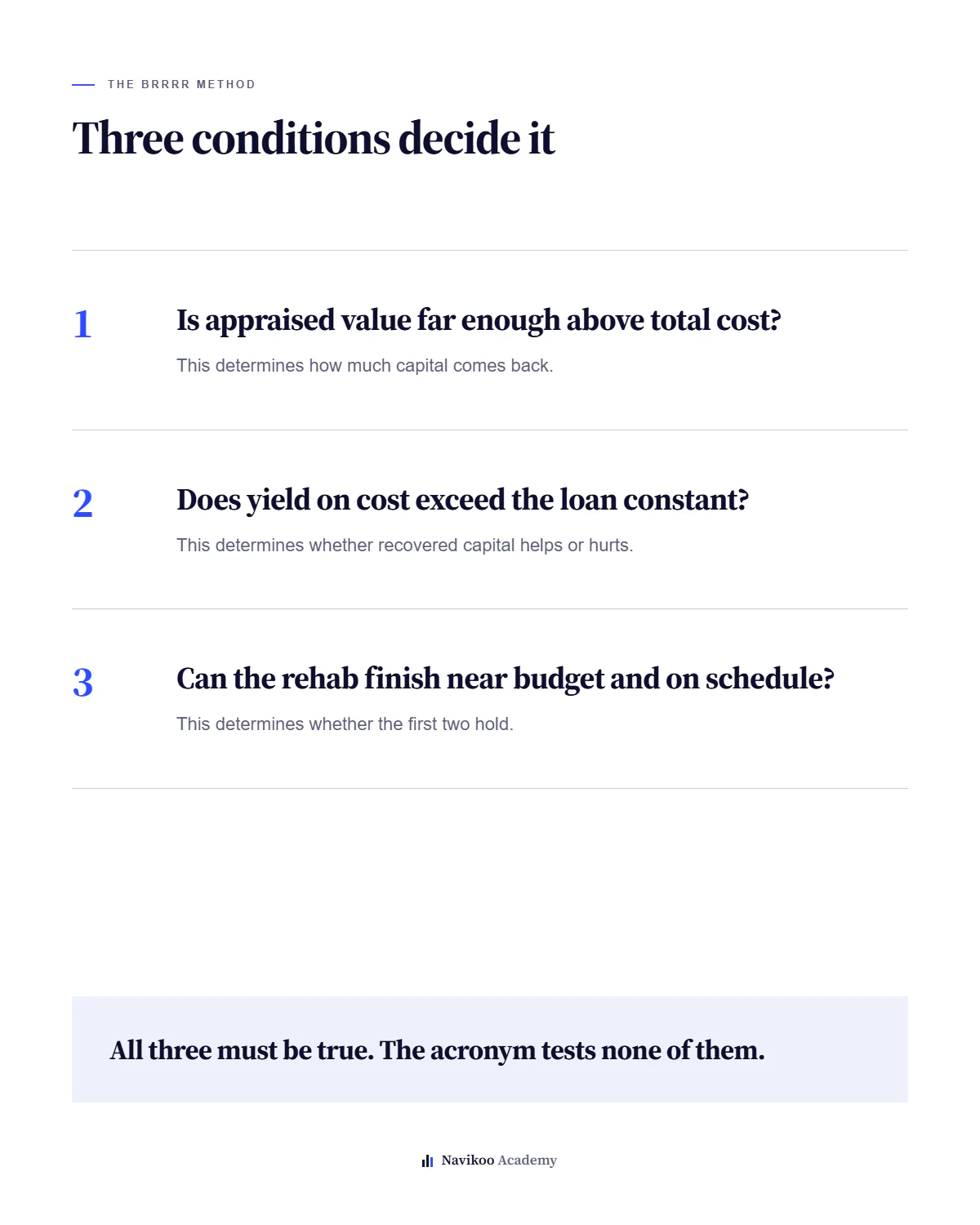
Whether the BRRRR method works as an investing strategy depends on conditions the acronym never mentions: the spread between acquisition price and appraised value, the spread between yield on cost and the loan constant, and the investor's ability to finish the work near budget. Two investors running the identical five-step sequence in different markets, or at different points in a rate cycle, produce entirely different outcomes.
The tips that circulate online usually assume the refinance recovers 100% of invested capital, producing what gets called an infinite return. That outcome is mathematically real and requires buying far enough below value that the appraisal exceeds total cost by a wide margin. It is uncommon, and pursuing it single-mindedly pushes investors toward maximum debt on properties that then fail to perform.
The Biggest Risks of the BRRRR Method
Four failure modes account for most of the damage in this strategy, and they compound rather than occurring independently.
A Low Appraisal
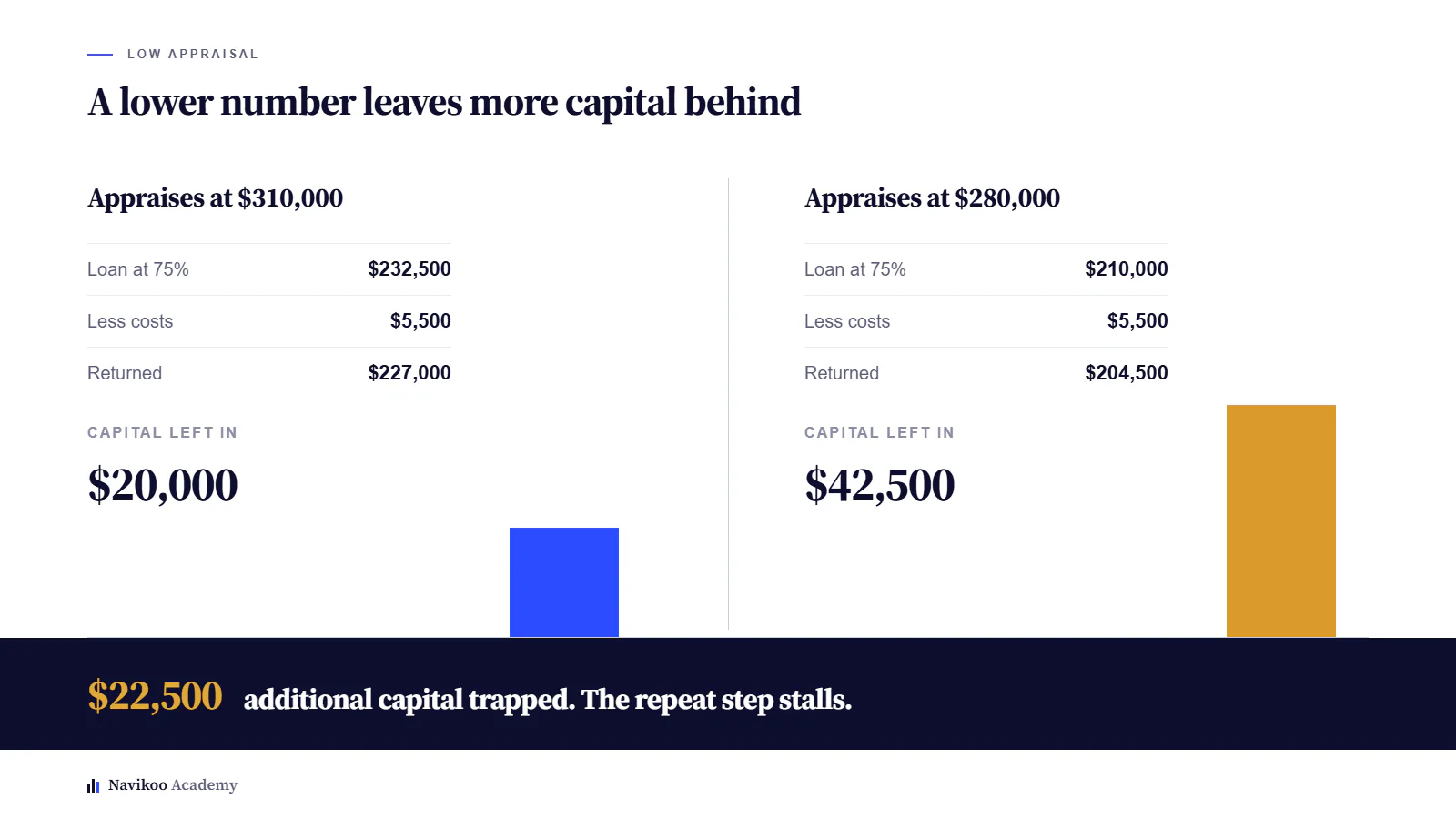
This is the concentrated financial risk of the entire BRRRR method. Suppose the appraisal valuation returns $280,000 instead of $310,000, roughly 10% low. A 75% loan now yields $210,000 and delivers $204,500 after costs. Capital left in the property rises from $20,000 to $42,500.
That $22,500 does not disappear. It sits in the property until a later sale or refinancing releases it, and meanwhile it is unavailable for the next acquisition. The repeat step stalls.
Rehab Overruns and Timeline Creep
Budgets and schedules fail together. Costs above plan raise total invested, which lowers yield on cost. Extended timelines add holding expenses and delay the first rent check, and on short-term debt that delay is costly.
Seasoning Rules
Many banks require a property to be held for a defined period before refinancing may be based on the new value rather than the purchase price. Requirements differ by lender and program. An investor assuming an immediate exit who encounters a waiting period carries expensive interim debt longer than modeled.
Rate Movement Between Purchase and Refinance
The rehab period creates unavoidable exposure. A deal underwritten at one rate and refinanced months later at a higher one can move from viable to unfundable, as the two tables above show.
BRRRR and House Flipping Are Not Alternatives
The two get compared as competing real estate strategies for the same distressed house, which misunderstands both.
A flip converts a property into money quickly and generates taxable proceeds. The BRRRR method keeps the property, builds equity through amortization and appreciation, produces passive income when it performs, and carries the tax advantages that come with holding rental property investments. One ends. The other accumulates real estate assets, and passive income compounds alongside them.
The practical filter is whether the finished property makes a good rental. Something in a strong resale market with weak tenant demand should be flipped. Something in one of the right markets for durable rent, with modest resale appeal, is a BRRRR candidate. Renovating for the wrong exit wastes money on finishes no tenant pays for, or skips systems no buyer forgives. Navikoo offers both Flip and BRRRR Calculators.
Is the BRRRR Method Right for Your Financial Goals?
BRRRR layers several risks that a stabilized rental purchase does not: renovation risk, lease-up risk, appraisal risk, and refinance risk. Investors stacking several BRRRRs simultaneously multiply all three across the portfolio.
For an investor whose goals center on building wealth over a decade or more, that wealth building strategy can be worth accepting, since forced appreciation is one of the few ways to create equity without waiting for the real estate market to move. For someone who needs reliable income now, or who would be badly damaged by a stalled deal, a stabilized property bought conventionally is the better opportunity.
The BRRRR method also performs worst when financing costs rise, which is frequently when distressed acquisitions look most attractive.

Pros and Cons
Pros. Capital recycles into successive deals instead of sitting in one property, which is the whole investment case for the method. The investor keeps an appreciating asset. Forced appreciation through renovations creates equity that market movement alone would take years to produce. Cash received through refinancing is generally borrowed money rather than proceeds from selling the asset, although investors should evaluate their specific tax situation with a qualified tax professional.
Cons. The exit depends on an appraiser and a lender, neither of whom the investor controls. Higher debt means thinner margins and less resilience to vacancy. Construction risk sits on top of tenant risk. And the method is most fragile precisely when borrowing costs are climbing.
What to Verify Before Committing Capital
Four things deserve confirmation before an offer, and none appear in the five letters of the BRRRR method.
Confirm the after-repair figure with comparable sales of finished properties in the same submarket, then underwrite the low end of that range rather than the midpoint. Calculate yield on cost against a realistic loan constant at a rate above today's, since the exit happens months from now. Ask prospective banks about seasoning requirements before acquiring rather than after. And model the deal assuming the exit delivers less than hoped, because the real question is whether the property is worth owning with $42,500 still in it, not only with $20,000.
Investors who want to see how purchase price, rehab budget, rent in specific rental areas, and refinance terms interact across a full cycle can run that investment analysis in Navikoo's analysis tools rather than testing one variable at a time.
The number to distrust first is the appraised value, because it is the only input in this real estate method that a stranger determines after the investment has already been made.