Property Management in Real Estate: What It Costs and How to Choose the Right Manager
Property management covers the day-to-day running of a rental, from leasing and rent collection to maintenance, compliance and state licensing. This guide explains what property managers actually do, how much they charge beyond the headline fee, when to self-manage or hire, and how to judge a manager by performance rather than price.
Property management is the day-to-day operation of real estate on behalf of its owner: finding and screening tenants, collecting payments, arranging repairs, enforcing the lease, and keeping the property compliant with state and local regulations. Property owners either do this themselves or pay a property management company to do it for them.
Most owners compare property managers on one number, the percentage of rent they charge. That number is usually the smallest part of what property management costs, and it says nothing about what a good manager saves.
A firm advertising 7% can easily cost more than one charging 9%, before either has filled a single vacancy.
What Is the Role of Property Management?
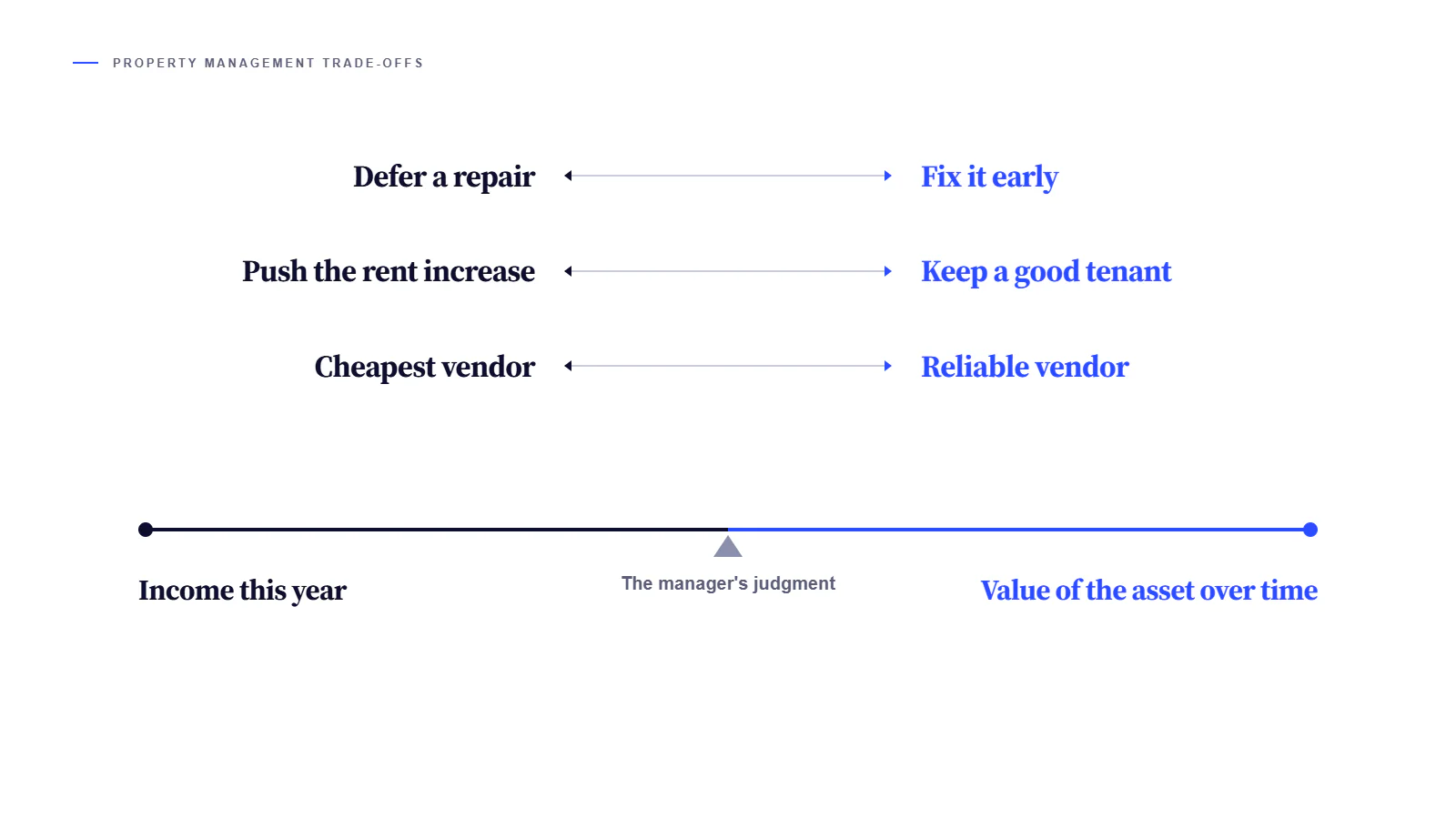
The role of property management is to convert a building into reliable rental income while protecting the asset over time.
Those two goals pull against each other constantly: deferring repairs raises this year's cash flow and lowers the property's value, while an aggressive increase can win a month of revenue and lose a good tenant.
Property managers are paid to make those trade-offs on the owner's behalf. That is why the quality of judgment matters more than the list of responsibilities or services, and why two firms offering identical property management services on paper can produce very different results from the same building. For property owners new to real estate investing, this is the least intuitive part of the decision.
What Does a Property Manager Actually Do?
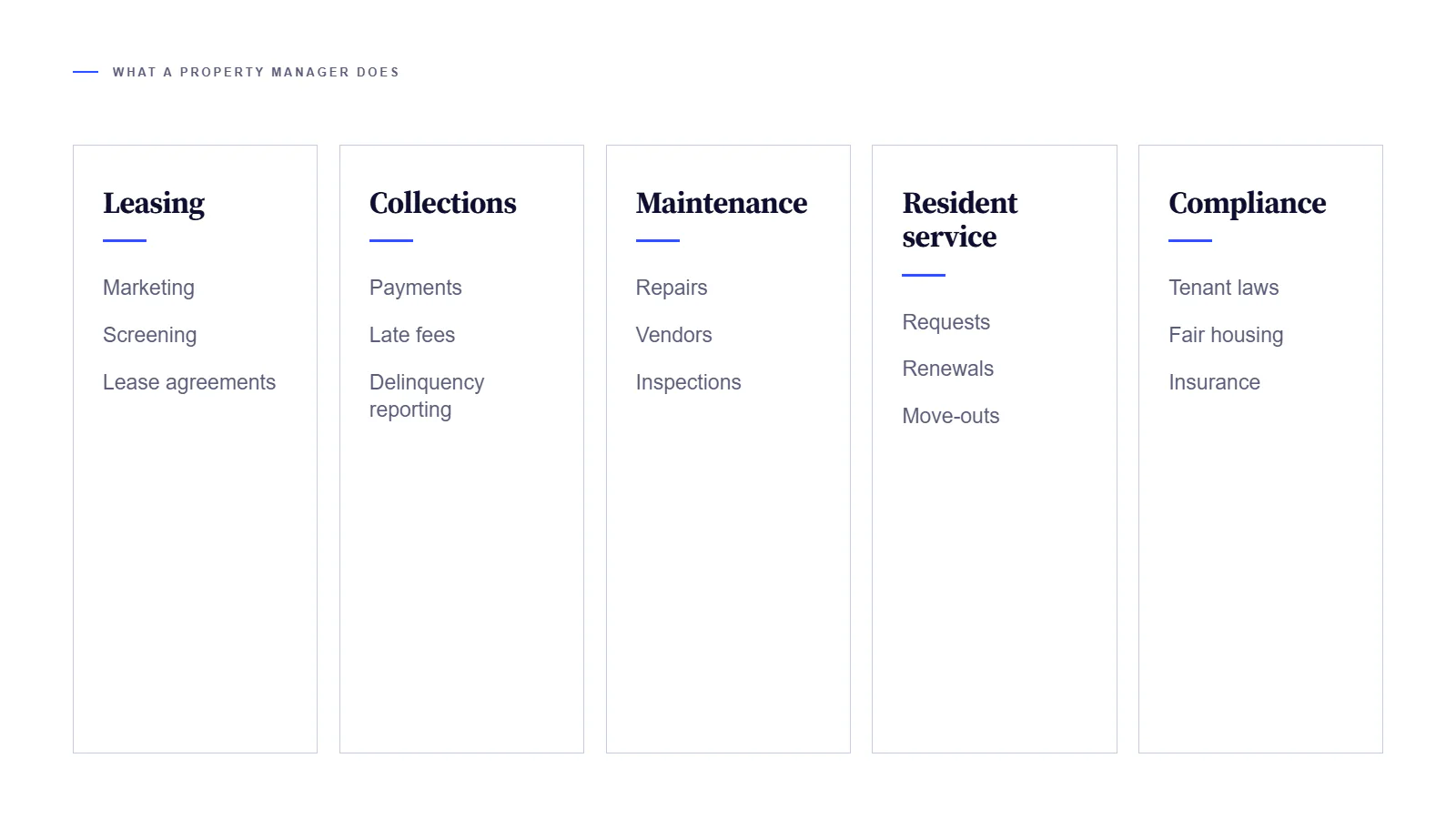
The responsibilities of property managers fall into five groups. Most property management firms cover all five duties; the differences lie in how well, how fast, and at what additional cost.
Area | Core duties |
|---|---|
Leasing | Marketing properties, showing units, screening applicants, drafting each lease agreement |
Collections | Collecting payments, enforcing late fees, reporting delinquencies |
Maintenance | Routine repairs, vendor coordination, scheduled walk-throughs, emergency response |
Resident service | Handling requests and complaints, renewals, move-outs, and removal when necessary |
Compliance | Tenant laws, fair housing, habitability standards, insurance coordination |
Leasing and Tenant Placement
Leasing is where a manager earns or loses the most money. A unit filled in two weeks with reliable tenants is worth far more than one filled in six with marginal ones, and prospective tenants judge a building partly by how quickly its manager responds. Good property leasing combines pricing discipline, fast turnaround, and consistent screening, sometimes supported by third-party tools such as PetScreening for animal policies. Larger firms may assign a dedicated leasing manager to this work.
Rent Collection
Rent collection now runs almost entirely through online platforms, so the difference between property managers lies in enforcement rather than mechanics.
How quickly late notices go out, how consistently fees are applied, and when the manager escalates determine how much of the rental income actually arrives.
Maintenance and Inspections
Maintenance is where property owners most often lose visibility.
A manager decides which repairs happen, which vendor does them, and whether a small leak gets fixed now or becomes a ceiling replacement later. Routine property inspections catch problems early; a manager who only responds to tenant calls is working reactively, and reactive maintenance of properties is consistently the more expensive kind.
Pro tip: Make sure the property manager’s repair-approval threshold is set at a reasonable level. If it is too high, you can lose control over spending; if it is too low, you may be contacted for every minor repair, even something as simple as replacing a filter. As a general rule, around $350 per unit is often a practical middle ground.
Tenant Relations and Evictions
This covers everything from a broken dishwasher to a renewal negotiation. Handled well, it produces longer tenancies, which is the single largest lever on vacancy cost. Handled badly, it produces turnover. Evictions sit at the far end of this work and require strict adherence to state procedure, since a procedural error can restart the process entirely.
Compliance and Insurance
Rental housing sits under layers of regulations, and compliance is among the responsibilities owners most underestimate: fair housing law, security deposit rules, habitability standards, local licensing and inspection regimes. Tenant laws vary substantially by state and city. A manager also coordinates property insurance claims and vendor insurance certificates, so that a contractor injured on site does not become the owner's liability.
Residential and Commercial Property Management
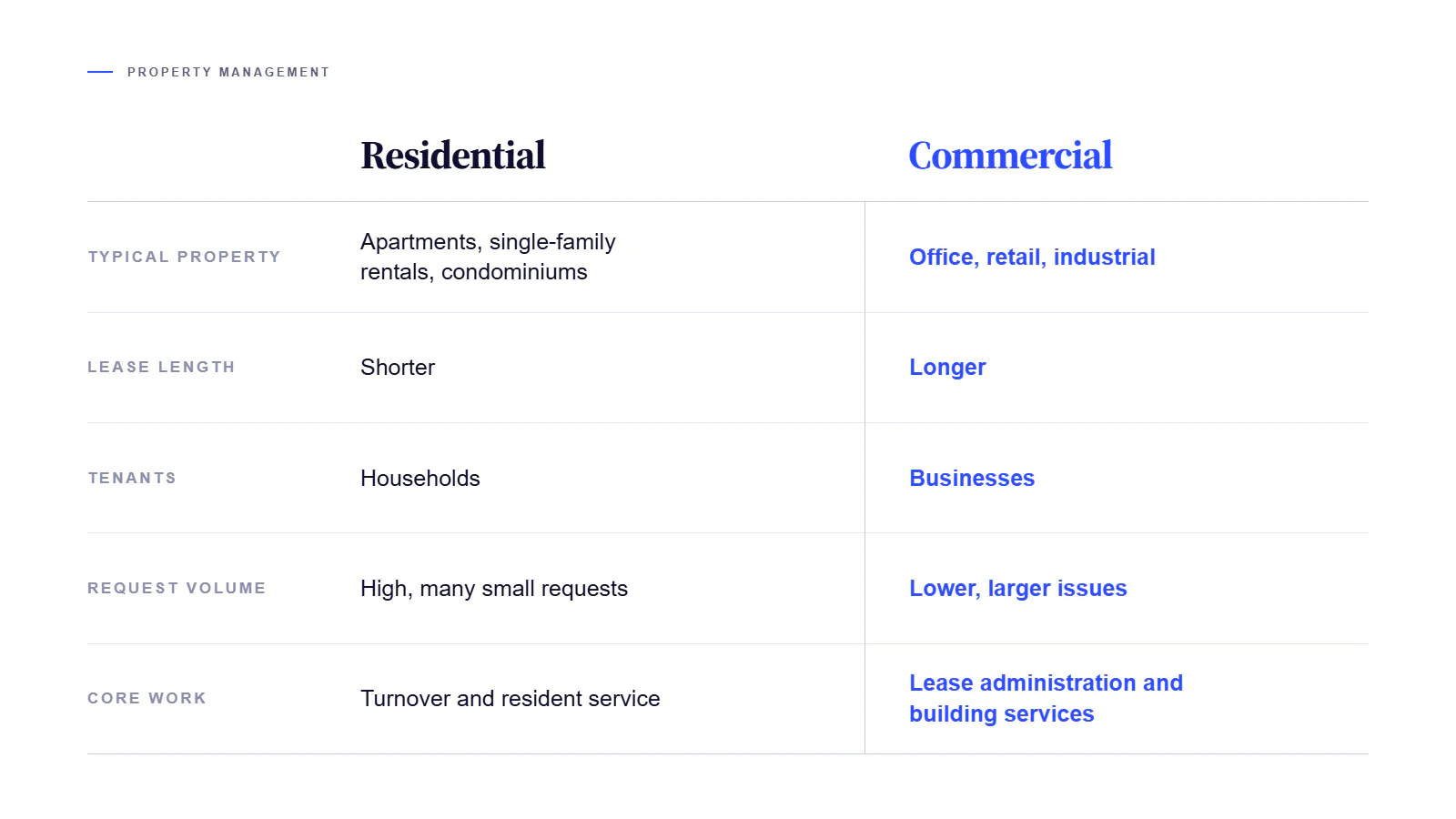
Residential property managers handle apartments, single-family rental homes, and sometimes condominium associations, where the work centres on turnover and a high volume of small requests. This side of property management tends to be operationally intense and relatively standardized, which is why residential property managers often carry large portfolios of doors.
The commercial side of property management covers office, retail, and industrial space. Leases run longer, tenants are businesses, and the work shifts toward lease administration, expense reconciliation, and building services such as common-area systems. Commercial properties also often involve property developers or institutional owners, and the fee structures differ accordingly.
How Much Do Property Managers Charge?
The headline figure for property management is usually a percentage of collected rent, though some firms charge flat monthly fees instead. LeaseRunner's overview, "How Much Do Property Managers Charge? Percentage vs Flat-Rate", compares the two structures in detail and is a useful starting point for local ranges.
The Fee Lines Beyond the Percentage
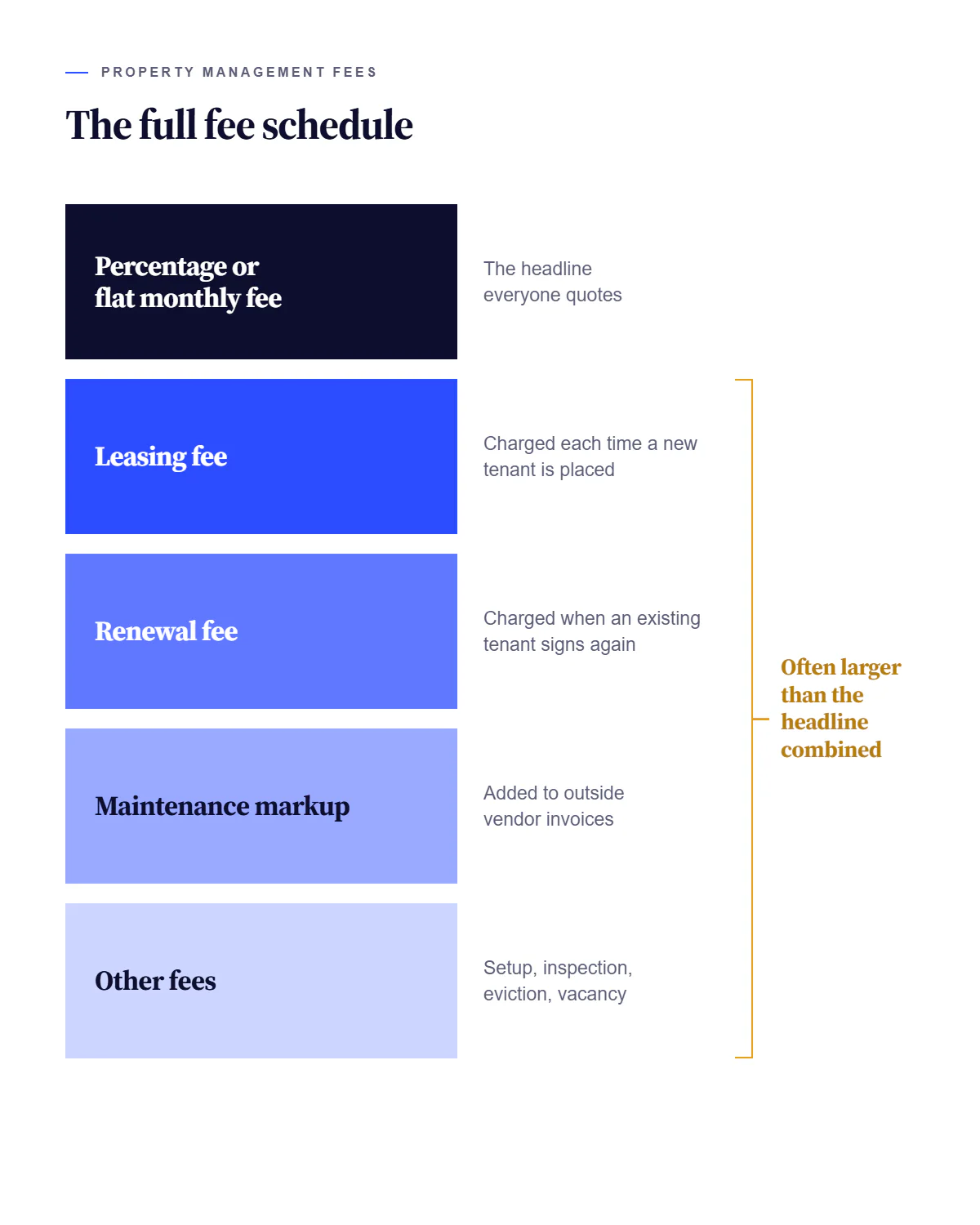
The management fee is rarely the only charge. A typical contract may also include:
A leasing fee each time a new tenant is placed, often expressed as a fraction of one month's rent
A renewal fee when an existing tenant signs again
A markup on maintenance invoices from outside vendors
Setup, inspection, eviction, or vacancy fees
Each of these is negotiable, and together they frequently exceed the percentage itself. Property owners collecting free quotes from several firms should ask for the full fee schedule rather than the headline rate.
Comparing Two Managers on the Same Building
The figures below are illustrative teaching assumptions rather than market data. An eight-unit rental building at $1,400 per unit has $134,400 of gross potential income. Outside repair work runs $12,000 a year.
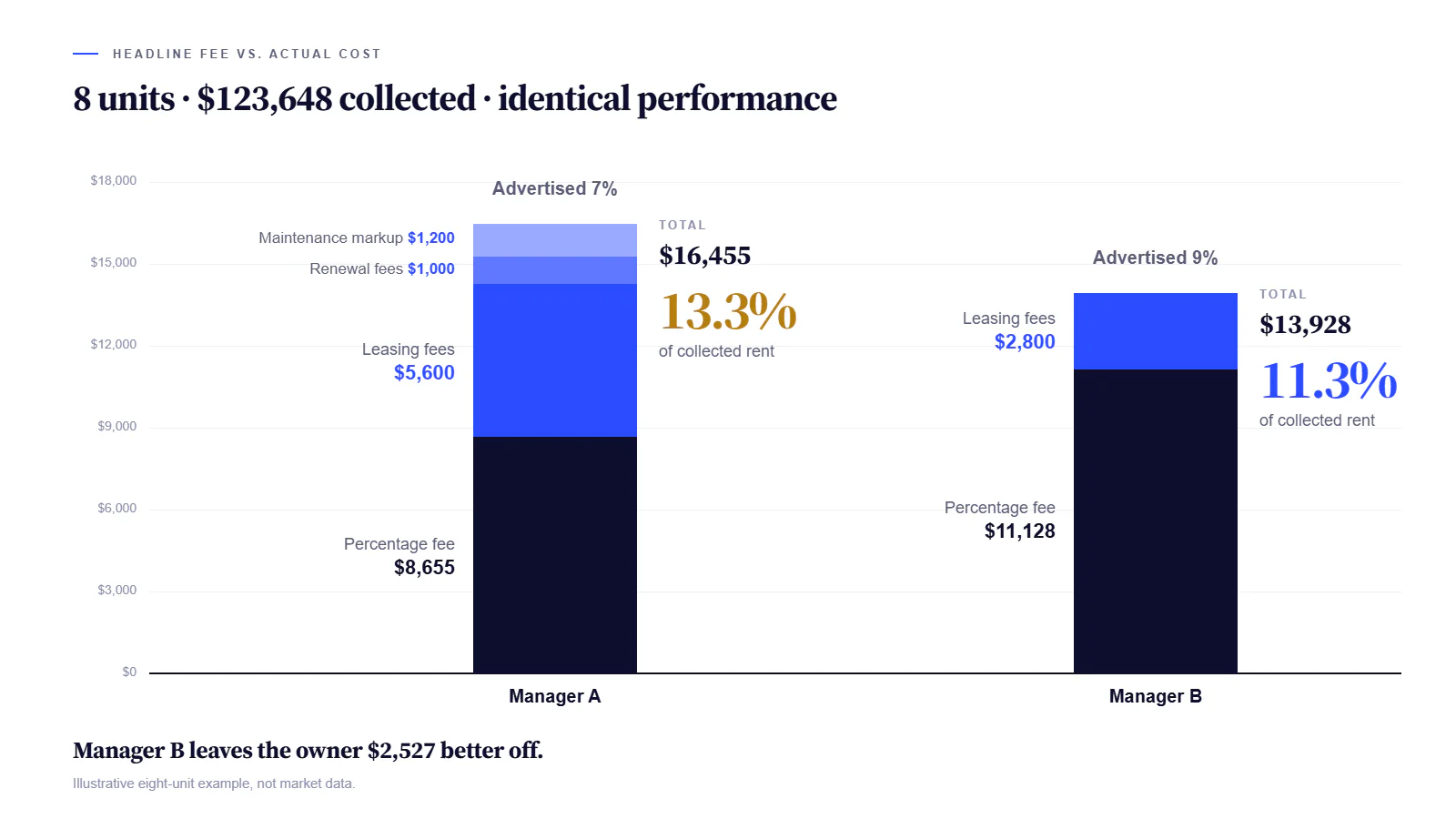
Manager A charges 7% of collected rent, a leasing fee equal to a full month's rent, $250 per renewal, and a 10% markup on maintenance. Manager B charges 9% of collected rent, a leasing fee of half a month's rent, and nothing else.
At Identical Performance
Assume both run the building at 8% vacancy with four turnovers a year.
Manager A | Manager B | |
|---|---|---|
Rent collected | $123,648 | $123,648 |
Percentage fee | $8,655 | $11,128 |
Leasing fees | $5,600 | $2,800 |
Renewal fees | $1,000 | $0 |
Maintenance markup | $1,200 | $0 |
Total cost | $16,455 | $13,928 |
Share of collected rent | 13.3% | 11.3% |
The 7% manager costs 13.3% of what the building collects. The 9% manager costs 11.3%, and leaves the owner $2,527 better off with nothing about the building's performance changing.
When Performance Differs
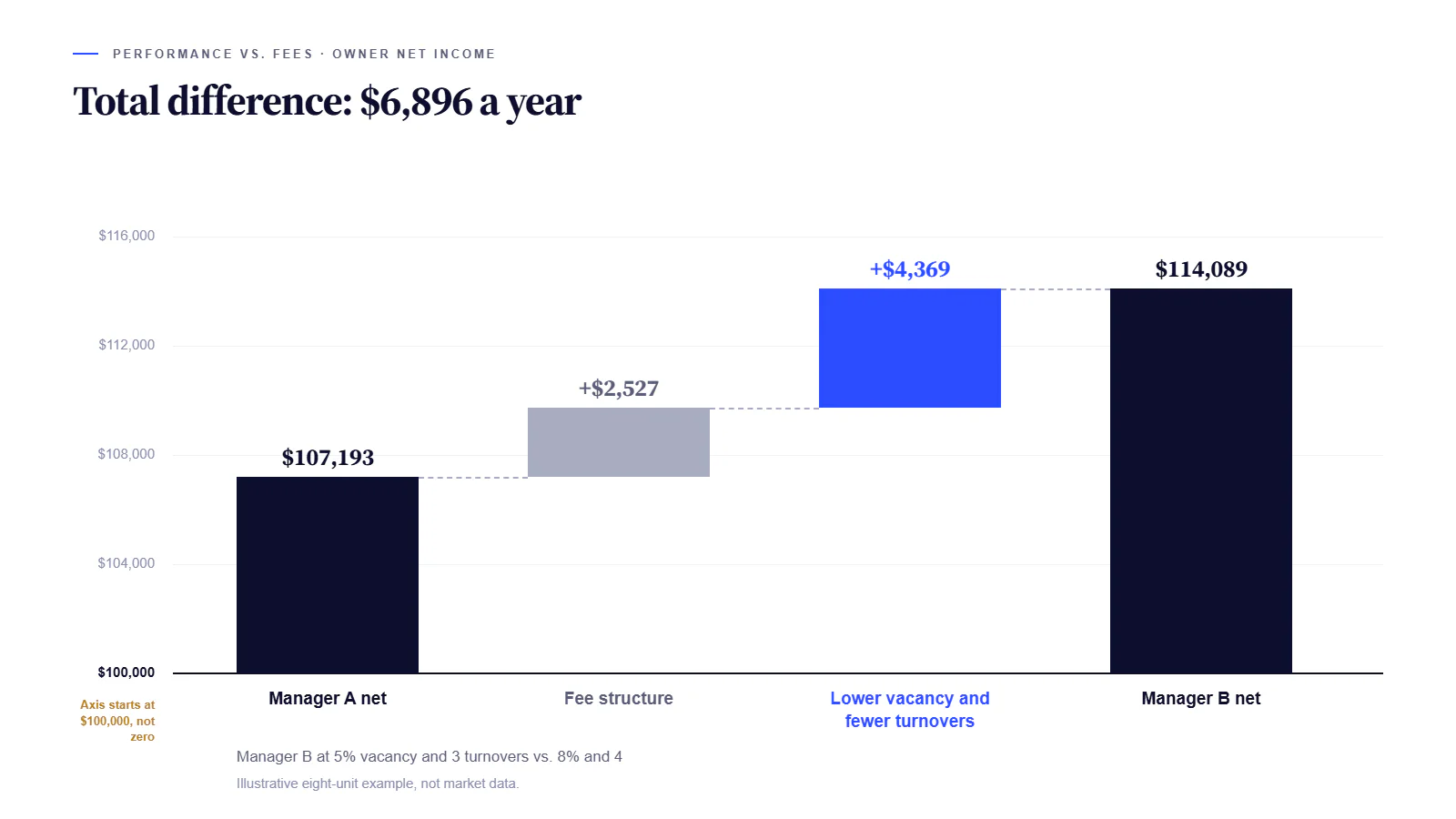
Now suppose Manager B's faster leasing and better tenant retention bring vacancy down to 5% and turnovers down to three a year.
Collected rent rises to $127,680. B's total cost falls to $13,591, or 10.6% of collections, and the owner nets $114,089 against $107,193 under Manager A. The difference is $6,896 a year on an eight-unit building.
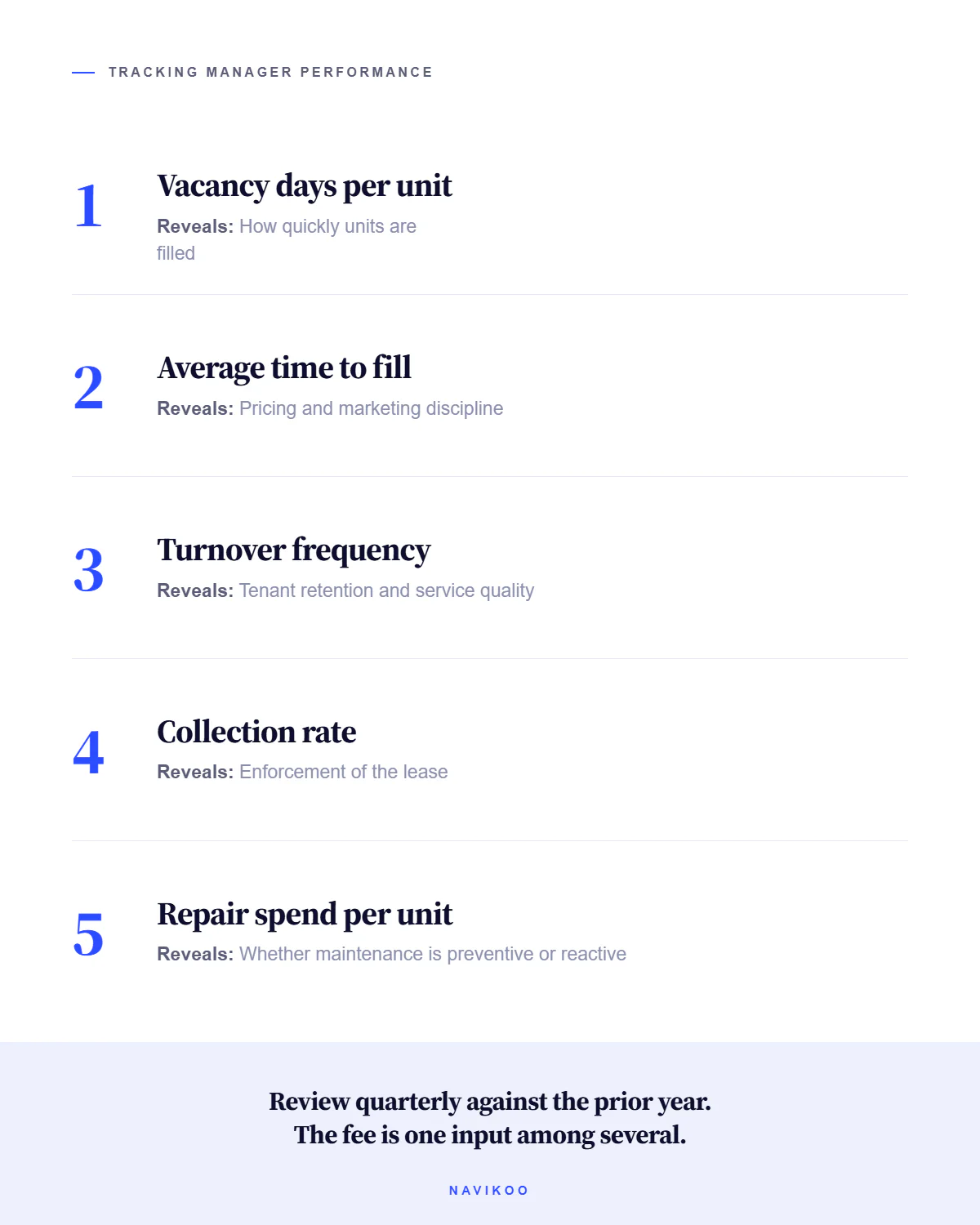
This is the comparison that matters in property management. A manager's value shows up in vacancy days, turnover frequency, and collections, and none of those appear on a fee schedule. Owners who choose on the headline percentage are optimizing the smallest line in the calculation.
Property Management License Requirements
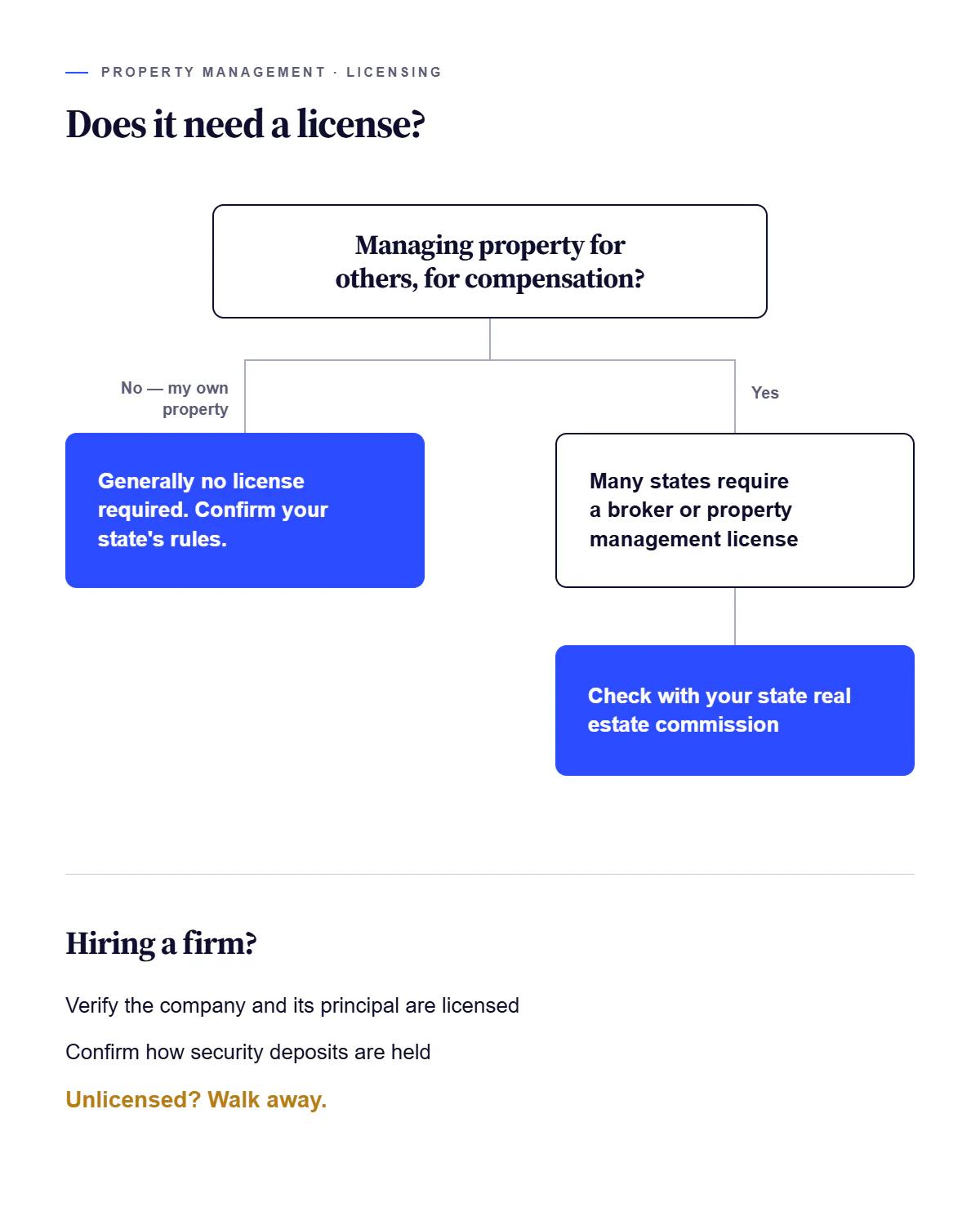
Many states require a real estate broker license or a dedicated property management license to manage property for others in exchange for compensation. Owners managing their own buildings generally do not need a license. Requirements, exemptions, and the licensing body differ by state, so the relevant state real estate commission is the authoritative source on which license applies.
For an owner hiring a firm, confirming that the company and its principal hold the property management license their state requires is a basic check that is surprisingly often skipped. Licensing also affects how client funds such as security deposits must be held, which matters if the firm ever fails. An unlicensed operator is a reason to walk away regardless of the fee.
When to Self-Manage and When to Hire
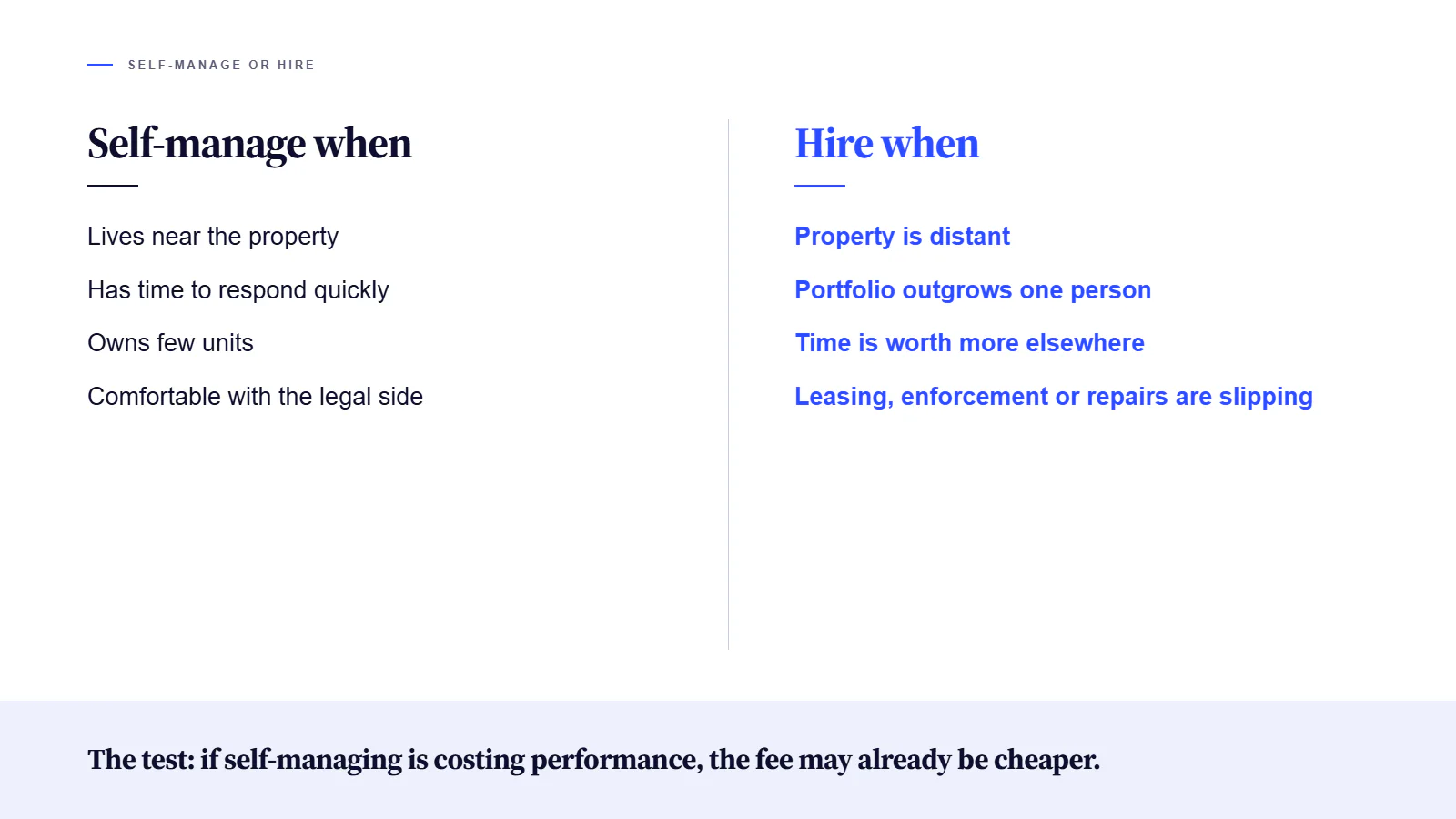
Self-managing property makes sense when the owner lives nearby, has time, owns few units, and is comfortable with the legal side. It keeps the fee, keeps control, and teaches the business. It also concentrates every late-night call on one person and requires knowing which plumber or electrician to trust.
Hiring property management makes sense when the property is distant, the portfolio has grown past what one person can respond to quickly, or the owner's time is more valuable elsewhere. A useful test: if self-managing means slower leasing, looser enforcement, or deferred repairs, the fee may already be cheaper than the performance being lost. Owners weighing that choice across several properties can track results by building or subscribing to a free portfolio tracker.
How to Evaluate a Property Management Company
Reading the Contract
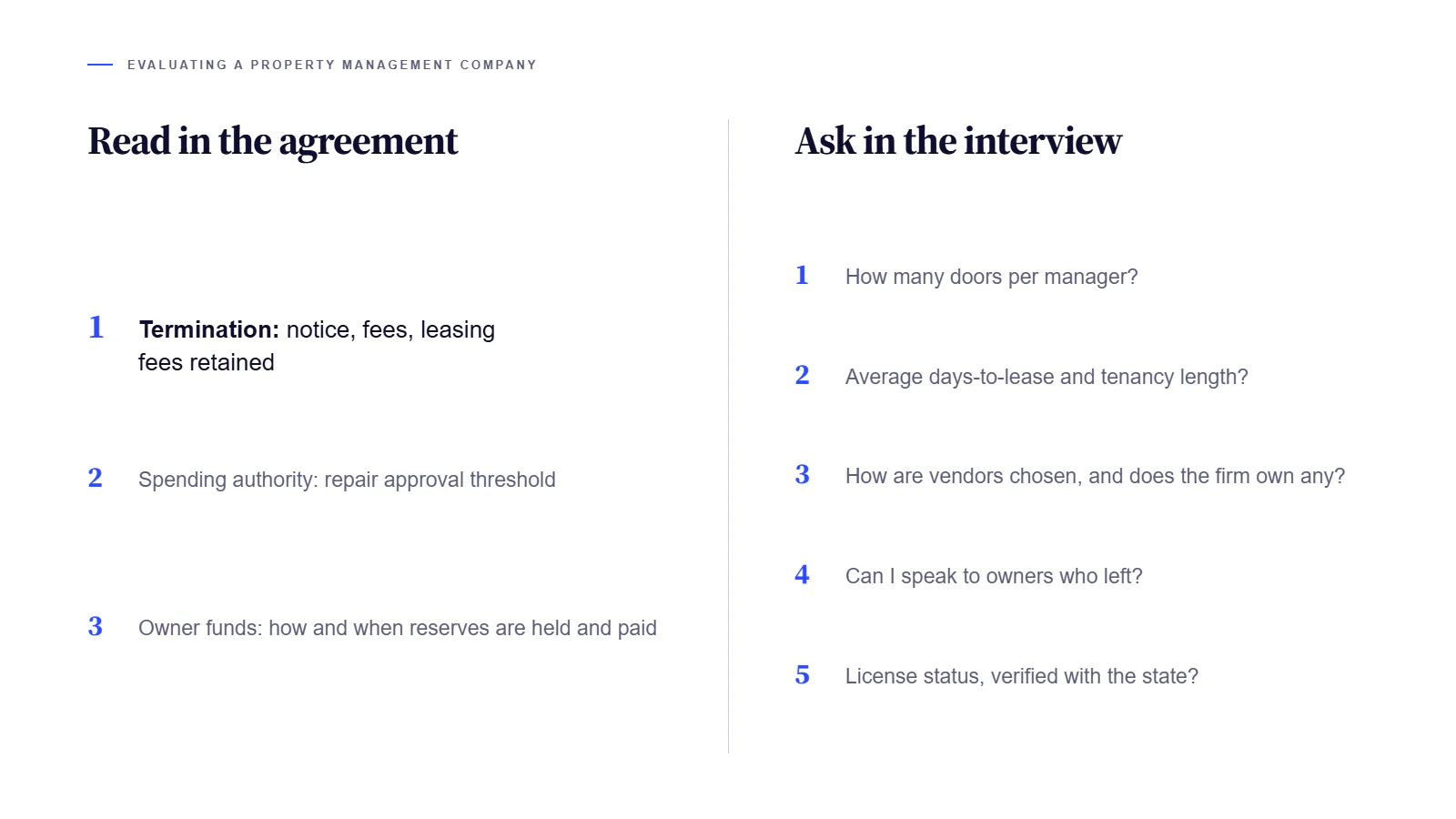
The management agreement defines what the owner is actually buying. Read the termination clause first: how much notice, whether a fee applies, and whether the firm keeps leasing fees on tenants it placed. Then check spending authority, meaning the repair amount above which the manager must obtain approval, and how and when owner funds and reserves are held and distributed.
Questions Worth Asking
Ask how many doors each manager handles, since overloaded property managers respond slowly and a property management team stretched thin shows it first in maintenance delays. Ask for average days-to-lease and average tenancy length on comparable residential property, not a marketing summary, and ask how the firm divides responsibilities between leasing and ongoing management.
Ask how maintenance vendors are chosen and whether the firm owns any of them. And ask for references from owners who left, not only those who stayed, and confirm the firm's license status directly with the state rather than from its website.
Experienced agents and other real estate professionals in the area often know which firms have the strongest reputations and which do not.
Property Management Software
Most firms run on platforms such as AppFolio or Buildium, which handle payments, repair requests, accounting, and owner reporting. Self-managing owners use the same category of tools at a smaller scale, and most vendors provide a support specialist during setup. The platform matters less than whether property managers actually use it to give owners timely, readable reports; a firm with good tools and slow reporting is still a firm with slow reporting.
Owners managing relationships with several managers, vendors, and tenants can keep those contacts organized through CRM, separate from whatever system the manager runs.
What to Track After You Hire
The fee schedule is fixed at signing. Property management performance is not, and it is the part to watch.
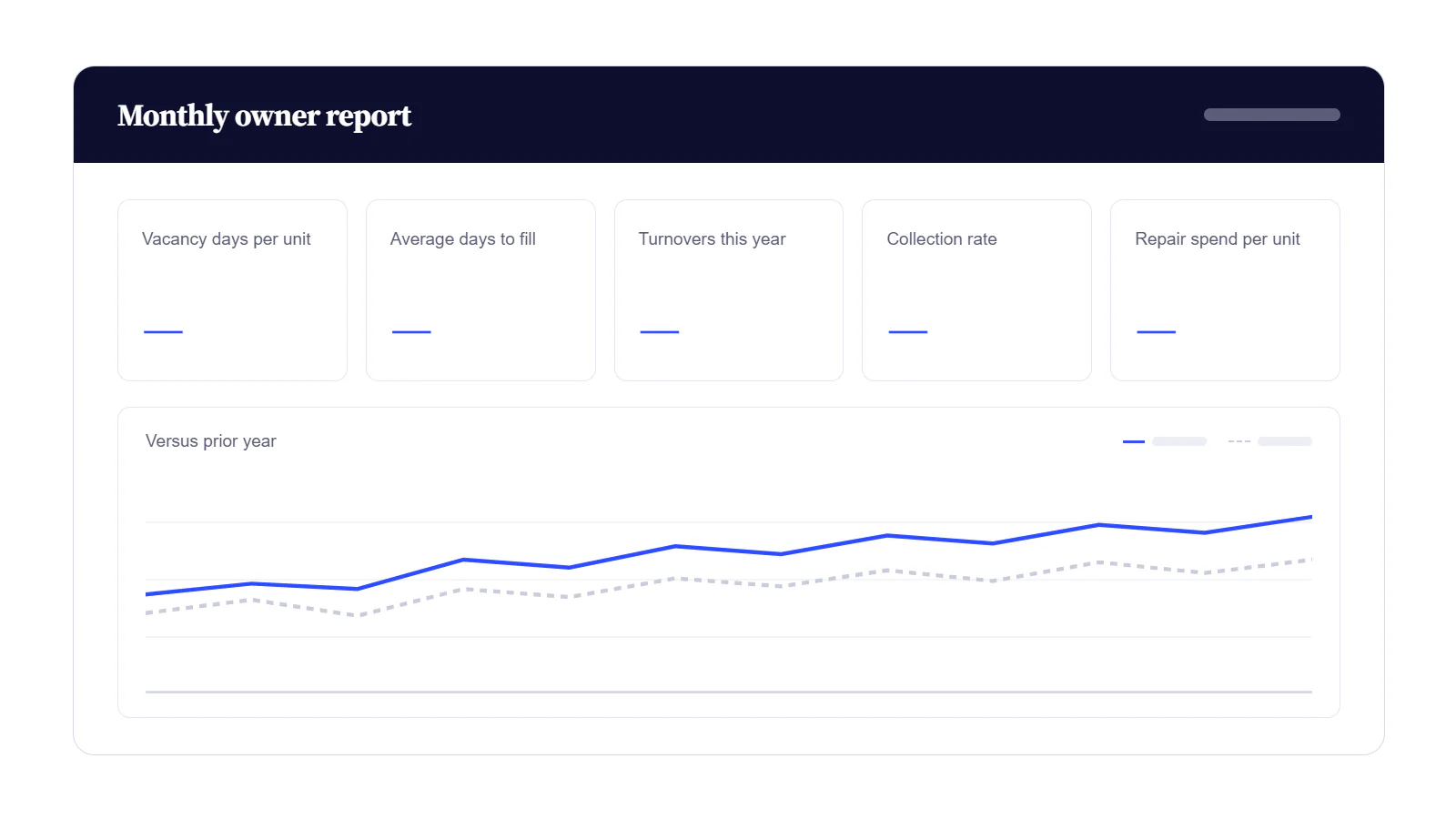
Track vacancy days per unit, average time to fill, turnover frequency, collection rate, and repair spend per unit against the prior year. Property managers holding those steady or improving them are earning the fee, whatever it is. A manager whose numbers drift while reports stay upbeat is costing more than any percentage on the agreement shows. This guide's comparison came down to $6,896 a year on eight units: $2,527 from the fee structure itself and $4,369, more than 60% of the gap, from performance.
Across the real estate industry, the property management decision is usually framed as a question of cost. It is better framed as a question of results, measured quarterly, with the fee treated as one input among several. Property owners who review those numbers every quarter rarely end up overpaying for property management services that are not performing.