Seller Financing in Real Estate: What You Are Actually Negotiating
Seller financing gives buyers and sellers more flexibility over price, interest rate, down payment, amortization, and loan term than a standard mortgage. Learn how to compare different structures, understand balloon-payment risk, account for existing liens, and evaluate the full cost of a seller-financed deal before signing.

Seller financing is an arrangement in which the property seller also provides some or all of the financing used by the buyer to complete the purchase. Instead of receiving the entire purchase price from a traditional mortgage lender at closing, the seller accepts a down payment and a promise to repay the remaining balance over time.
The structure can offer considerably more flexibility than a standardized mortgage. Price, interest rate, down payment, amortization, maturity, prepayment rights, and other terms may all become part of the negotiation.
That flexibility still operates within applicable federal and state law. Consumer mortgage rules, state lending requirements, foreclosure procedures, existing liens, and the specific property involved can all affect how a seller-financed transaction may be structured.
For investors, the most useful way to analyze seller financing is to stop looking at the interest rate in isolation. A lower rate can be paired with a higher purchase price, a larger down payment, or a less favorable balloon. The entire package determines what the financing actually costs.
What is Seller Financing Agreement in Real Estate?
In a common seller-financing structure, the seller transfers the property to the buyer and finances part of the purchase price.
The buyer typically makes a down payment and signs a promissory note establishing the debt. The seller receives a mortgage, deed of trust, or other security instrument permitted under state law to secure repayment.
Payments may be made directly to the seller or through a third-party loan servicer.
Seller financing does not eliminate legal or underwriting considerations. Depending on the transaction, federal consumer-credit rules and state lending laws may still apply. The Consumer Financial Protection Bureau's Regulation Z includes specific provisions for certain seller-financed dwelling transactions and seller-financer exclusions.
How Seller Financing Works
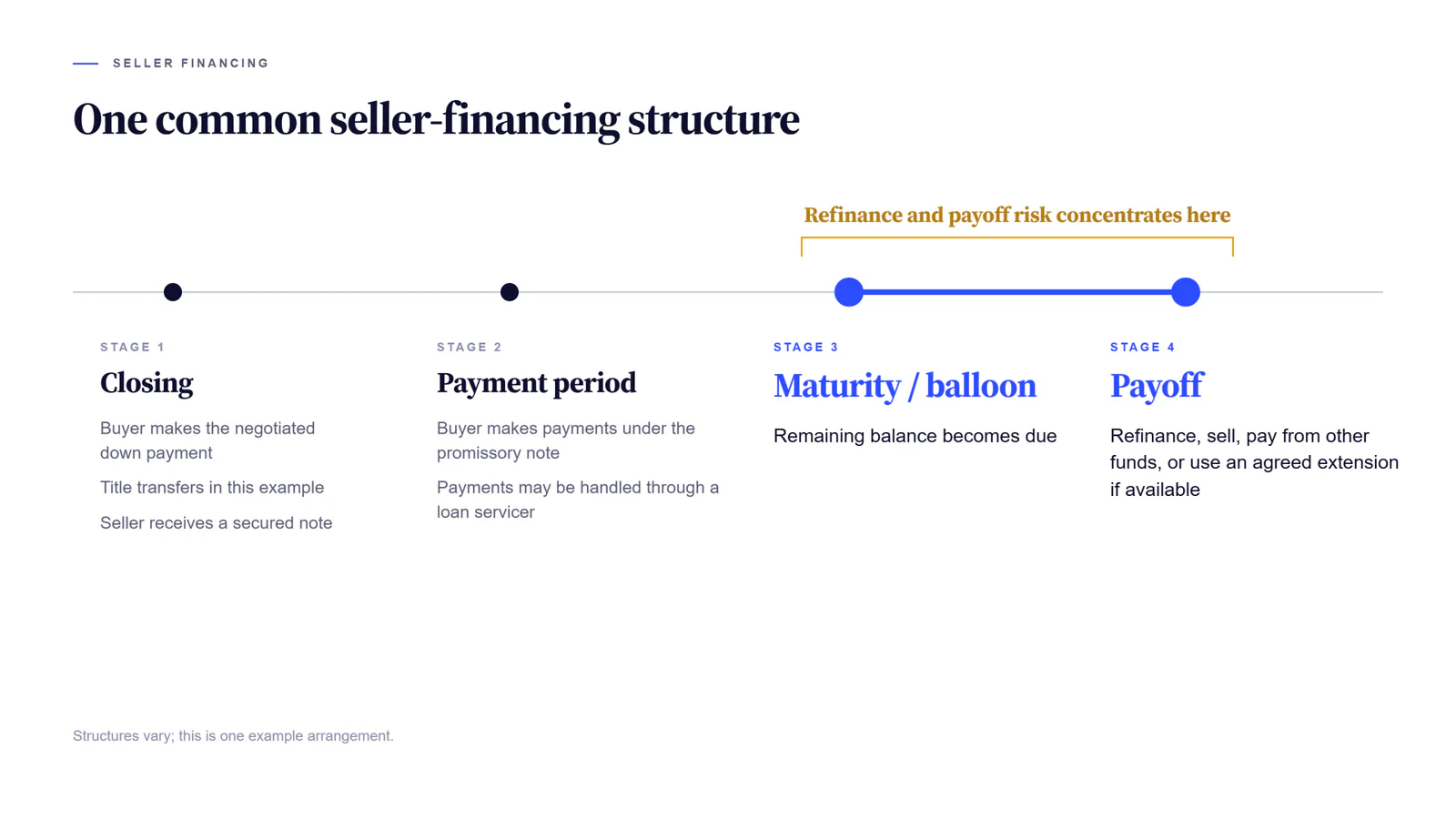
Consider a common structure where title transfers at closing.
The buyer makes the negotiated down payment.
The seller finances the remaining balance.
The buyer signs a promissory note specifying items such as:
principal balance
interest rate
monthly payment
amortization schedule
maturity date
late-payment provisions
default provisions
prepayment rights
The seller receives a recorded security interest in the property, such as a mortgage or deed of trust depending on the jurisdiction.
Many seller-financed notes use an amortization period longer than the actual loan term.
For example, payments might be calculated over thirty years while the note matures after five years.
At the five-year maturity date, the remaining balance becomes due unless the agreement provides another arrangement. The buyer may need to refinance, sell, pay the balance from other funds, or use an extension mechanism that was negotiated in advance.
The maturity date therefore deserves as much attention as the monthly payment.
Investors can model the payment and remaining loan balance using a free real estate loan calculator before agreeing to a balloon structure.
Owner Financing and Other Names
Seller financing and owner financing are commonly used to describe the same general concept.
Other terms include:
seller carryback
seller-held note
purchase-money financing
A land contract or contract for deed is related but structurally different. Depending on state law and the agreement, legal title may remain with the seller until specified conditions are satisfied.
Those differences affect the parties' rights after default, which is one reason the specific legal structure matters more than the label used in a listing.
Seller Financing Documents: Promissory Note, Mortgage and Deed of Trust
The documents determine what each party is obligated to do and what remedies are available if something goes wrong.
The Promissory Note
The promissory note documents the debt.
It generally identifies:
amount financed
interest rate
payment schedule
amortization
maturity or balloon date
late-payment provisions
default provisions
prepayment terms
The note should reflect the actual economics agreed by the parties rather than relying on side conversations or informal promises.
Investopedia provides a general overview of promissory notes, but real-estate notes should be drafted for the specific transaction and jurisdiction.
The Deed of Trust or Mortgage
In a common structure where title transfers to the buyer, the promissory note creates the repayment obligation while a mortgage, deed of trust, or similar recorded instrument secures that obligation with the property.
The exact form varies by state.
That security instrument can give the seller foreclosure or other enforcement remedies if the buyer defaults, subject to the agreement and applicable state law.
Other seller-financing structures use different documentation, so investors should not assume every owner-financed transaction is legally identical.
Who Should Draft Them
Seller-financed transactions are a strong case for using a real estate attorney licensed in the state where the property is located.
Consumer mortgage regulations can also matter.
For example, CFPB's current Regulation Z contains specific requirements and exclusions for certain seller financers based on the number and type of transactions and the financing structure. The applicable rules can differ materially between an investment-property transaction and consumer credit secured by a dwelling.
A qualified attorney, title professional, and—where appropriate—licensed mortgage professional can help determine which rules apply and make sure the documents reflect the intended transaction.
Why Would a Seller Offer Seller Financing?
Understanding the seller's objective is useful because seller financing works best when the structure solves a problem for both sides.
The Installment Sale Angle
Receiving sale proceeds over time may allow some sellers to qualify for installment-sale tax treatment rather than recognizing all eligible gain in the year of sale.
The treatment is not automatic, and interest, depreciation recapture, property type, and the seller's individual tax situation can affect the result.
A seller considering this benefit should have a tax professional model it before agreeing to the structure.
The seller may also value the interest income generated by the note.
Instead of receiving all sale proceeds immediately, the seller accepts credit risk in exchange for periodic payments and a return on the financed balance.
The Price-for-Terms Trade
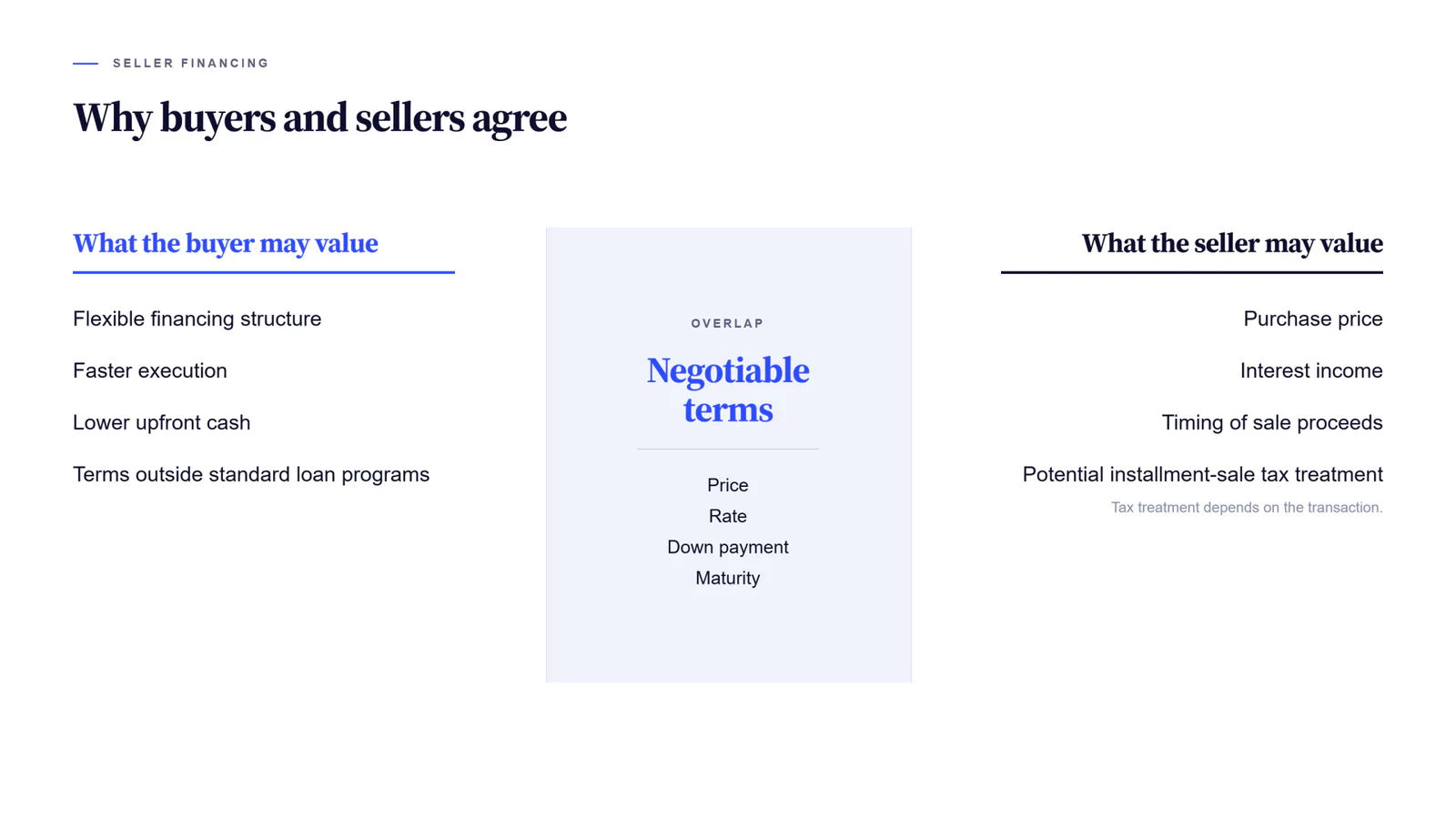
Seller financing can also create room to negotiate variables that would otherwise be separated.
A seller may care most about:
purchase price
size of the down payment
monthly income
interest rate
timing of the final payoff
tax consequences
certainty of closing
The buyer may care about a different set of constraints.
That creates opportunities for trades.
A buyer might accept a higher purchase price in exchange for a lower interest rate.
Another buyer might prefer a larger monthly payment in exchange for a lower price.
A seller who needs substantial cash at closing may require a larger down payment while being flexible elsewhere.
The economics become easier to understand once each concession is converted into dollars.
Price Against Interest Rate: A Worked Comparison
The figures below are illustrative teaching assumptions rather than market data.
Assume a property has an estimated current market value of approximately $500,000.
The buyer is considering two seller-financed structures. Both use 20% down, 30-year amortization, and a five-year balloon.
The Two Offers
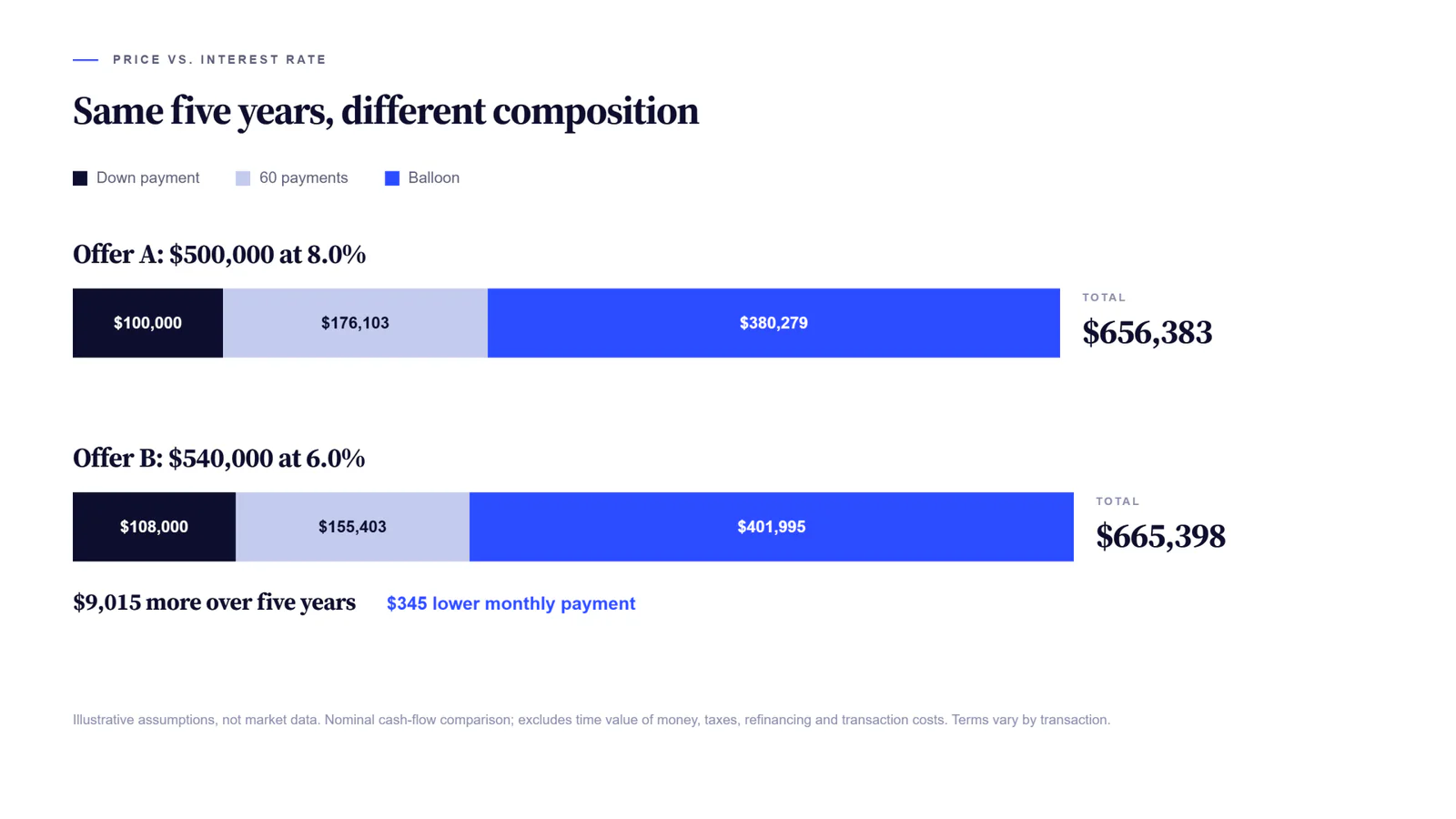
Offer A
Purchase price: $500,000
Down payment: $100,000
Seller-financed note: $400,000
Interest rate: 8.0%
Monthly principal and interest: approximately $2,935
Offer B
Purchase price: $540,000
Down payment: $108,000
Seller-financed note: $432,000
Interest rate: 6.0%
Monthly principal and interest: approximately $2,590
Offer B reduces the monthly payment by roughly:
$2,935 − $2,590 = $345
That monthly saving makes the lower-rate structure look attractive.
The balloon tells a different story.
What They Actually Cost
Offer A | Offer B | |
|---|---|---|
Down payment | $100,000 | $108,000 |
60 monthly payments | $176,103 | $155,403 |
Balloon due at year five | $380,279 | $401,995 |
Total nominal cash paid over five years | $656,383 | $665,398 |
Under these assumptions, Offer B requires approximately:
$665,398 − $656,383 = $9,015 more
in nominal cash over the same five-year period.
The lower monthly payments save approximately $20,700 over five years.
But that saving is offset by:
$8,000 more upfront
approximately $21,716 more remaining at the balloon
This comparison is intentionally simple. It does not adjust for the time value of money, taxes, refinancing costs, selling costs, or alternative uses of the buyer's capital.
Its purpose is to show why monthly payment alone does not determine which structure is cheaper.
The Equity Position Is Worse Too
Assume the property's market value remains $500,000 after five years.
Under Offer A, the remaining debt is approximately $380,279.
That leaves:
$500,000 − $380,279 = $119,721
of property equity before selling costs.
Under Offer B, approximately $401,995 remains due.
Equity based on the same $500,000 market value is:
$500,000 − $401,995 = $98,005
The lower-rate transaction therefore leaves approximately $21,716 less equity under these assumptions.
The difference comes from financing a larger initial purchase price.
What Changes the Answer
Time changes the economics because the lower interest rate becomes more valuable the longer the note remains outstanding.
Using the same assumptions:
Balloon Term | Offer A Total | Offer B Total | Difference |
|---|---|---|---|
Three years | $594,783 | $616,325 | B costs $21,543 more |
Five years | $656,383 | $665,398 | B costs $9,015 more |
Seven years | $716,455 | $712,807 | B costs $3,648 less |
Ten years | $803,106 | $780,329 | B costs $22,776 less |
The nominal cash-flow crossover occurs at roughly six and a half years.
That means the best structure depends partly on how long the buyer expects the seller financing to remain in place.
A purchase price becomes part of the buyer's basis immediately.
An unfavorable interest rate may eventually be refinanced, but only if future property value, borrower qualification, lending standards, and market rates make refinancing possible.
Price and financing therefore need to be negotiated together rather than evaluated separately.
How Much Money Do You Need for Seller Financing?
There is no universal seller-financing down payment.
The amount can depend on:
seller objectives
buyer creditworthiness
property value
existing liens
tax considerations
the amount of cash the seller needs at closing
applicable lending requirements
The Floor Nobody Mentions
Existing seller debt can create an important practical constraint.
Suppose a seller is selling a property for $500,000 but still owes $280,000 on an existing mortgage.
If that mortgage must be paid off at closing, the transaction must generate enough cash or replacement financing to satisfy the payoff.
A structure involving only $50,000 of cash at closing and a $450,000 seller note would not provide the $280,000 needed to retire that mortgage.
Other structures—including formal loan assumptions, subordinate seller financing, wraparound financing, or transfers subject to existing debt—can change the mechanics.
They can also introduce additional legal and lender-consent issues.
The seller's current loan documents should therefore be reviewed before treating the amount of seller financing as unlimited.
When the property is owned free and clear, the seller generally has more flexibility over how much cash must be received at closing.
Seller Financing Balloon Payments and Refinance Risk
A seller-financed note may have payments calculated over thirty years while becoming fully due after only five.
That difference creates refinance risk.
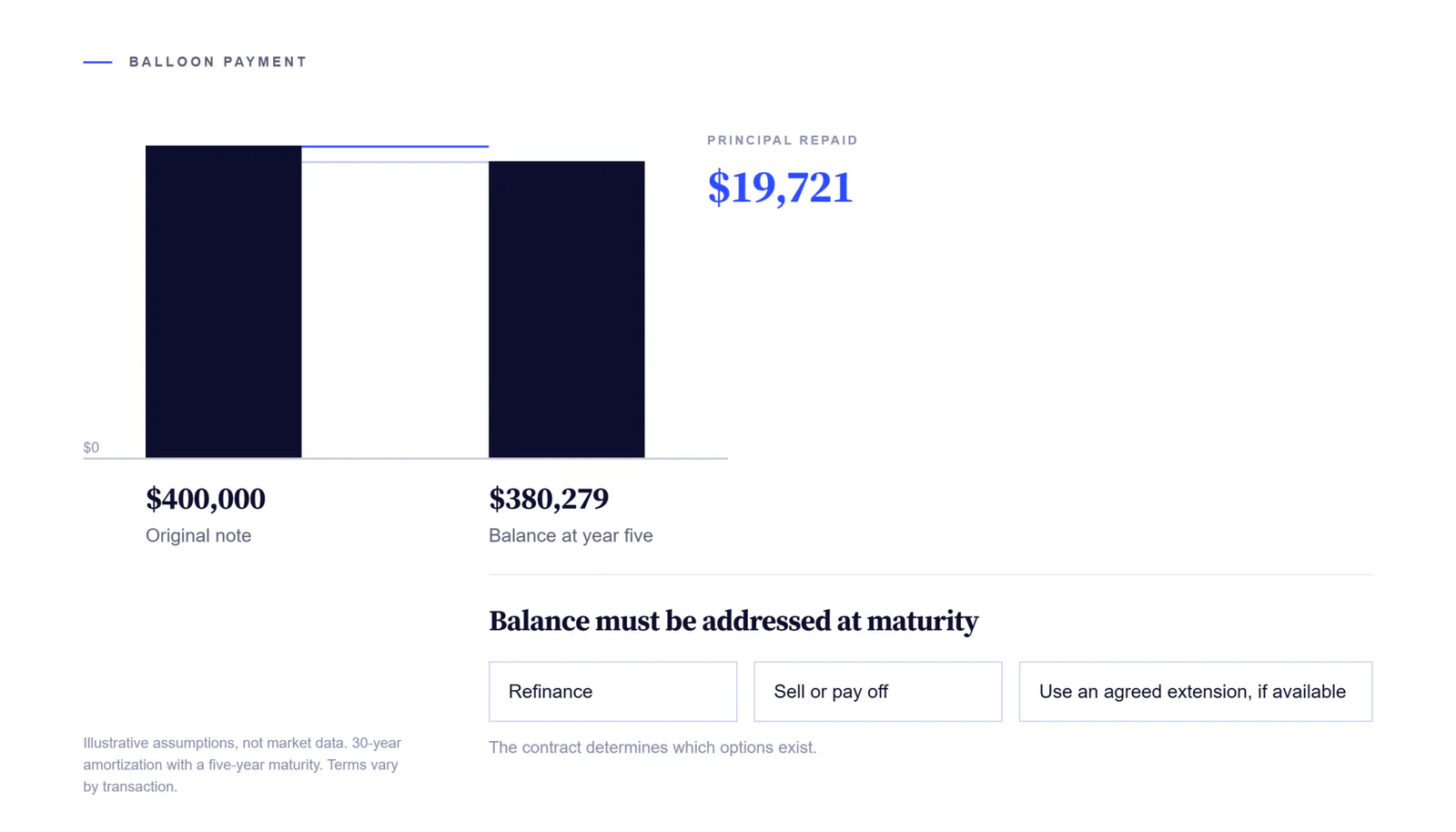
On the $400,000 note in Offer A, approximately $380,279 remains outstanding after five years.
Only about $19,721, or just under 5% of the original principal, has been repaid through scheduled amortization.
The buyer must have a plan for the remaining balance.
Possible outcomes can include:
refinancing with another lender
selling the property
paying off the note from other capital
using an extension or modification if the original agreement permits it and the parties agree
The first two are common underwriting assumptions, but neither is guaranteed.
Property values can fall.
Interest rates can rise.
Lending standards can tighten.
The buyer's financial position can change.
For that reason, the future refinance should be modeled before the seller-financed note is signed.
An extension option can also be negotiated upfront. The seller may require compensation or conditions for providing one, but it can create valuable flexibility if refinancing markets are unfavorable at maturity.
Prepayment rights deserve the same attention. A buyer who can repay without penalty has more flexibility to refinance if better financing becomes available.
What Are the Downsides of Owner Financing?
The risk depends on which side of the transaction you are on.
For the Buyer - Risks of Seller Financing
Seller financing may involve:
a shorter maturity than conventional financing
balloon-payment risk
fewer standardized loan terms
higher or lower rates depending on the overall negotiation
administrative complexity if payments are not professionally serviced
refinance risk at maturity
The interest rate should not automatically be assumed to be above conventional mortgage pricing.
A seller may offer a below-market rate in exchange for another concession such as:
higher purchase price
larger down payment
shorter maturity
stronger collateral
more favorable default terms
The package matters more than any one term.
For the Seller
The seller takes on credit risk.
If the buyer defaults, enforcement may require foreclosure or another legal remedy under state law and the transaction documents.
The seller also receives the financed portion of the sale over time rather than immediately.
If the seller accepts a junior lien behind another lender, the senior lender generally has priority against the collateral.
Seller financing can therefore provide interest income and negotiating flexibility, but it also replaces immediate sale proceeds with a private credit exposure secured by the property.
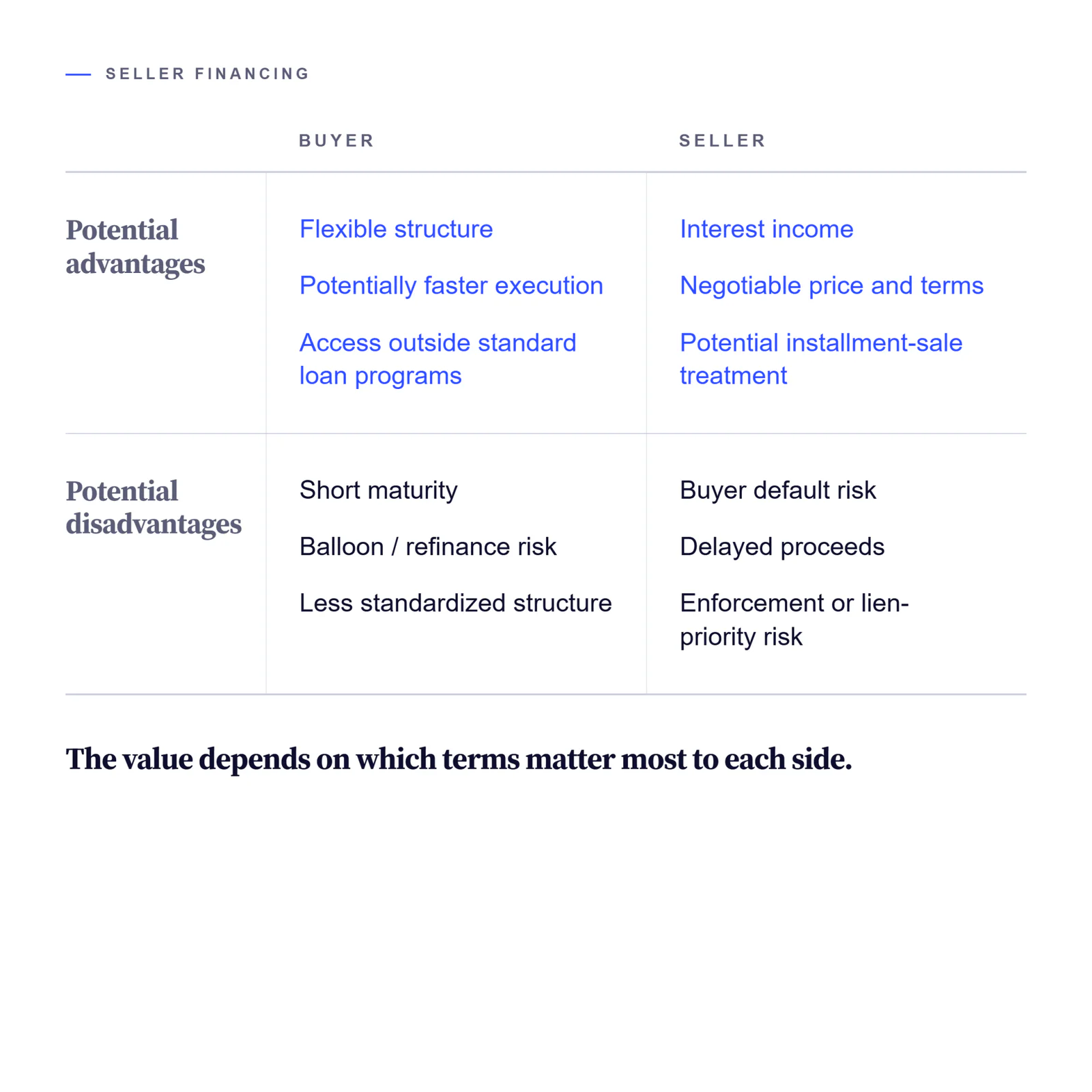
Pros and Cons of Seller Financing at a Glance
The trade-offs differ for each party.
Buyer | Seller | |
|---|---|---|
Potential advantages | Flexible structure, access outside standard loan programs, potentially faster execution | Interest income, negotiated price and terms, possible installment-sale tax treatment |
Potential disadvantages | Balloon/refinance risk, shorter maturity, potentially less standardized protections | Buyer default risk, delayed proceeds, enforcement costs, possible junior-lien position |
The negotiation becomes more productive when each side identifies which terms matter most.
A seller who strongly values monthly income may care less about receiving the maximum down payment.
A buyer who expects to refinance quickly may care more about purchase price and prepayment rights than about getting the lowest possible rate.
Seller financing creates value when those preferences differ enough to allow a trade.
How Seller Financing Compares to Other Financing Options
Conventional financing often offers attractive long-term pricing, but it comes with standardized underwriting requirements for both the borrower and the property.
Hard-money and other short-term lenders generally emphasize speed, collateral, and the business plan, often at a higher financing cost.
Seller financing can provide more flexibility because many of the economics are negotiated directly with the property owner.
That flexibility is not unlimited.
Applicable federal and state laws may regulate the structure, particularly when consumer credit secured by a dwelling is involved. CFPB Regulation Z includes specific seller-financing provisions and requirements depending on the transaction.
A lease option belongs in a different category.
The occupant leases the property and receives an option to buy under specified conditions rather than becoming the owner through a financed purchase at closing.
Because ownership, tax treatment, remedies, and risk allocation differ, a lease option should not be treated as interchangeable with seller financing.
The Due-on-Sale Clause
Existing mortgage debt deserves separate attention.
A due-on-sale clause generally gives a lender the contractual right to accelerate the loan when the secured property or an interest in it is transferred without the lender's required consent.
Federal law broadly permits enforcement of due-on-sale clauses, subject to specific statutory exceptions for certain transfers.
This matters when a seller proposes:
wraparound financing
a subject-to transfer
another structure leaving existing debt in place
The existing lender's rights do not disappear simply because the buyer and seller agree on a separate financing arrangement.
A formally approved assumption can avoid the unauthorized-transfer issue when the lender permits the buyer to assume the existing debt under its requirements.
Before structuring around an existing mortgage, the parties should review the loan documents and obtain appropriate legal advice.
How Can You Find Seller-Financed Homes?
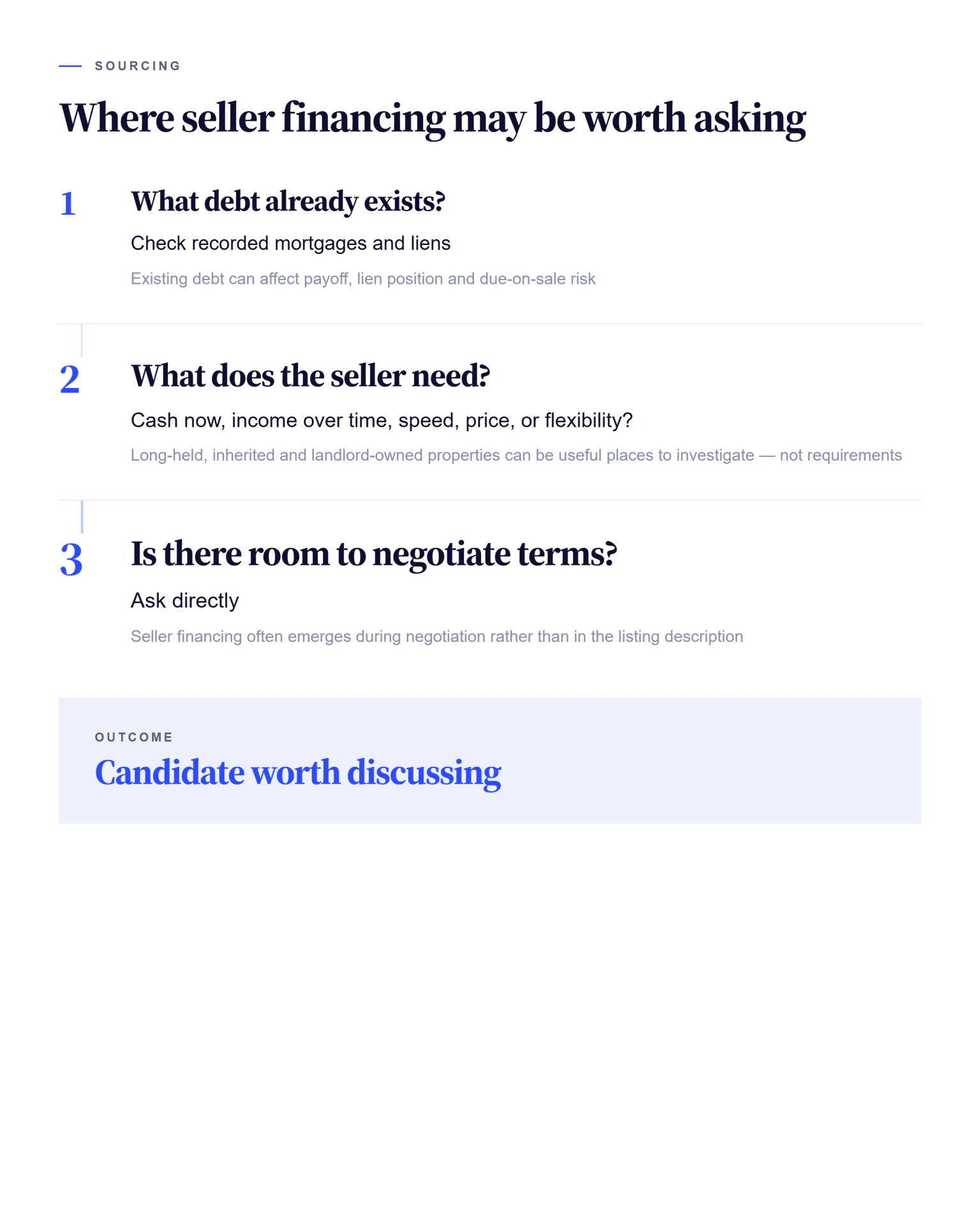
Seller financing does not need to be advertised in advance.
Sometimes a listing explicitly states:
seller financing available
owner will carry
flexible terms considered
In other cases, the idea emerges only after a buyer understands what the seller is trying to accomplish.
Free-and-clear properties can be attractive candidates because there is no existing mortgage payoff complicating the seller's ability to carry financing.
Other situations worth exploring can include:
long-held properties
inherited real estate
landlords exiting the business
properties difficult to finance conventionally
sellers who prefer recurring income to receiving all proceeds immediately
These are indicators, not requirements.
A property with an existing mortgage may still support some form of seller financing, but the lien structure and lender rights need to be understood first.
Public property records can help identify ownership history and recorded liens.
Agents familiar with seller financing can also help structure offers, but experience matters. Asking how many owner-financed transactions an agent has actually participated in can provide useful context.
Direct conversations with property owners can uncover opportunities that were never marketed as seller financing in the first place.
How Do I Draft a Seller Financing Deal?
The economics should be understood before the legal documents are finalized.
Once the parties agree on the business terms, qualified counsel can document the structure that actually reflects them.
Terms Worth Negotiating
The interest rate is only one variable.
Other terms can carry equal or greater value:
Purchase price
Down payment
Amortization period
Maturity or balloon date
Extension rights
Prepayment rights and penalties
Default and cure periods
Payment servicing
Tax and insurance escrow
Assignment rights, where permitted
Release provisions for multi-parcel collateral
Security and lien priority
Not every term will be appropriate or legally available in every transaction.
The purpose of the negotiation is to identify which variables matter to each side and then have the final documents reviewed under the law governing that property.
Option agreements and land contracts should also be evaluated on their own legal and tax consequences rather than treated as interchangeable substitutes for a seller-held note.
Is Seller Financing a Good Idea for Real Estate Investors?
Seller financing can make sense when flexibility creates real value for both sides.
Examples can include situations where:
the property is difficult to finance conventionally
the buyer wants a faster or more flexible structure
the seller values installment income
the seller is willing to exchange price for financing terms
the buyer wants to preserve bank borrowing capacity
conventional financing is available but less attractive than the negotiated seller terms
It can also be useful when property condition creates a temporary financing problem that the buyer expects to resolve.
Seller financing should not, however, be used merely to ignore an affordability problem.
If the buyer cannot reasonably service the debt, changing the identity of the lender does not improve the property's economics.
The transaction still needs to support:
the required payments
operating costs
reserves
the eventual balloon or payoff
Investors should still verify whether the property's income can support the proposed payments, particularly by understanding the debt service coverage ratio (DSCR).
The flexibility is valuable only when the underlying repayment plan is sound.
What to Verify Before Signing
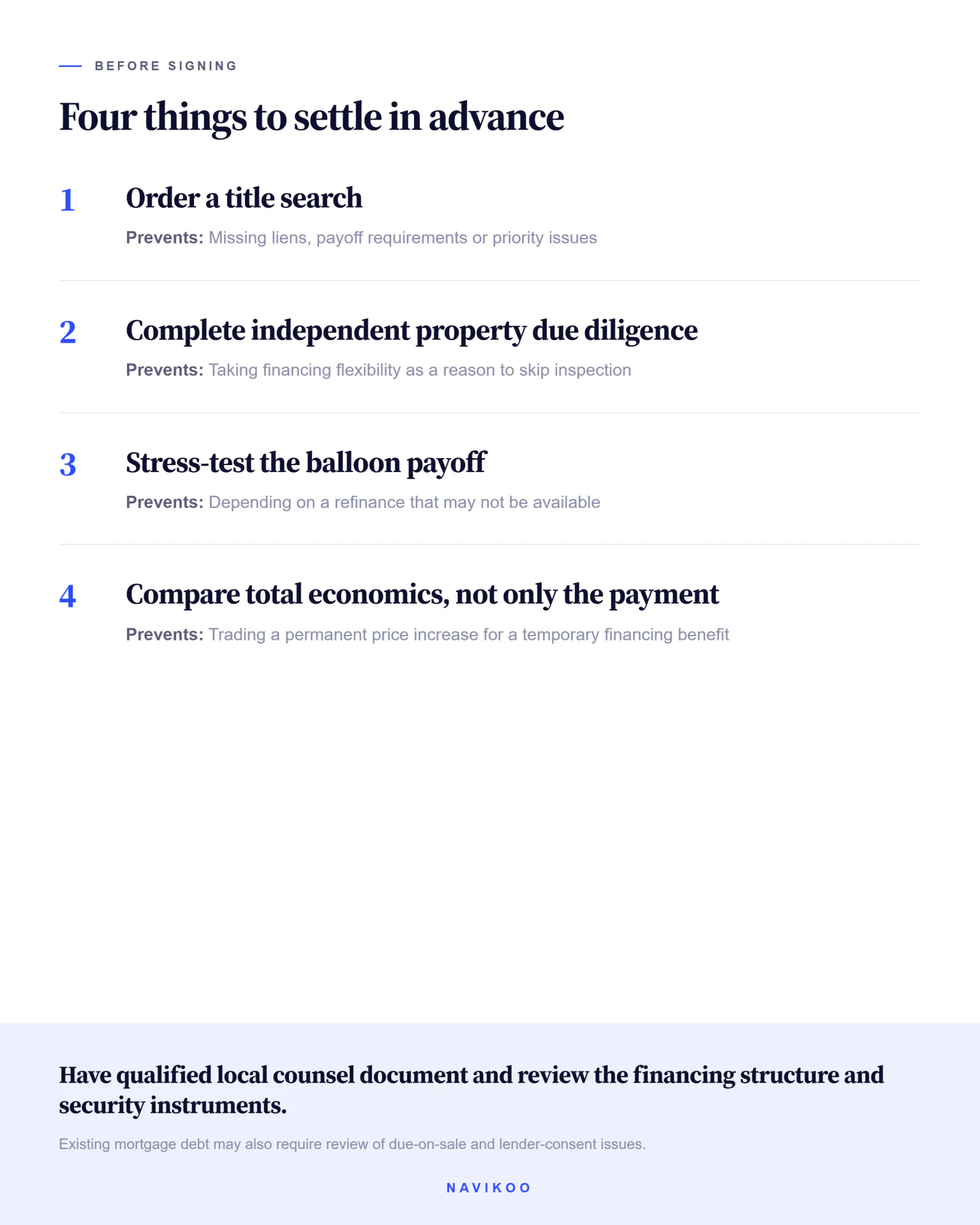
Start with title.
Order a title search and identify:
existing mortgages
tax liens
judgments
other recorded encumbrances
lien priority
If existing debt will remain in place, review the loan documents and due-on-sale implications with qualified counsel.
Then verify the property independently.
Seller financing should not reduce normal due diligence. Inspection, insurance availability, property condition, income verification, and market value still matter.
Next, underwrite the balloon.
Model what the refinance might look like at maturity using assumptions that are less favorable than today's.
Ask what happens if:
rates are higher
property value is lower
NOI falls
lender leverage is reduced
the buyer cannot qualify for the expected refinance
Finally, compare the entire financing package rather than just the monthly payment.
Purchase price, interest rate, down payment, amortization, balloon balance, prepayment terms, and maturity all interact.
Investors comparing seller-financing structures can model purchase price, down payment, interest rate, loan term, and cash flow in Navikoo's Rental Property Calculator before choosing between financing offers
A well-structured seller-financing deal solves different constraints for the buyer and seller while leaving both sides with a workable exit. The numbers should make that trade visible before the documents are signed.
Frequently Asked Questions About Seller Financing
Is seller financing the same as owner financing?
Yes. Seller financing and owner financing usually describe the same basic arrangement: the property seller provides some or all of the financing used by the buyer instead of receiving the entire purchase price from a conventional lender at closing.
How does seller financing work in real estate?
The buyer typically pays a negotiated down payment, signs a promissory note for the financed balance, and makes payments according to the agreed interest rate, amortization schedule, and maturity date. The seller generally receives a mortgage, deed of trust, or other permitted security interest in the property.
What is a typical down payment for seller financing?
There is no universal seller-financing down payment. It depends on the seller's cash needs, existing mortgage balance, buyer creditworthiness, property value, financing structure, and applicable law.
Does seller financing require a balloon payment?
Not always. Some seller-financed loans may fully amortize, while others use a longer amortization schedule with a shorter maturity date, creating a balloon balance that becomes due at maturity.
Can seller financing have a lower interest rate than a bank loan?
Yes. The interest rate is negotiable, but a lower rate may be exchanged for a higher purchase price, larger down payment, shorter maturity, or other favorable terms for the seller.
Is seller financing legal?
Seller financing can be legal, but the applicable rules depend on the property, transaction structure, state law, and whether federal consumer-credit requirements apply. Seller-financed transactions should be documented by qualified professionals familiar with the jurisdiction.
What happens if the buyer defaults on seller financing?
The seller's remedies depend on the promissory note, security instrument, transaction structure, and applicable state law. In many properly secured transactions, foreclosure or another legal enforcement process may be available.
Can a seller finance a property that still has a mortgage?
Sometimes, but existing debt can materially complicate the structure. The current mortgage may need to be paid off, assumed with lender approval, subordinated, or otherwise addressed. Due-on-sale provisions can also matter if the existing debt remains in place.