How to Analyze a Rental Property: 8-Step Guide
Learn how to analyze a rental property using cash flow, cap rate, cash-on-cash return, DSCR, and the 1% rule. This beginner-friendly guide walks through a complete example and shows how to evaluate a deal before making an offer.

Buying a rental property can look simple from the outside: purchase a home, find a tenant, collect rent, and wait for the money to roll in. Then property taxes, insurance, vacancies, repairs, financing, and management costs arrive and politely introduce themselves to your bank account.
That is why every potential investment property should be analyzed before you make an offer.
A proper rental property analysis helps you answer questions such as:
Will the property produce positive monthly cash flow?
How much cash will I need to purchase it?
Is the projected return worth the risk?
Can the rental income comfortably cover the mortgage?
What happens if rent is lower or expenses are higher than expected?
Does the location support the long-term investment plan?
In this guide, we will walk through the most important calculations using a realistic example. You will learn how to evaluate cash flow, net operating income, cap rate, cash-on-cash return, the 1% rule, debt service coverage ratio, and long-term returns.
Have a property in mind?
Analyze a Property for Free with Navikoo
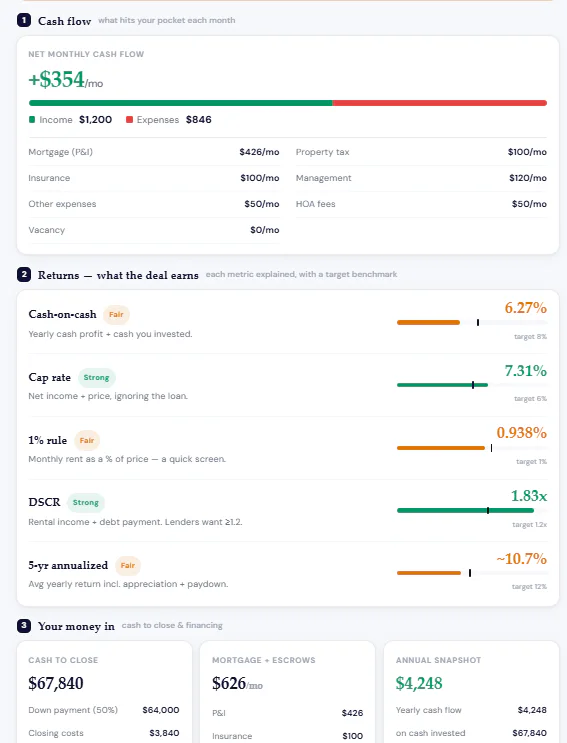
What information do you need to analyze a rental property?
Start by collecting accurate information about the purchase, financing, income, and expenses.
Purchase information
Gather the following:
Purchase price
Down payment
Initial repair or renovation costs
Inspection and appraisal costs
Any immediate reserves needed after closing
The down payment is not your entire investment. Closing costs, repairs, lender fees, and reserves can significantly increase the amount of cash required.
Financing information
You will also need:
Loan amount
Interest rate
Loan term
Estimated principal and interest payment
Mortgage insurance, when applicable
Loan fees or points
For a fixed-rate mortgage, the principal and interest payment depends on the loan amount, interest rate, and loan term. Property taxes, insurance, HOA dues, and other expenses must be evaluated separately rather than ignored because they are not part of principal and interest.
Rental income
Estimate:
Expected monthly rent
Other income, such as parking, storage, laundry, or pet fees
Expected vacancy rate
Potential concessions or leasing costs
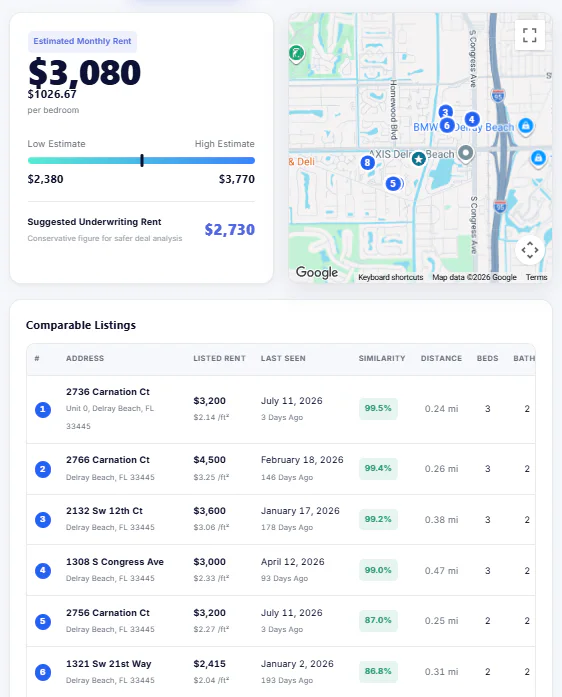
Do not choose the highest rent you can find online and declare victory. Review comparable rentals with similar bedrooms, bathrooms, size, condition, amenities, and location.
Need to check the market rent in your area?
Check the property with Navikoo’s Rent Estimate tool
Operating expenses
Common rental-property expenses include:
Property taxes
Landlord insurance
Property management
Repairs and maintenance
Capital expenditure reserves
HOA fees
Utilities paid by the owner
Landscaping or snow removal
Pest control
Licensing and inspection fees
Accounting and legal costs
Leasing and advertising expenses
The IRS also identifies expenses such as interest, taxes, insurance, utilities, maintenance, and property-management costs as common rental-property expenses. Tax treatment depends on the investor’s circumstances, so consult a qualified tax professional before making tax decisions.
Rental property example
Suppose an investor is considering a long-term rental with the following numbers:
Purchase Price = $220,000
Down payment =20% - Down payment amount= $44,000
Closing costs = $6,600
Total initial cash invested = $50,600
Loan amount = $176,000
Interest rate= 6.75% - Loan term = 30
Expected monthly rent= $1,900
Vacancy allowance = 6% - Property management = 8% - Property taxes = $2,000 - Insurance = $1,600
Based on these assumptions, the estimated monthly principal and interest payment is approximately $1,142.
Let’s run the deal step by step.
Step 1: Calculate effective rental income
The property may rent for $1,900 per month, but it is risky to assume that it will remain occupied and fully collected every day of the year.
This example uses a 6% vacancy allowance.
Monthly vacancy allowance:
$1,900 × 6% = $114
Effective monthly rental income:
$1,900 − $114 = $1,786
The property therefore produces an estimated $1,786 in effective monthly rental income after accounting for vacancy.
Vacancy is not limited to a tenant physically moving out. Lost income can also come from turnover, nonpayment, concessions, cleaning, repairs between tenants, or the time required to advertise and lease the property.
Step 2: Estimate property-management costs
This example uses an 8% management fee applied to collected rent after vacancy.
Monthly management expense:
$1,786 × 8% = $142.88
Estimated property management is therefore approximately $143 per month.
An investor planning to self-manage may be tempted to enter zero. That can make the deal look better, but your time still has value. Out-of-state investors should be especially cautious about assuming they can manage the property without local support.
Step 3: Calculate net operating income
Net operating income, commonly called NOI, is the property’s effective income minus its operating expenses before mortgage payments.
For this example:
Monthly income = $1,786.00 Property management = $142.88Property taxes = $166.67Insurance = $133.33Monthly NOI = $1,343.12
Estimated annual NOI:
$1,343.12 × 12 = $16,117.44
The property’s estimated NOI is approximately $16,117 per year.
Mortgage principal and interest are not subtracted when calculating NOI. Financing is considered later when calculating cash flow, cash-on-cash return, and DSCR.
Step 4: Calculate monthly cash flow
Rental property cash flow is the money remaining after operating expenses and debt payments.
A simplified formula is:
Cash flow = Effective rental income − Operating expenses − Debt service
For this property:
Net operating income$1,343.12
Mortgage principal and interest−$1,141.53
Estimated monthly cash flow$201.59
Rounded, Navikoo displays approximately $202 in monthly cash flow.
Estimated annual cash flow:
$201.59 × 12 = $2,419.08
The deal is technically cash-flow positive, but the margin is narrow. A major repair, tax increase, extended vacancy, or insurance increase could eliminate much of the profit.
Positive cash flow does not automatically make a property a good investment. The amount of cash flow should be considered alongside the investor’s cash invested, financing risk, property condition, location, and long-term objectives.
Step 5: Calculate cash-on-cash return
Cash-on-cash return measures the annual pre-tax cash flow compared with the amount of cash invested.
The formula is:
Cash-on-cash return = Annual pre-tax cash flow ÷ Total cash invested
For this property:
Annual cash flow: approximately $2,419
Down payment: $44,000
Closing costs: $6,600
Total cash invested: $50,600
Cash-on-cash return:
$2,419 ÷ $50,600 = 4.78%
The estimated cash-on-cash return is 4.78%.
Cash-on-cash return accounts for financing because it measures cash flow against the investor’s actual cash contribution. Cap rate, by comparison, evaluates property operations without considering the mortgage structure.
Navikoo’s interpretation of this result could read:
Cash-on-cash return is below the preferred range.
The deal produces positive cash flow, but the return on the initial cash investment may be modest relative to the investor’s target.
There is no universal cash-on-cash return that works for every investor. A lower return may be acceptable in a stable location with strong appreciation potential, while another investor may require significantly higher immediate income.
Step 6: Calculate the cap rate
The capitalization rate, or cap rate, compares annual NOI with the property’s value or purchase price.
The formula is:
Cap rate = Annual NOI ÷ Purchase price
For this property:
$16,117 ÷ $220,000 = 7.33%
The estimated cap rate is 7.33%.
Cap rate is useful for comparing properties because it evaluates the property before financing. However, it does not tell you how much cash you will personally earn after paying the mortgage.
That is why cap rate and cash-on-cash return should be reviewed together rather than treated as interchangeable metrics.
Step 7: Check the 1% rule
The 1% rule is a quick screening guideline that compares monthly rent with the purchase price.
The formula is:
1% rule ratio = Monthly rent ÷ Purchase price
For this property:
$1,900 ÷ $220,000 = 0.86%
The property’s rent-to-price ratio is 0.86%.
That means it is close to, but does not meet, the traditional 1% guideline.
Navikoo’s interpretation could read:
The deal is close to the 1% rule but does not fully pass it.
Use a complete analysis before rejecting or pursuing the property.
The 1% rule is only a preliminary filter. It does not account for interest rates, property taxes, insurance, vacancy, management, repairs, or differences between local markets. A property below 1% can still perform well, while a property above 1% can still be a financial gremlin wearing a nice cap rate as a hat.
Step 8: Calculate DSCR
The debt service coverage ratio, or DSCR, measures whether the property’s operating income can cover its debt payments.
The formula is:
DSCR = Net operating income ÷ Annual debt service
For this property:
Annual NOI: approximately $16,117
Annual principal and interest: approximately $13,698
$16,117 ÷ $13,698 = 1.18
The estimated DSCR is 1.18x.
A DSCR above 1.00 means the modeled NOI exceeds the property’s debt service. Navikoo uses 1.20x as a target benchmark for its deal interpretation, although actual lender requirements and calculation methods vary.
Navikoo’s insight could read:
DSCR is above breakeven but below the 1.20x target.
The projected income covers the debt payment, but there is a limited cushion if rent decreases or expenses increase.
Fannie Mae and Freddie Mac define DSCR as a comparison between property income or net operating income and annual debt service. Exact underwriting definitions may differ by lender and loan program.
What does the AI property-tax estimate change?
The investor entered annual property taxes of $2,000, but Navikoo’s model estimates $2,400.
That $400 annual difference may not look dramatic, but it changes the deal’s results:
Monthly cash flow $202 vs $168 - Cash-on-cash 4.8% vs 4% - DSCR 1.18x vs 1.15x
The purpose of the AI estimate is not to pretend it knows more than the county tax office. It is to identify a possible mismatch that the investor should verify.
Property taxes can change after a sale, reassessment, renovation, exemption removal, or change in local tax rates. Confirm the likely post-purchase tax bill with the relevant county or municipality before relying on the seller’s current payment.
This is one of Navikoo’s main advantages: it does not only display a collection of percentages. It highlights inconsistencies and explains how they may affect the investment.
Do not forget maintenance and capital expenditures
The example above reproduces the supplied Navikoo results, but it does not include a separate maintenance or capital-expenditure reserve.
That omission matters.
Suppose the investor adds a maintenance reserve equal to 5% of gross rent:
$1,900 × 5% = $95 per month
The original $202 monthly cash flow would fall to approximately $107 per month.
A second reserve for major capital items—such as the roof, HVAC system, appliances, plumbing, or exterior work—would reduce the projected cash flow further.
The correct reserve depends on the property’s age, condition, inspection findings, systems, and local repair costs. A newly renovated property may need a smaller near-term reserve than an older property with aging mechanical systems, but no property remains repair-free forever. Buildings are rude that way.
How to stress-test the rental property
A base-case projection is not enough. Investors should also test what happens when assumptions become less favorable.
Consider running at least three scenarios.
Base case
Use the most likely assumptions:
Expected market rent
Normal vacancy
Current financing quote
Verified expenses
Reasonable maintenance reserves
Conservative case
Test:
Lower rent
Higher vacancy
Higher taxes or insurance
Additional maintenance
One month of unexpected turnover
A higher interest rate if financing is not locked
Upside case
Test:
Modest rent growth supported by comparable properties
Lower negotiated purchase price
Seller-paid closing costs
Lower financing costs
Documented opportunities to add income
Do not use the upside case as the excuse required to make a weak base case look attractive.
Understanding the 13.7% five-year annualized return
Navikoo projects a 13.7% five-year annualized return for this example.
This metric is different from the 4.78% first-year cash-on-cash return.
A multiyear return may incorporate assumptions such as:
Property appreciation
Rent growth
Expense growth
Mortgage principal reduction
Ongoing cash flow
Future sale price
Selling costs
Because those assumptions extend into the future, investors should review them carefully. A 13.7% modeled return is not a guarantee that the property will deliver a 13.7% return.
The result is most useful when the investor can view and adjust the assumptions behind it.
Location analysis matters too
A spreadsheet can calculate a cap rate, but it cannot tell you whether the surrounding area supports the investment strategy.
Navikoo combines financial analysis with location insights such as:
Rental-demand indicators
Employment trends
Nearby schools
Reported crime data
Transportation access
Development projects
Local amenities
Potential neighborhood strengths and weaknesses
These insights should be treated as a starting point for due diligence, not a replacement for visiting the area, reviewing objective local data, speaking with qualified local professionals, and verifying property-specific information.
For an out-of-state investor, location context can be just as important as the calculator. A promising return can quickly become less exciting when the property is difficult to manage, insure, rent, or maintain.
Navikoo’s AI Scout, available within the Rental Calculator, helps you quickly evaluate a neighborhood by highlighting its key pros and cons, local characteristics, and other useful insights for your investment decision.
How could an investor improve this deal?
Based on the example, Navikoo might highlight several possible actions.
1. Negotiate the purchase price
The property generates positive cash flow, but its cash-on-cash return is below the investor’s preferred range.
A lower purchase price may:
Reduce the required down payment
Reduce the loan amount
Lower the monthly mortgage payment
Improve cash flow
Improve cash-on-cash return
Improve DSCR
2. Request a seller credit
A seller credit toward closing costs may reduce the investor’s initial cash requirement and improve cash-on-cash return.
The amount and availability of seller concessions depend on the loan program, contract, appraisal, and lender requirements.
3. Verify achievable rent
The property’s 0.86% rent-to-price ratio is close to the 1% guideline but does not meet it.
Review comparable rentals to determine whether $1,900 is conservative, aggressive, or realistic. Do not increase the rent assumption merely to force the spreadsheet to behave.
[Internal CTA: Estimate the Property’s Rent with Navikoo]
4. Compare financing options
A lower rate, smaller lender fee, or different loan structure may improve cash flow. Compare the total cost of each option—not only the advertised interest rate.
5. Verify the tax discrepancy
The $2,000 user input and $2,400 AI estimate should be resolved before making an offer.
A property-tax surprise after closing is not the kind of artificial intelligence anyone requested.
6. Review management assumptions
An out-of-state investor should obtain real quotes from local property managers. Ask about:
Monthly management fees
Tenant-placement fees
Lease-renewal fees
Maintenance markups
Inspection fees
Eviction coordination
Minimum monthly charges
The advertised percentage may not represent the complete cost.
Is this rental property a good deal?
Based on the supplied assumptions, this property has several positive signs:
Positive estimated monthly cash flow
A 7.33% cap rate
DSCR above 1.00x
A rent-to-price ratio reasonably close to 1%
A positive modeled five-year return
It also has several concerns:
Cash flow is only about $202 per month before a separate maintenance reserve
Cash-on-cash return is 4.78%
DSCR is below Navikoo’s 1.20x target
The user-entered tax figure is lower than the AI estimate
The deal does not fully satisfy the 1% rule
Repairs and capital expenditures could materially reduce cash flow
The result is not a simple yes or no.
It is a potentially workable deal with a narrow cash-flow cushion. The investor should verify the rent, property taxes, insurance, condition, management costs, and repair reserves before proceeding.
The deal may become more attractive with a lower purchase price, seller credit, stronger documented rent, better financing terms, or lower verified expenses.
Analyze the complete deal—not just one metric
No single KPI can tell you whether to buy a rental property.
The 1% rule is fast but incomplete. Cap rate ignores financing. Cash-on-cash return focuses on initial cash efficiency but not the complete long-term outcome. DSCR measures debt coverage but does not account for every risk. Five-year returns depend heavily on future assumptions.
A better analysis brings the metrics together and explains what they mean.
That is what Navikoo is designed to do:
Present clear financial signs and KPIs
Calculate cash flow and investment returns
Compare investor inputs with AI-generated estimates
Explain strengths, concerns, and missing information
Provide location advantages and disadvantages
Surface negotiation opportunities
Connect rental analysis with additional investor tools
Ready to run the numbers?
Analyze a Property for Free!
Enter the purchase price, financing, rent, vacancy, taxes, insurance, and management assumptions to see whether the property supports your investment goals.
Frequently asked questions
What is the most important number when analyzing a rental property?
There is no single most important number. Cash flow, cash-on-cash return, cap rate, DSCR, total cash required, and property condition should be reviewed together.
How much monthly cash flow should a rental property generate?
The right amount depends on the investor’s goals, market, property type, risk tolerance, financing, and cash invested. A positive number alone may not provide enough protection against vacancies or repairs.
Is a 7.33% cap rate good?
A 7.33% cap rate may be attractive in one market and risky in another. Compare it with similar local properties and investigate why the return is higher or lower.
Is a 4.78% cash-on-cash return good?
It depends on the investor’s target and the property’s expected risk and growth. In this example, Navikoo flags 4.78% as below the preferred range rather than automatically labeling the deal bad.
What does a DSCR of 1.18 mean?
A DSCR of 1.18x means the modeled NOI is approximately 1.18 times the annual debt service. The property covers its projected loan payments, but the cushion is limited.
Can I use the 1% rule instead of a rental property calculator?
The 1% rule can help screen properties quickly, but it does not account for financing or property-specific expenses. Use a complete calculator before making an offer.
Should I trust an AI rent or tax estimate?
Use AI estimates as additional data points, not final answers. Verify rents with comparable listings and local professionals, and verify taxes with the appropriate local government office.
Disclaimer: Navikoo provides educational tools and estimates, not financial, legal, lending, appraisal, accounting, or tax advice. Results depend on the information and assumptions entered and may not reflect actual performance. Property values, rents, interest rates, vacancies, taxes, insurance, expenses, and financing terms can change. Verify material information and consult qualified professionals before purchasing or financing an investment property.