How to Find Off Market Properties for Rental Investing
A private real estate deal can remove competition without creating a bargain. Rental investors may avoid bidding wars and gain flexibility on pricing and negotiation, but they also lose part of the market's price discove

A private real estate deal can remove competition without creating a bargain. Rental investors may avoid bidding wars and gain flexibility on pricing and negotiation, but they also lose part of the market's price discovery.
The useful skill is not simply finding homes before other buyers; it is proving that the price, rent, repairs, and title still make sense against open-market properties.

What Counts as an Unlisted Rental Property?
Private real estate deals include owner-direct sales, upcoming listings, permitted pocket listings, expired MLS listings, assigned contracts, and homes found through outreach.
For investors, these sourcing strategies create access, not guaranteed value. The label describes how the property reaches buyers, not its values. One investment property can be attractive privately and overpriced the next day if the market evidence does not support it.
Where to Find Unlisted Rental Properties
Real Estate Agents and Early-Access Listings
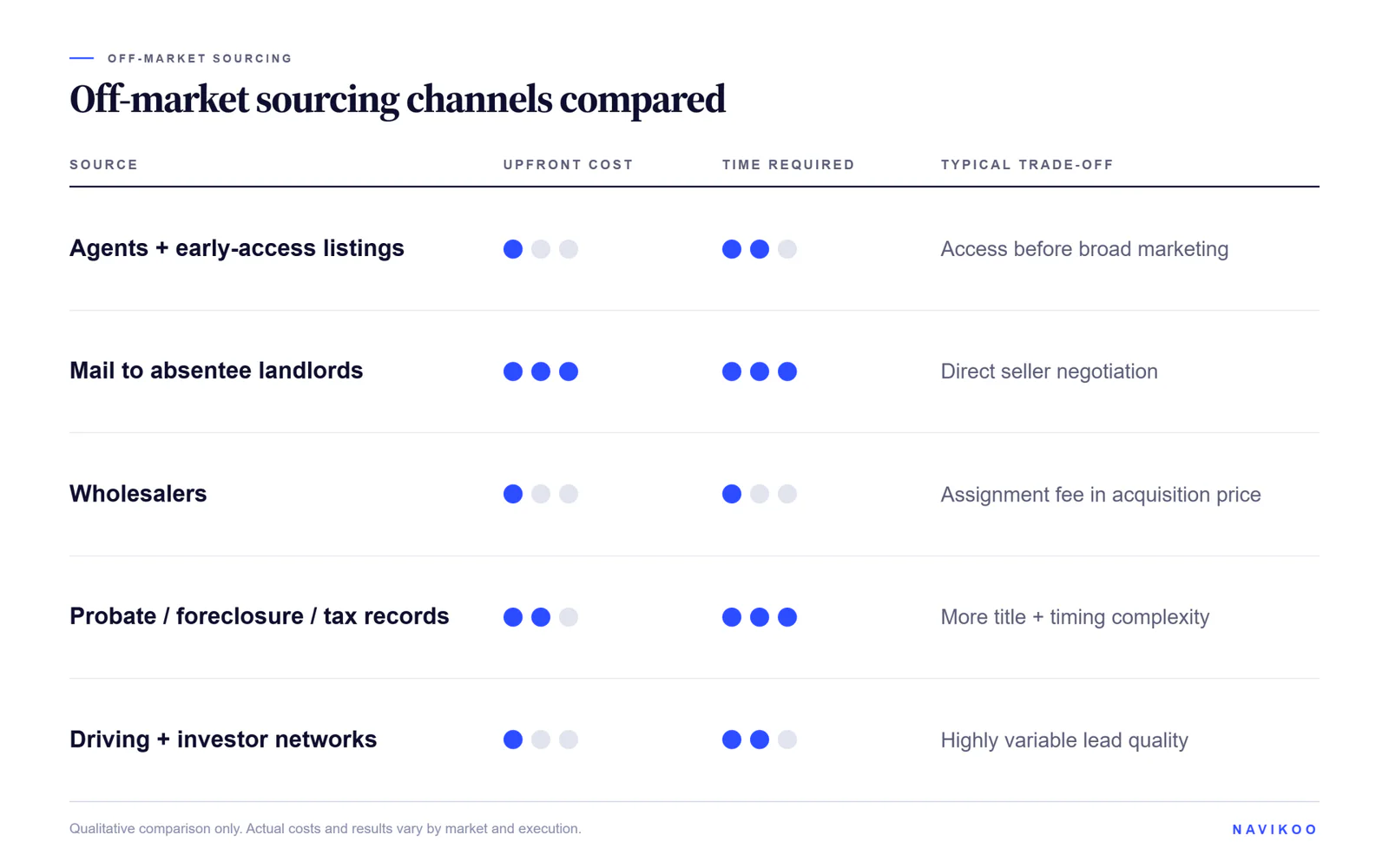
A real estate agent who works with investors may hear about sellers preparing to list, expired listings, or a pocket listing before broad market marketing begins. MLS rules still matter, and local options differ. A second real estate agent can help pull market comps so the offer is based on evidence rather than the seller's expectation, and another agent may know buyers competing for similar rentals.
Mail to Absentee Landlords
County records can identify absentee property owners, long-term landlords, and single-family rentals in neighborhoods you already understand. Direct mail marketing works best as a repeated campaign. Keep the search narrow enough that every response can be underwritten instead of paying to contact homes you would never buy. There are several investor tools that can help you with this: PropStream and BatchLeads.
Wholesalers and Assigned Contracts
Wholesaling can reduce sourcing effort because someone else finds the deal, but the assignment fee is economically part of your acquisition cost. State rules are not uniform, so review the contract, disclosures, and local real estate licensing rules before assuming the same process works everywhere.
Foreclosures, Probate, and Tax Delinquency
Foreclosures, probate records, and delinquent-tax rolls can point to sellers who value speed or certainty. They can also carry title, occupancy, court-timeline, and condition risk. The advantage comes from solving a transaction problem, not from assuming distress guarantees a discount.
Driving for Dollars and Investor Networks
Vacant or poorly maintained houses can be traced through public records. Real estate investor meetups can also surface market deals that other investors cannot pursue, and an agent or lender in the room may be as useful as the lead itself.

Can You Find Unlisted Properties on Zillow?
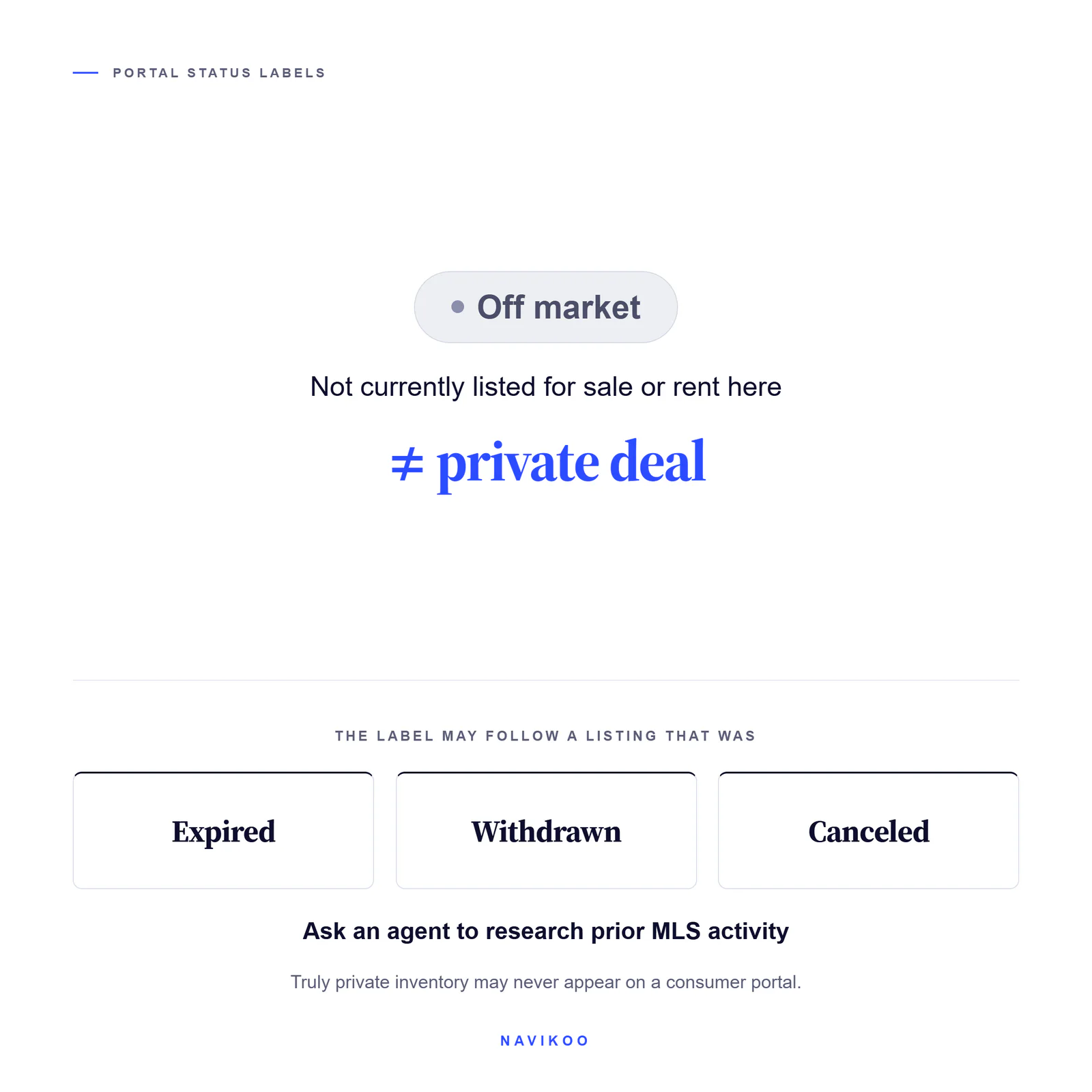
Sometimes, but Zillow's “off market” label usually means a home is not currently listed for sale or rent on Zillow; it does not mean the owner is quietly selling. Zillow also limits certain selectively marketed listings under its own market-access standards, so genuinely private deals may never appear there.
How to Find Homes Taken Off the Market
Ask an agent to pull expired, withdrawn, and canceled MLS listings. Review homes that were listed but did not close, then compare the seller's new position with recent open-market homes. A stale listing becomes useful only when the new terms improve the investment.
What's the Best Way to Find Private Deals?
Little time, more capital: agents and wholesalers
More time, lower sourcing budget: targeted mail and driving
Best long-run mix: one scalable strategy plus one relationship source
Track cost per lead, offer, and purchase rather than lead volume alone
Pros and Cons of Buying Privately
Pros | Cons |
|---|---|
Less competition from buyers | No automatic competitive market price check |
Flexible closing dates, repairs, leasebacks, or seller financing | Sourcing costs before any purchase |
Access to homes before a full open-market sale | More responsibility for condition, title, and comparable-sales work |
More opportunities to solve unusual seller situations | Some sellers expect a premium simply because the transaction is private |
Does the Discount Survive the Cost of Finding It?
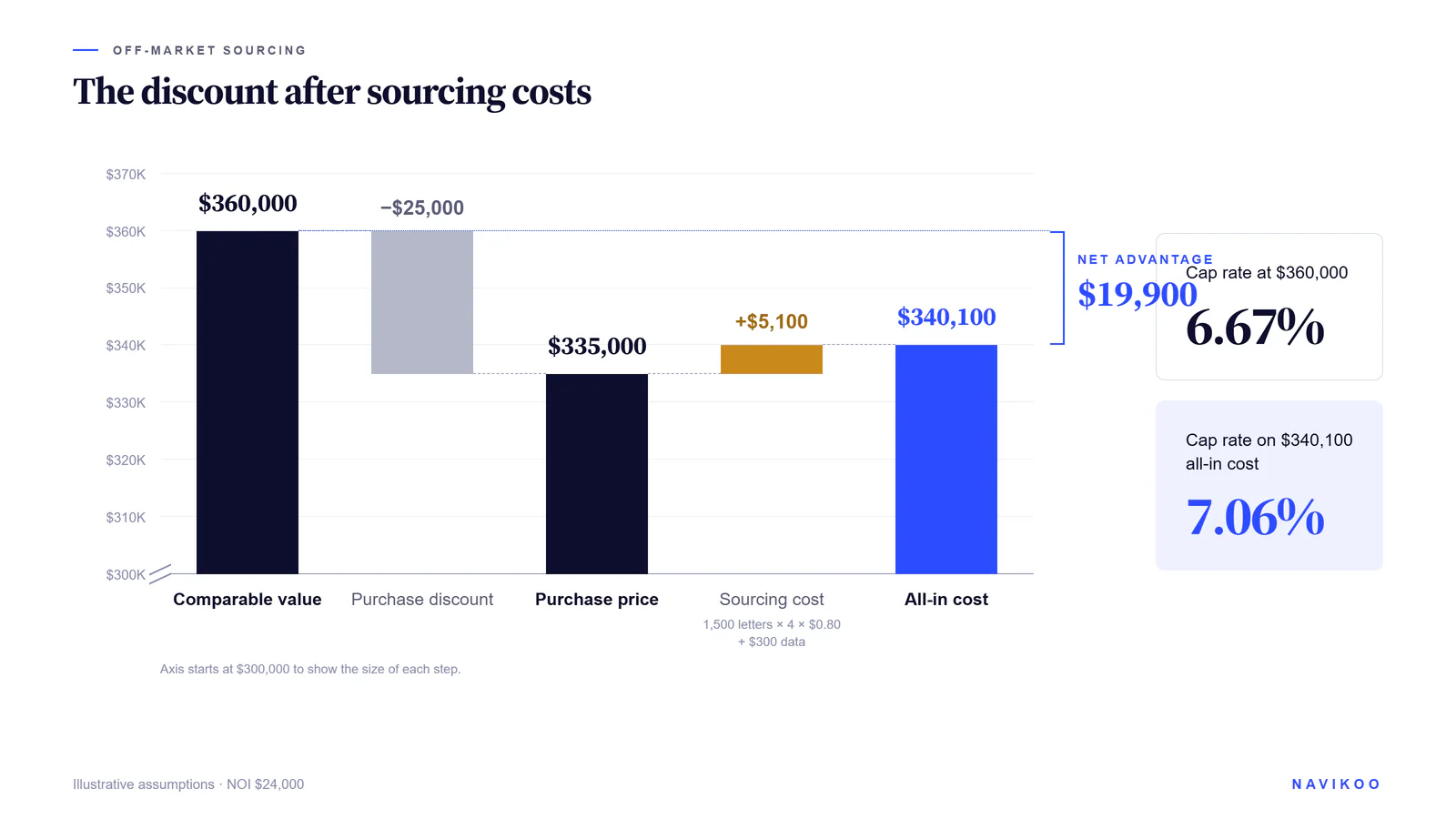
Assume a hypothetical triplex produces $24,000 of NOI. Comparable open-market properties support $360,000, while outreach produces a $335,000 purchase. Sourcing costs total $5,100: 1,500 letters sent four times at $0.80 plus $300 of data.
All-in cost becomes $340,100, so the $25,000 headline discount is really $19,900.
Cap rate improves from 6.67% to about 7.06%.
Those numbers show why sourcing cost belongs inside the deal analysis.
When the Discount Disappears
Now assume the seller asks $350,000, independent comps support $340,000, and inspection finds a $20,000 roof. Effective cost becomes $370,000, or $30,000 above supported value, and the same $24,000 NOI produces a 6.49% cap rate. A private purchase did not create the loss; weak diligence did.

Risks to Underwrite Before You Make an Offer
Valuation risk: Pull your own comps and rental assumptions. Do not rely on a seller's price or a wholesaler's after-repair value. Compare the house with recent real estate sales and open-market homes, then use fair market value and cap-rate analysis to decide what you can pay.
Condition, title, and outreach risk: Keep an inspection contingency when practical and use a home maintenance checklist or rehab estimate to price deferred work. Use a title company and consider a real estate attorney for probate, liens, or assignments. If calls or texts become part of your strategies, federal and state telemarketing rules can apply. Outreach should be based on property and transaction criteria rather than protected characteristics.

Where the Opportunities Come From
The strongest opportunities often come from sellers for whom a public listing is inconvenient.
For investors, the opportunity is usually a trade between certainty and exposure: landlords with tenants in place, heirs managing probate, or owners who value privacy and certainty.
Smaller rental properties and family homes may produce owner-direct conversations, and investors may see more opportunities there, but every deal still needs the same market underwriting. Privacy can create flexibility; it does not create value by itself.
Before You Sign
Investors should compare purchase price plus sourcing cost, repairs, closing costs, and reserves with comparable market properties. Verify rent, NOI, cap rate, title, and financing before the deposit becomes hard. If the advantage only exists at the seller's number, renegotiate or walk away. Navikoo's rental property calculator lets you test the investment before closing and compare it with public-market alternatives.