How to Execute the “Slow” BRRRR Strategy in 2027
Slow BRRRR uses the same buy, rehab, rent, refinance, repeat strategy—but removes the pressure to refinance immediately. See why waiting can make sense in 2027, how seasoning affects the timeline, and how to size the refinance around the property's actual cash flow.
A slow BRRRR is simply the BRRRR method without the rush.
You still buy a property that needs work, fix it, rent it, refinance it, and eventually repeat. The difference is that you do not take on an expensive short-term mortgage that forces you to refinance again in a few months.
In the classic BRRRR method, getting equity back quickly is often the whole plan. With a slow BRRRR, you use a mortgage or cash you can comfortably carry and wait until the numbers make sense.
That is the idea behind slow BRRRR in 2027: if the appraisal or rate is disappointing, you can wait instead of being forced into a bad deal.
What Is the BRRRR Method in Real Estate?
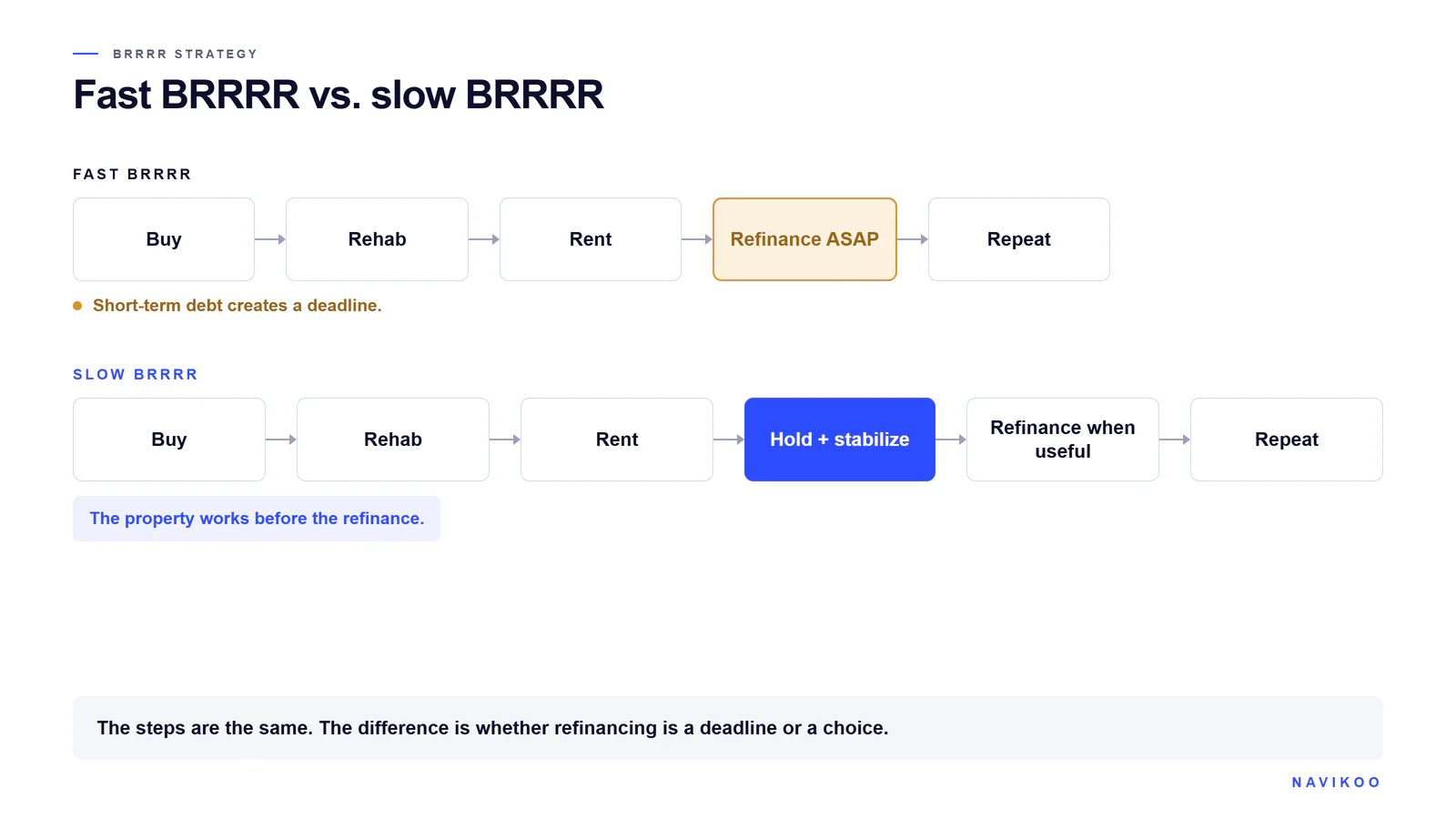
BRRRR stands for Buy, Rehab, Rent, Refinance, Repeat. It is a real estate investment strategy for building a portfolio of rental properties without needing a brand-new pile of cash for every purchase. The five steps of BRRRR:
Buy a distressed property below what it will be worth once fixed.
Rehab it so it is safe, attractive, and worth more.
Rent it to good tenants at a market rate.
Refinance into long-term financing based on the new, higher value, pulling out some or all of the cash you put in.
Repeat with the recovered cash on the next deal.
The appeal of real estate investing this way is easy to see. When the BRRRR method goes perfectly, the investor ends up owning a renovated rental with tenants covering the mortgage payment, while most of the initial investment comes back out. That recycled cash is what lets real estate investors grow from one property to five without saving up five separate down payments.
The weak point is just as easy to see once you look for it. Everything hinges on step four, and on whether the refinance work goes as planned. The appraisal has to come in high enough, at a rate low enough, for the new loan to be large and the rental income to still cover it. If any part of that fails, the cash stays stuck in the property, and the "repeat" step stalls.
What Makes a BRRRR "Slow"?
There is no official definition. It is simply a version of the BRRRR method where you stop treating the cash-out like a deadline. Here is how BRRRR work changes.
You use money you can hold longer. The fast version often starts with hard money loans or private lenders because they can close quickly and may finance a distressed deal that a bank will not. A slow BRRRR tries to use longer-term money when possible: cash, a HELOC on another property in your portfolio, traditional financing, or a conventional investment property mortgage. If you truly plan to live in one unit of a small multifamily building, owner-occupied options may also fit. FHA loans can allow a small down payment, but you have to follow the occupancy rules.
You give the property time. Because the purchase debt is not coming due in a few months, you can finish the rehab, get the property leased, build rental history, and wait for a better moment to change the financing.
You do not have to pull out every dollar. In the fast version, refinancing is usually the exit from expensive short-term debt. In the slow version, it is a choice. You can take the maximum amount available, choose a smaller amount that protects the monthly numbers, or keep the original mortgage.
That is the strategy difference between fast BRRRR and slow BRRRR: one is built around speed, while the other is built around flexibility.
Fast BRRRR | Slow BRRRR | |
|---|---|---|
Purchase money | Hard money or private funds | Cash, HELOC, conventional or owner-occupied financing |
Typical cash-out timing | 3 to 12 months | 12 months or more |
Cash needed at the start | Lower | Higher |
Cash-out approach | Usually as much as possible | Optional and sized to the property |
Main risk | Forced to refinance on bad terms | Cash stays tied up longer |
Why 2027 Favors the Slow Version
Three things in the real estate market make patience more useful in 2027: borrowing costs, modest national price growth, and the timing of a cash-out.
First, money is expensive. Freddie Mac reported a 7.24% average 30-year fixed mortgage rate on October 29, 2026. Fannie Mae's October housing forecast projects a 7.5% average throughout 2027. Financing for these properties can cost even more. A higher rate means the same income supports a smaller loan.
Second, do not count on appreciation to save the deal. Fannie Mae's October forecast projects only 0.6% national home-price growth for 2027. That is a national forecast, not a prediction for every city, but it is a good reminder that the appraisal should be supported by the rehab and local comparable sales, not by hope.
Third, fast financing can create a deadline. A fast BRRRR method may leave BRRRR investors needing to refinance whether the new terms are attractive or not. The slow version gives the property time to stabilize and gives investors the ability to choose.
That choice is the point. If rates improve, you can refinance later. If they do not, a good property should still pay for itself. Having time is valuable. As a real estate strategy, the slow version is less about predicting 2027 and more about avoiding a situation where one bad financing window controls the entire strategy.

The Seasoning Rules That Already Slowed BRRRR Down
“Seasoning” simply means a waiting period. Before approving a conventional refinance, the lender may look at how long you have owned the property and how long the current debt has been in place.
For a Fannie Mae cash-out transaction, at least one borrower generally must have been on title for six months. If the deal is paying off an existing first lien, that debt generally must be at least 12 months old.
That 12-month rule matters to the BRRRR method. If you bought with a hard money first loan, finished the rehab in four months, and rented the property in month five, you may still need to carry that expensive debt until the first loan is old enough.
There is an exception for certain cash purchases. Fannie Mae's delayed financing rule can allow an earlier cash-out when the original purchase used no mortgage financing, but the new amount is limited to the documented amount used to buy the property plus eligible costs on the new transaction. It is not a shortcut for immediately borrowing against every dollar of value created by the rehab.
Other financing programs can use different seasoning rules, so always confirm the exact policy before buying. The size of the cash-out has a ceiling too. Under Fannie Mae's current matrix, cash-out financing can go to 75% LTV on a one-unit property and 70% on a two- to four-unit property.
A Slow BRRRR Example, Step by Step
Let's keep the numbers simple. Imagine an investor finds a tired duplex for $160,000 and expects to spend $45,000 on the rehab. After the work, the BRRRR property is expected to appraise for $260,000 and produce $2,600 in monthly rent.
After vacancy, taxes, insurance, repairs, management, and reserves, assume about $1,430 a month is left before debt payments. That is the income available to support the financing.
Fast version: the investor uses a hard money lender that finances most of the purchase plus the rehab. The loan is $189,000 at 11% interest-only, plus two points. The down payment and upfront cash are much lower, which is the attraction.
But six months of expensive debt costs more than $10,000 in interest. Then the cash-out comes in at 70% of the $260,000 appraisal, or $182,000. That is less than the hard money payoff, so the investor has to bring more money to closing instead of receiving cash back. After the new debt, the property produces only about $95 a month of cash flow.
Slow version: the slow BRRRR uses conventional purchase financing with 25% down. The purchase loan is $120,000 at a hypothetical 7.75%, and savings cover the rehab. The cash needed at the start is much larger—about $89,800 including closing costs and the work.
The advantage is that the permanent payment is manageable while the property stabilizes. Once rented, the investment produces about $570 a month after debt service before any later cash-out.
After 12 months, the investor can decide whether the BRRRR method should continue with a full cash-out, a smaller one, or no cash-out at all. The second lender is no longer solving an emergency; it is offering a choice.
After month 12 | Fast: hard money, cash-out month 6 | Slow: full 70% cash-out | Slow: right-sized cash-out |
|---|---|---|---|
Cash needed at start | $24,580 | $89,800 | $89,800 |
Net carrying cost | $9,135 | $476 | $476 |
New financing | $182,000 at 8% | $182,000 at 7.75% | $159,685 at 7.75% |
Cash back at closing | −$11,550 | $58,503 | $36,746 |
Cash left in the deal | $45,265 | $31,773 | $53,531 |
Monthly cash after closing | $95 | $126 | $286 |
Coverage | 1.07 | 1.10 | 1.25 |
The surprising part is that the slow version starts with more cash but can still leave the investor in a stronger position later. The fast investment saves cash on day one, but the expensive carry and weak cash-out can erase that advantage.
The Refinance Test: How Much Cash Can You Really Pull Out?
Financing sets the maximum. The property sets the amount that is actually comfortable.
Assume the duplex produces $17,160 a year before debt service. If you want the income to cover the new payment by 1.25 times, the cash-out should be sized so annual debt payments stay around $13,728.
That means the same property can support very different loan amounts depending on the rate:
New rate | Approx. amount supported at 1.25 coverage | Share of $260,000 value |
|---|---|---|
6.5% | $180,993 | 69.6% |
7.0% | $171,952 | 66.1% |
7.5% | $163,612 | 62.9% |
8.0% | $155,908 | 60.0% |
At 6.5%, the rental can support almost the full 70% cash-out used in the example. At 7.5%, it supports closer to 63%. The difference is money that stays as capital in the property.
That is not necessarily bad.
Leaving more equity lowers the payment, improves the monthly surplus, and gives the investor more room for vacancy or repairs.
Income matters too. If the monthly income rises by $100 per unit, the rental rate increases enough that the same property can support a larger cash-out without weakening the cushion.
This is why many investors misunderstand the BRRRR method. “Pull out all your money” is a great outcome, but it is not the rule. In real estate investing, a strong plan still works when some equity stays behind.
The refinance should improve the investment, not rescue it.
You can test purchase price, rehab costs, rent, expenses, rate, and cash flow in a Rental Property Calculator before making an offer.

The 7-Step Slow BRRRR Plan
1. Choose a market where the rent supports the price. The BRRRR strategy gets easier to manage when you start with income, not appreciation. In a flat-price year, the deal has to work on rent. Real estate bought on rent math survives flat prices; real estate bought on appreciation math does not. Look for neighborhoods where post-rehab rents cover a conventional payment with room to spare. A building that only works if values jump is a house flipping bet, not a long-term investment. Small multifamily buildings and older single-family homes in stable neighborhoods are where most slow deals are found.
2. Line up cheaper money before you shop. Financing is where a slow strategy is won or lost. Decide whether you will use cash, a HELOC, or conventional loans, and get purchase financing preapproved. An investor planning to live in one unit of a duplex or fourplex can look at owner-occupied programs, which allow smaller down payments but come with occupancy requirements. Traditional loans like these are slower to close than hard money, so build that into your offers. FHA financing on one- to four-unit homes is for owner-occupied principal residences; the buyer must satisfy FHA occupancy requirements.
3. Underwrite the refinance at today's rate, not a hoped-for one. If the deal only works when you refinance below 7%, it does not work yet. Run it at 7.5% or higher and treat any improvement as upside.
4. Rehab for the renter, not for a magazine. Durable flooring, updated kitchens and baths, safe systems, and good light raise both rent and appraised value. Luxury finishes in a working-class neighborhood usually raise neither.
5. Build a year of clean records. Signed leases, on-time payments, receipts for every rehab dollar, and before-and-after photos help the appraisal go smoothly. A full year of reported rental income on bank statements or a tax return also makes your file stronger to most underwriters.
6. Choose the size of the cash-out. After the purchase loan reaches 12 months, compare a full cash-out, a smaller right-sized amount, and no refinancing at all, using actual rental figures rather than projections. The right choice keeps a healthy cushion and returns enough cash for the next purchase.
7. Repeat at a sustainable pace. A slow BRRRR investor building a portfolio may add one or two properties a year instead of four. Over five years, a real estate portfolio that never had to sell or borrow at a bad time often ends up larger than one that grew fast and stalled. Long-run rental portfolios, and the investors who own them, are built by surviving the slow years, not by winning the fast ones.
When Slow BRRRR Is the Wrong Choice
The slow approach is not automatically the better strategy. It ties up much more cash at the start: $89,800 versus $24,580 in the example. An investor with limited savings may only manage one slow deal, while the fast version could have started two, if both cash-outs worked.
It can also cost real money in a fast-recovering market. If rates fell sharply and prices jumped, investors who refinanced early would lock in better terms sooner, and the slow investor's extra cash would have sat idle for a year, a real opportunity cost for any investment, and a reminder that real estate timing cuts both ways. A distressed property that needs a full gut rehab, with no working kitchen or bath, often cannot qualify for conventional purchase financing at all, which forces short-term money regardless of preference.
Finally, a slow pace does not fix a bad deal. If the purchase price is too high or the rehab budget is wrong, waiting a year only delays the bad news. Patience helps when the numbers are sound and timing is the only problem. As a BRRRR investment strategy, the slow version rewards discipline more than speed, and it fits real estate investing for people who already have savings or equity to start with. Investors starting from zero may need a smaller first property, or a partner, before the strategy fits. Either way, the goal is a portfolio that can carry itself.
What to Check Before Your First Slow BRRRR Deal
Start with the cash-out and work backward, because that is the step where the BRRRR method succeeds or stalls. Investors should ask lenders, in writing, what seasoning, maximum loan-to-value, and coverage requirements they will apply to this specific investment property a year from now. Then test the deal at 7.5% with a conservative appraisal, and confirm it still leaves monthly cash flow you would be happy with even if you never refinanced.
If it passes, the slow version is less a compromise than a sturdier take on the same idea, and many real estate investors will find it easier to sleep on. It will not deliver financial freedom or passive income on a fixed schedule, and nobody's return on investment is guaranteed. But in a year when borrowing is expensive and prices are flat, a property that pays for itself while you wait gives you the one thing the fast version of the BRRRR method cannot: the choice of when to refinance.