Buy and Hold Real Estate: Where a Long Hold Actually Makes Its Money
Buy and hold real estate means purchasing a property, renting it out, and keeping it for years rather than months, usually five, ten, or more. The owner collects rent, pays down the mortgage with that income, and benefit

Buy and hold real estate means purchasing a property, renting it out, and keeping it for years rather than months, usually five, ten, or more. The owner collects rent, pays down the mortgage with that income, and benefits if the property gains value over time. It is one of the most common long-term real estate strategy choices in the United States, and a frequent starting point for individual real estate investors.
The appeal is easy to state. Rental income can cover part or all of the expense of owning the building while the owner builds wealth through equity over time. What is less often explained is how that wealth actually accumulates. In many buy and hold deals, the monthly surplus is the smallest part of the result. Principal paydown and appreciation do most of the work, and both depend on time.
That has a practical consequence. Buy and hold is a strategy defined by its holding period, so the decisions that matter most are the ones that let an owner keep the property through bad years: a sensible purchase price, adequate reserves, and financing that does not force a sale.
What Is Buy and Hold in Real Estate?
At its simplest, buy and hold is a long-term investment strategy: buy a rental property, lease it to responsible tenants, and keep it while rent rises and the loan balance falls. Profits arrive slowly, from four separate sources, and the owner is rewarded for patience rather than speed.
It sits at the opposite end of real estate investing from flipping. A flipper buys, renovates, and sells within months, seeking a one-time profit after renovation work and transaction costs; ordinary income taxes may apply when the property is held primarily for sale in a trade or business. A buy and hold investor accepts a slower path in exchange for compounding, a recurring stream of income, and the tax treatment that comes with owning rental real estate.
For beginners in real estate investing, the distinction matters because it changes what a good deal looks like. A flipper wants a wide margin between purchase price and resale value. A long-term owner wants a property whose rent covers its expenses today and whose location gives it a reason to hold value for a decade.
How It Compares With Other Investment Strategies
Approach | Typical horizon | Main source of profit | Owner involvement |
|---|---|---|---|
Buy and hold | Many years | Rent, loan paydown, appreciation, tax benefits | Ongoing, unless delegated |
Fix and flip | Months | Resale margin after renovations | Intensive, short-term |
Years | Forced appreciation, then refinance and hold | Heavy upfront, then ongoing | |
Real estate investment trusts | Any | Dividends and share-price changes | None |
Publicly traded REITs offer real estate exposure with daily liquidity, no landlord duties, and a more hands-off stream that many investors treat as passive income, which makes them a useful benchmark when weighing other investments. Direct ownership offers what a fund cannot: control over the property, the ability to use leverage, and depreciation deductions that flow to the individual owner. Each real estate investment strategy trades liquidity, effort, and control differently, so the right choice depends on the investor’s time and temperament as much as on projected returns.
The Four Ways a Long Hold Pays
No comprehensive guide to buy and hold real estate can skip this part, because it explains why the approach works even when a property barely breaks even month to month.
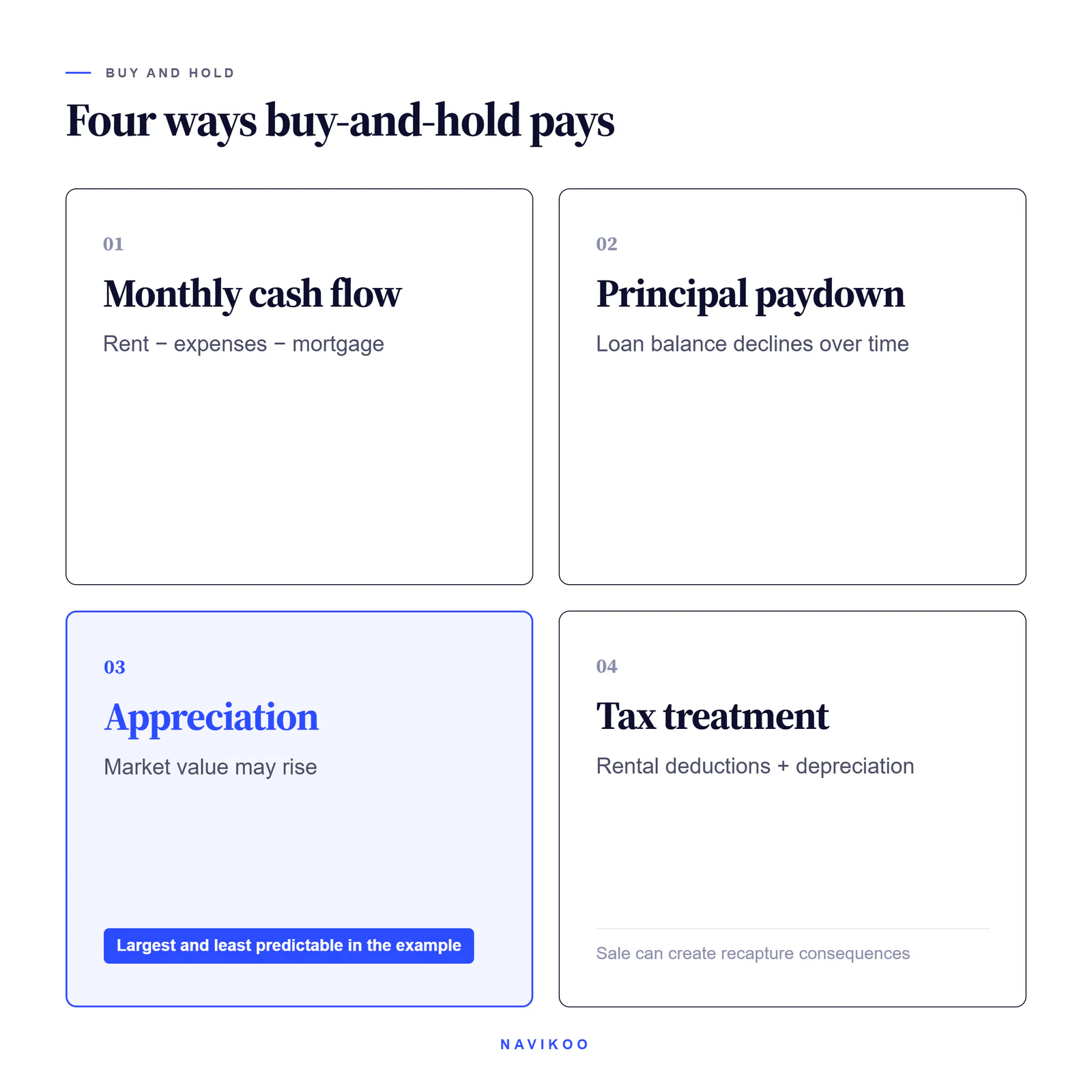
1. Monthly Cash Flow
Rental income minus operating expenses and mortgage payments is what lands in the owner’s account. It is the most visible number, and most investors screen deals on it first. In practice it is often modest in the early years, especially with a large loan, and it tends to grow as rents rise while a fixed-rate payment stays the same.
2. Principal Paydown
Every mortgage payment includes some principal. The tenant’s lease payments are, in effect, buying the property for the owner a little at a time. Early in a 30-year loan most of each payment goes to mortgage interest, so paydown starts slowly and accelerates.
3. Appreciation
Property appreciation is the increase in market value over time. It is the largest and least predictable of the four. Real estate has historically tended to rise in value over long periods in many US markets, but not everywhere, not every decade, and not in a straight line.
National house price indexes such as the FHFA House Price Index show both long upward trends and periods of decline, and individual metros vary widely.
4. Tax Treatment
Owners of rental property can generally deduct operating expenses, property taxes, and loan interest, and they can depreciate a residential building over 27.5 years. Depreciation is a non-cash deduction that can shelter part of the income from tax, though sale of depreciated property can create depreciation-recapture consequences.
The IRS guide to residential rental property covers the federal rules. The details depend on the owner’s income, participation, property use, and how the investment is held, so they belong with a tax professional rather than a rule of thumb.
A Ten-Year Buy and Hold Example
The numbers below are a hypothetical teaching example, not a forecast or a current real estate market benchmark. They are chosen to show how a buy and hold investment property that roughly breaks even in year one can still produce a respectable long-term result, and what that result depends on.
The Purchase
An investor is buying a single-family rental for $260,000 with 25% down and a 30-year fixed-rate loan at an assumed 6.75%. Closing expenses are assumed at 3% of the price.
Year-one figures | Amount |
|---|---|
Down payment | $65,000 |
Closing costs | $7,800 |
Total cash invested | $72,800 |
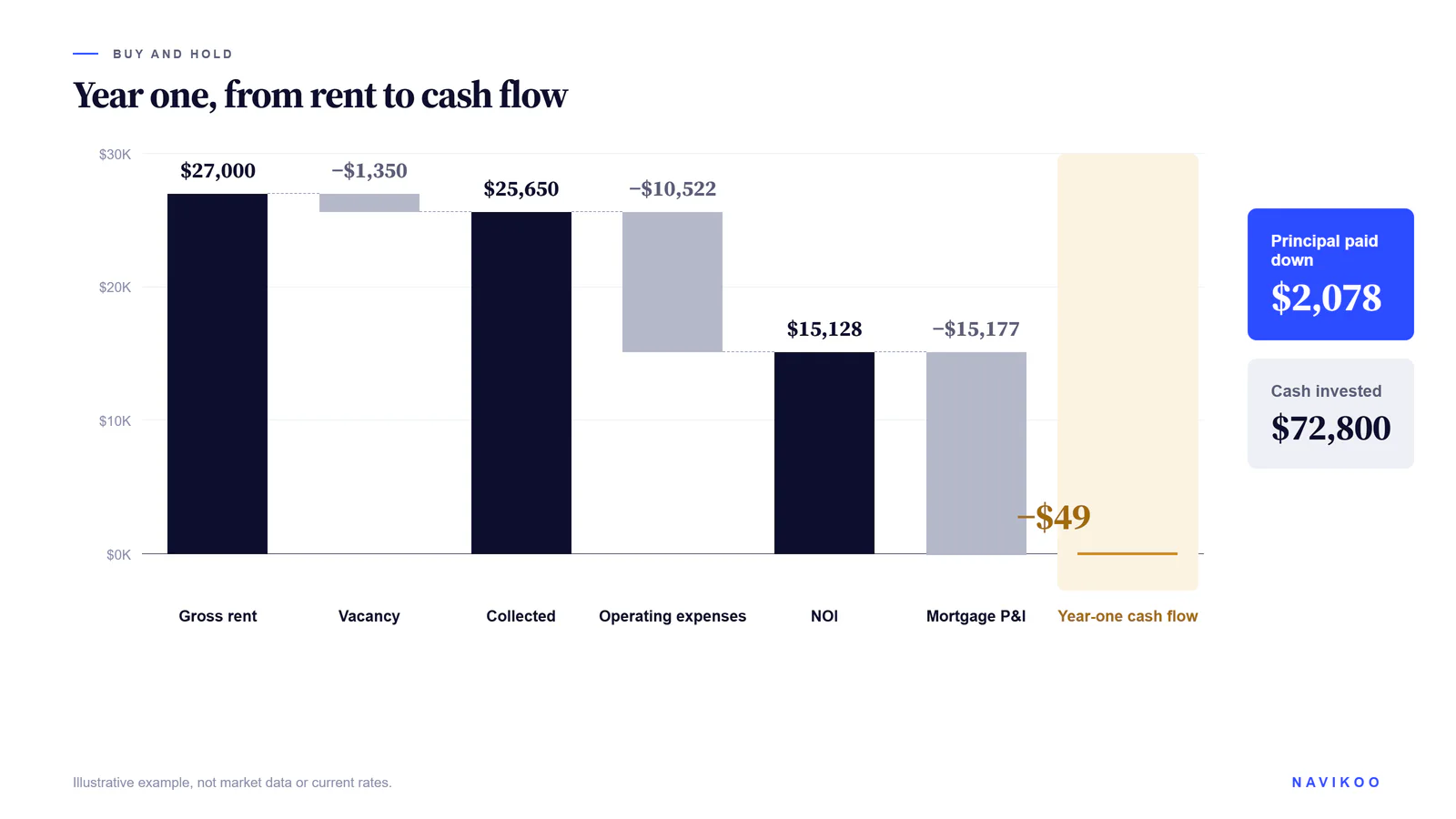
Gross rent ($2,250 × 12) | $27,000 |
Collected after 5% vacancy | $25,650 |
Operating expenses (taxes, insurance, maintenance, reserves, 8% management) | −$10,522 |
Net operating income | $15,128 |
Mortgage (principal and interest) | −$15,177 |
Year-one cash flow | −$49 |
Principal paid down in year one | $2,078 |
At first glance this deal earns nothing. The owner’s monthly result is a rounding error below zero, and a quick yield screen would reject it. Yet the tenant has already retired $2,078 of the loan, and that figure grows every year.
Ten Years Later
Assume rents and operating expenses both rise 3% a year, the property appreciates 3% a year, and the owner sells after ten years, paying 7% in selling fees and commissions.
Source of profit | Ten-year total |
|---|---|
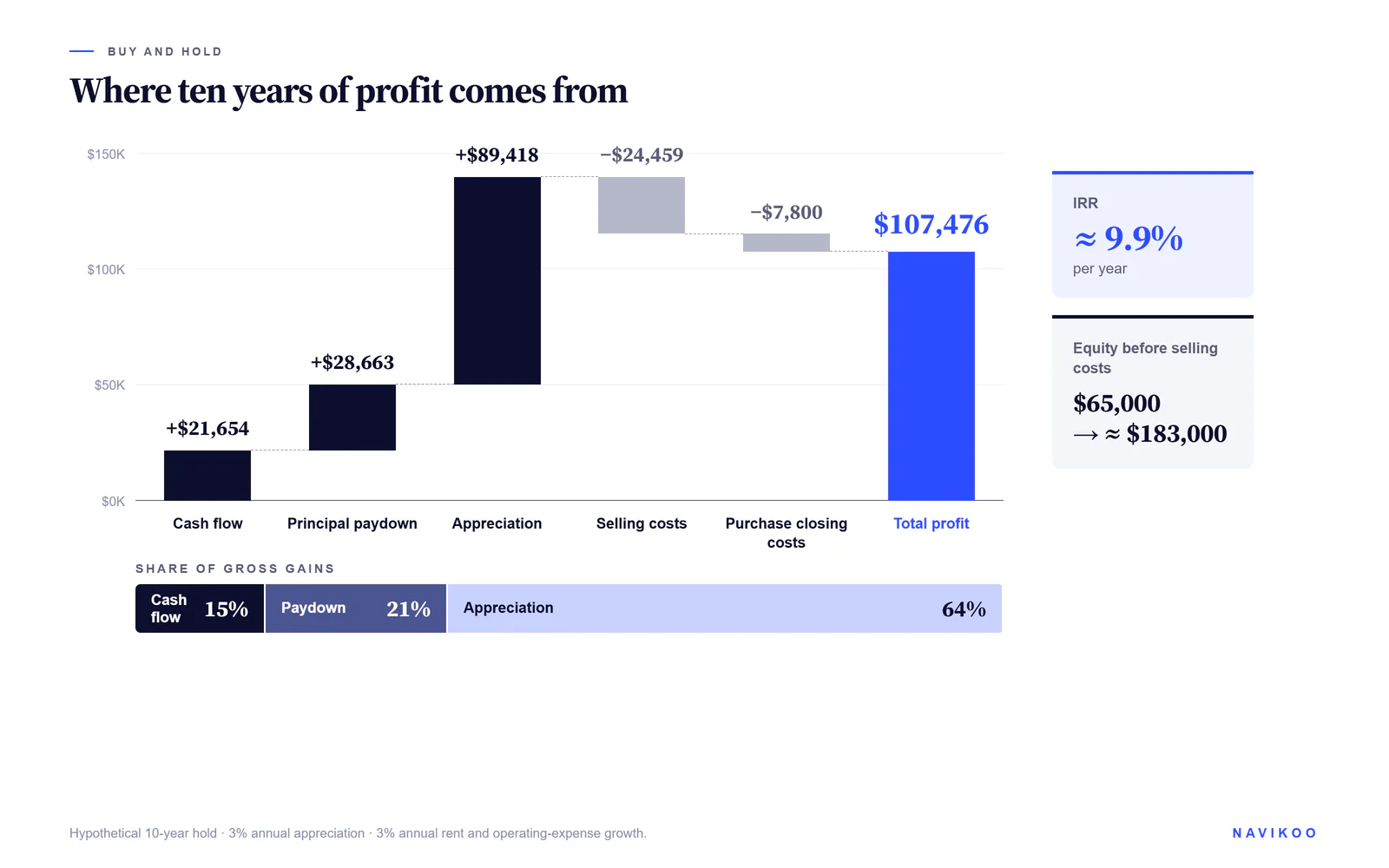
Cumulative cash flow | $21,654 |
Principal paydown | $28,663 |
Appreciation ($260,000 to $349,418) | $89,418 |
Selling costs at 7% | −$24,459 |
Purchase closing expenses | −$7,800 |
Total profit on $72,800 invested | $107,476 |
That works out to an internal rate of return of about 9.9% a year, before income taxes. The annual surplus contributes only about 15% of the gross gains; appreciation contributes the majority. The investor’s equity grows from $65,000 at purchase to about $183,000 before selling fees.
This is the part of buy and hold that year-one metrics miss. Judged only on its first twelve months, the property looks weak. Judged over the full holding period, the combination of rental income, principal reduction, and assumed appreciation more than doubles the original cash invested.
What Changes the Answer
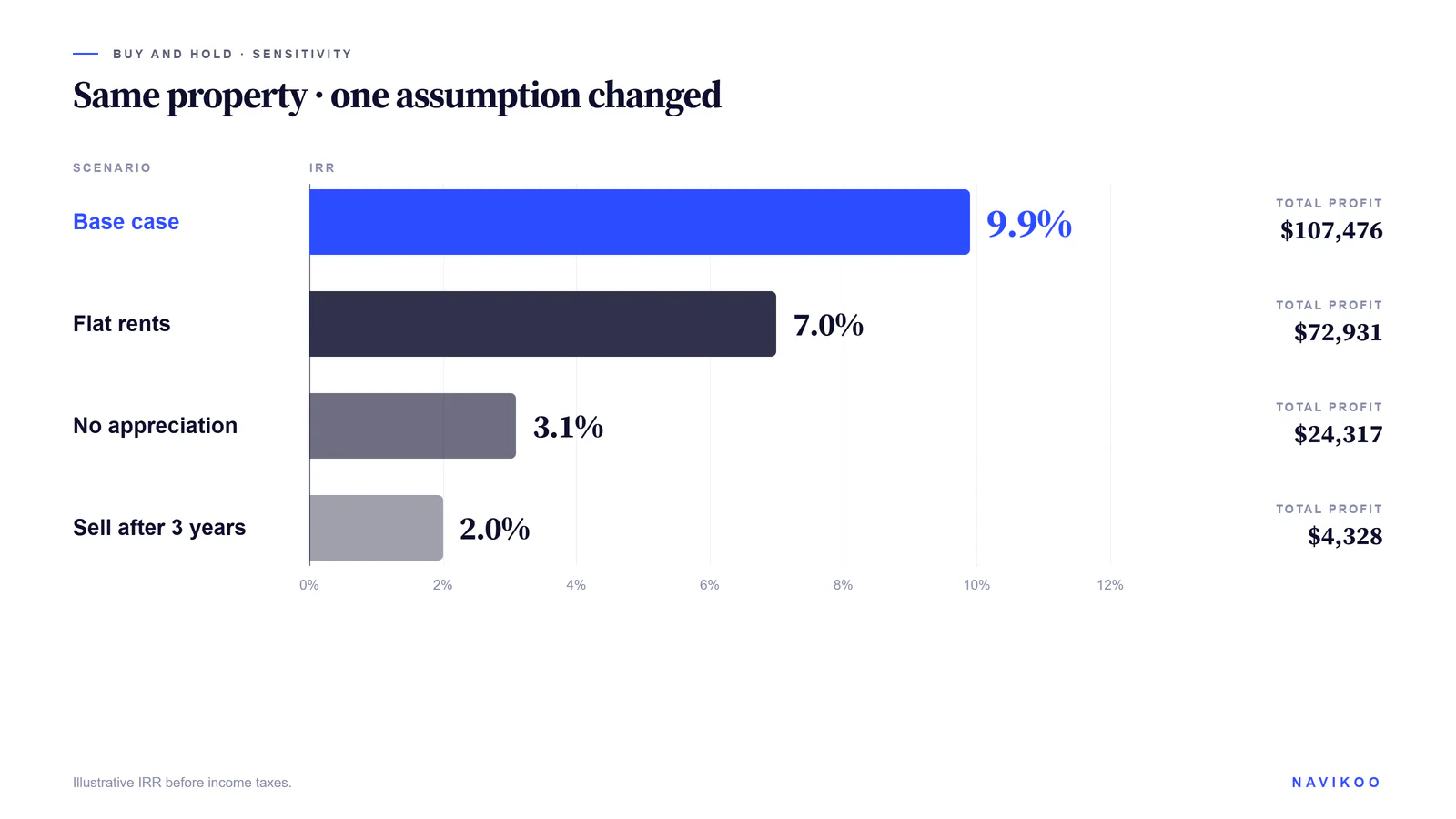
The same property, with one assumption changed at a time:
Scenario | Total profit | Annual IRR |
|---|---|---|
Base case: 3% appreciation, 3% rent growth, 10-year hold | $107,476 | 9.9% |
No appreciation | $24,317 | 3.1% |
Rents flat for ten years, expenses still rising 3% | $72,931 | 7.0% |
Sold after three years | $4,328 | 2.0% |
Two lessons stand out. First, appreciation carries the base case, so a buy and hold investment that only works with appreciation is relying heavily on the market rather than the property's current economics. Second, time matters as much as any input: a three-year hold earns almost nothing because buying and selling costs consume the early gains.
Investors can test their own purchase price, rents, expenses, and financing in Navikoo’s free rental property calculator before making an offer.
Is Buy and Hold Still a Good Strategy?
For investors with a long horizon and stable finances, the logic of the buy and hold strategy is straightforward: rental income can help fund loan paydown, while a fixed-rate mortgage keeps scheduled principal and interest unchanged. That combination is one reason real estate is often described as a hedge against inflation. Rents and property values may rise during inflationary periods while a fixed nominal mortgage is repaid in cheaper dollars, but operating costs can rise too.
The margin for error changes with borrowing and operating costs. Higher borrowing rates, insurance premiums, property taxes, and maintenance can squeeze the surplus on new purchases. The hold strategy works best over a long holding period when the price is justified by today’s rent rather than tomorrow’s appreciation.
Compared with traditional savings accounts or an index fund, buy and hold real estate asks more of the owner in exchange for leverage and control, and turns a passive investment into a part-time business. Weighing the pros and cons depends less on market conditions in a given year than on whether the investor can keep the property through a vacancy, a major repair, or a downturn without being forced to sell.
Do I Need a Large Down Payment for This Strategy?
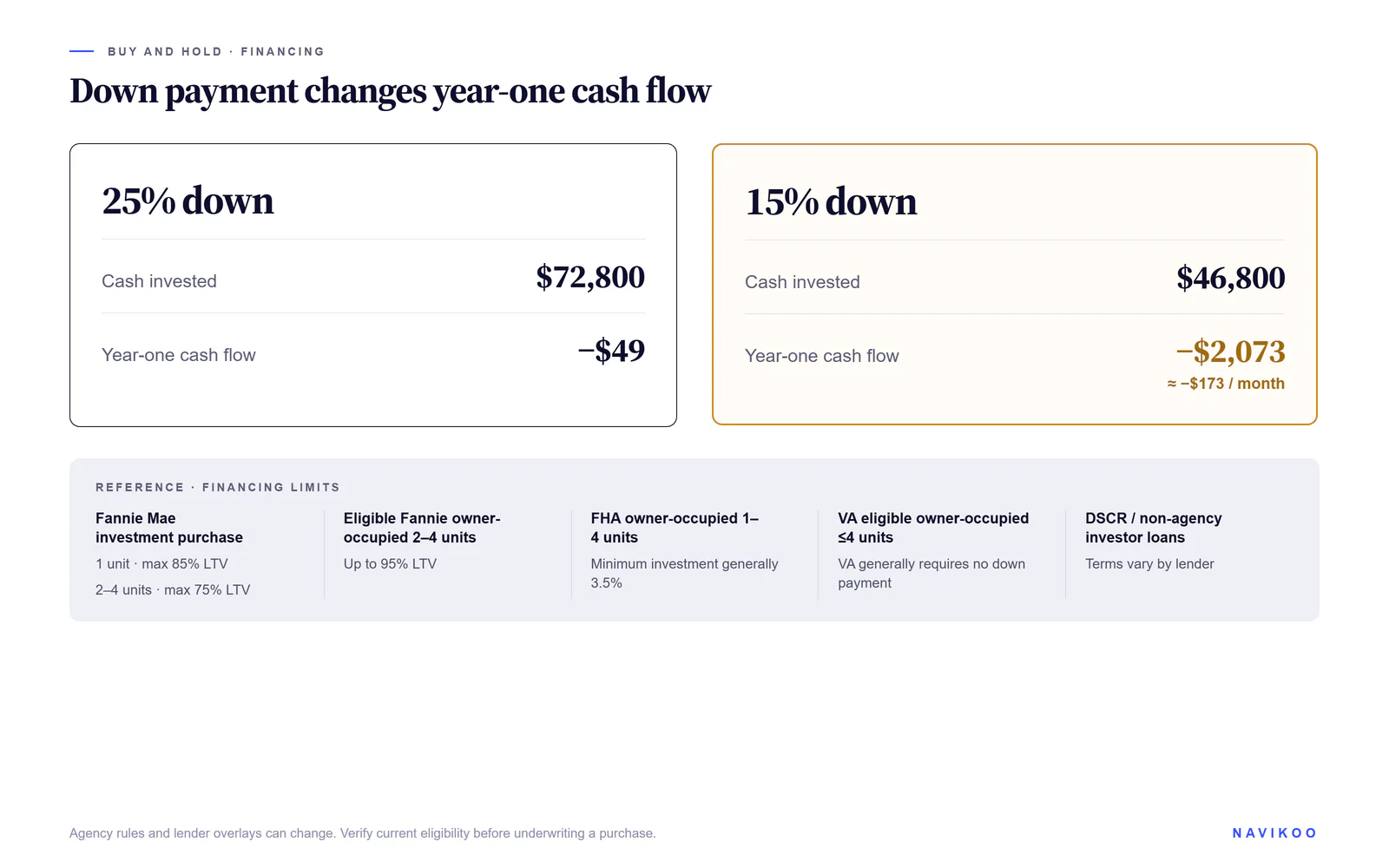
Not always, but the down payment changes how the investment performs. Conventional financing for an investment property generally requires more equity than a loan on a home the owner lives in. Under Fannie Mae's current eligibility matrix, the maximum purchase LTV is 85% for a one-unit investment property and 75% for a two- to four-unit investment property, equivalent to minimum down payments of 15% and 25% before any stricter lender requirements.
There are lower-down-payment routes, each with conditions:
Owner-occupied two- to four-unit property: FHA and conventional loans can allow much smaller down payments if the buyer lives in one unit, which is the basis of house hacking. Current Fannie Mae conventional guidance permits up to 95% LTV on eligible owner-occupied 2–4 unit purchases, while FHA generally requires a 3.5% minimum investment for eligible borrowers.
VA loans: Eligible veterans can buy an owner-occupied property of up to four units, and VA itself generally does not require a down payment, although lender, entitlement, appraisal, and underwriting requirements still apply.
DSCR lenders: These qualify largely from the property’s income and debt coverage rather than the borrower’s personal income. Down payment, reserve, credit, and pricing requirements vary by lender; unlike traditional mortgages, they are generally non-agency investor products.
A partner: An investor with capital can contribute the down payment in exchange for a share of the profits and ownership.
A smaller down payment raises leverage and therefore raises both the potential profit on money invested and the investment’s risk. In the example above, putting 15% down instead of 25% cuts the cash needed from $72,800 to $46,800, but year-one cash flow falls from −$49 to about −$2,073, so the owner must feed the property roughly $173 a month. That is manageable for some investors and a source of forced sales for others.
What Are the Disadvantages of a Buy and Hold Strategy?
The advantages and disadvantages of a buy and hold strategy are not symmetrical. The advantages build quietly; the disadvantages arrive as specific, sometimes expensive events.
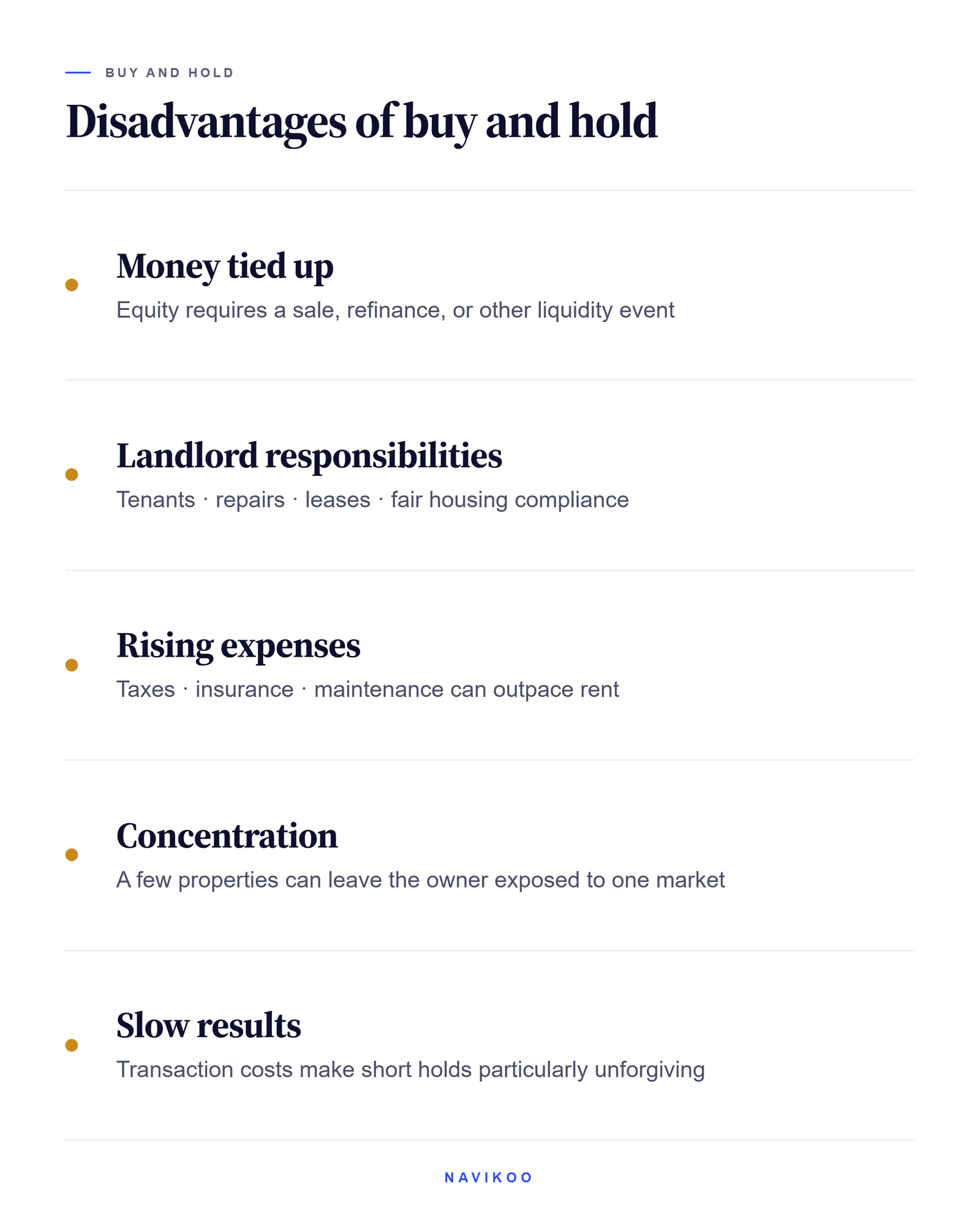
Money Tied Up for Years
Rental real estate is an illiquid investment. Money stored in a property cannot be spent without selling or refinancing, both of which take money and time. An investor who may need those funds within a few years should think carefully before choosing a hold strategy.
Landlord Responsibilities
Owning rentals means screening tenants, handling repairs, enforcing leases, and following fair housing and local landlord-tenant law. Those duties do not disappear in a bad year, and they multiply with each property added.
Rising Expenses Outside Your Control
Taxes, insurance, and maintenance tend to rise over time, sometimes faster than rents. The flat-rent scenario above cut total profit by about a third. Owners should budget reserves rather than assume today’s bills will stay where they are.
Concentration and Local Market Risk
A small real estate portfolio is concentrated in a few buildings and often a single market. A major employer leaving, an oversupply of new rentals, or a change in local regulation can affect every property at once.
Slow Results
Most of the gains come late. Investors who measure success by year-one income can underestimate the role of holding period, which, as the three-year scenario showed, is when this real estate strategy pays least.
Choosing the Right Property for a Buy and Hold Strategy
Types of Properties
Single-family homes are often straightforward for beginners to understand, finance, and resell, and they can attract longer-term tenants. Condos and townhomes can be cheaper to buy but add homeowners association fees and rules that can limit renting. Multifamily properties of two to four units spread vacancy risk across several tenants and can qualify for residential financing, while larger buildings move into commercial real estate lending.
Research the Market Before the Price
A sound real estate investment strategy for the long term starts with the location, not the listing. Market research should look at job and population trends, rent relative to prices, local tax rates, insurance premiums, and landlord rules. A market analysis that shows the property covering its expenses at today’s prices matters more than a forecast of future appreciation.
Property Condition
Buying an older home at a discount can look attractive until the roof, HVAC system, and plumbing all need replacing within the same decade. An inspection that estimates the remaining life of major systems is worth more in a buy and hold investment than on a flip, because the owner will pay for every replacement.
Property Management: Self-Manage or Hire
Self-managing an investment keeps more of the income but requires time and local presence. A property management company commonly charges a percentage of collected rent plus possible leasing or renewal fees. Good property managers can reduce the owner's workload and may improve leasing, collections, maintenance coordination, or tenant retention, but property management should be judged against actual results. For investors who want something closer to passive income, hiring a manager is one way to reduce day-to-day involvement.
The example above already includes an 8% management fee. Leaving it out would make the deal look better on paper and would understate the true expense of owning the rental once the investor’s own time is counted. Good property management also protects the asset’s long-term condition, which is where a buy and hold owner’s equity ultimately sits.
Growing From One Rental to Several
Many investors expand their real estate investing by repeating the first purchase, using savings and rising equity to fund the next down payment. Some use a cash-out refinance after values rise; others buy properties that need light renovations and add value before renting. Each strategy speeds growth, and each adds leverage, so the reserves that protect one property need to grow with the number of doors.
The diversification question also matters. Rental real estate can be a solid part of an investment portfolio, but holding all of one’s net worth in a few local buildings is a concentrated position. Weighing direct rentals against other investment options, including REIT funds and retirement accounts, is part of deciding how large a role real estate investing should play.
Owners managing several holdings can monitor rents, expenses, and loan balances in one place with Navikoo’s portfolio tracker. Tracking each investment’s actual results against its original projections is the most reliable way to learn which real estate purchases are performing and which assumptions were too optimistic.
Before You Buy
The test for any buy and hold purchase is whether the owner can keep it for ten years under reasonable stress. Investors should run the numbers at today’s rent, with realistic vacancy, full management fees, and reserves for capital repairs. Then remove appreciation from the model and see whether the investment still makes sense on rental income and loan paydown alone.
If it does, appreciation becomes upside rather than a requirement, and time works in the owner’s favor. If it does not, the deal depends more heavily on the market cooperating. Over the long run, a group of investments that can survive conservative assumptions is more resilient than one built on optimistic forecasts.