Value-Add Property Investing: How Renovations Create NOI and Property Value
Value-add real estate focuses on improving a property's income, reducing expenses, and creating measurable value through better operations and targeted renovations. Learn how investors use yield on cost, NOI growth, rent premiums, and exit cap rates to determine whether a value-add deal actually works.

A value-add property is one where an investor can improve the economics through work the current owner has not completed. That opportunity might come from deferred maintenance, below-market rents, vacant units, inefficient operating expenses, or improvements the local rental market will actually pay for.
For larger income-producing properties, the financial logic is especially important. Improvements that create sustainable net operating income (NOI) can influence property value through the capitalization rate.
At a 6% cap rate, one additional dollar of sustainable annual NOI implies roughly $16.67 of additional value, all else equal.
That relationship is what makes value-add investing strategies attractive, but it also explains why these projects are sensitive to assumptions about rent, expenses, construction costs, and exit pricing.
What Counts as a Value-Add Property
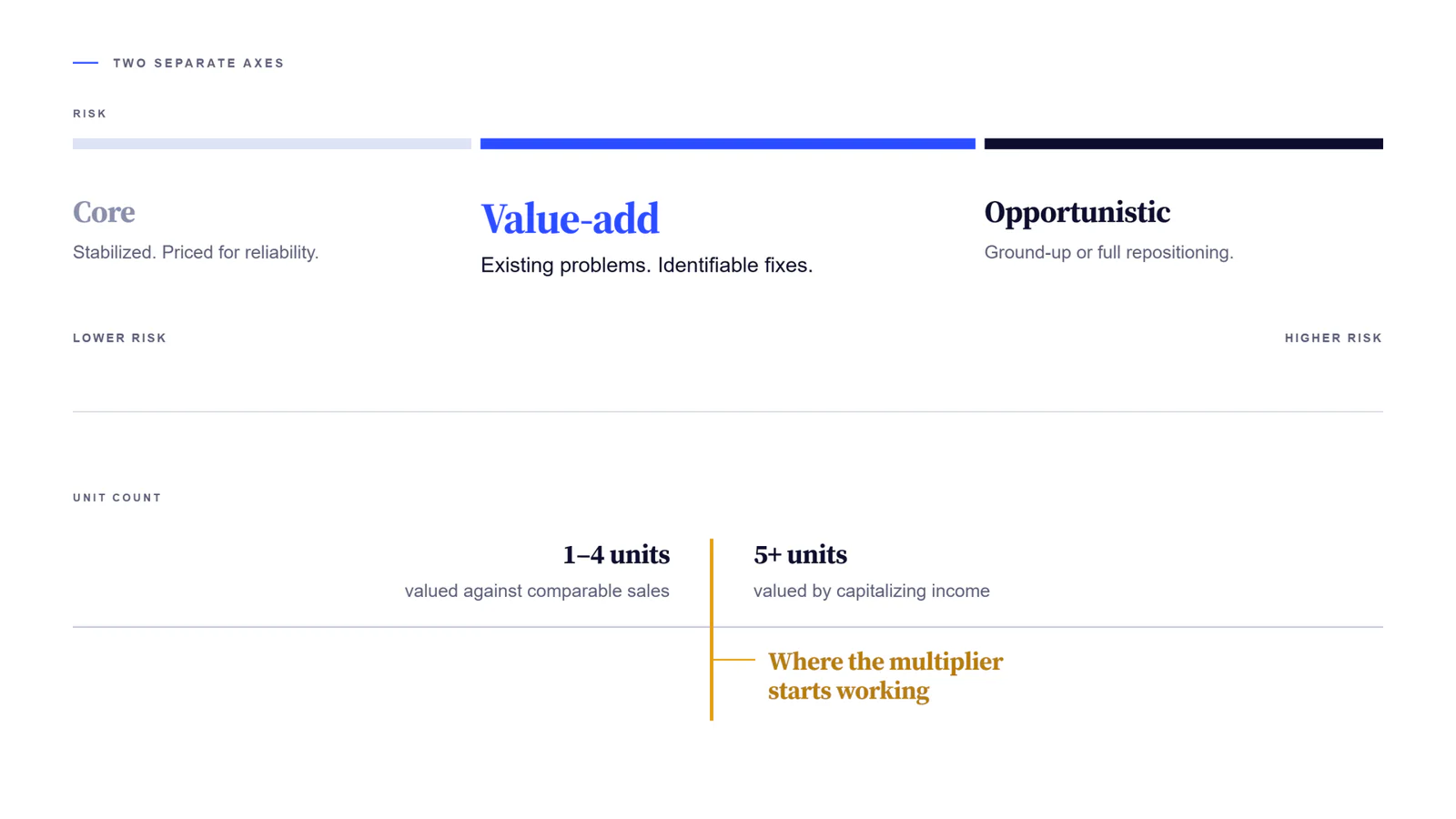
Value-add sits between stabilized investments and more speculative development strategies.
A core asset is typically stabilized, well occupied, and purchased primarily for dependable income. Opportunistic investments may involve ground-up development, major repositioning, or properties requiring substantial structural or operational change.
A value-add investment sits between those two.
The property already exists and usually produces some income, but the investor believes specific improvements can increase that income, reduce recurring expenses, improve occupancy, or otherwise strengthen the asset.
Where It Sits Among Real Estate Strategies
Value-add investing generally requires more execution than buying a stabilized property.
The investor may need to manage:
renovations
lease expirations
tenant turnover
operating changes
financing during construction
stabilization after the work is completed
That makes the strategy more dependent on execution skill than a stabilized acquisition.
Investors with construction experience, reliable contractors, strong property management, or operational expertise may have an advantage because more of the projected return depends on carrying out the business plan successfully.
Investors looking primarily for immediate passive income may find the first part of the hold less attractive because renovation and lease-up can temporarily reduce cash flow.
How Value Actually Gets Created: Opportunities
The Three Levers
Most value-add plans rely on some combination of three economic levers:
Increase revenue.
Raise rents where the market supports it, improve occupancy, reduce concessions, or create additional rentable space.
Reduce recurring operating expenses.
Improve utility recovery, renegotiate vendor contracts, reduce unnecessary management costs, or improve operating efficiency.
Improve the physical property.
Renovations matter when they support a measurable economic result such as higher rent, better occupancy, lower turnover, reduced maintenance, or lower future capital needs.
The physical renovation is therefore not necessarily the end goal.
It is usually a means of changing the property's economics.
An expensive improvement that produces no measurable effect on rent, occupancy, retention, expenses, or future capital requirements may improve the building without improving the investment.
Why the Multiplier Only Applies Above Four Units
The NOI-to-value relationship becomes much more direct in five-plus-unit multifamily because income-based valuation usually carries greater weight.
For properties containing one to four residential units, comparable residential sales generally have more influence on appraised value. Income can still matter, especially for an investment property, but an additional dollar of NOI does not translate as mechanically into appraised value.
For a five-plus-unit multifamily property, buyers and appraisers typically pay much closer attention to:
rent roll
NOI
market cap rates
occupancy
lease structure
That is why improving sustainable NOI can have a more direct effect on value in commercial multifamily.
The market still determines the capitalization rate, and comparable transactions still matter. The difference is that operating performance becomes much more central to the valuation.
A Worked Value-Add Deal
The figures below are illustrative teaching assumptions rather than market data.
Suppose an investor acquires a multifamily property for:
$1,400,000
The property currently produces:
$91,000 of NOI
That represents a going-in cap rate of approximately:
$91,000 ÷ $1,400,000 = 6.50%
The business plan includes $360,000 of renovations and improvements.
Total project cost becomes:
$1,400,000 + $360,000 = $1,760,000
After renovation and stabilization, projected NOI reaches:
$132,000
Yield on Cost Against the Prevailing Cap Rate
Yield on cost measures stabilized NOI against the total amount invested in the project.
Yield on Cost = Stabilized NOI ÷ Total Project Cost
For this example:
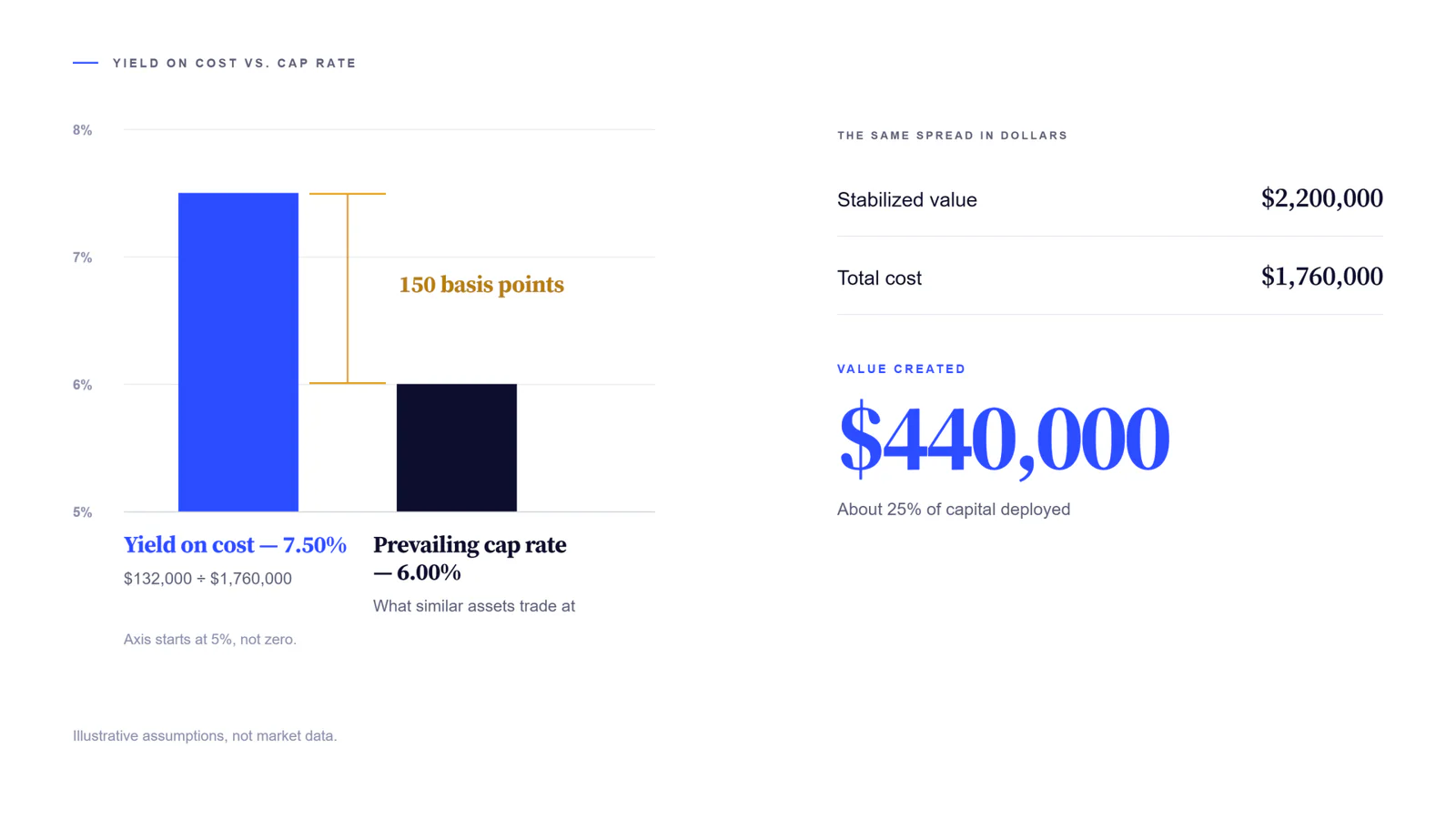
$132,000 ÷ $1,760,000 = 7.50%
Now assume comparable stabilized properties trade around a 6.0% cap rate.
The indicated stabilized value would be:
$132,000 ÷ 0.06 = $2,200,000
That creates a spread between:
7.50% yield on cost
6.00% market cap rate
The difference is 150 basis points.
In dollar terms:
$2,200,000 − $1,760,000 = $440,000
That $440,000 should be viewed as indicated value above total project cost, not guaranteed profit.
It does not automatically account for:
financing costs
lender fees
interest during renovation
acquisition costs not included above
selling costs
taxes
additional carrying expenses
delays during stabilization
The spread is still useful because it shows whether the operating plan appears to create enough value to justify the work and risk.
What the Spread Has to Cover
The 150-basis-point spread also provides a cushion against assumptions moving in the wrong direction.
Construction may cost more than expected.
Renovated units may take longer to lease.
Market rents may not reach the underwritten level.
Interest expense may rise.
The exit cap rate may be higher than expected.
A strong value-add deal should therefore produce enough spread that a modest miss in one assumption does not eliminate the entire return.
What Happens When the Assumptions Move
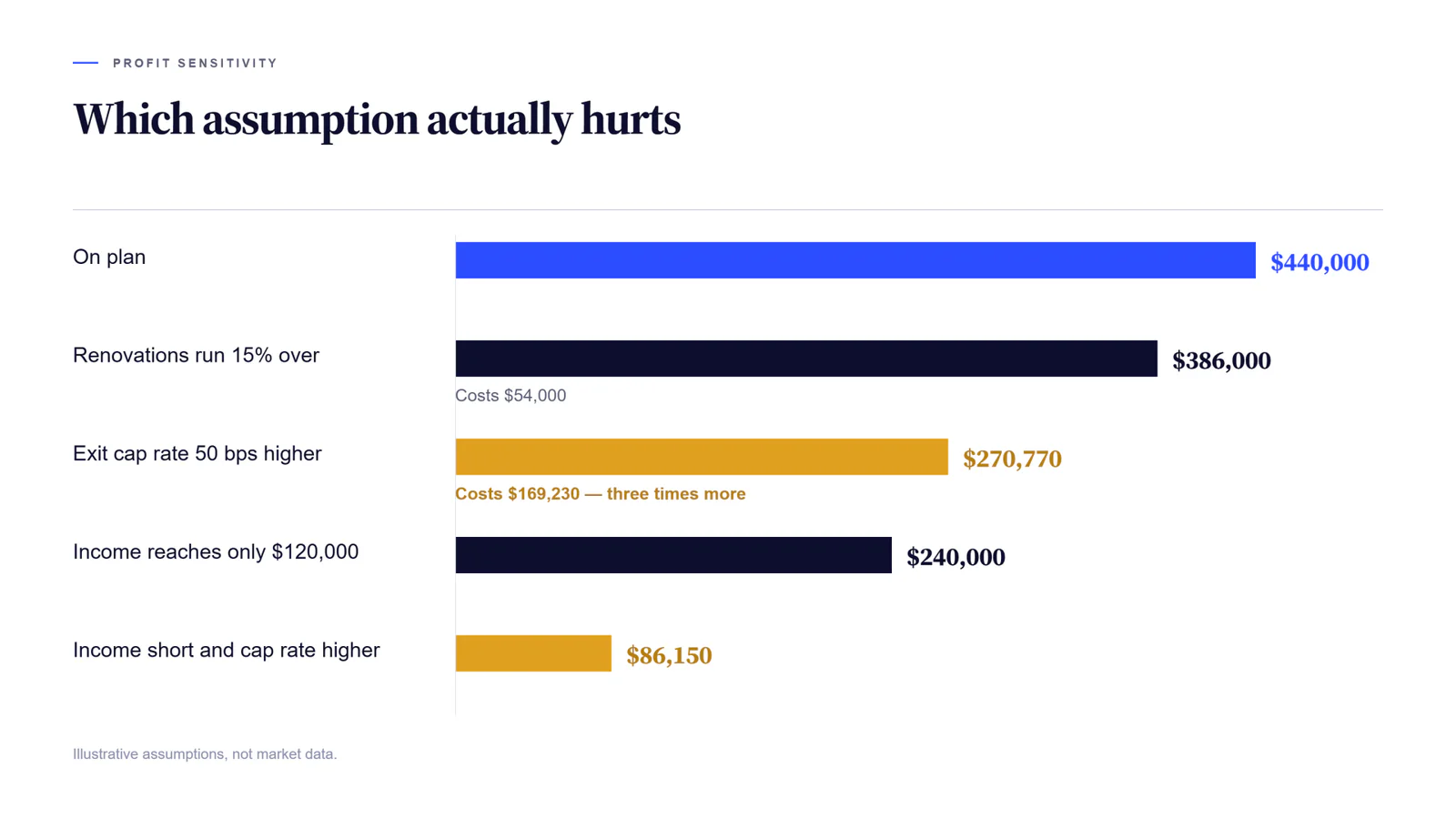
The downside becomes clearer when the major assumptions are tested independently.
Scenario | Stabilized Value | Total Cost | Value Above Total Cost |
|---|---|---|---|
On plan | $2,200,000 | $1,760,000 | $440,000 |
Renovations run 15% over | $2,200,000 | $1,814,000 | $386,000 |
Exit cap rate is 50 bps higher | $2,030,770 | $1,760,000 | $270,770 |
NOI reaches only $120,000 | $2,000,000 | $1,760,000 | $240,000 |
NOI falls short and cap rate is higher | $1,846,150 | $1,760,000 | $86,150 |
In this example, exit pricing creates the largest single decline.
A 15% renovation overrun adds:
$54,000
to project cost.
But moving the exit cap rate from 6.0% to 6.5% reduces the indicated stabilized value by roughly:
$169,230
That does not mean exit cap rate will always be the most important variable. The ranking changes depending on renovation size, leverage, holding period, income growth, and the magnitude of each downside case.
It does show why exit pricing deserves the same level of stress testing as construction.
The investor can influence property operations and renovation execution.
Market cap rates are largely driven by factors the investor cannot control directly, including interest rates, capital availability, investor demand, and broader market conditions.
Which Renovations Actually Create Value for Real Estate Investors?
For value-add underwriting, the strongest improvements are those with a measurable economic effect.
That may come from:
higher rent
lower vacancy
better tenant retention
reduced operating expenses
lower maintenance
reduced future capital requirements
The Test That Decides
Consider a $6,000 unit renovation that supports an additional $85 per month in rent.
Annual additional gross rent is:
$85 × 12 = $1,020
Assume vacancy and management reduce the amount reaching NOI to approximately:
$891 annually
The incremental NOI return on the renovation cost is:
$891 ÷ $6,000 = 14.9%
At a 6% cap rate, that sustainable $891 of additional NOI implies approximately:
$891 ÷ 0.06 = $14,850 of value
The economics therefore look attractive if the rent premium is genuinely supported by the market.
Now consider a $30,000 amenity.
If the amenity produces no measurable increase in:
rent
occupancy
retention
operating efficiency
future capital savings
the underwriting should assume no value creation rather than invent one.
The improvement may still make the property more attractive, but the investor should be able to identify how that benefit enters the financial model.
Kitchens, bathrooms, flooring, in-unit laundry, and similar upgrades can support meaningful rent premiums in some markets.
They do not automatically pass the test.
The expected premium should be verified against comparable renovated units before the work is budgeted.
How to Improve Returns on a Value-Add Property
Several practices make the business plan easier to defend.
Sequence improvements around lease expirations.
Renovating occupied units often requires turnover, so the rent roll can determine the renovation schedule as much as contractor availability does.
Work on expenses as well as rents.
A sustainable $10,000 reduction in annual operating expenses can have the same NOI impact as $10,000 of additional recurring income.
Potential areas include:
utility billing
vendor contracts
property tax appeals
insurance shopping
maintenance systems
management efficiency
Not every saving will last indefinitely, so recurring savings should be distinguished from temporary ones.
Match financing to the business plan.
Once the property is stabilized, its NOI also affects how much permanent debt it can support through the debt service coverage ratio (DSCR).
Depending on the property and scope, investors may use bank financing, bridge loans, renovation loans, private capital, or other transitional financing during the improvement period before moving into longer-term debt after stabilization.
The important question is whether the financing term gives the property enough time to complete the work and stabilize.
A loan maturing before the project reaches stabilized NOI can force a refinance or sale at the wrong time.
Stress-test the exit at a higher cap rate.
If comparable assets trade at 6.0% today, test the deal at 6.5% or another defensible downside case.
A business plan that works only if today's pricing remains unchanged depends heavily on the market rather than on the operational improvements being made.
Which Markets Suit Value-Add Multifamily
Three conditions make a value-add thesis easier to defend.
The first is a visible spread between unrenovated and renovated rents.
If older units rent for $1,400 and comparable renovated units consistently lease for $1,650, the market provides evidence that renovation may support additional income.
The second is tenant demand capable of supporting that premium.
Local income, employment, vacancy, and new supply all influence how much additional rent the submarket can absorb.
A projected premium becomes less convincing if household incomes are stagnant while large amounts of competing inventory are being delivered.
The third is enough transaction activity to estimate exit pricing with reasonable confidence.
Recent comparable sales help investors understand the cap rates buyers are actually paying.
Thin markets create more uncertainty because fewer transactions are available to establish where a renovated property might trade at exit.
None of these conditions guarantees a successful investment.
Together they make the assumptions behind the plan easier to verify.
About That 90% of Millionaires Claim
The often-repeated claim that “90% of millionaires made their money in real estate” is frequently attributed to Andrew Carnegie, but a reliable source or methodology is difficult to establish.
It is better treated as a quotation than as investment evidence.
Real estate has undoubtedly created substantial wealth for many investors, but a value-add deal should stand on assumptions that can be examined directly:
purchase price
renovation cost
rent premiums
operating expenses
NOI
financing
exit value
Those numbers provide a stronger basis for a decision than an unverifiable statistic about how wealthy people supposedly became wealthy.
Key Benefits and Real Costs from Investors
Value-add investing can reward investors who have the time, liquidity, and operational ability to improve an underperforming property.
The potential benefits include:
faster equity creation than relying only on market appreciation
greater control over the property's operating performance
the ability to capture below-market rents
opportunities to improve recurring expenses
more influence over NOI at stabilization
The trade-offs are concentrated during the execution period.
Construction risk, lease-up risk, financing risk, operating risk, and exit pricing risk can all affect the same asset at the same time.
Cash flow may also fall during renovation or stabilization, depending on how much of the property is vacant while work is completed.
The strategy therefore fits investors who can absorb temporary disruption in exchange for the possibility of creating value through execution.
What to Verify Before Committing
Start with the rent premium.
Compare renovated units with actual recently leased properties whenever possible rather than relying only on asking rents.
The relevant question is not whether renovated units look better.
It is whether tenants in that submarket are consistently paying more for the difference.
Next, rebuild the renovation budget using contractor pricing rather than broad averages. Investors can start with a rehab cost estimator to organize the scope and preliminary budget, then validate the major line items with local contractor bids.
A broad per-unit allowance can help with early screening, but the final underwriting should reflect the actual scope of work and the uncertainty inside that scope.
Pay particular attention to items that are difficult to verify before construction begins.
Then test the exit.
If the base model uses a 6.0% exit cap rate, run the deal at 6.5% or another reasonable downside assumption.
If the projected return disappears under a modest increase in the exit cap rate, a significant part of the thesis depends on market pricing rather than operational improvement.
The same discipline applies to NOI.
Run the model with lower rents, higher vacancy, slower lease-up, or higher operating expenses.
Investors can test rent premiums, vacancy, operating expenses, financing, and stabilized NOI in Navikoo's Rental Property Calculator, then compare how different assumptions change cash flow and return.
The best value-add underwriting makes the source of the return easy to identify. If the project depends on improving NOI, the model should show exactly where that improvement comes from, what it costs to create, and how much room remains if the market does not cooperate.
Frequently Asked Questions About Value-Add Properties
What is a value-add property?
A value-add property is an existing real estate asset where an investor believes operational or physical improvements can increase income, reduce expenses, improve occupancy, or otherwise strengthen the property's economics.
How do renovations increase property value?
Renovations create value when they produce measurable economic benefits such as higher rent, lower vacancy, better retention, lower operating costs, or reduced future capital needs. In income-producing properties, higher sustainable NOI can support a higher valuation.
What is the difference between a value-add property and a stabilized property?
A stabilized property is generally operating near its intended occupancy and income level, while a value-add property still has identifiable opportunities to improve performance through renovation, lease-up, rent growth, or expense management.
How do you calculate value created from higher NOI?
A simplified income approach is:
Property Value = NOI ÷ Cap Rate
For example, $10,000 of additional sustainable NOI at a 6% cap rate implies about $166,667 of additional value, assuming the cap rate and other conditions remain unchanged.
What is yield on cost in a value-add deal?
Yield on cost compares stabilized NOI with total project cost:
Yield on Cost = Stabilized NOI ÷ Total Project Cost
It helps investors compare the return created by the business plan with prevailing market cap rates.
What is the biggest risk in value-add investing?
There isn't one universal risk. Construction overruns, slower lease-up, lower-than-expected rents, financing costs, operating changes, and a higher exit cap rate can all materially affect the outcome.