Fix and Flip Real Estate: How to Protect the Profit Before You Buy
Fix and flip real estate is more than buying low and selling high. Learn how ARV, renovation costs, financing, carrying expenses, and time determine the real profit on a flip, see a complete worked example, compare financing options, and stress-test a deal before making an offer.

Fix and flip real estate is a short-term real estate strategy: buy a property below its potential value, renovate it, and sell it for more than the full cost of buying, improving, financing, holding, and selling it.
Unlike a rental, the investment usually produces one payday at the exit. Until that sale closes, the project consumes cash. That is why the purchase-to-resale spread can be deceptive. ATTOM reported that the typical U.S. home flipped in the second quarter of 2026 generated a $60,526 gross profit and a 21.5% gross return, but its methodology defines gross profit as resale price minus purchase price. Renovation costs, financing, property taxes, insurance, utilities, and selling expenses sit outside that headline number. ATTOM
The better way to think about flipping is as three estimates that have to survive contact with reality: the resale value, the renovation budget, and time. A small miss in one can be manageable. A miss in all three can erase the entire margin.
What Flipping a House Actually Involves
A real estate flipping project moves through acquisition, planning, renovation, and resale. In flipping houses, most of the profit is determined before the first contractor arrives, because the purchase price sets how much room remains for every mistake that follows.
Finding and Buying the Property
Flip investors often target houses in disrepair, estate sales, foreclosures, tired rentals, and owners who value certainty or speed. An off-market lead can reduce competition, but private access does not make a property cheap. The approximate market value still has to be supported with comparable sales. An investor-focused real estate agent can help pull recent sold comps and identify neighborhoods where renovated homes actually attract buyers. Investors sourcing many leads can also track addresses, offers, follow-ups, and due-diligence tasks in Navikoo’s CRM and deal pipeline instead of rebuilding the process in spreadsheets for every house.
Planning the Scope Before Closing
A serious scope is more than “new kitchen, paint, floors.” Build one renovation plan with a contractor, separating required repair needs from upgrades, and price the scope line by line. A failing roof, foundation movement, sewer line, old electrical service, or new plumbing can change the deal far more than the finishes buyers see first.
This is also where Navikoo’s Rehab Cost Estimator can support the first pass. Use it to organize a preliminary scope and budget, then replace estimates with local contractor bids before committing capital.
The tool should speed up planning, not substitute for an inspection or contractor.
Renovating Without Losing the Schedule
Renovating is where a spreadsheet becomes a construction project. Permits, inspections, change orders, material lead times, contractor availability, and concealed conditions all move the completion date. Keep a contingency above the expected rehab budget and approve scope changes against the original budget rather than treating each change as an isolated decision.
Selling the Finished House
The finished property is usually listed with a real estate agent and marketed to owner-occupants. ATTOM reported a typical 161 days from purchase to resale for Q2 2026 U.S. flips. That is useful market context, not a project schedule: a simple cosmetic renovation can move faster, while structural work, permits, or a slow buyer market can extend the hold considerably. ATTOM
The Three Numbers That Decide a Flipping Project
After-Repair Value
After-repair value, or ARV, is the approximate market value of the property once planned renovations are complete. It should come from recent comparable sales of renovated homes with similar size, location, condition, bed/bath count, and features—not from the price an investor needs the project to reach. ARV is the most dangerous number to stretch because every other calculation sits beneath it. Build the comp set yourself or have an agent do it, then make adjustments conservatively.
This is a natural place for Navikoo’s Fix & Flip Calculator: keep the ARV beside the purchase price, rehab, financing, carrying, and selling assumptions so the deal is evaluated as one system rather than as five unrelated numbers.
Renovation Costs
The second number in a real estate flipping investment is the construction budget. Good estimates distinguish labor, materials, permits, dumpsters, contractor overhead, and the contingency reserved for unknowns. Cosmetic renovations are usually easier to price than structural repairs, additions, foundation work, major electrical changes, or sewer replacement.
Predictable repairs are valuable because the contractor can price them before demolition. A Free Rehab Cost Estimator is most useful here as a screening tool. If a property passes the first estimate, confirm the budget with bids and a written scope before closing.
Time
Time is a cost line in flipping, even though it never appears on a contractor invoice. Loan interest, property taxes, insurance, utilities, lawn care, security, and other carrying expenses continue while the project is delayed. A four-month schedule that becomes eight months can damage profit even if the renovation budget itself stays intact.
The 70% Rule in Flipping: Useful Filter, Weak Approval Test
The 70% rule is a familiar screen in real estate investing:
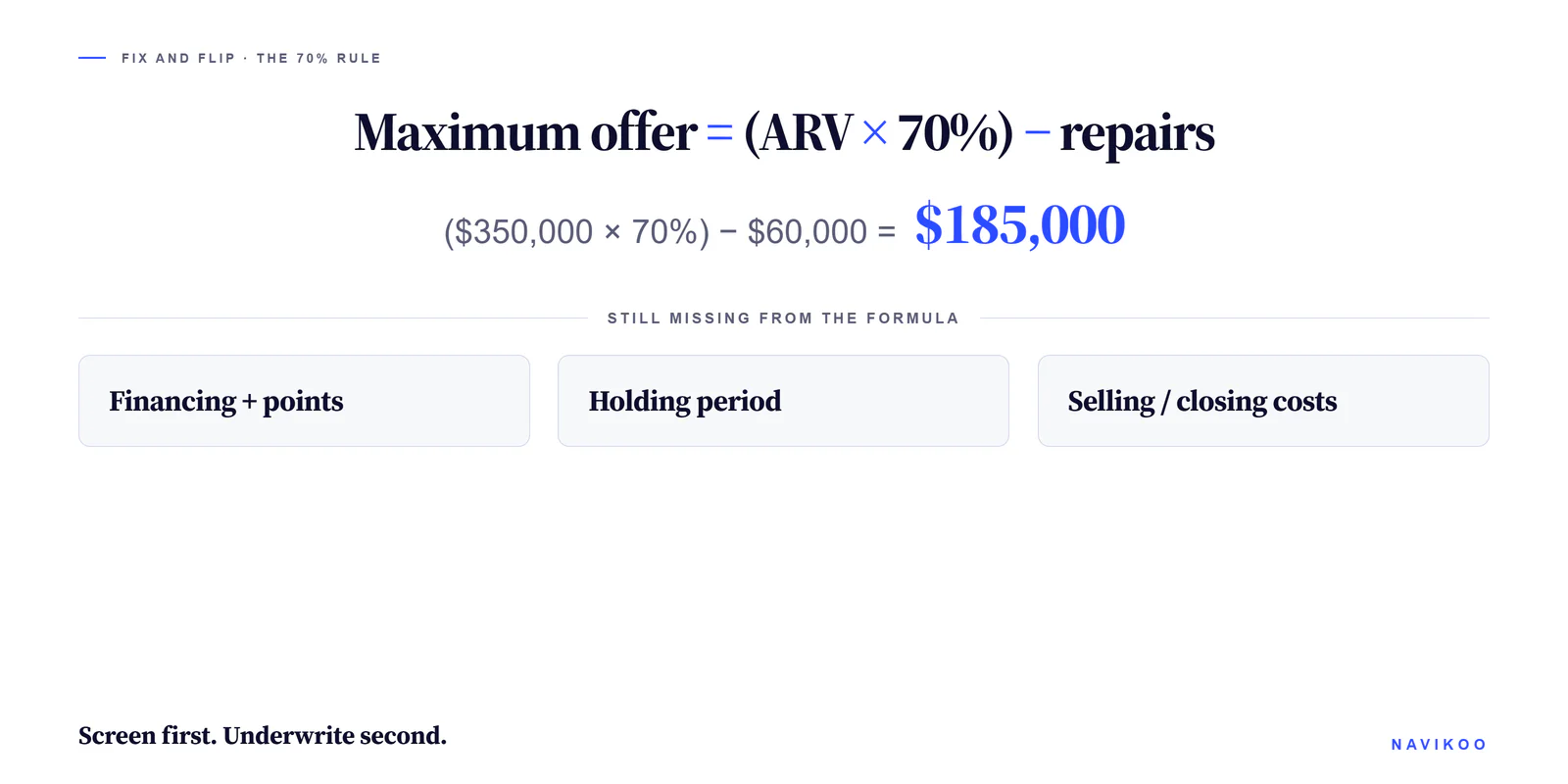
Maximum offer = (ARV × 70%) − repair costs
With a $350,000 ARV and $60,000 of repairs, the formula produces a $185,000 maximum offer. It is useful when hundreds of leads need to be screened quickly, because it forces some room between acquisition price and the rehab budget. It is not a substitute for full underwriting. The rule does not know the interest rate, loan points, expected hold, local transfer taxes, agent compensation, or how expensive it is to resell in that real estate market.
That is why a Fix & Flip Calculator should be the second step: use the 70% rule to reject obvious misses, then model the actual financing and exit costs on deals that survive.
A Worked Flipping Example, Line by Line
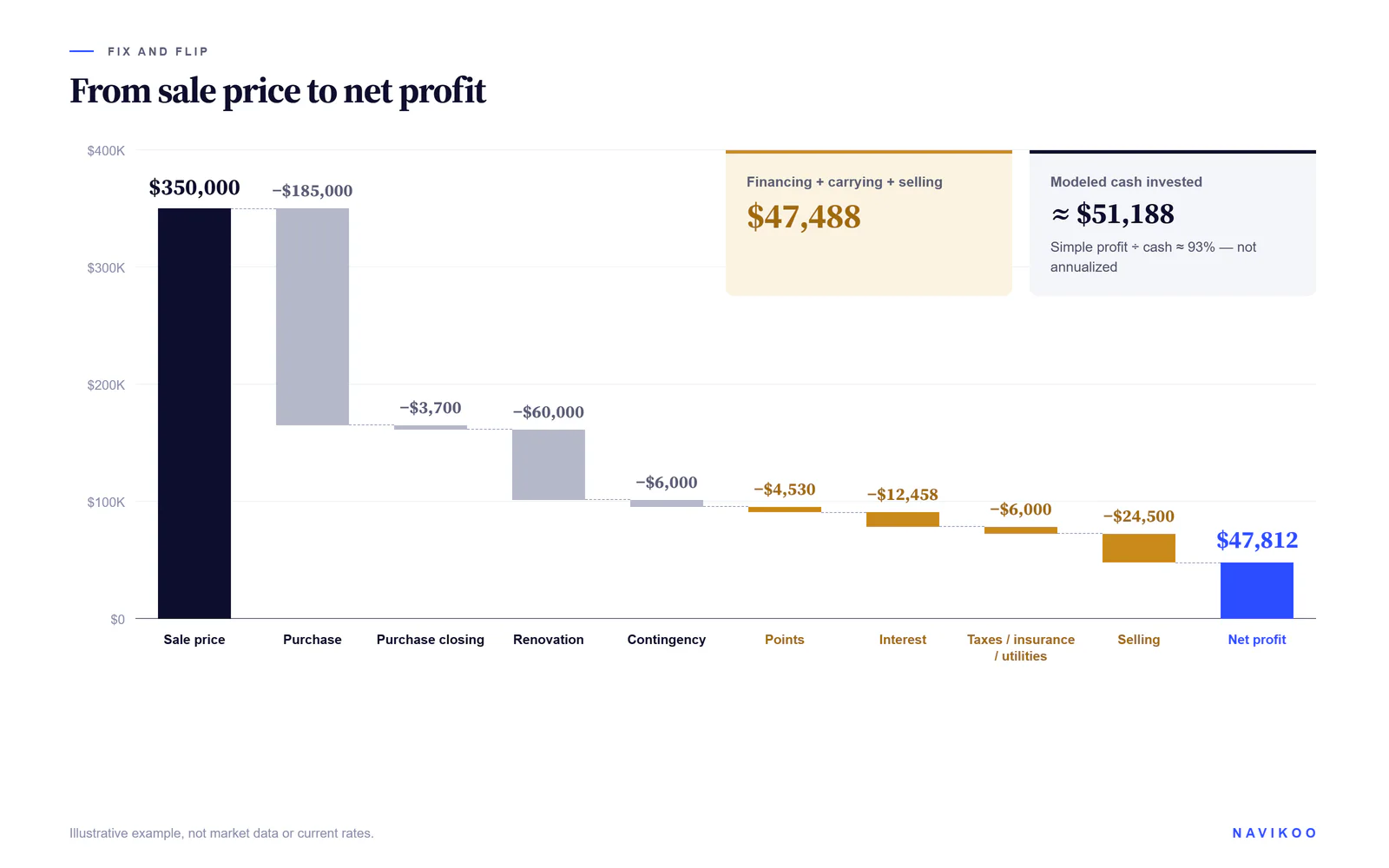
The figures below are hypothetical teaching assumptions, not current lender terms or a forecast. The real estate investment uses the same $350,000 ARV and $185,000 purchase price. A short-term lender finances 90% of the purchase and 100% of a $60,000 renovation budget. The assumed loan amount is $226,500 at 11% interest-only with 2 points. For simplicity, the example charges interest on the full loan balance for six months even though many real renovation loans fund rehab money through draws, which can change actual interest expense.
Line item | Amount |
|---|---|
Purchase price | $185,000 |
Purchase closing costs (2%) | $3,700 |
Renovation budget | $60,000 |
Contingency (10% of renovation) | $6,000 |
Loan points (2% of $226,500) | $4,530 |
Interest, 6 months at 11% | $12,458 |
Taxes, insurance, utilities (6 × $1,000) | $6,000 |
Selling costs (7% of $350,000) | $24,500 |
Total cost | $302,188 |
Sale price | $350,000 |
Net profit | $47,812 |
The flipping project creates a $165,000 gross purchase-to-sale spread, yet only $47,812 remains after the modeled costs. Financing, carrying, and selling expenses alone total $47,488—almost as much as the profit.
What the Investor’s Cash Is Doing
Because the loan covers most of the acquisition and all of the base construction budget, modeled cash outlay is about $51,188: the purchase down payment, closing costs, contingency, points, interest, and six months of carrying costs. Net profit divided by that cash is roughly 93%, before income taxes. That investment return is not an annualized expected return and it is not a reason to increase leverage. It shows the opposite: when relatively little equity supports a large project, a small loss in sale value can wipe out a large percentage of the investor’s own money.
Stress-Test the Flipping Deal Before the Offer
The most useful part of a flipping model is not the base case. It is what happens when ordinary problems show up.
Three Ordinary Misses
Scenario | Net profit | Margin on sale price |
|---|---|---|
Base case | $47,812 | 13.7% |
ARV 7% lower ($325,500) | $25,028 | 7.7% |
Renovation runs $12,000 beyond contingency | $35,812 | 10.2% |
Hold stretches from 6 to 10 months | $35,508 | 10.1% |
All three happen | $722 | 0.2% |
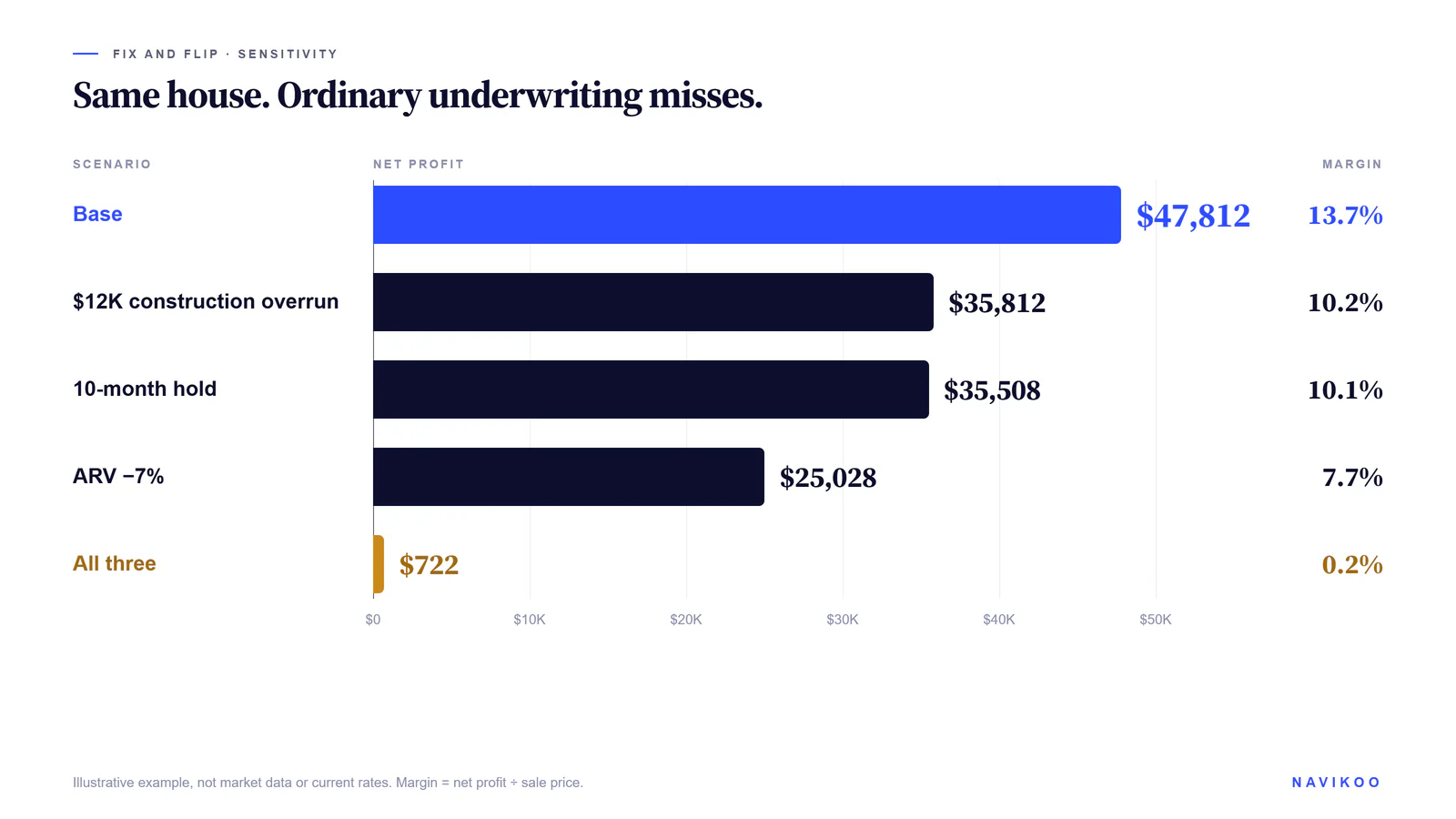
None of the misses is extreme. Comparable sales can support a lower price than expected; structural or new plumbing work can surface after demolition; the buyer can take longer to close. Together they reduce the modeled profit from $47,812 to $722.
Navikoo’s Fix & Flip Calculator is the natural place for flipping analysis like this. Change the sale price, rehab budget, financing, and hold period without rebuilding the spreadsheet. A real estate investment that remains profitable after two or three misses has more room for real-world execution.
Is Fix and Flip Risky?
Yes. The risks in flipping are concentrated because the project has one major exit and a short window to reach it.
Estimate Risk
ARV and rehab costs are both forecasts. Overstating the first while understating the second is the quickest path from projected profit to loss.
Time and Execution Risk
Every week of delay adds carrying cost and may push the listing into a different selling season. Contractor scheduling, inspections, permits, and material delays all matter, but so does the investor’s effort in making decisions quickly and keeping the renovation moving.
Market Risk
Flipping houses means the resale occurs in a future real estate market, not the one that existed when the property was purchased. Market downturns, higher buyer mortgage rates, new competing listings, or weaker demand can reduce the exit price or increase days on market.
Financing Risk
Flipping often relies on short-term financing with a maturity date. If the project is not sold, the investor may need an extension, refinance, or price reduction. The more leveraged the real estate investment, the less room there is for a lower sale price.
Financing Options for Flipping Houses
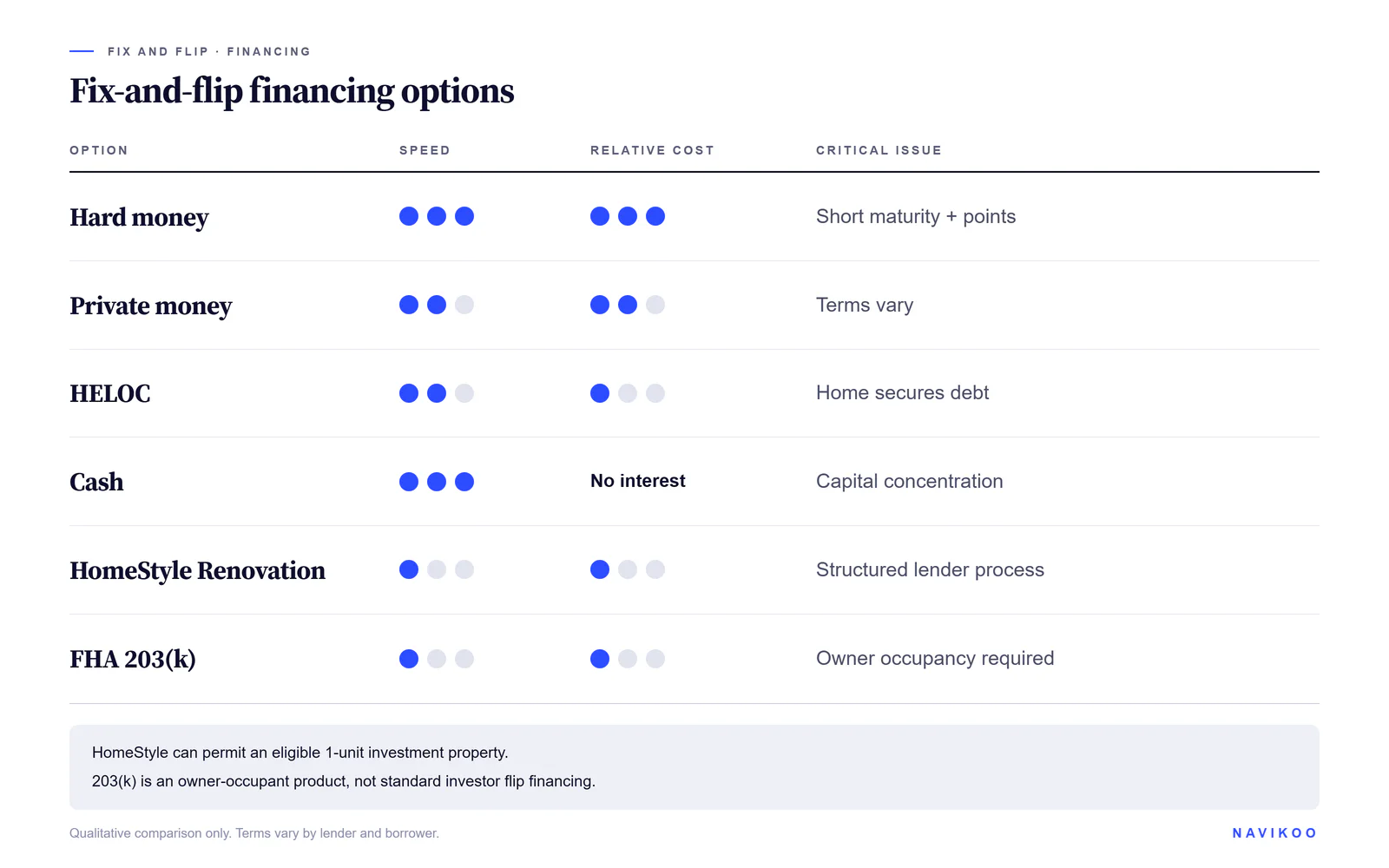
Financing options for flipping depend on speed, property condition, borrower strength, intended occupancy, and how much cash can be tied up.
Hard money: Fast, asset-focused financing often used by experienced flippers. Higher interest, points, draw controls, and short maturities make total cost more important than the quoted rate.
Private money: Capital from individuals or private groups on negotiated terms. Documentation and legal structure matter even when the lender is a friend or business contact.
Home equity lines: A HELOC can provide flexible capital, but the investor’s own residence may secure the debt. CFPB warns that failure to repay a HELOC can put that home at risk. Consumer Financial Protection Bureau
Cash: Removes interest and lender timing risk but concentrates more of the investor’s capital in one project.
Fannie Mae HomeStyle Renovation: Current Fannie Mae rules can allow a one-unit investment property, as well as eligible owner-occupied properties, to finance acquisition and renovations in one conventional mortgage. It is more structured and generally slower than hard money. Fannie Mae Selling Guide
FHA 203(k): Designed around eligible owner-occupants rather than a conventional investor flip. It can finance purchase and rehabilitation of qualifying 1–4 unit properties when FHA occupancy requirements are met. HUD
A Loan Calculator can compare payment and interest assumptions, but for a short-term project also enter points, lender fees, draw mechanics, extension costs, and the expected payoff month in the full flip analysis.
What Are the Best Houses to Flip?
There is no universal property type for flipping houses, but easier projects tend to have a deep pool of prospective buyers and repair scopes that can be estimated with reasonable confidence.
Strong Area, Weak House
A dated or poorly maintained property in a neighborhood with proven renovated sales is usually easier to underwrite than the best house in a weak location. The real estate investment discount should come from condition, not from needing the whole neighborhood to change.
Predictable Renovations
Paint, flooring, fixtures, kitchens, baths, landscaping, and other repeatable renovations are easier to estimate than foundation movement, large additions, fire damage, or major structural work. Complexity is not automatically bad, but it requires a larger margin and stronger planning.
A Layout Buyers Already Understand
Mainstream single-family layouts in a liquid price band often reach more buyers than highly unusual homes. The point is not that every project must have three bedrooms and two baths; it is that the final product should match what buyers in that neighborhood are already purchasing.
Enough Comparable Sales
A flip without relevant renovated comps is difficult to value before purchase and difficult for the eventual buyer’s appraiser to support. More comparables narrow the range around the expected resale price.
Clean Title and Permits
Title issues, unpermitted additions, open permits, or unresolved code problems can delay both renovation and resale. Resolve these questions during due diligence rather than at the closing table.
ATTOM’s Q2 2026 flipping data also shows why “cheap” is not the same as “good.” Homes purchased between $100,000 and $200,000 produced a typical 28% gross margin, while properties bought for $50,000 or less produced a typical $15,000 loss and −38% gross return. Those are national gross figures, not a buying rule. ATTOM
Which Cities Are the Best for Fix-and-Flip Houses in 2026?
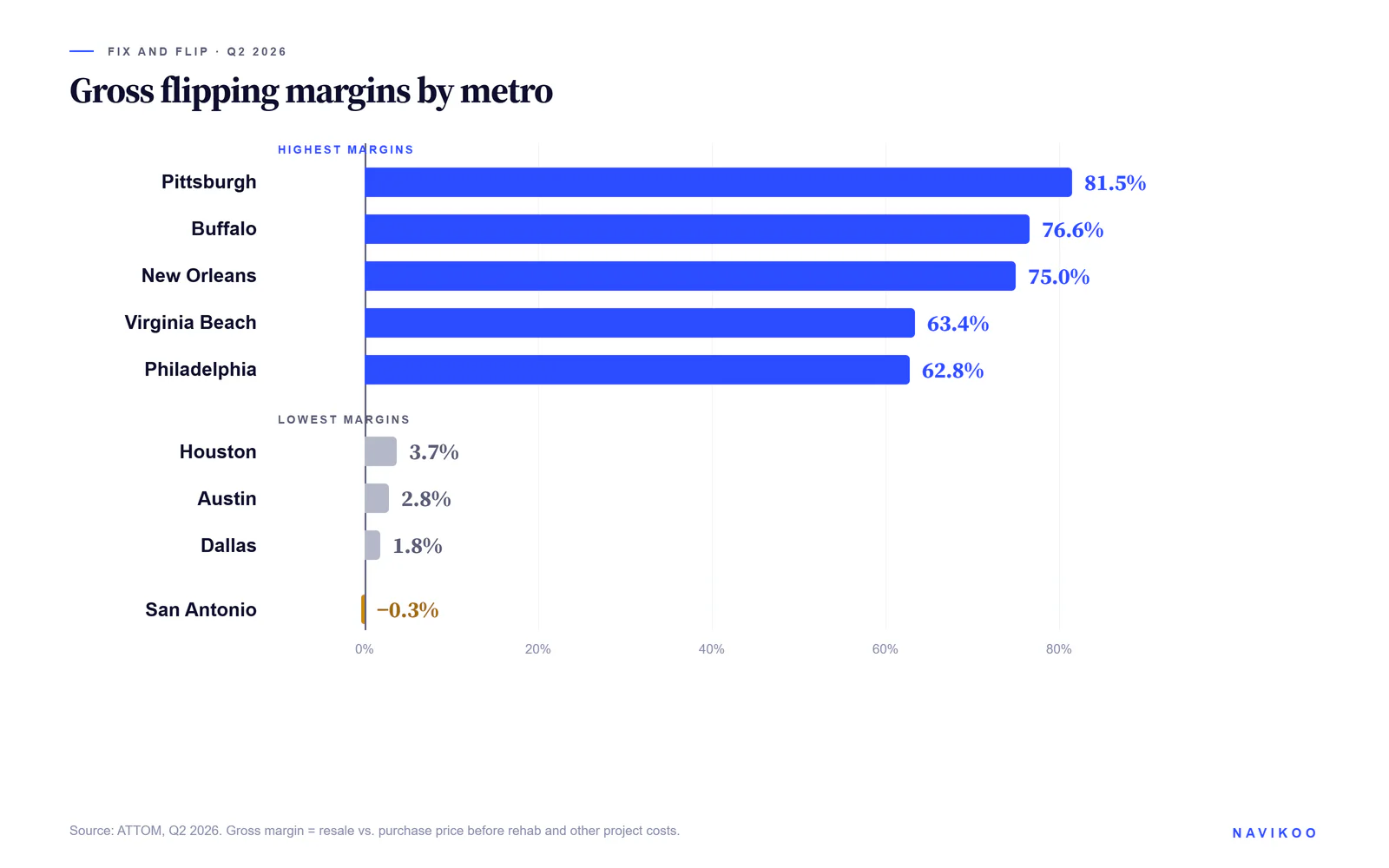
ATTOM’s Q2 2026 report found that, among metros with more than one million people, the largest typical gross flipping margins were Pittsburgh 81.5%, Buffalo 76.6%, New Orleans 75.0%, Virginia Beach 63.4%, and Philadelphia 62.8%. At the low end, San Antonio posted a 0.3% typical loss, followed by Dallas at 1.8%, Austin at 2.8%, and Houston at 3.7%. Those numbers are not a list of the best places to invest. ATTOM’s margin is resale price versus purchase price before renovation and holding costs, and the company notes that it expanded property-record coverage in 2026. A high gross margin may coexist with older housing, heavier renovations, higher insurance, slower permits, or block-by-block risk. Market research at the neighborhood level, supported by renovated comps and contractor pricing, matters more than a metro ranking.
Flip or Hold? Build a Second Exit Before You Buy
For a flipping investment, resale should be the primary exit, but a rental analysis can tell you whether there is a credible Plan B. If the finished house could rent for enough to support the permanent financing available at completion, converting the project to a hold may be better than accepting a weak sale in a temporary slowdown.
That does not make every failed real estate investment a good rental. The property still needs a workable rent, taxes, insurance, operating expenses, and long-term loan. Navikoo’s Rental Property Calculator can test the backup hold case before purchase rather than after the resale plan has already failed.
Taxes on Flipping Profits
Tax treatment for a flipping investment depends on what the property is in the taxpayer’s hands. IRS guidance says property held mainly for sale to customers in a trade or business is not a capital asset. For active flippers operating a business, profit can therefore be ordinary business income rather than a long-term capital gain simply because a property was owned for more than a year. A genuine principal residence can qualify for the federal home-sale exclusion when the ownership and use tests are met, but an owner-occupied renovation project should not be marketed to investors as an automatic tax-free flip. Intent, business activity, occupancy, prior exclusions, and the specific facts matter. A real estate CPA should review the plan before the sale rather than after the tax year closes.
Build the Team Around the Weakest Part of the Deal
A real estate agent helps with sold comps, buyer expectations, and resale strategy. A contractor turns the renovation scope into quantities, trades, timing, and change orders. Inspectors and specialty trades identify issues that a cosmetic walk-through misses. The title company or real estate attorney handles ownership, liens, and closing issues. Lenders control a different schedule: draws, inspections, extension dates, and payoff requirements.
Other flipping investors’ experiences in the same area can be useful for finding contractors and understanding permits, but local anecdotes are not a substitute for written bids, comparable sales, or the actual loan documents.
For real estate investors working multiple investment opportunities, CRM and deal pipeline can keep leads, offers, contacts, follow-ups, and stages organized while the Fix & Flip Calculator and Rehab Cost Estimator handle the underwriting side. The benefit is not another dashboard; it is keeping the sourcing decision and financial decision tied to the same deal.
Before You Make an Offer
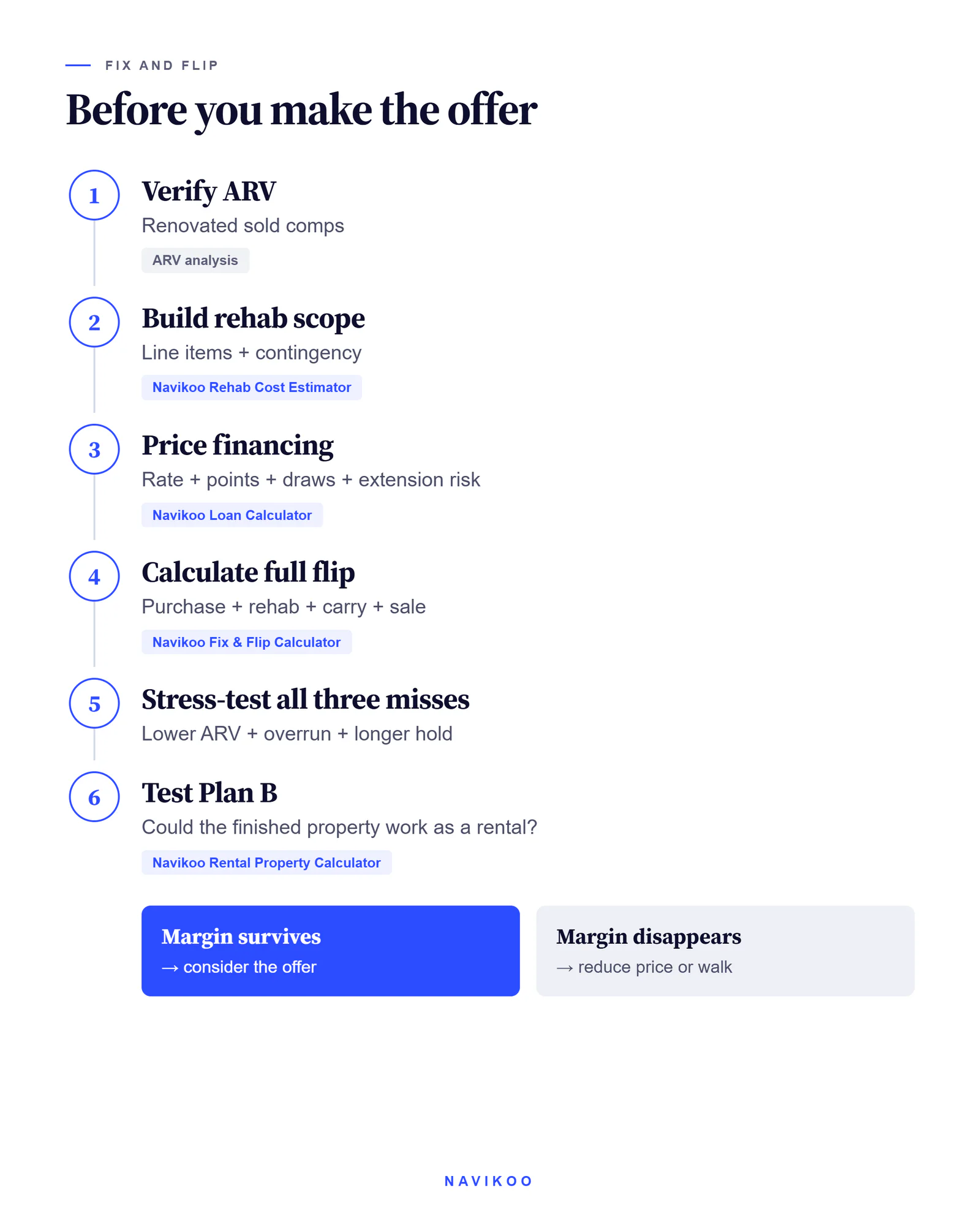
Pull your own renovated comps for ARV. Build a line-item scope and contingency. Run the financing through the expected payoff date, not a generic monthly rate. Model selling costs for the local market, then extend the hold at least two months beyond the renovation schedule.
Finally, rerun the property with a lower sale price, higher construction cost, and longer timeline at the same time. If the profit disappears under ordinary misses, the house is not providing enough margin at the current offer. The cheapest mistake in real estate flipping is often the investment that never gets purchased.