Fair Market Value in Real Estate: The Price Nobody Has Paid Yet
Fair market value estimates what a property would sell for under normal market conditions, but that number is not the same as what the property is worth to every investor. Learn how sales comparisons, income, and cost approaches are used to estimate value, how cap rates can shift the result, and why investment value can differ from the market's price.

Fair market value is the price an asset would sell for between an informed, willing buyer and an informed, willing seller, with neither under pressure and the asset exposed to the market for a reasonable time. It is an estimate of a transaction that has not happened.
That hypothetical quality is what makes it useful and what makes it slippery. Every appraisal, tax filing, estate return, and lending decision rests on a fair market value, yet none of them observe one directly. They reconstruct it from evidence.
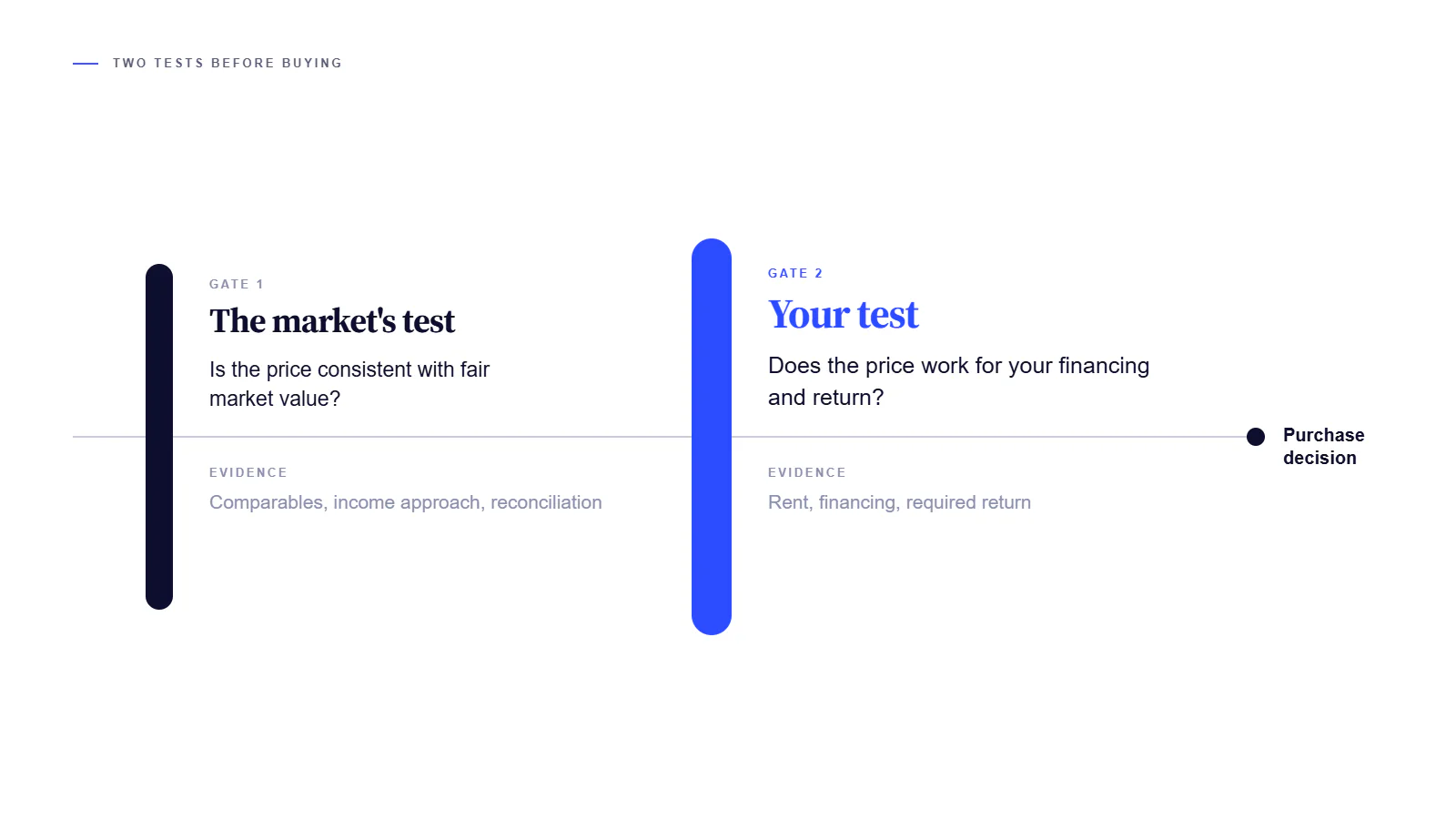
For an investor, the more important point is that fair market value describes the market, not you. The price a particular buyer should pay depends on their financing, their required return, and their plans for the asset.
That figure can sit well above or well below the market's, and much of what makes property investing work happens in the gap.
What Is Fair Market Value in Real Estate?
The IRS Definition
The standard tax definition comes from the estate tax regulations and was restated in Revenue Ruling 59-60. Fair market value is the price at which an asset would change hands between a willing buyer and a willing seller, neither under any compulsion to buy or to sell, and both having reasonable knowledge of relevant facts.
That revenue ruling addressed closely held stock, but its framing became the reference point for valuing almost anything for federal taxation, including real estate. Investopedia's overview of fair market value covers the same core conditions in plainer language.
Five Conditions Hidden in One Sentence
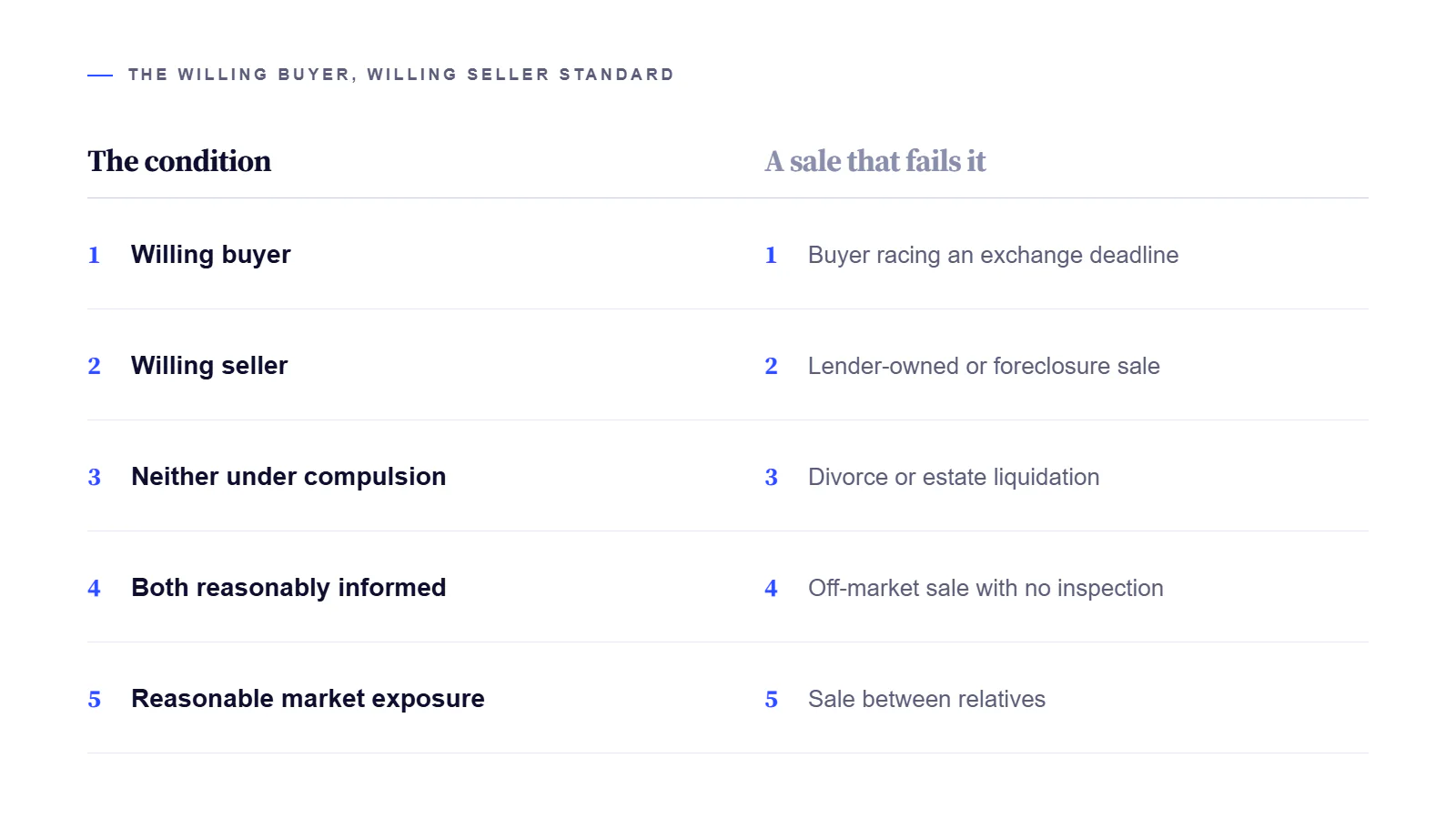
The definition reads simply. Unpacked, it imposes five conditions on the hypothetical sale:
A willing buyer, not a motivated or distressed one
A willing seller, not a forced or foreclosing one
Neither party under compulsion
Both reasonably informed about the asset and the market
Enough exposure in a competitive market for the asset to find its buyer
Real transactions violate these constantly. A divorce sale, an estate liquidation, a 1031 exchange buyer racing a deadline, a lender-owned home, a sale between relatives.
Each produces a real price that is not a fair market value. A valuation built on those deals without adjustment inherits the distortion, which is why appraisers screen out property transactions that fail the willing-buyer test.
Fair Market Value vs. Appraised, Assessed, Market and Investment Value
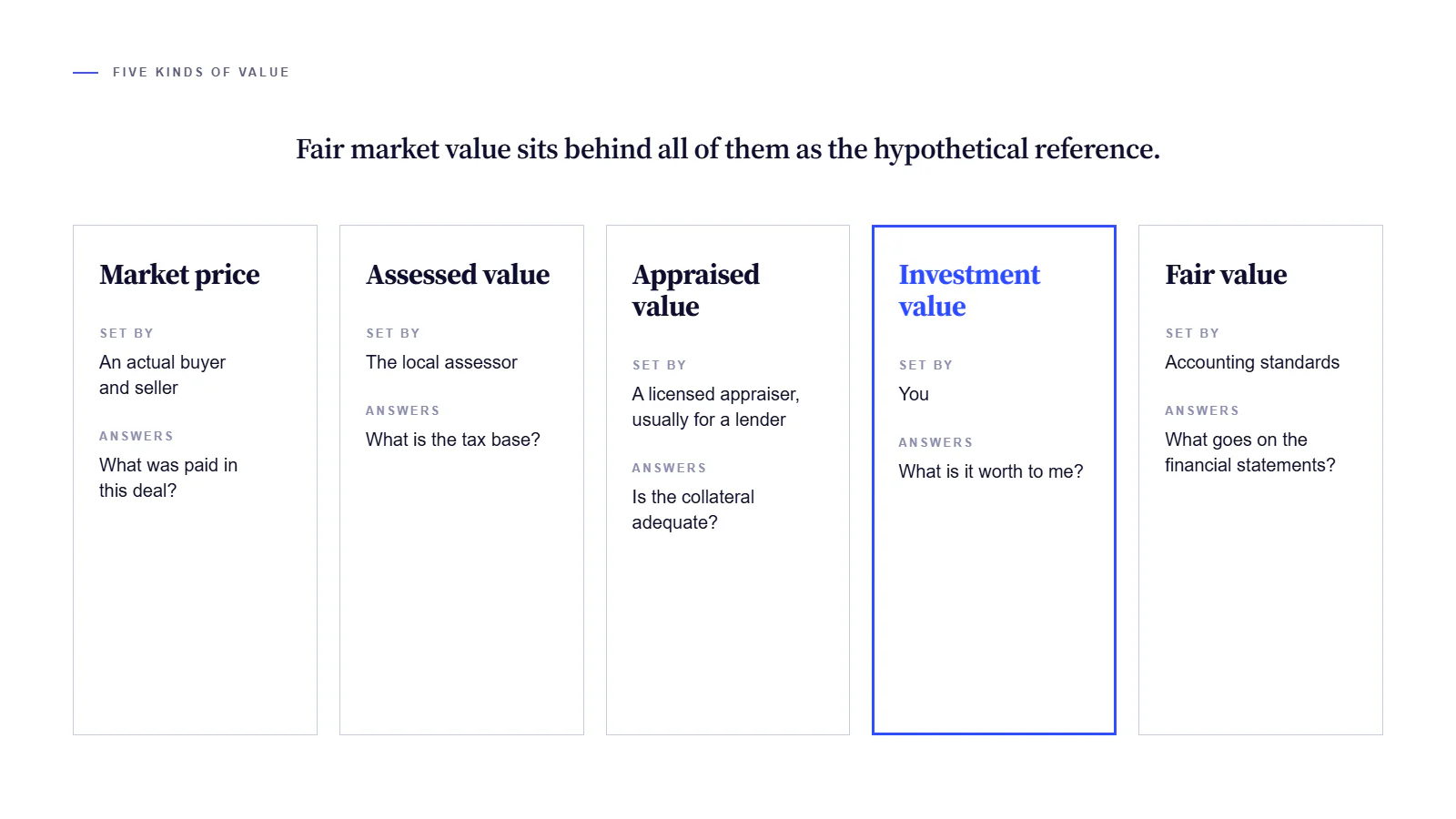
The same building can carry four or five different numbers at once, each answering a different question. Confusing them is the most common way investors misread a valuation.
Market Price
The price actually paid in a specific deal. It is observed rather than estimated, and it reflects whatever pressures that buyer and seller faced. That transaction price is evidence of fair market value, not the thing itself.
Assessed Value
The figure a local assessor assigns for tax purposes. Some jurisdictions assess at full value, others at a fixed percentage, and many update on cycles that lag the real estate market by years. Assessed value is therefore a poor stand-in for fair market value.
An assessed value tells an investor about tax liability. It says little about what the building would sell for.
Appraised Value
A professional opinion of value prepared by a licensed appraiser, usually for a lender. A mortgage appraisal estimates market value under defined conditions and reflects the lender's interest in collateral rather than any buyer's opportunity.
Investment Value
The value of a property to one specific investor, given their financing, tax position, return requirement, and plans. It is the number that should drive a purchase decision, and it rarely matches fair market value.
Some investors call this intrinsic value. The label matters less than the idea: it is personal, and two buyers can hold very different figures for the same building. An investor pursuing a value-add strategy may rationally arrive at a different investment value if they can improve sustainable NOI beyond what the current market assumes.
Fair Value in Financial Reporting
Fair value is the accounting counterpart, used in financial statements and financial reporting. It is conceptually close to fair market value but defined by a separate framework and applied for different purposes.
The two often produce similar numbers. They are not interchangeable terms, and each operates under different standards, so a fair value reported by a fund is not automatically the fair market value a tax filing requires. Fair value also tends to be marked more frequently, since reporting periods demand it.
How Do I Calculate Fair Market Value?
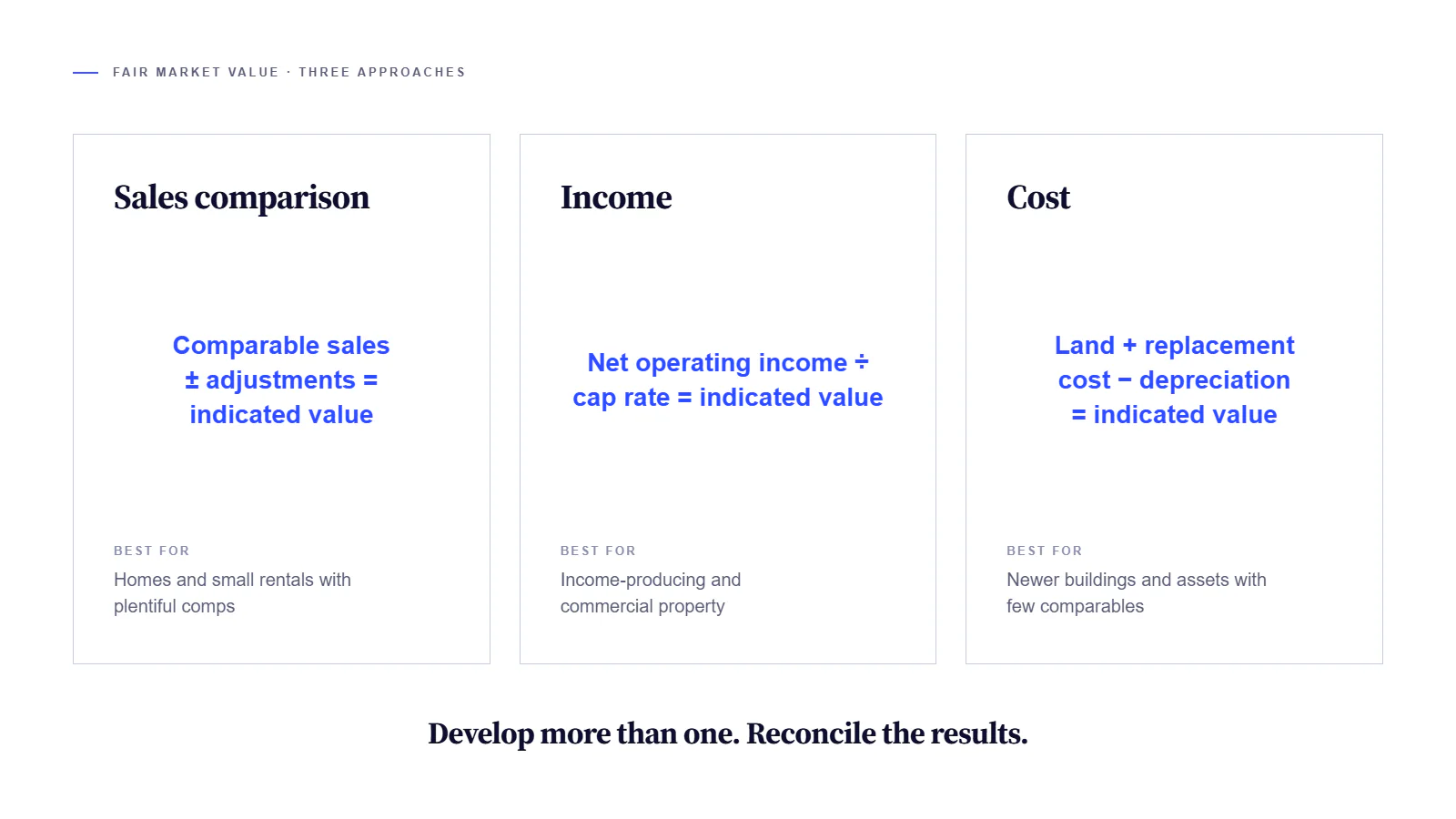
Appraisers use three approaches to fair market value. For income-producing property they typically develop more than one, then reconcile the results, because no single valuation method is correct in isolation.
The Sales Comparison Approach
Find recent sales of comparable buildings, adjust each for differences from the subject, and derive an indicated market value. Adjustments cover size, condition, location, unit mix, and timing.
This approach dominates residential valuation because comparable property sales are plentiful and home buyers think in comparisons. Market comparables are the closest thing to direct evidence the process has.
The Income Approach
Divide net operating income by a market capitalization rate. It values the building by what it produces, which is how most investors reason about rental investments.
It depends heavily on both inputs. The rental revenue has to reflect what the market will actually pay, and the cap rate is itself derived from recent acquisitions of similar buildings. Because NOI is the numerator in this valuation method, small errors in rent, vacancy, or operating expenses can materially change the indicated value.
The Cost Approach
Estimate what rebuilding the improvements new would cost, subtract accumulated depreciation, and add land value.
It works best for newer buildings and for unique assets where comparables are scarce, and least well for older buildings where depreciation is hard to measure.
A Worked Example: One Fourplex Asset, Three Approaches
The figures below are illustrative teaching assumptions rather than market data. The subject is a fourplex producing $38,400 of net operating income.
Sales Comparison
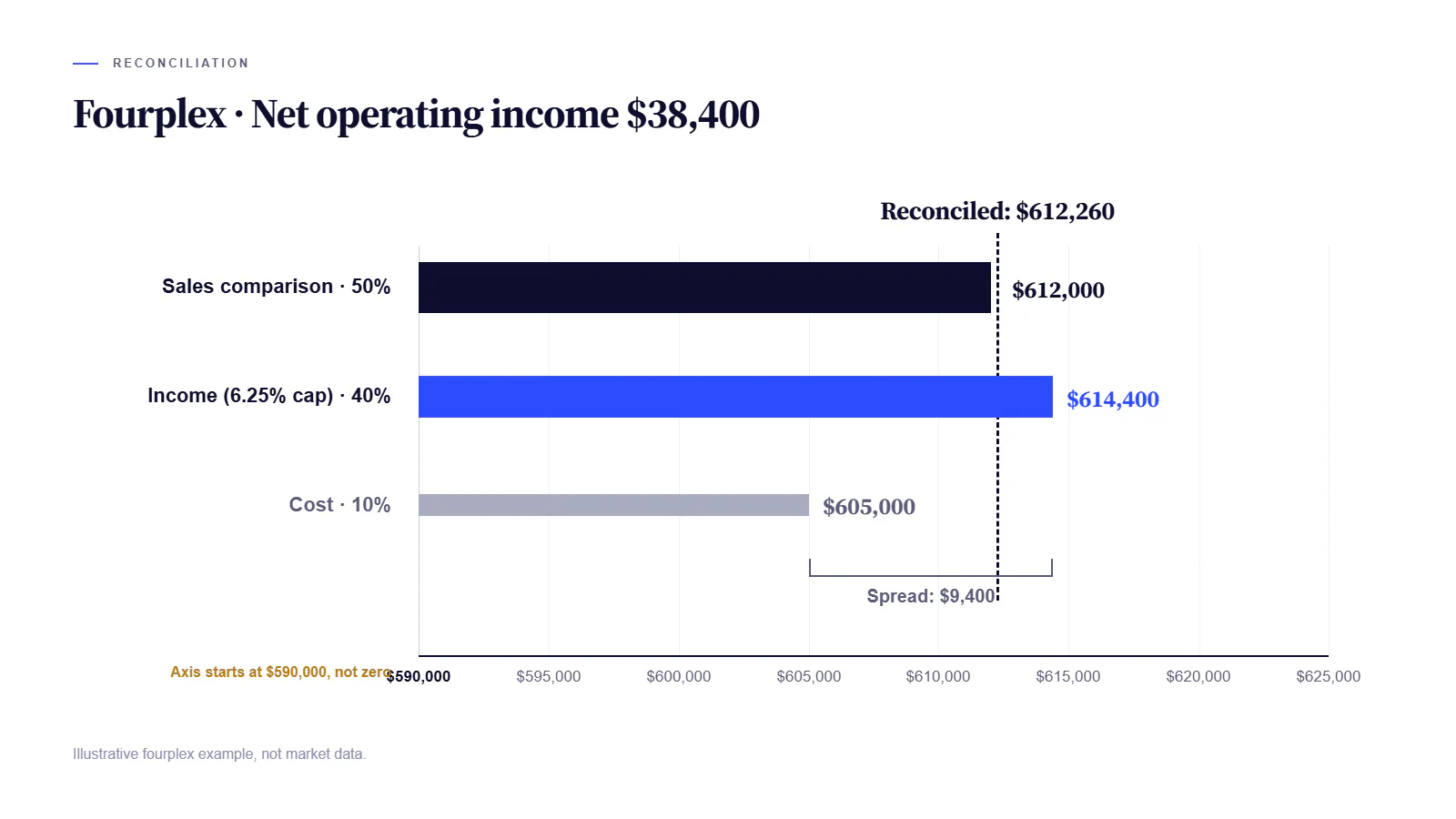
Three comparable fourplexes, each adjusted for differences in condition, size, and location, indicate values of $612,000, $598,000, and $625,000. Their average is $611,667.
The appraiser concludes an indicated value of $612,000, giving slightly more weight to the comp closest in size and condition.
Income Capitalization
At a market cap rate of 6.25%, $38,400 of net operating income indicates a value of $614,400.
Cost
Land is valued at $140,000. Rebuilding the improvements new would cost $560,000, less $95,000 of accumulated depreciation, leaving $465,000 for the structure. Total indicated value: $605,000.
Reconciling the Three
Approach | Indicated value | Weight |
|---|---|---|
Sales comparison | $612,000 | 50% |
Income | $614,400 | 40% |
Cost | $605,000 | 10% |
Reconciled fair market value | $612,260 |
Rounded, the conclusion is about $612,000. The weights are a judgment rather than a formula.
Sales comparison earns the most because the comps are recent and similar. Income earns substantial weight because this is an investment asset. Cost earns little because the building is not new.
The three approaches land within $9,400 of each other. That tight spread is what gives the fair market value conclusion credibility.
When approaches diverge sharply, the useful question is not which one to believe. It is what the divergence reveals about the building or the valuation assumptions behind it.
Where the Estimate Moves Most
Cap Rate Sensitivity
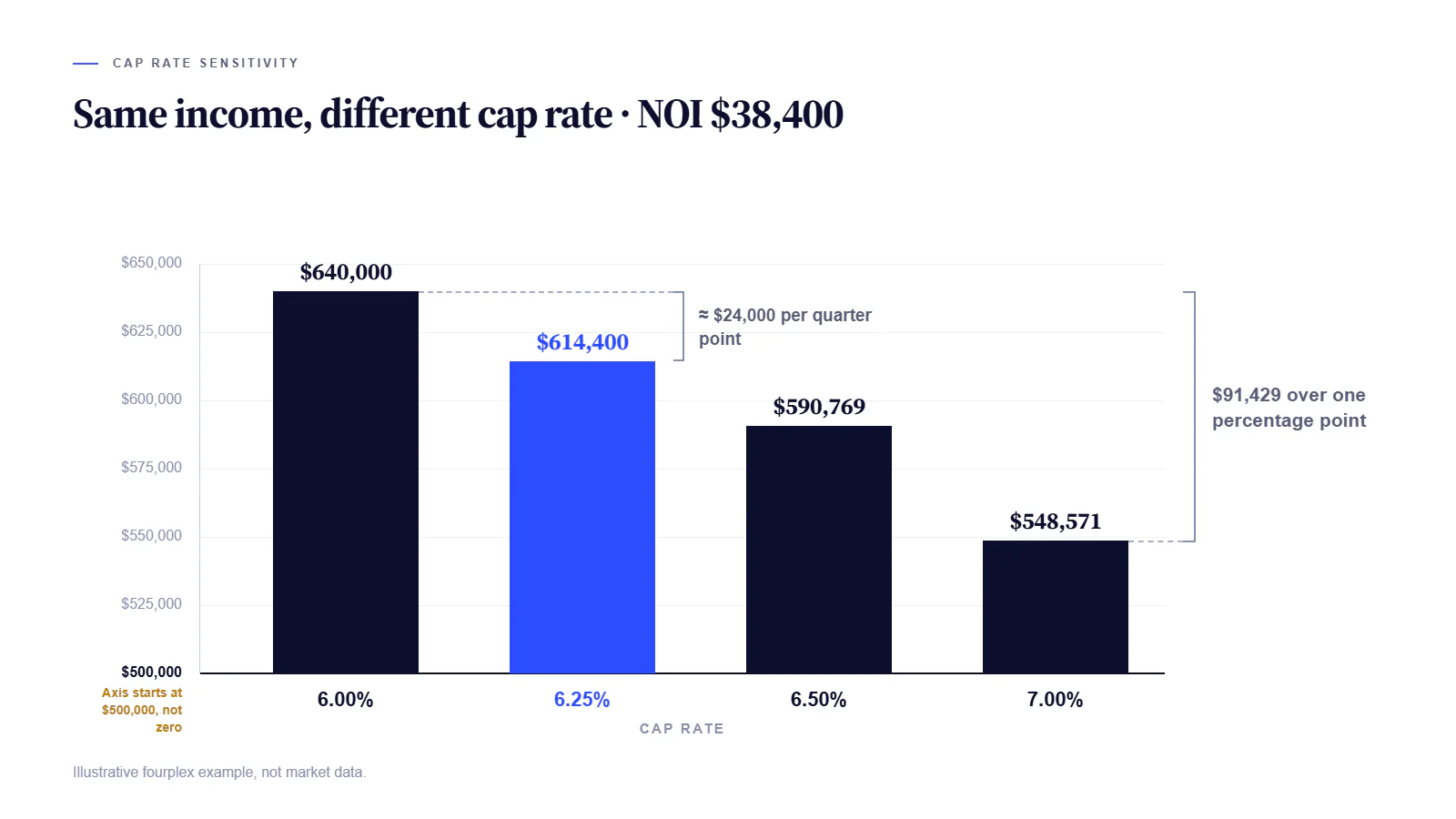
The income approach carries more sensitivity than its tidy formula suggests. Hold net operating income at $38,400 and vary only the cap rate:
Cap rate | Indicated value |
|---|---|
6.00% | $640,000 |
6.25% | $614,400 |
6.50% | $590,769 |
7.00% | $548,571 |
A quarter-point shift moves fair market value by roughly $24,000. A full point takes $91,429 off the top of the range.
The cap rate is also the input with the least direct evidence behind it. It is inferred from other deals rather than observed, and it moves with market conditions faster than most valuation reports acknowledge.
Why Appraisers Lean on Comps
This is why, for small residential income real estate, sales comparison usually carries the most weight, and why an experienced appraiser treats the income approach as a cross-check there. Comparable closings are observable prices. A cap rate is a derived ratio, and a small error in it produces a large error in value.
For larger commercial assets, the balance shifts toward income. Buyers price those primarily on what they earn, and comparable transactions are fewer and less alike, so the income approach becomes the more reliable anchor despite its sensitivity.
Fair Market Value Against Investment Value
Here is where the concept starts driving decisions rather than paperwork.
Two Buyers, One Fourplex
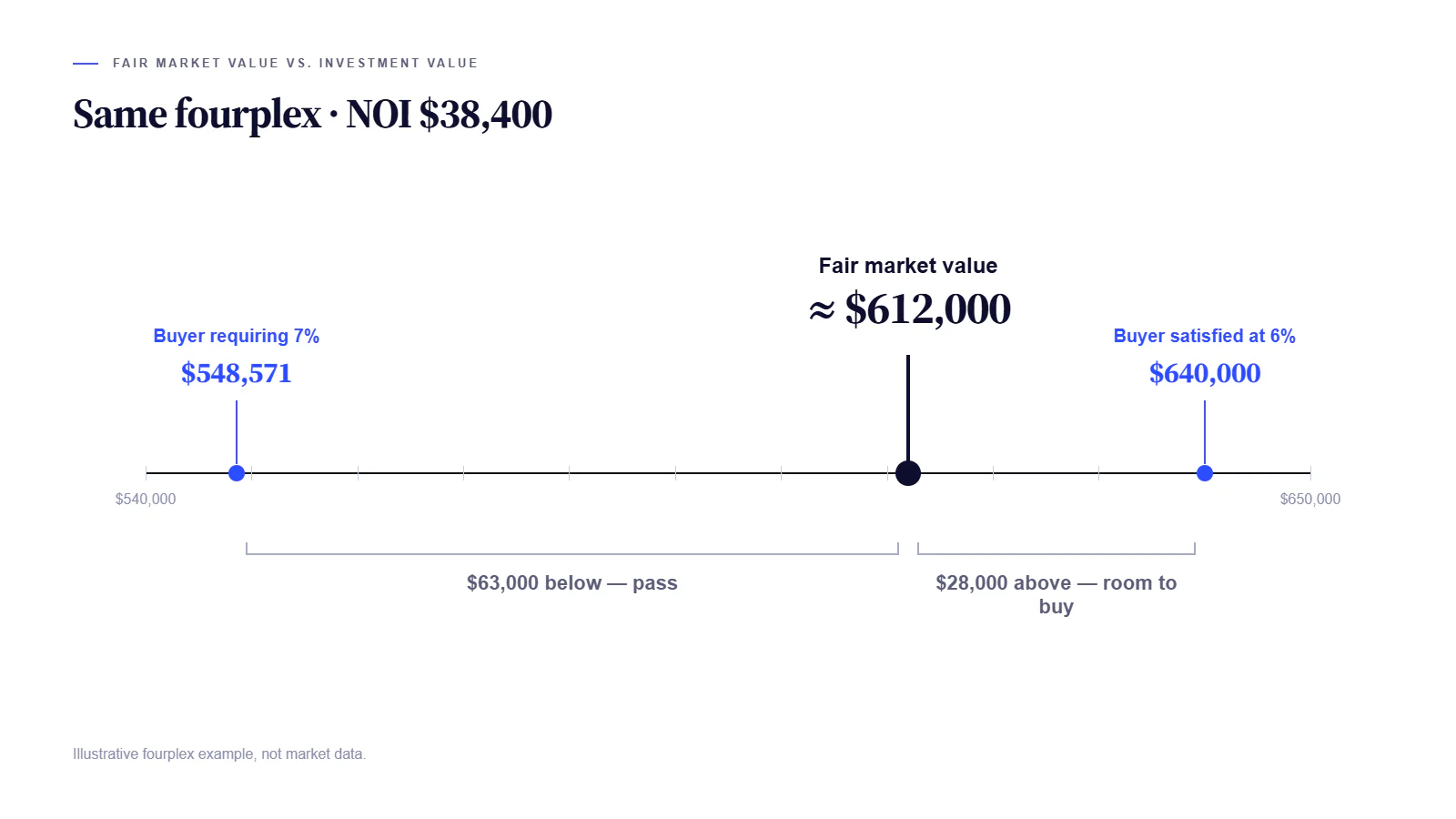
Take the same fourplex with a fair market value near $612,000. Two investors look at it.
The first needs a 7% return on the fourplex's income to make the deal work with their financing. At that requirement, $38,400 of income supports a price of $548,571. The building is worth $63,000 less to them than its fair market value, and they should pass.
The second is satisfied at 6%, perhaps because they are placing cash with no debt, completing an exchange, or planning improvements that will raise the income. At that requirement, the same fourplex is worth $640,000 to them, about $28,000 above fair market value.
Where Deals Actually Happen
Neither investor is wrong. Fair market value is roughly where the typical buyer clears. Investment value is where one particular buyer clears.
A strategic buyer who can extract more from the asset than the market assumes will rationally pay above fair market value. A disciplined buyer with a higher hurdle will rationally refuse to. That is investment valuation in practice, and it is why a fair price for the market can still be the wrong price for you.
The practical consequence: an appraisal confirming a price does not confirm the price works for your financial decisions. Any real estate investor who stops at "it appraised" has checked the market's arithmetic, not their own.
Running the deal through the free rental property cash flow calculator with your actual financing is how investment value becomes visible, including whether the cash flow supports the purchase at all.
What Is 100% Fair Market Value?
The phrase usually appears in property tax. It means the property is assessed at its full estimated fair market value, with no fractional ratio applied.
Jurisdictions differ. Some assess at 100% of fair market value; others apply a statutory percentage, so a building with a $612,000 market value might carry a much lower assessed figure by design.
Neither arrangement says anything about the asset's worth, only about how the local tax base is constructed. An investor comparing tax burdens across jurisdictions has to compare effective rates against market value rather than comparing assessed figures against each other.
The phrase also appears in lending and settlement documents, where it confirms a transfer was priced at full market value rather than at a discount between related parties.
Fair Market Value in Tax Contexts
Estate and Gift Tax
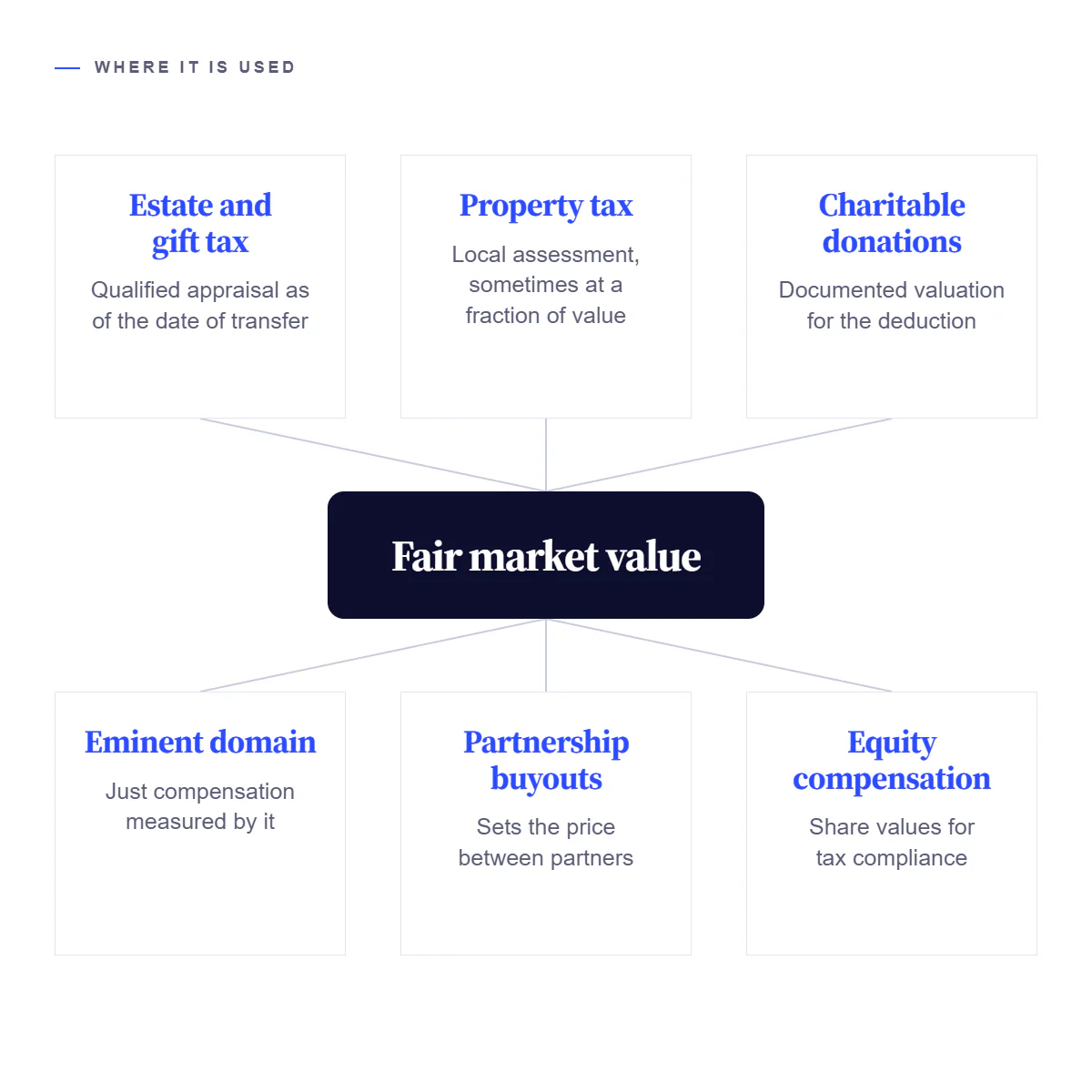
When real property passes at death or by gift, federal estate and gift tax rules value it at fair market value on the relevant date. That is where the willing-buyer definition does its most consequential work.
An inherited fourplex, a building gifted to a child, or a partial interest transferred into a family entity all require a defensible valuation, and estate planning around rental holdings often turns on how that valuation is supported. The IRS is explicit that undervaluing assets can trigger penalties and additional taxes, which is why gift tax filings involving property generally warrant qualified appraisers rather than an owner's estimate of fair market value.
Local Tax Assessment
This is the context investors meet most often. Because assessed figures lag and follow local methods, a purchase well above the assessed value can prompt a reassessment.
Underwriting should model the tax bill on the expected post-sale market value rather than on the seller's current bill, since the seller's number often describes a price nobody will pay again.
Other Uses
Fair market value also governs charitable donations of land and buildings, exchange documentation, partnership buyouts, and eminent domain, where just compensation for a taken asset is generally measured by it.
Beyond property, the same standard applies to equity compensation, where shares granted to employees must be valued for tax compliance, and to other forms of deferred compensation. The definition stays constant across uses while documentation standards differ.
When Fair Market Value Is Hardest to Establish
Three situations weaken the estimate.
Thin markets come first. A rural building or a specialized category with few recent transactions leaves sales comparison with little to work on, forcing heavier reliance on income or cost, both of which carry more judgment.
Unusual buildings come next. Property has no equivalent of the auction houses that set observable prices for art or collectibles, so a genuinely distinctive asset can only be valued by inference. Its fair market value is an argued conclusion rather than a measured one.
Shifting market conditions round it out. When prices move quickly, comparables from six months earlier may describe a market that no longer exists, and time adjustments grow large enough to dominate the property valuation.
Current market prices and the newest closings deserve more weight than older data in that environment, even when older data is more plentiful. Any comparable older than the last turn in market conditions needs explicit adjustment before it can join the pricing benchmarks the valuation relies on.
Getting a Fair Market Value Appraisal
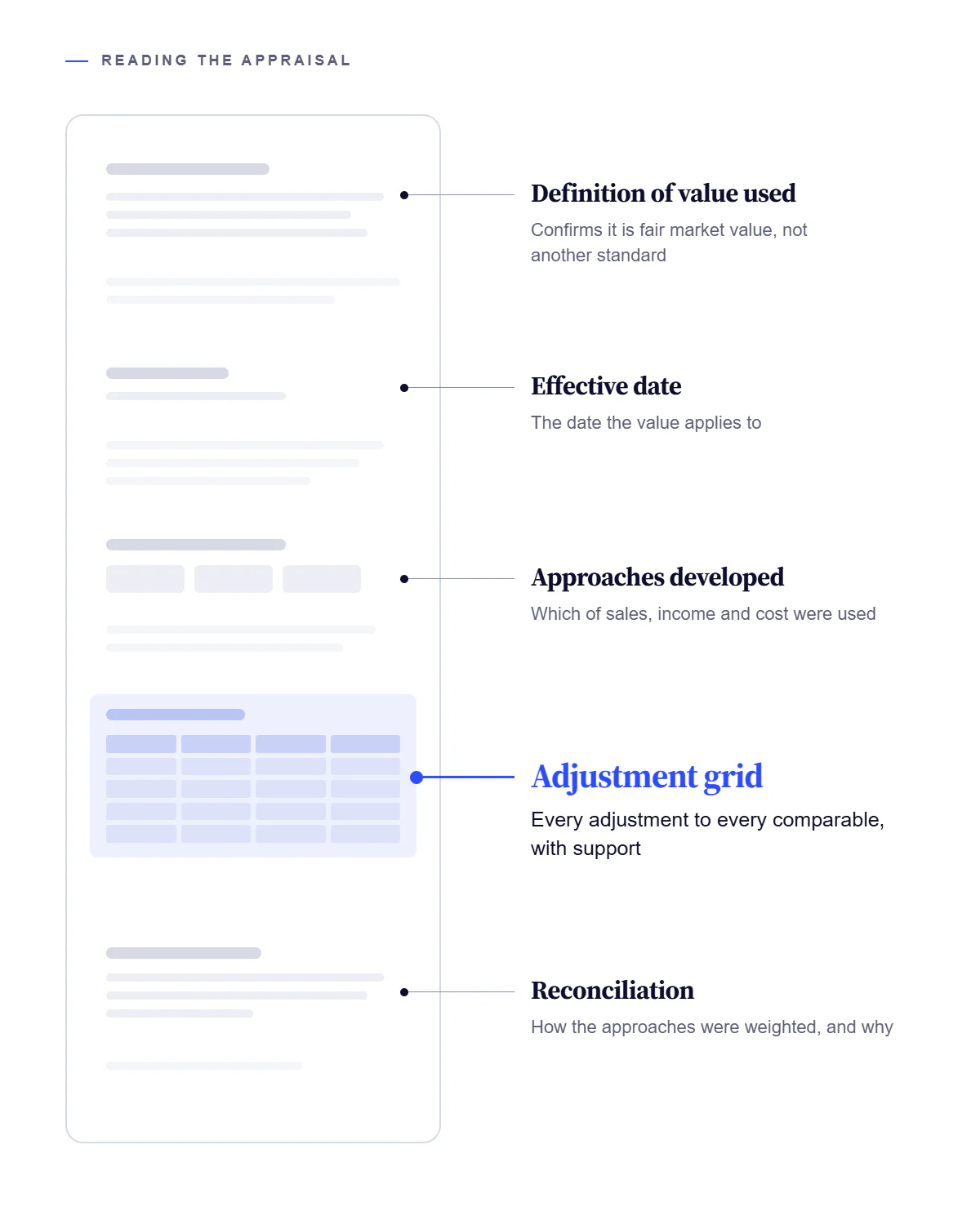
An appraisal for tax purposes differs from a lender appraisal in who it serves and how closely it will be examined. For estate, gift, or donation filings, the report should state the definition of value used, the effective date, and each approach developed.
An investor commissioning one should confirm the appraiser has experience with that asset type and request that every applicable approach be developed and reconciled. Real estate appraisal quality shows in the adjustment grid rather than the conclusion, and a strong valuation explains every adjustment it makes.
Read the adjustments on each comparable. The conclusion is only as good as the adjustments that produced it, and a single unsupported adjustment can move an indicated value more than every other factor combined.
What to Check Before Relying on a Number
Ask which value it is. An assessment, a list price, a lender's appraised value, and a fair market value can all describe the same building while answering different questions.
Look at the comparables behind the valuation. Were they arm's-length deals between willing parties? A comp that was a foreclosure or a family sale does not meet the definition, however recent it is.
Check the cap rate against the evidence behind it. In an income-based valuation, a quarter point of error is worth tens of thousands of dollars, and it is the input most often asserted rather than supported.
Check how widely the approaches diverged. A tight reconciliation is corroboration. A wide one is a signal to understand the market context before trusting the average.
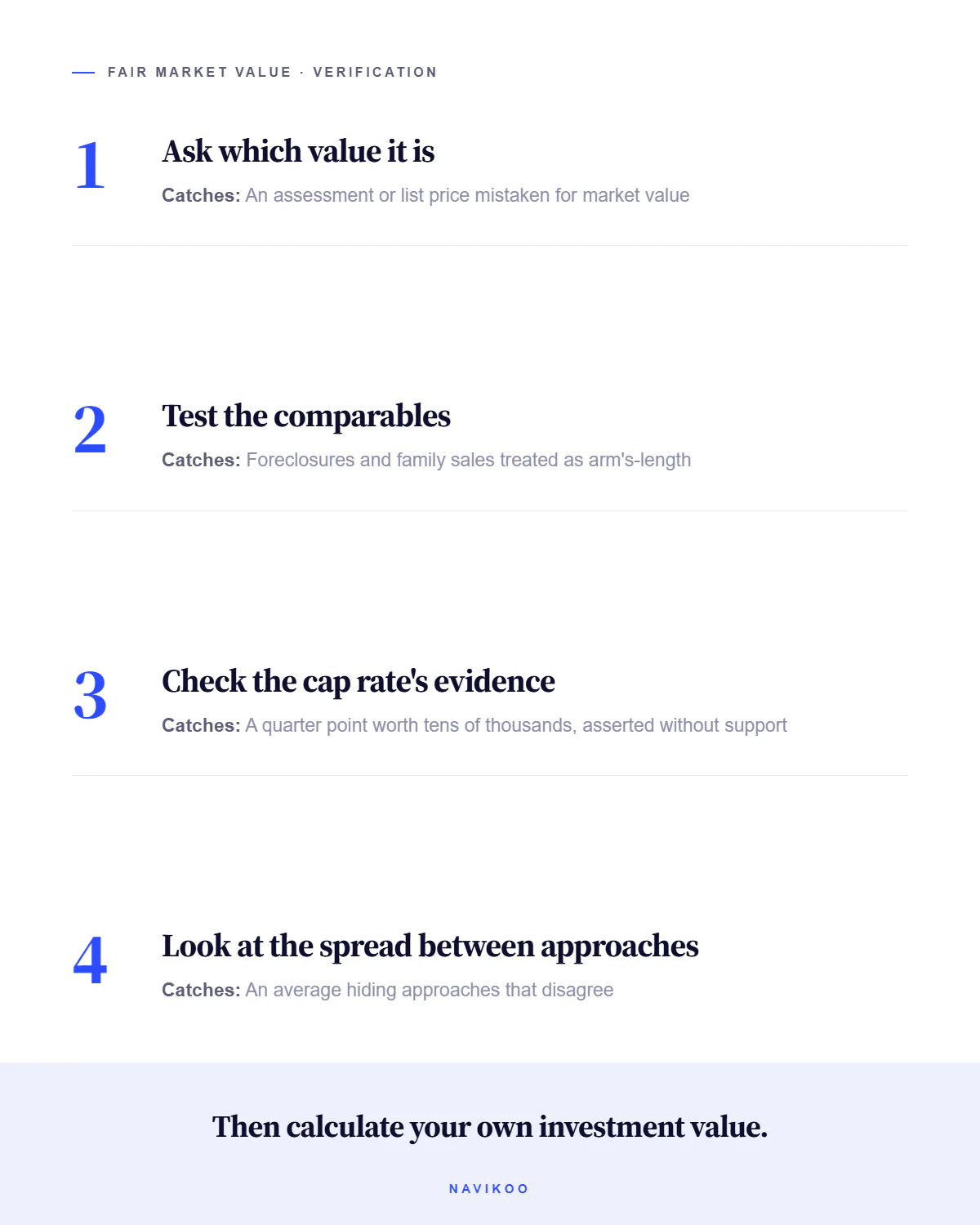
Then calculate your own investment value. Fair market value establishes what a reasonable buyer might pay for the asset's value today. Whether you should pay it depends on the rent the building can support, the financing available to you, and the return you require.
The rent estimator gives the income side of that calculation a grounded starting point, and rent is the input most real estate assets are ultimately priced on.
A deal that appraises at the agreed price has passed the market's test. It has not yet passed yours, and the second test determines whether the purchase makes sense.