Fixed-Rate Mortgage: What Locking the Interest Rate Really Buys an Investor
A fixed-rate mortgage keeps the loan's interest rate and scheduled principal-and-interest payment stable even when market rates change. Learn how amortization works, compare 15- and 30-year mortgages, see current U.S. mortgage-rate benchmarks, stress-test a fixed loan against an ARM, and calculate whether refinancing actually saves enough to justify its cost.
A fixed-rate mortgage is a home loan whose interest rate stays the same for the life of the loan unless the owner later replaces it through refinancing or another payoff. The principal-and-interest payment is established when the loan closes, so market interest rates can rise or fall without changing that required payment.
That predictability is useful for homebuyers because it also makes long-run interest expense easier to model and for real estate investors holding rentals for many years. A known debt payment makes budgeting, rent analysis, and cash-flow projections easier because one of the largest recurring expenses is fixed. The trade-off is that a fixed-rate mortgage can begin with a higher interest rate than an adjustable-rate product available to the same applicant.
The more interesting feature for an investor is asymmetric rate exposure. If market rates rise, the owner can keep the original fixed rate. If rates fall enough, the owner may be able to refinance into a lower rate, although refinancing has costs and requires the applicant and property to qualify again.
That means the real decision is not simply “fixed or variable.” It is whether the value of payment certainty, refinancing flexibility, and protection from higher future interest justifies the initial pricing for the expected holding period.
What Is a Fixed-Rate Mortgage?
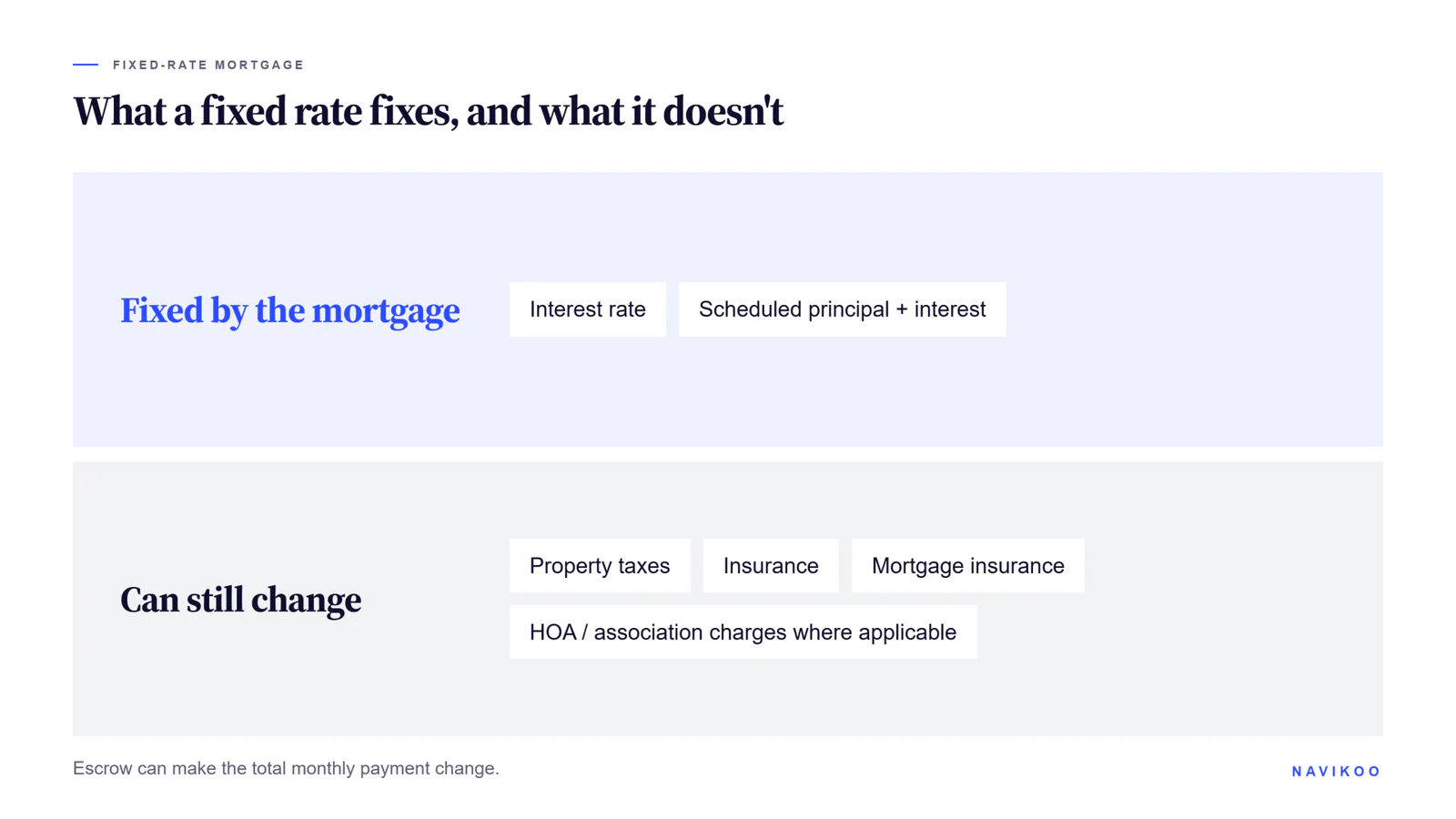
With a fixed-rate mortgage, the lender and borrower agree on one interest rate at closing and that rate does not reset during the scheduled term. Common terms include 30 years and 15 years, while some lenders also offer 10-, 20-, or 25-year terms. The fixed feature applies to the mortgage interest rate and scheduled principal-and-interest payments, not necessarily to the homeowner's entire monthly housing outflow.
Property taxes, homeowners insurance, mortgage insurance, association charges, and other escrowed items can change independently. An investor should therefore separate the fixed mortgage payment from taxes and insurance premiums when underwriting a rental. A reassessment or insurance renewal can increase the total monthly outflow even though the fixed-rate mortgage itself has not changed.
Fixed-rate mortgage loans can include conforming conventional loans, jumbo loans, and government-backed home purchase mortgages such as FHA, VA, or USDA loans when the applicable program permits them. These loans serve different borrowers and may carry different underwriting rules, mortgage insurance requirements, loan limits, and pricing. Conventional loans, government loans, and jumbo loans are therefore not interchangeable options even when each uses a fixed interest rate. Pricing differs by loan type, buyer equity, financial profile, occupancy, loan size, property characteristics, and lender. Investment-property loans are commonly priced differently from financing on a primary residence, so an owner-occupied national survey should be treated as a benchmark rather than an investor quote for a rental home.
How Fixed-Rate Mortgage Payments Work
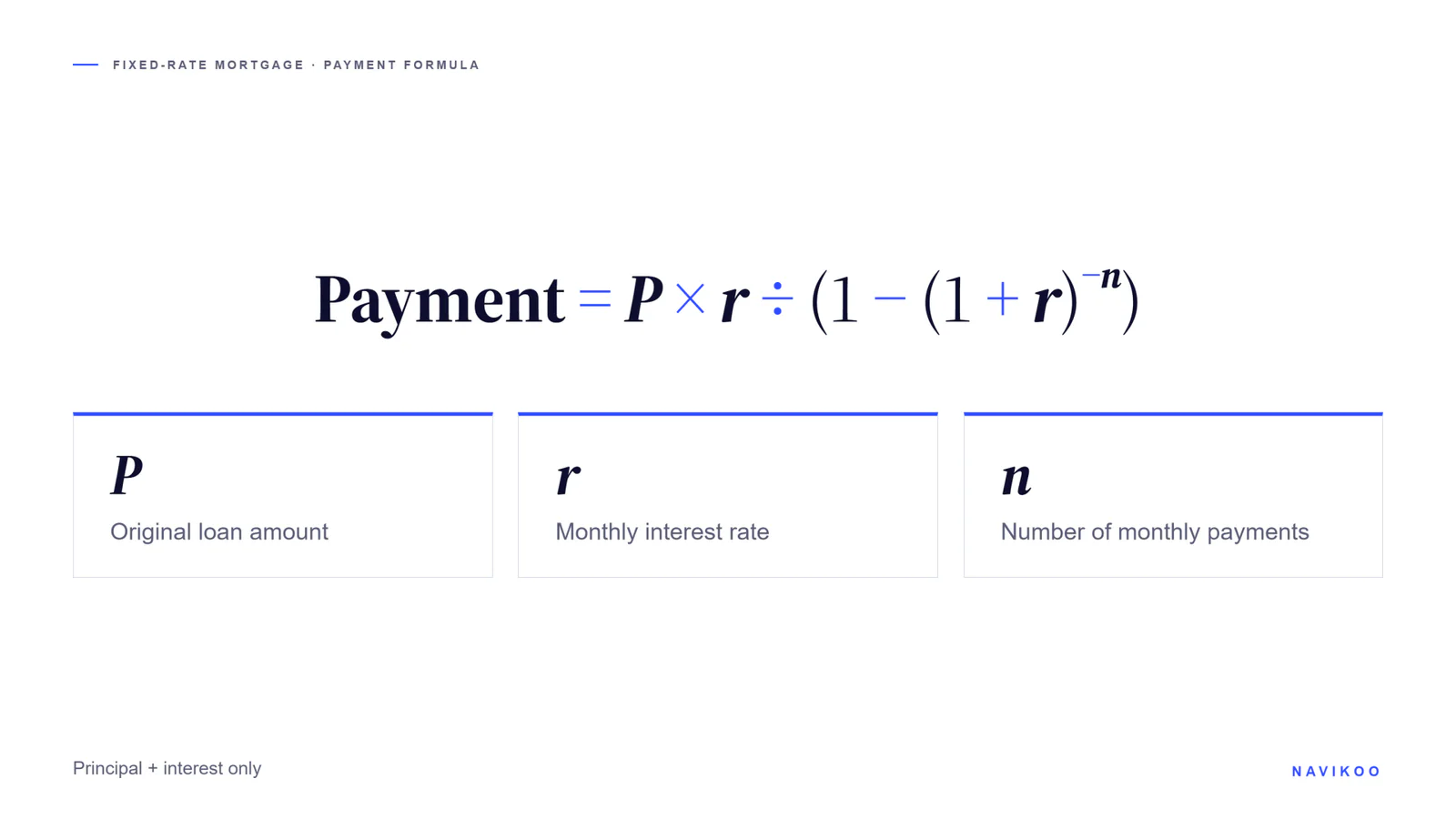
Each of the monthly payments on a fully amortizing fixed-rate mortgage contains interest for that month plus principal reduction, and the payment amounts follow the amortization schedule built into the mortgage. The monthly interest rate is the annual interest rate divided by 12, and the payment is sized so the balance reaches zero at the end of the term if the borrower makes only the scheduled payments.
Monthly payment = P × r ÷ (1 − (1 + r)^−n)
Here, P is the original loan amount, r is the monthly interest rate, and n is the number of monthly payments. The formula determines principal and interest only. Taxes, insurance premiums, mortgage insurance, and association fees are separate. The same mathematics applies across many fixed loans, and every dollar of interest is calculated from the outstanding balance, but fees and other terms can make two financing offers with identical rates economically different.
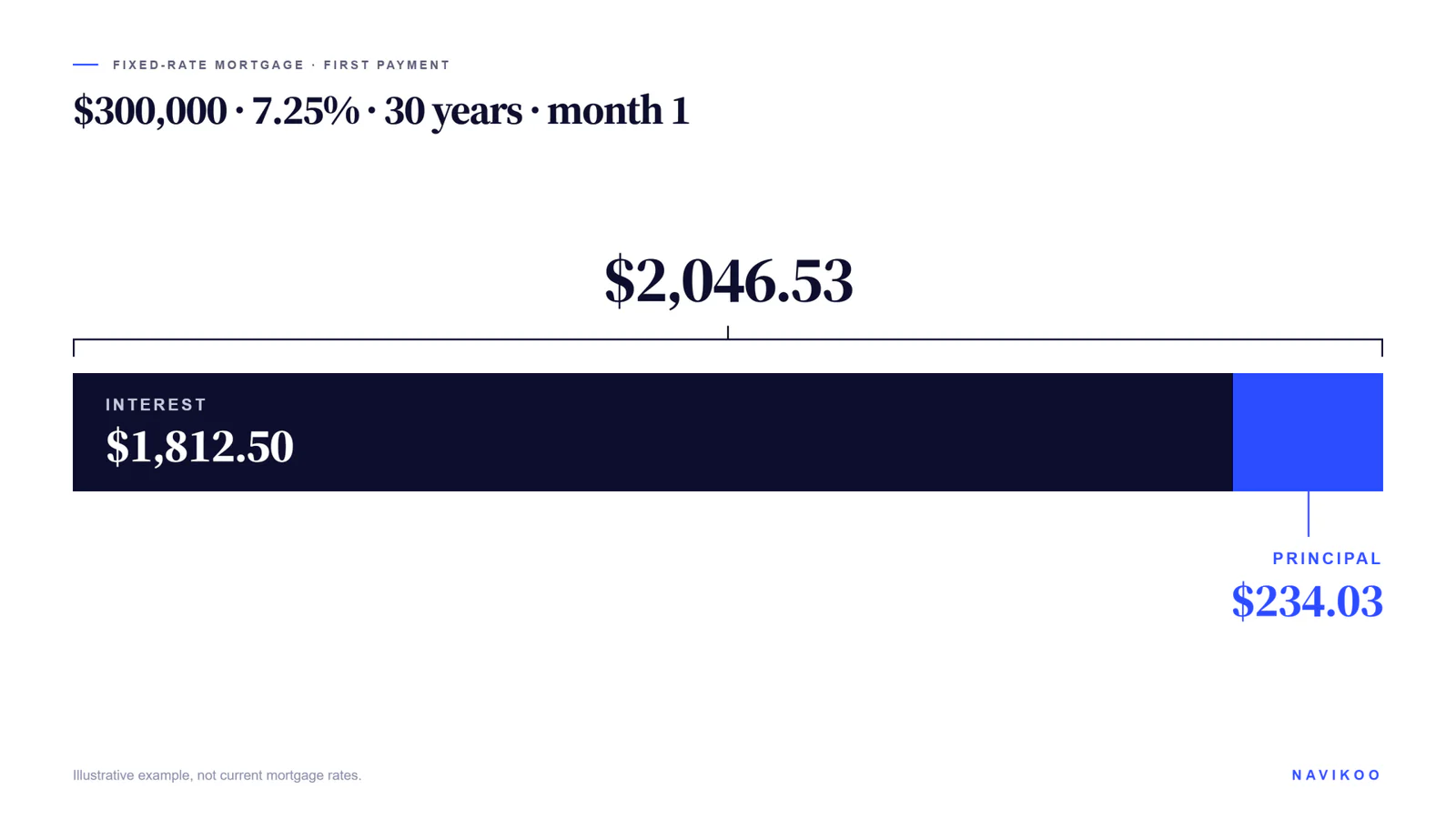
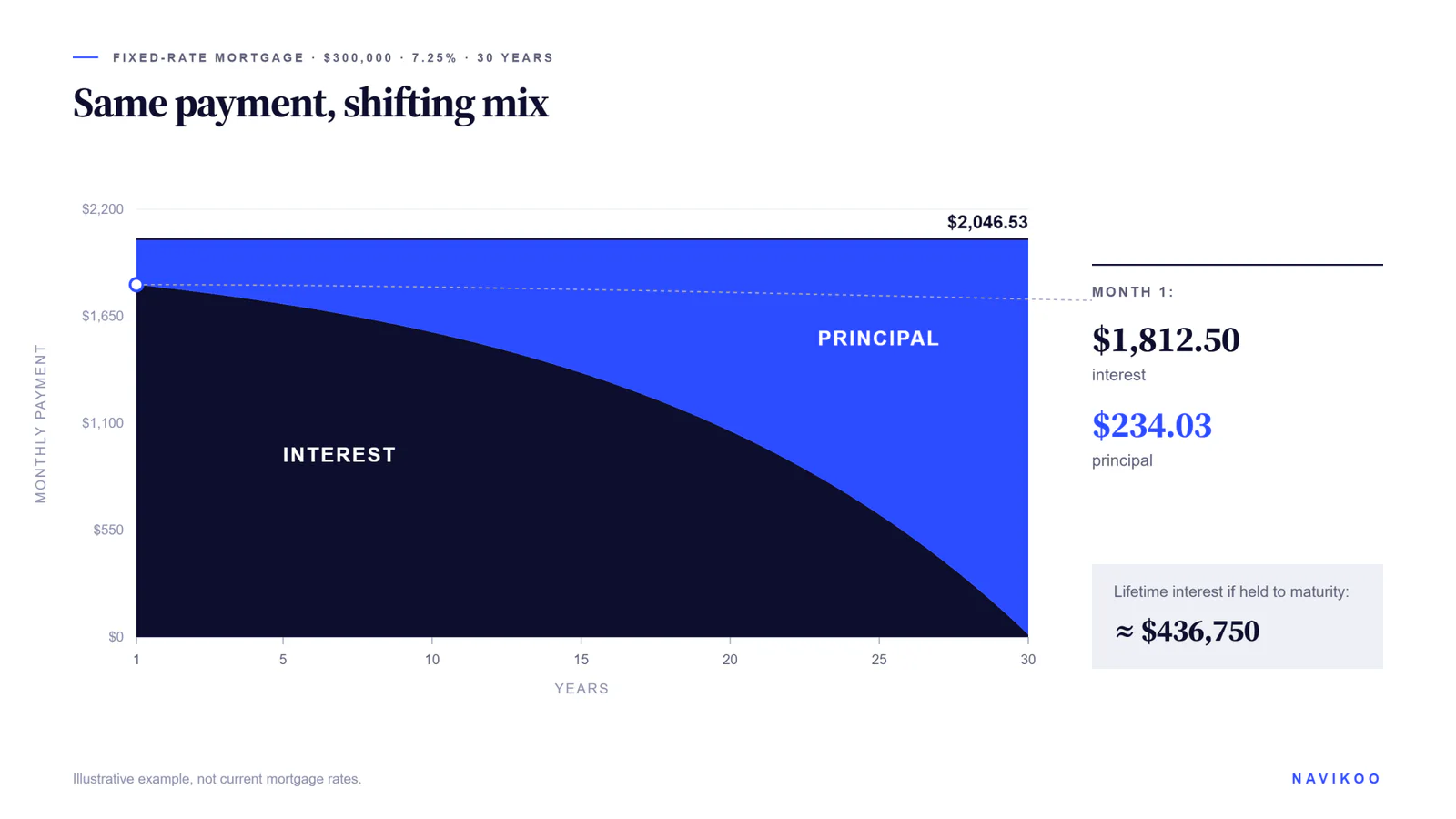
Assume a $300,000 mortgage at a 7.25% interest rate for a 30-year term. The monthly interest rate is approximately 0.604%, and the scheduled principal-and-interest payment is $2,046.53. During month one, $1,812.50 is monthly interest and about $234.03 is loan repayment.
As the balance declines, monthly interest falls and more of each fixed payment goes toward principal. If the owner keeps this mortgage for all 360 payments without making extra principal payments, total interest is approximately $436,750 on top of the $300,000 originally borrowed. Paying additional principal earlier reduces the balance sooner and therefore reduces the amount of interest charged in later months.
The 30-Year vs. 15-Year Fixed-Rate Mortgage
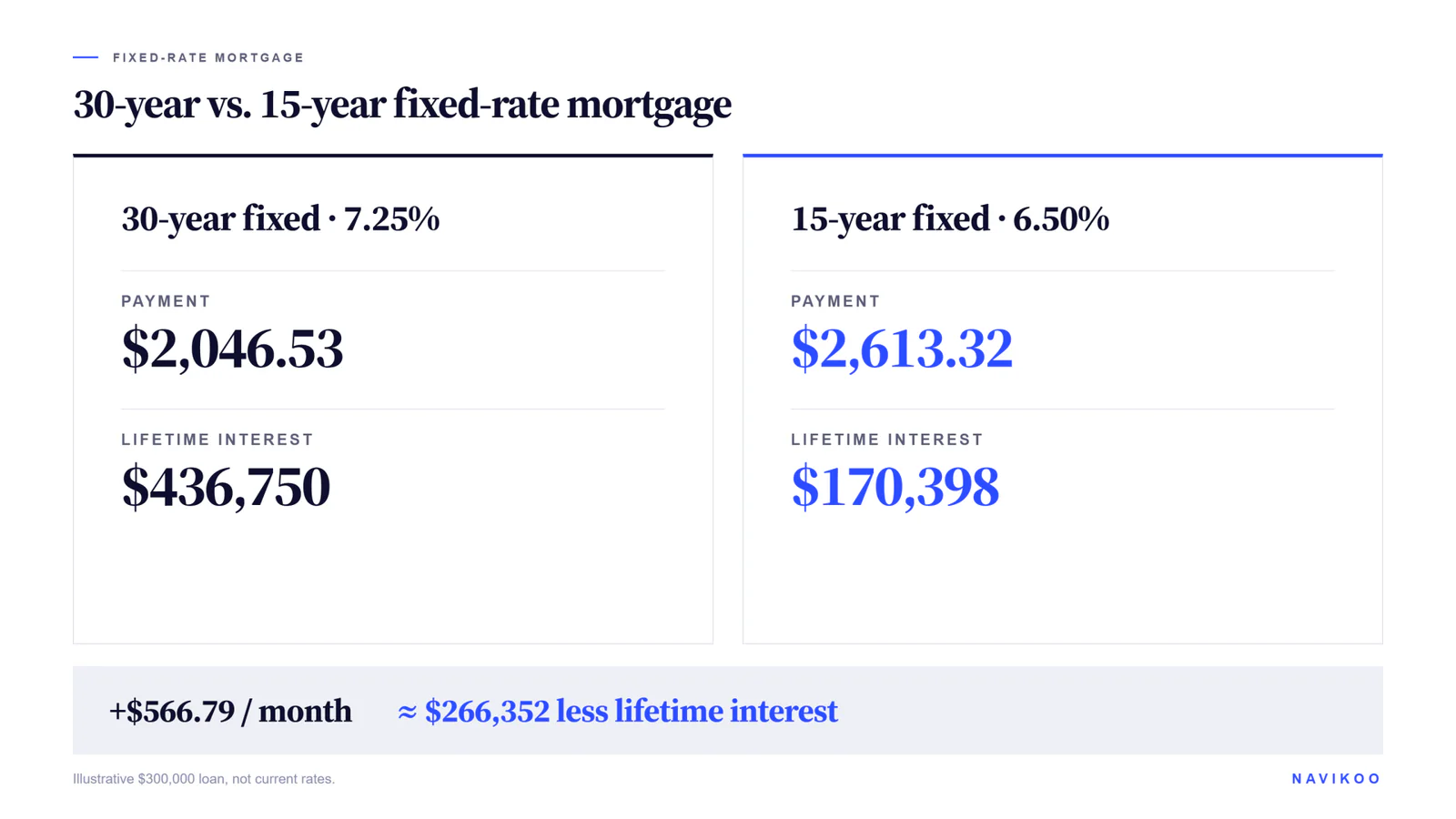
The loan term changes both the required payment and the lifetime interest cost, and the length of time over which principal is repaid changes how quickly equity builds. Using the same $300,000 loan for an illustrative comparison, assume a 30-year fixed-rate mortgage at 7.25% and a 15-year fixed-rate mortgage at 6.50%.
30-year fixed | 15-year fixed | |
|---|---|---|
Illustrative interest rate | 7.25% | 6.50% |
Monthly principal and interest | $2,046.53 | $2,613.32 |
Lifetime interest if held to maturity | $436,750 | $170,398 |
The shorter schedule accelerates principal and reduces interest exposure. The 15-year option requires about $566.79 more per month but produces roughly $266,352 less lifetime interest if both loans are held for their full durations. For an investor, the higher required payment also lowers monthly cash flow and debt service coverage, so lifetime interest should not be evaluated separately from liquidity.
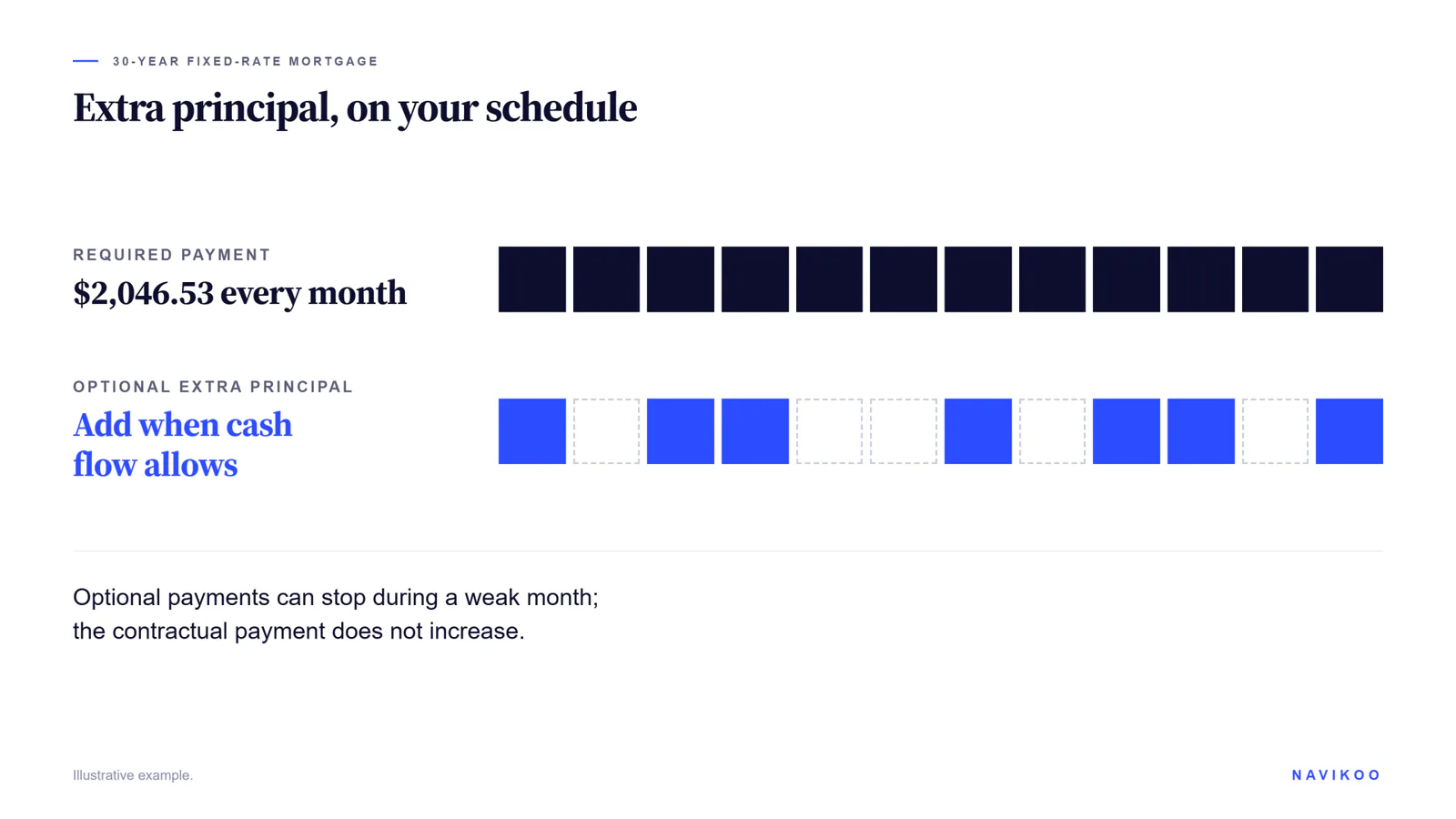
An investor who chooses the 30-year mortgage can still make voluntary extra principal payments when cash flow allows while preserving the lower required payment during a vacancy, repair, or other weak month. That does not replicate a 15-year loan exactly because the rates may differ, but it separates the contractual payment requirement from the owner's optional repayment pace.
What Is the Current Fixed Mortgage Rate?
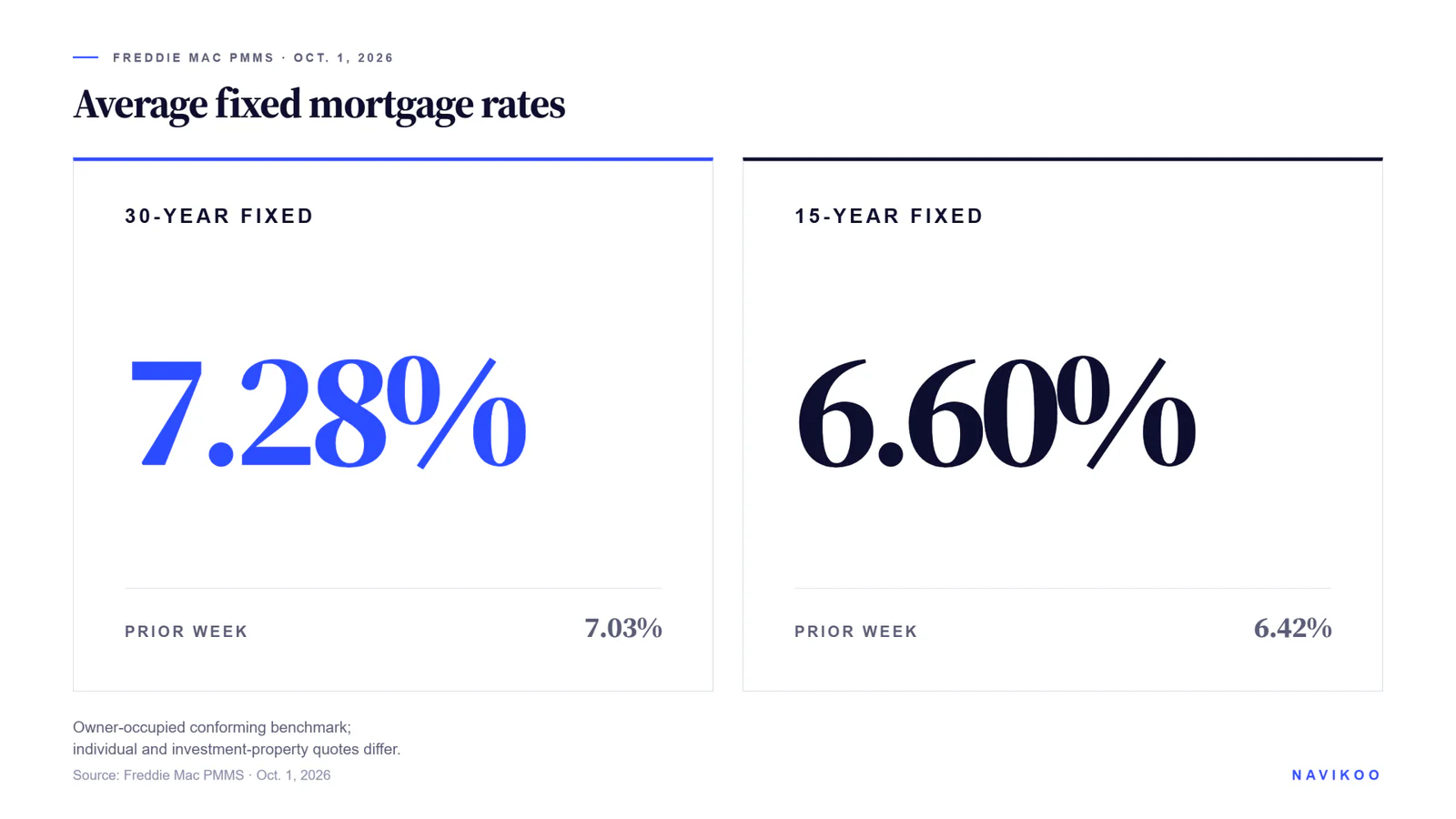
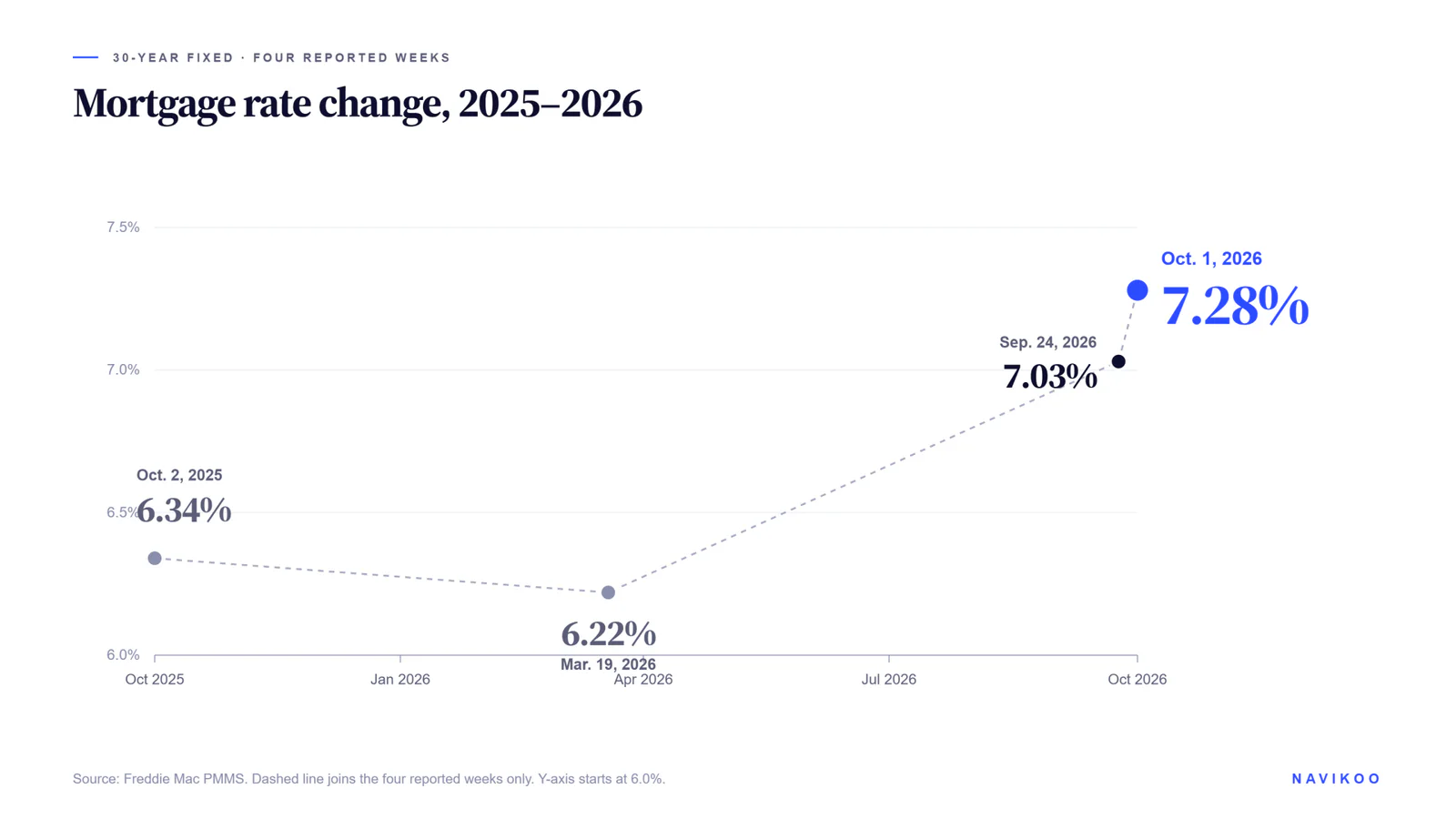
Mortgage rates change continuously, so the useful answer requires a date and a benchmark. A current fixed-rate mortgage rate is a market average or lender quote at a particular moment, not a permanent number attached to the product. As of October 1, 2026, Freddie Mac's Primary Mortgage Market Survey reported an average 7.28% rate for a 30-year fixed-rate mortgage and 6.60% for a 15-year fixed-rate mortgage. The prior week's averages were 7.03% and 6.42%, respectively.
Freddie Mac's current survey is based on mortgage applications submitted by lenders and is designed around conventional conforming purchase loans on owner-occupied one-unit properties for borrowers with good or excellent credit and roughly 20% borrower equity. It is not a quote for an investment property, jumbo loan, FHA loan, or every individual homebuyer. Banks, mortgage companies, and credit unions can all price mortgage loans differently, which is one reason home buyers should compare more than one offer.
Investors financing several properties can also compare individual mortgage loans with a blanket structure.
For perspective, the 30-year average was 6.22% on March 19, 2026 and 6.34% on October 2, 2025. Your own interest rate may differ materially because credit rating, equity contribution, points, mortgage size, occupancy, loan product, lender pricing, and the property itself all affect an actual quote. Investors should compare rates using the same assumptions rather than comparing an owner-occupied headline rate with an investment-property offer. Ask the mortgage loan officer to show the mortgage interest rate, APR, points, lock period, and monthly payments together so the home financing options can be compared on the same date.
Will Mortgage Rates Drop to 3% Again?
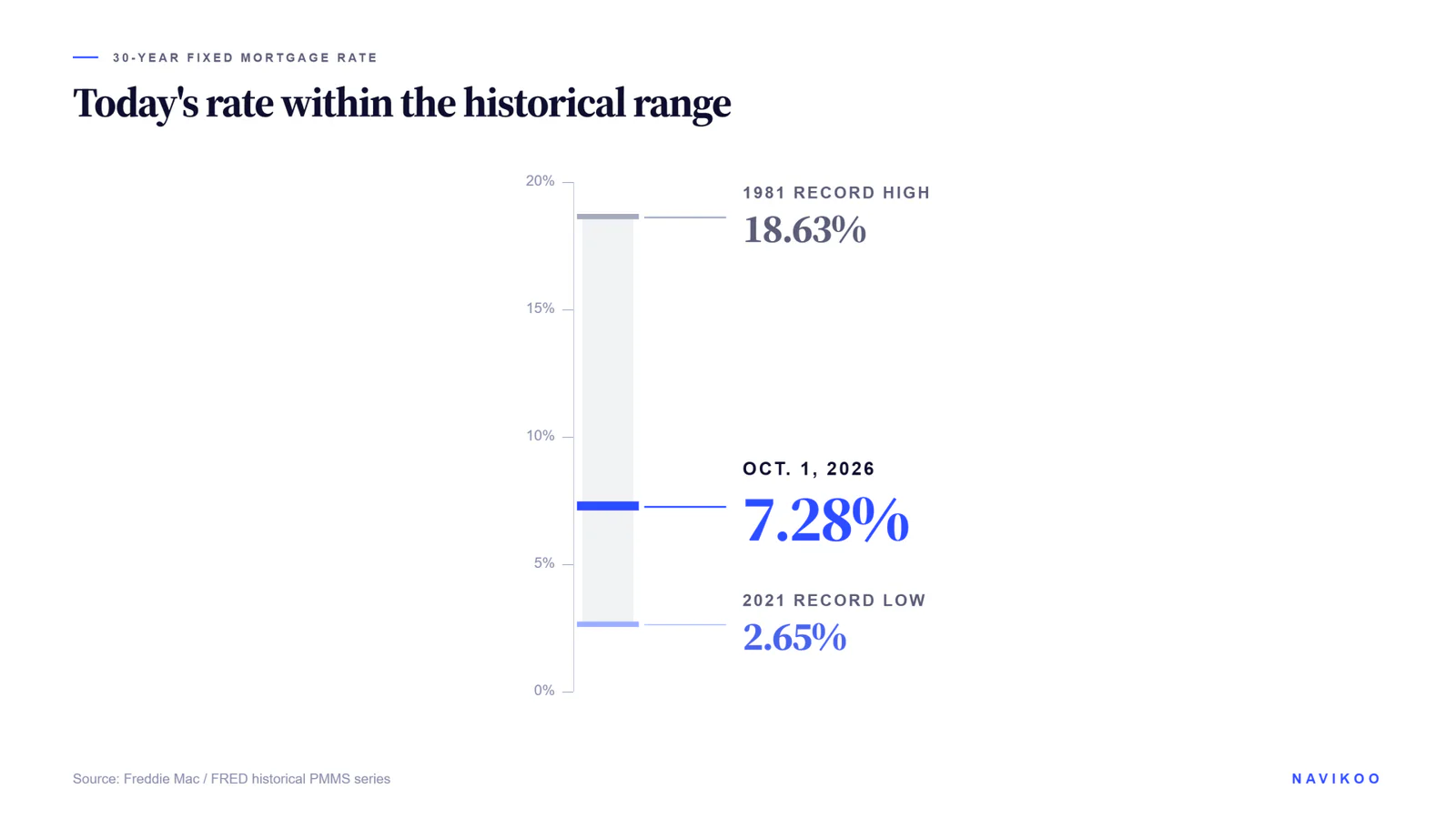
No one can know whether a 30-year fixed mortgage will return to 3%. What the historical data can show is how unusual that level was. Freddie Mac's series reached a record weekly low of 2.65% in January 2021 and a record high of 18.63% in October 1981. The October 1, 2026 average of 7.28% sits between those extremes, showing how widely the cost of interest has varied across cycles.
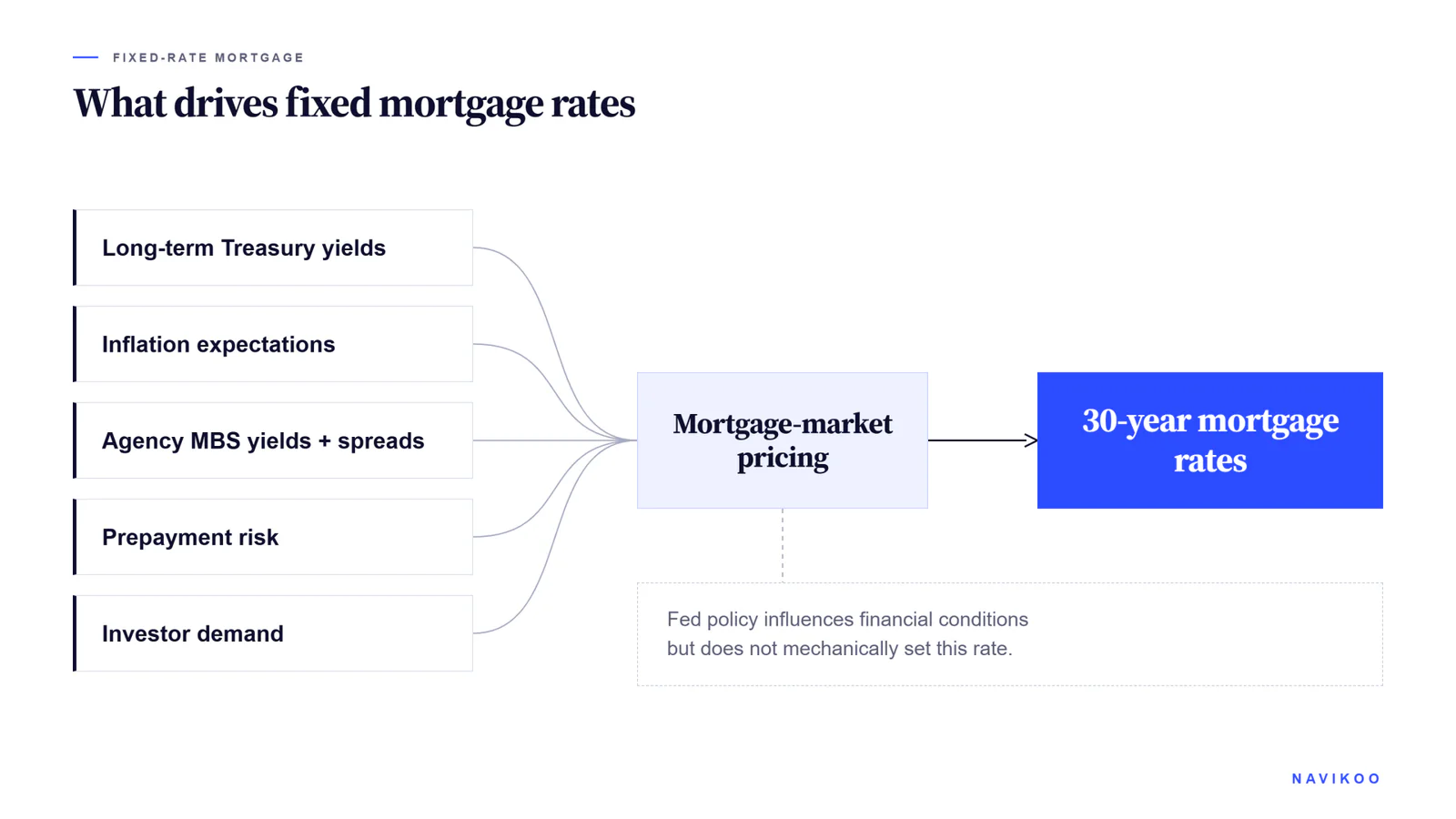
Mortgage interest rates, and therefore the interest charged on new home loans, are influenced by longer-term bond yields, yields and spreads on mortgage-backed securities, inflation expectations, economic growth, prepayment risk, and investor demand. The Federal Reserve can influence financial conditions, but the federal funds rate does not mechanically determine the 30-year mortgage rate. That is why mortgage rates can move even when the Fed has not changed its short-term policy rate.
For real estate investing, the practical underwriting rule is to avoid making a deal depend on uncommitted future refinancing. Analyze the property using the interest rate and financing available today, then treat a future rate reduction as a potential upside rather than part of the base case.
Fixed-Rate vs. Adjustable-Rate Mortgage
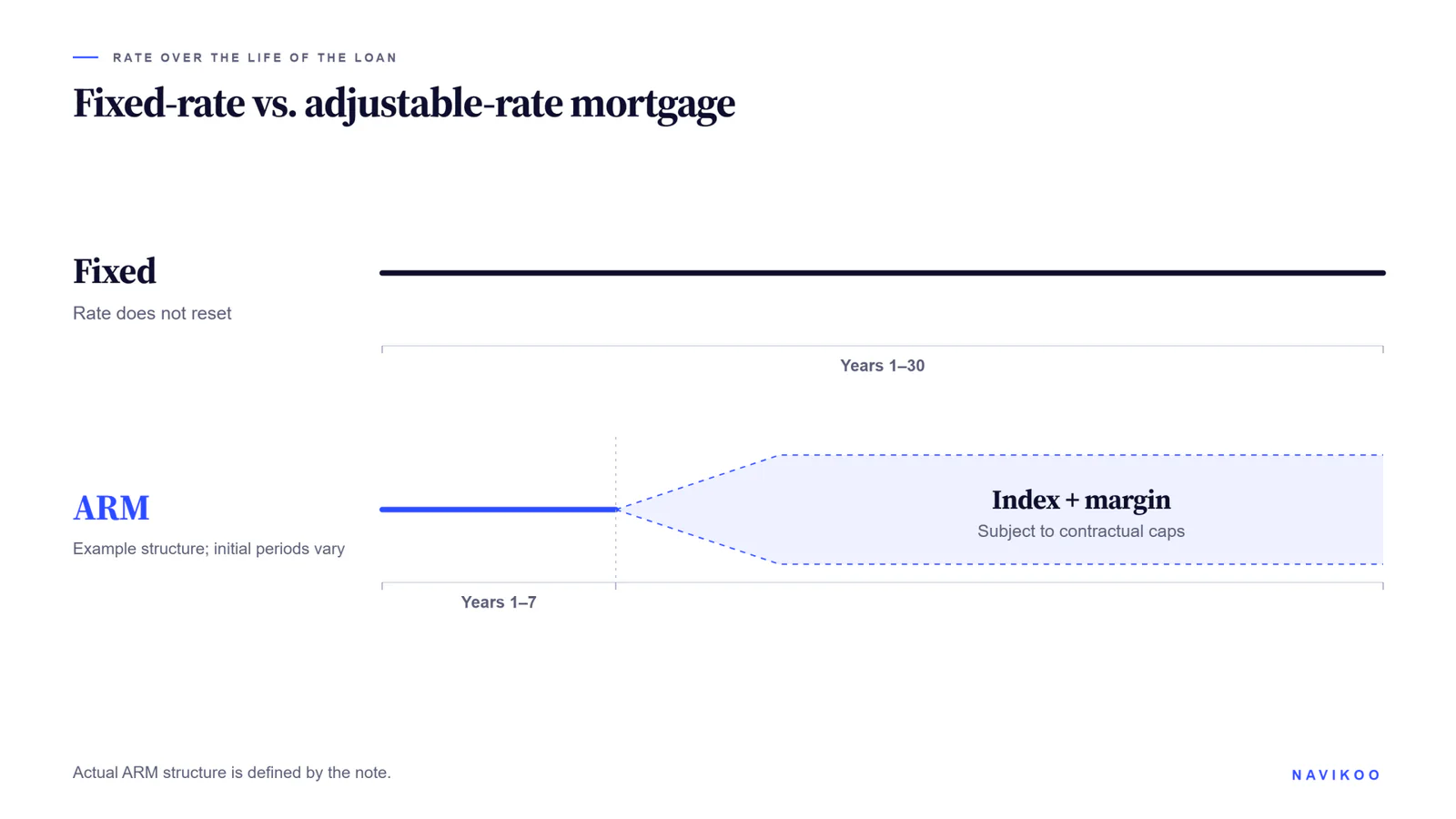
Adjustable rate mortgages generally begin with an initial rate that stays fixed for a specified period and then adjusts under the loan's index, margin, and rate caps. ARM rates therefore need to be evaluated with their adjustment rules, not only with the teaser rate shown at closing. A 7/1 ARM, for example, commonly means an initial fixed period of seven years followed by adjustments once per year, although the actual note controls. The starting ARM rate can be lower than a comparable fixed-rate mortgage, but the future payment is less certain.
Click here for more info about ARM.
A Worked Example on a Rental Property
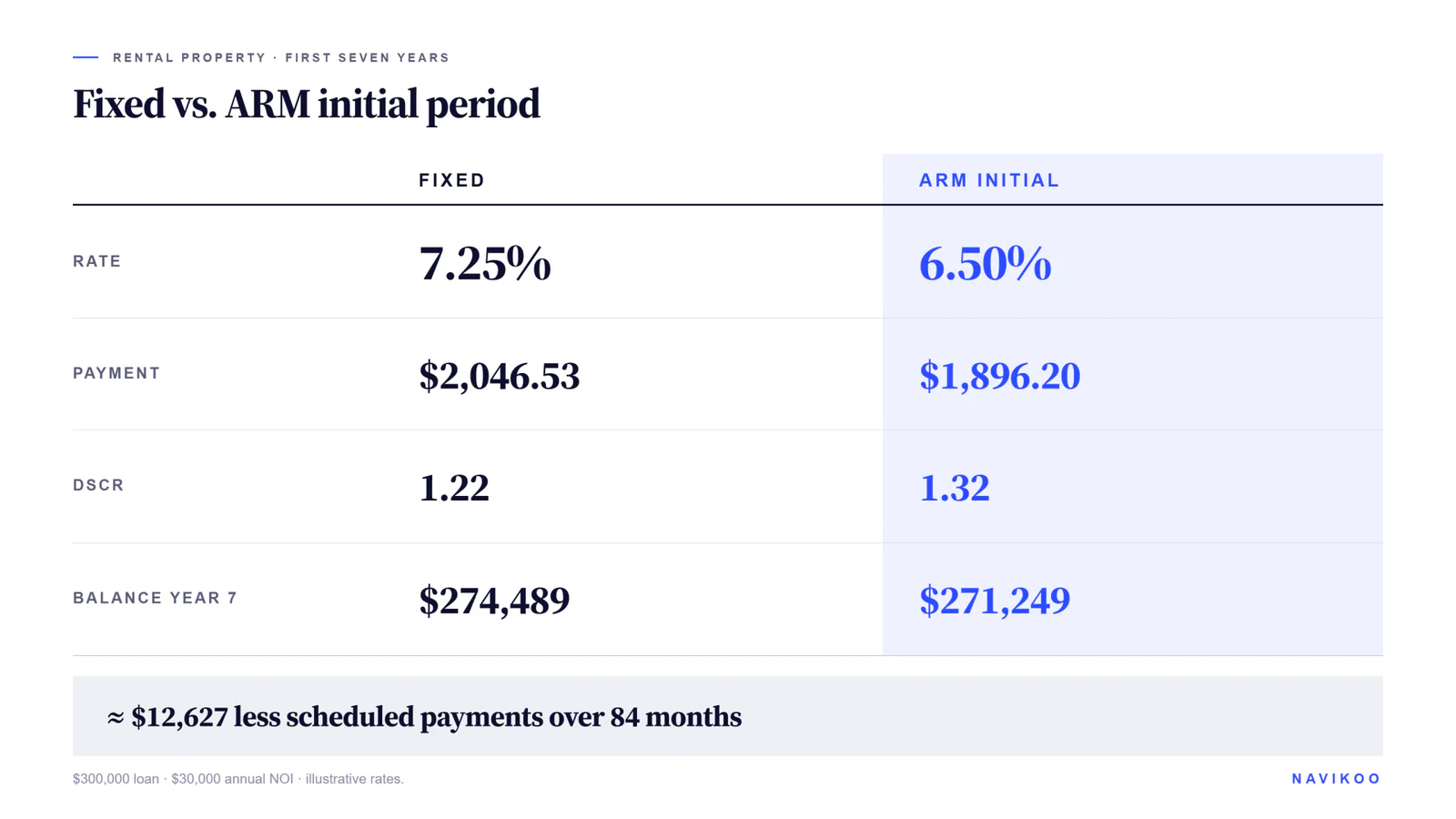
Assume an investor borrows $300,000 on a property producing $30,000 of annual NOI. Compare a 30-year fixed-rate mortgage at 7.25% with an illustrative 7/1 ARM starting at 6.50%, both amortized over 30 years during the initial period.
30-year fixed | 7/1 ARM, initial period | |
|---|---|---|
Monthly payment, years 1–7 | $2,046.53 | $1,896.20 |
Annual debt service | $24,558 | $22,754 |
DSCR | 1.22 | 1.32 |
Balance after 7 years | $274,489 | $271,249 |
During the first seven years, the ARM requires approximately $12,627 less in scheduled payments and produces higher initial DSCR under these assumptions. The comparison is incomplete, however, until the reset is modeled.
What Happens at the ARM Reset?
At the end of year seven, after month 84, the illustrative ARM balance is about $271,249 with 23 years remaining. If the rate resets to 8.50%, the recalculated payment is about $2,240.75 per month and DSCR falls to approximately 1.12. If the rate instead resets to 5.50%, the payment falls to approximately $1,734.06 and DSCR rises to about 1.44.
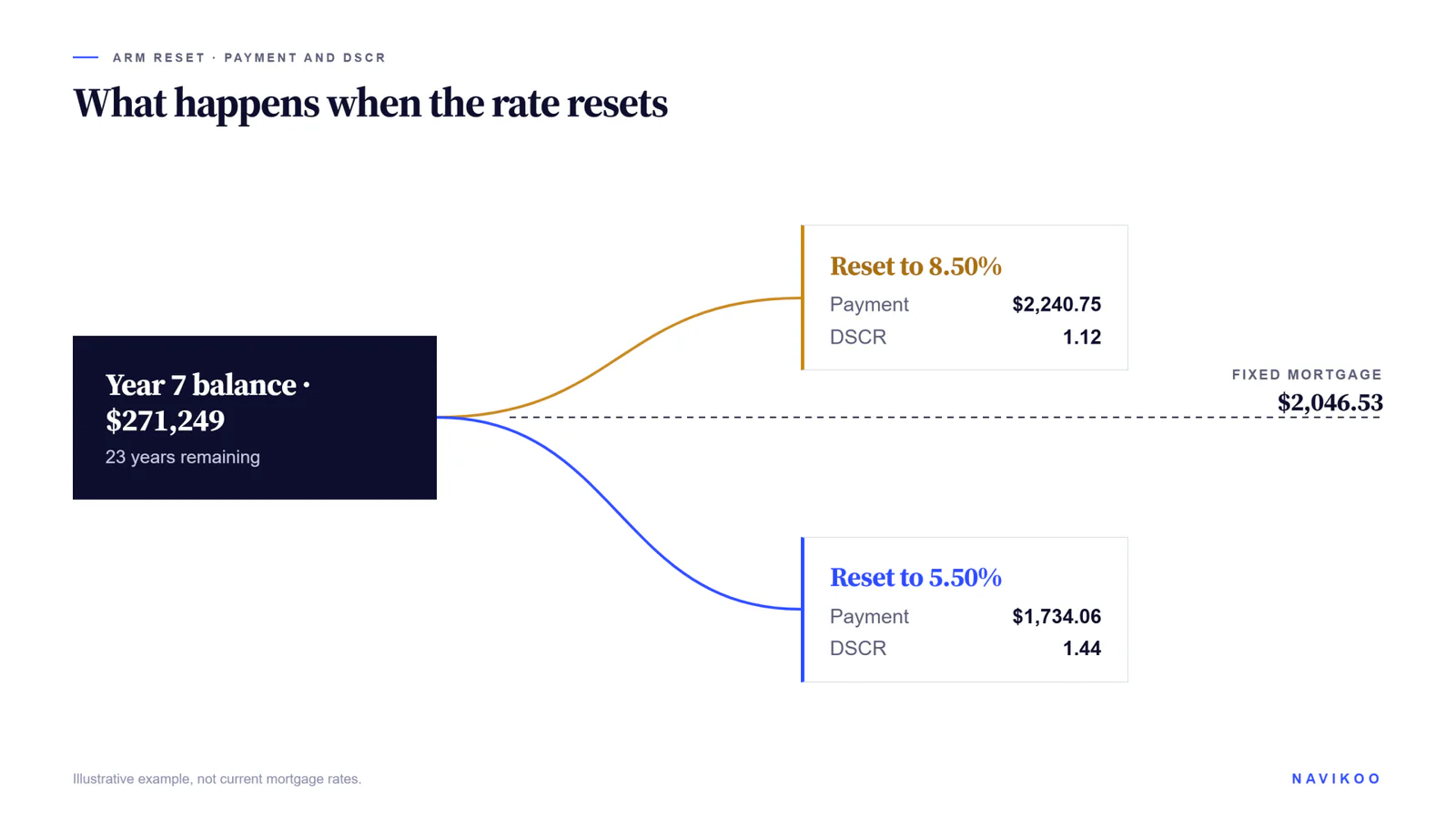
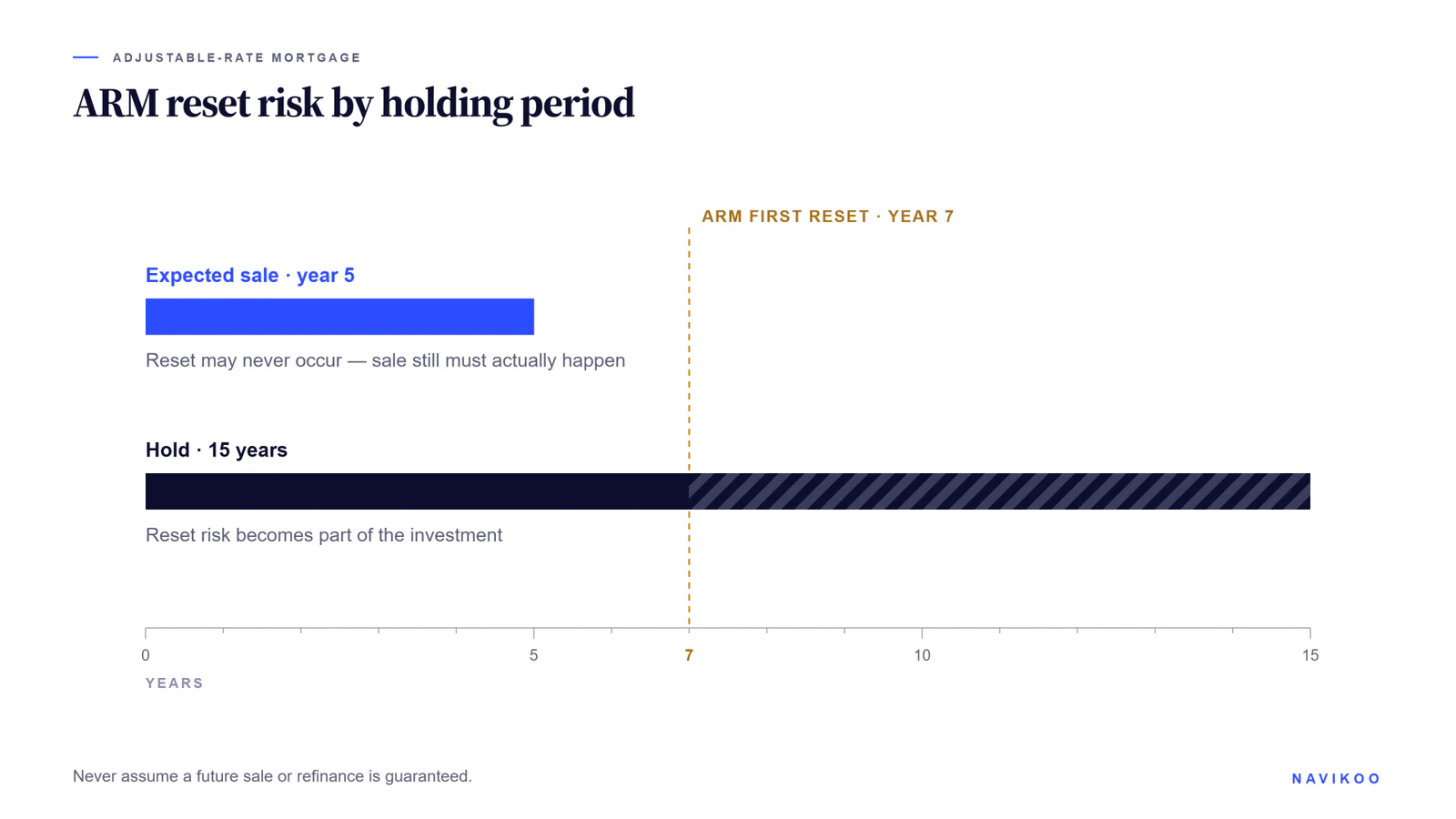
The fixed loan remains at $2,046.53 throughout both scenarios. The relevant question is therefore whether the lower initial payments and lower early interest cost are worth accepting reset risk and whether the mortgage still supports the investment if interest is materially higher after the initial period. An owner planning to sell before the adjustment has a different exposure from an investor planning to hold the property for 15 or 20 years, but neither should assume a future sale or new financing will definitely be available.
The Refinancing Option: Why a Fixed Rate Is Asymmetric
A fixed-rate mortgage can preserve the existing interest rate when market rates rise while leaving the owner free to seek new financing when rates fall. That asymmetry is one of the less obvious benefits of fixed mortgage financing because the homeowner is not forced to accept a higher market interest rate simply because new loans become more expensive. That flexibility has value, but refinancing is an option rather than a guarantee because the borrower must qualify again and the new loan must save enough to justify its closing costs.
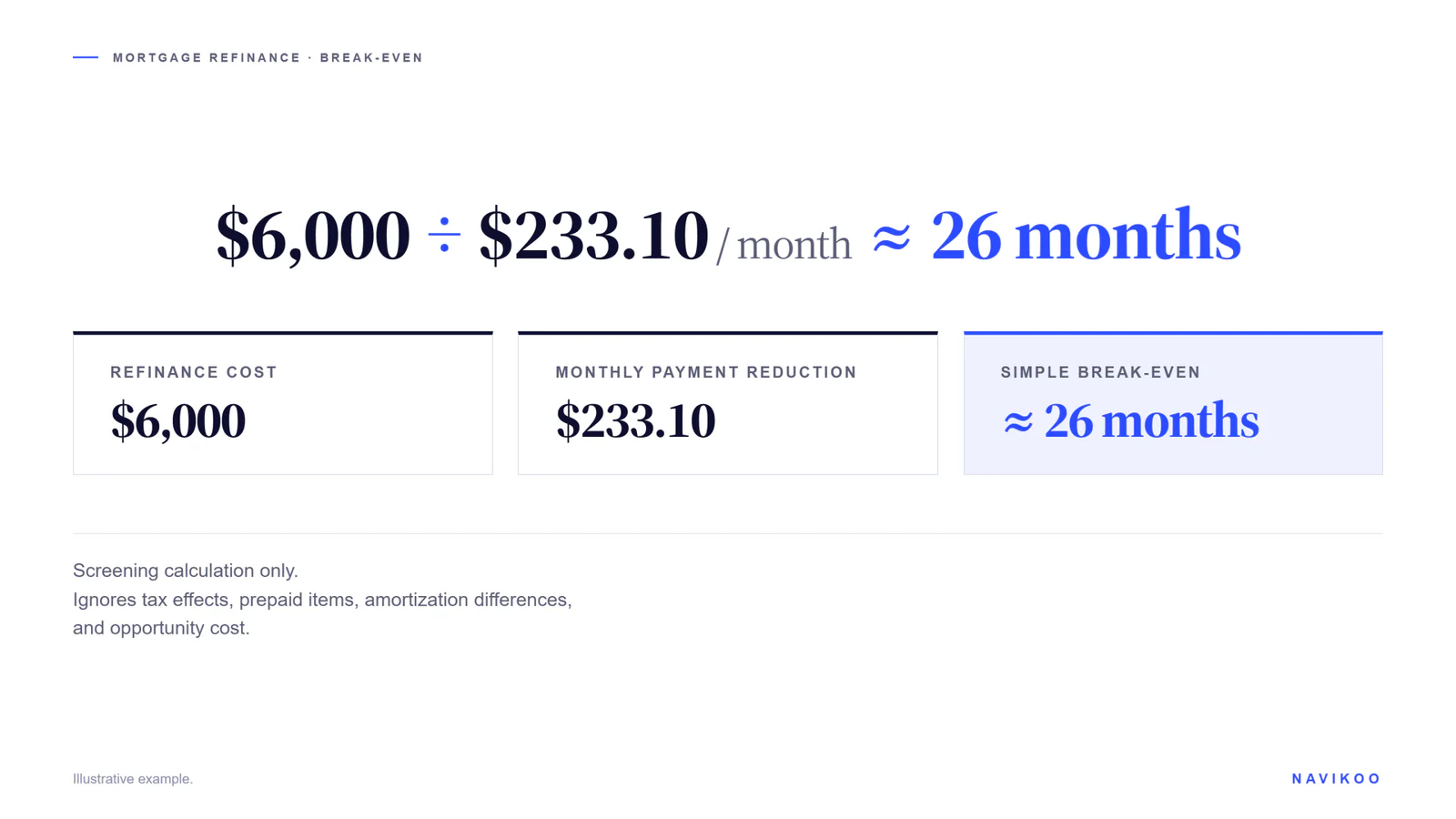
Suppose the illustrative $300,000 mortgage at 7.25% has been outstanding for three years. Its balance is about $290,620. If the investor can refinance that balance into a new fixed-rate mortgage at 6.00% amortized over the remaining 27 years, the principal-and-interest payment falls from $2,046.53 to about $1,813.43, a monthly reduction of $233.10.
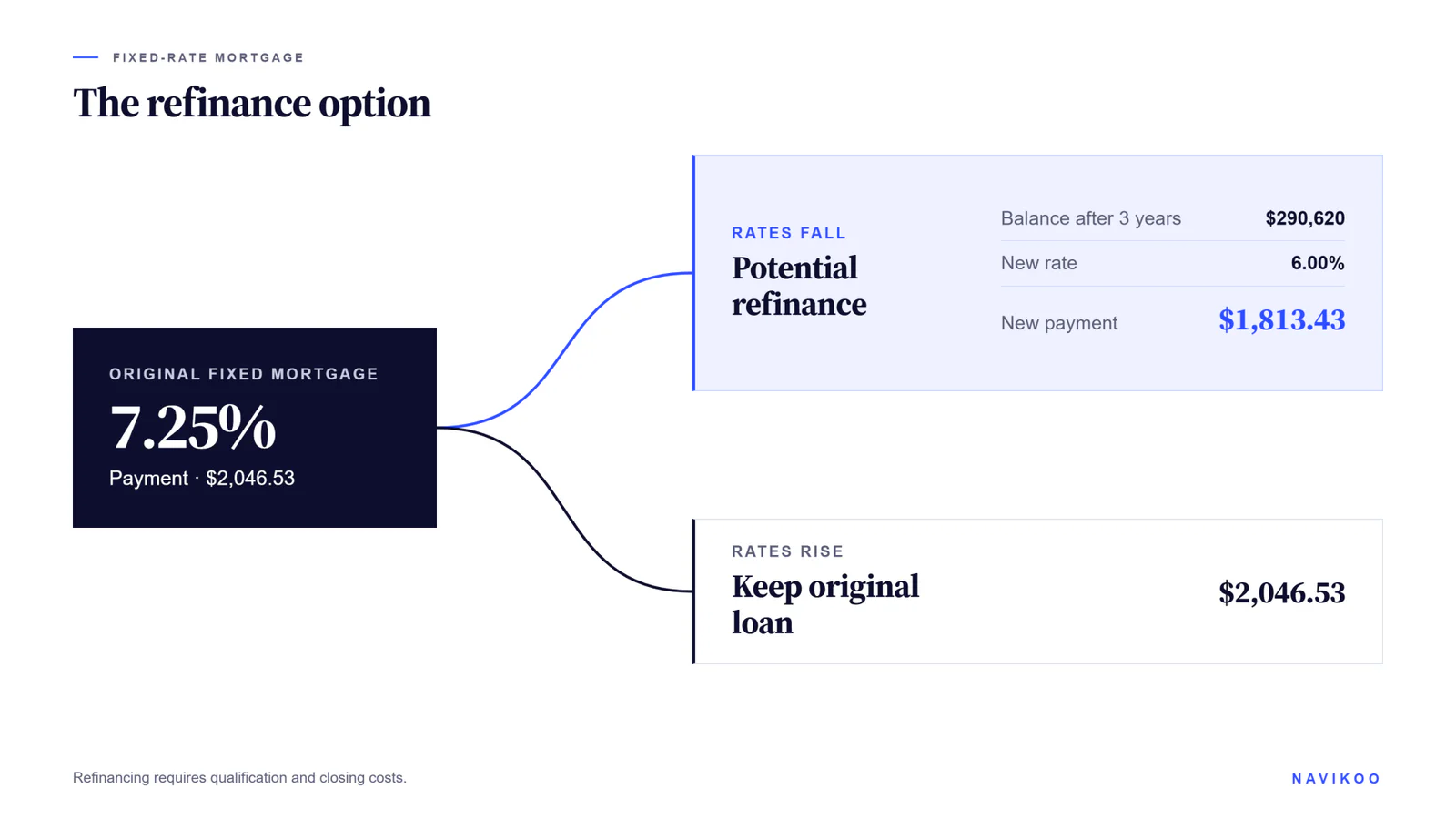
If refinancing costs $6,000, the simple payment-savings break-even is approximately 26 months. That calculation ignores tax effects, differences in prepaid items, changes in amortization, and any opportunity cost of cash paid at closing, so it is a screening measure rather than a complete refinance analysis.
Benefits and Drawbacks of a Fixed-Rate Mortgage
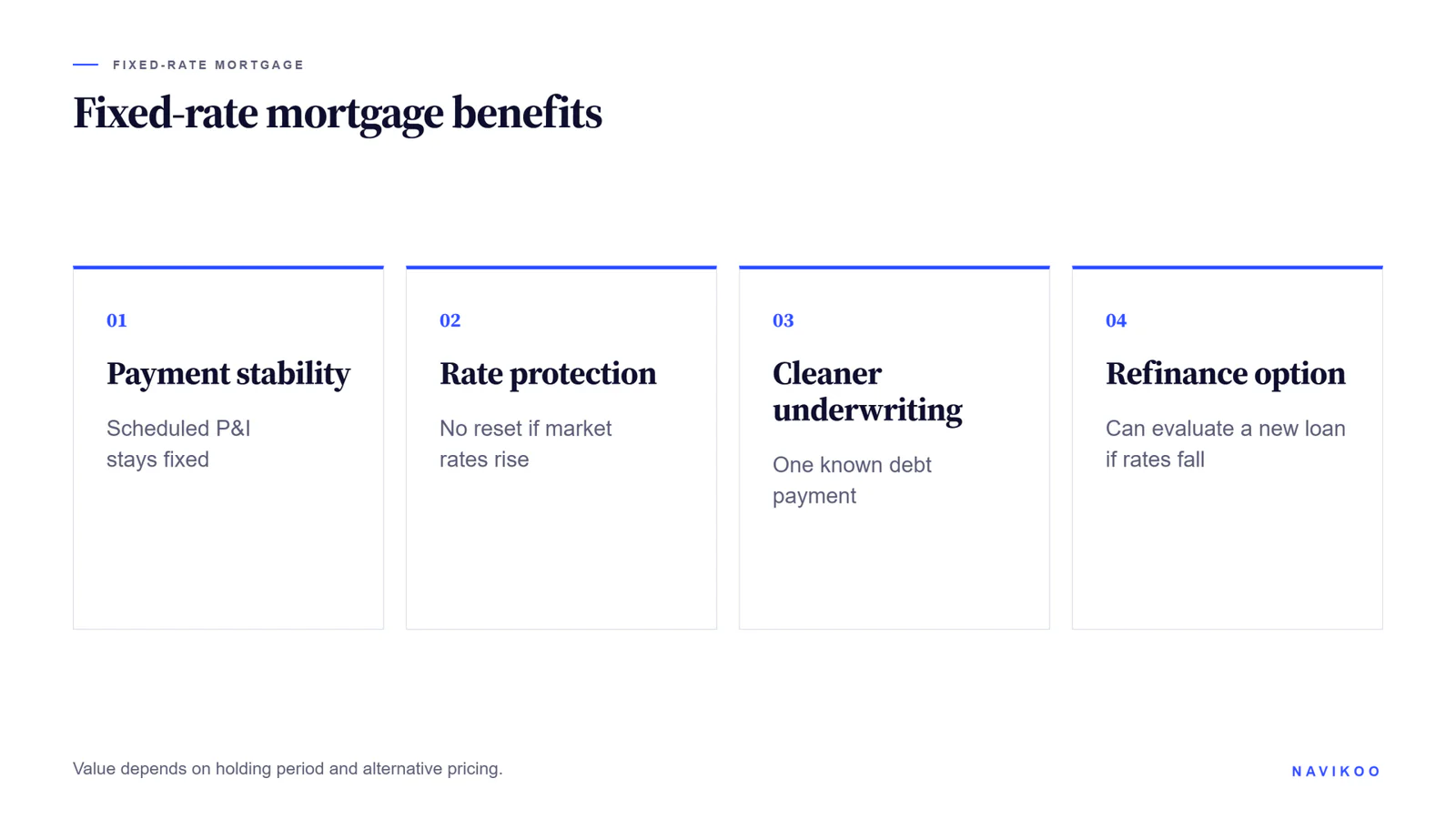
The main benefits are payment stability, predictable payments, protection from increases in market interest rates, simpler long-term cash-flow projections, and the ability to seek new financing if rates fall. Those benefits are most relevant when the home or rental will be held long enough for future rate volatility to matter. These features can be particularly useful when a rental's debt service coverage is thin or the intended hold extends well beyond an ARM's initial period.
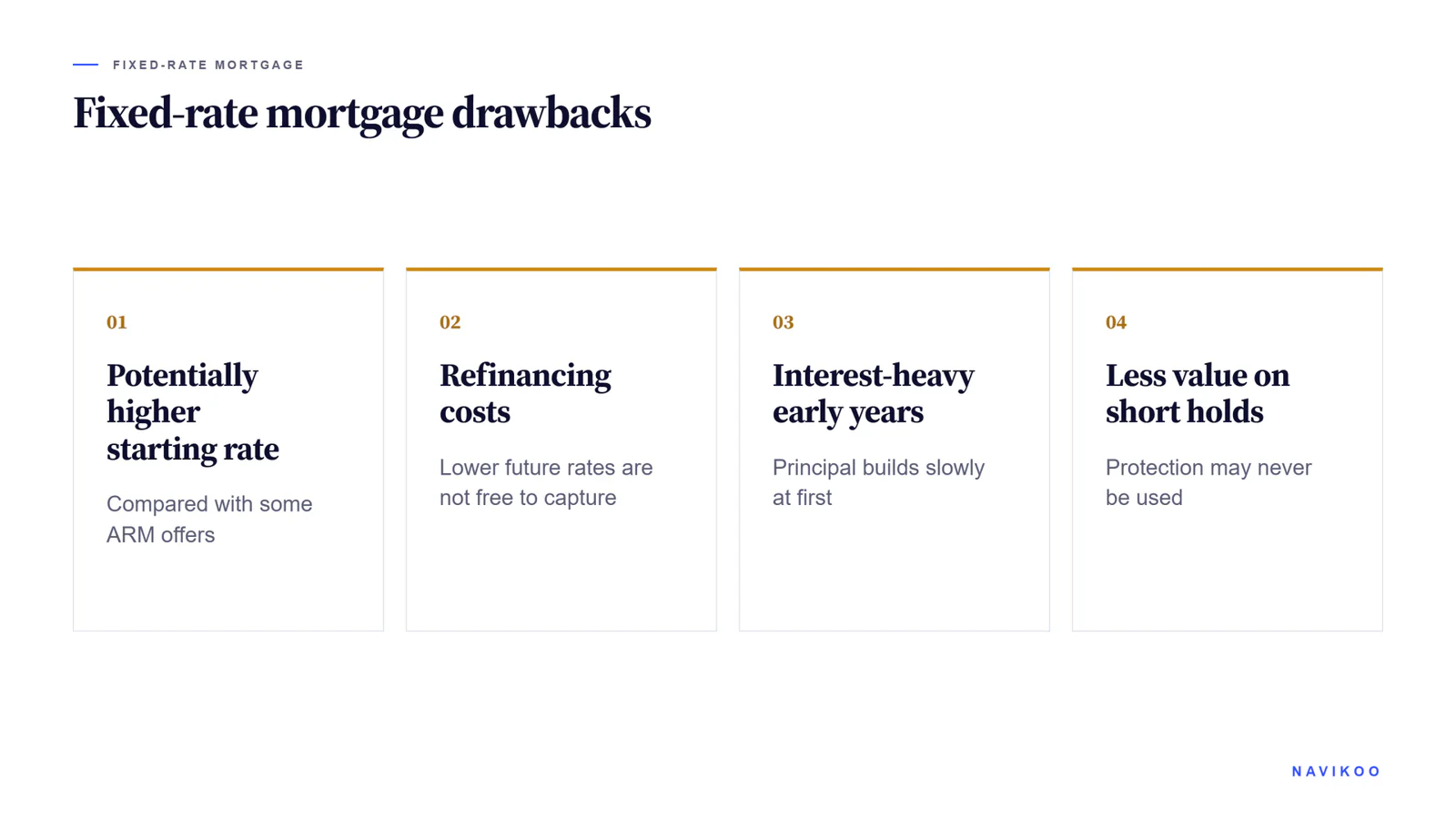
The drawbacks are a potentially higher initial interest rate than an adjustable loan, a larger starting payment when the ARM discount is meaningful, refinancing costs if the owner later wants a lower rate, and slow early principal reduction on a long amortization schedule. The value of fixing a rate is also smaller when the expected hold is short.
Why Choose a Fixed Rate Over an ARM?
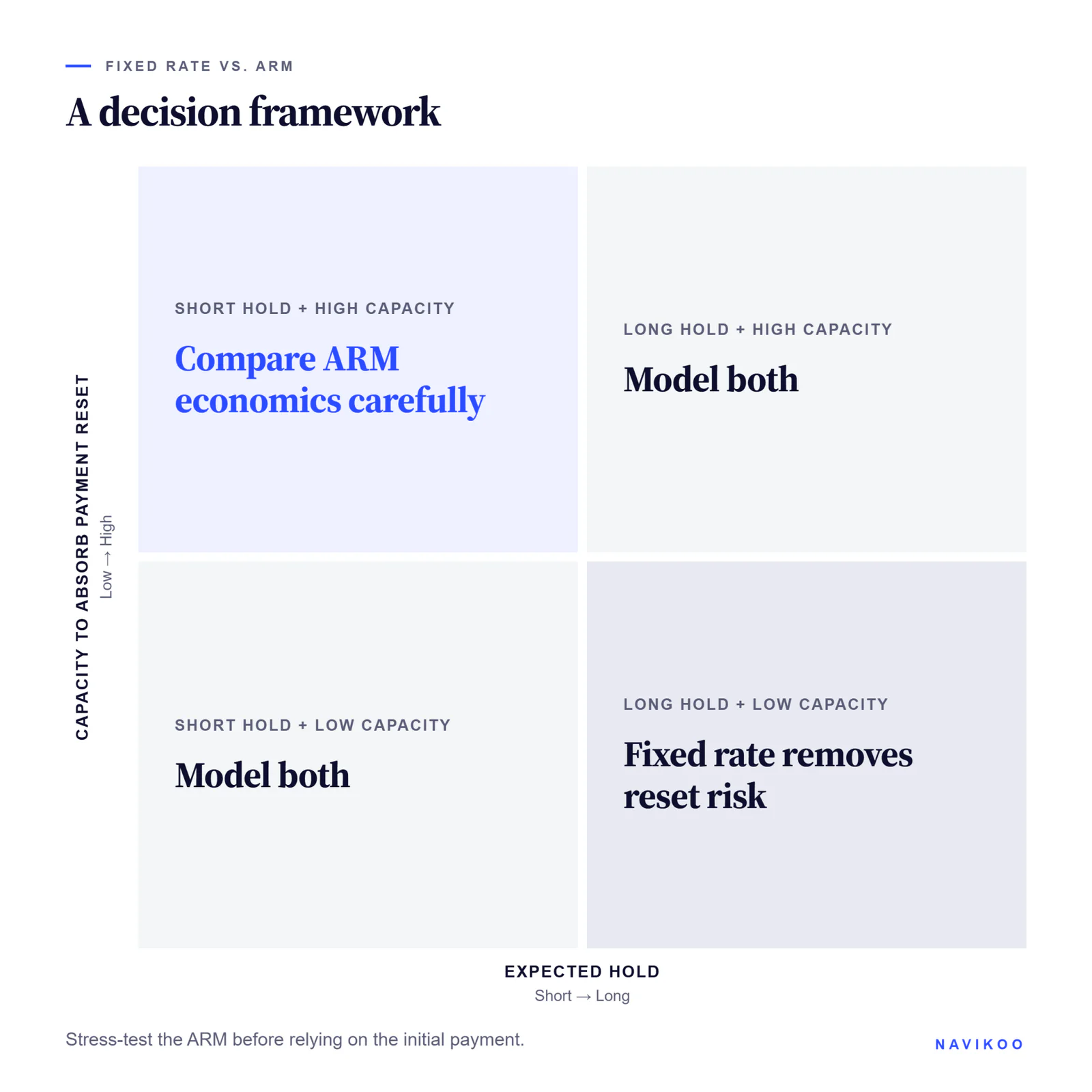
A fixed-rate mortgage may fit an investor who values certainty, expects a long holding period, or would have difficulty absorbing a large future payment increase. An ARM may fit a different risk profile when the initial pricing advantage is substantial and the applicant has enough income or property cash flow to tolerate a higher reset payment.
The useful test is not to predict which interest rate path will occur. Model the adjustable loan at its contractual caps or at another meaningfully higher reset rate, then compare those payments with the fixed mortgage. If the property only works under the ARM's initial payment, the financing decision is relying on future interest conditions rather than the property's current economics.
Free mortgage calculators can be used to compare fixed loan payments, different loan terms, and higher or lower interest-rate scenarios before deciding. For a rental property, pair that payment analysis with NOI and DSCR rather than looking only at the monthly mortgage payment.
Before You Lock a Rate
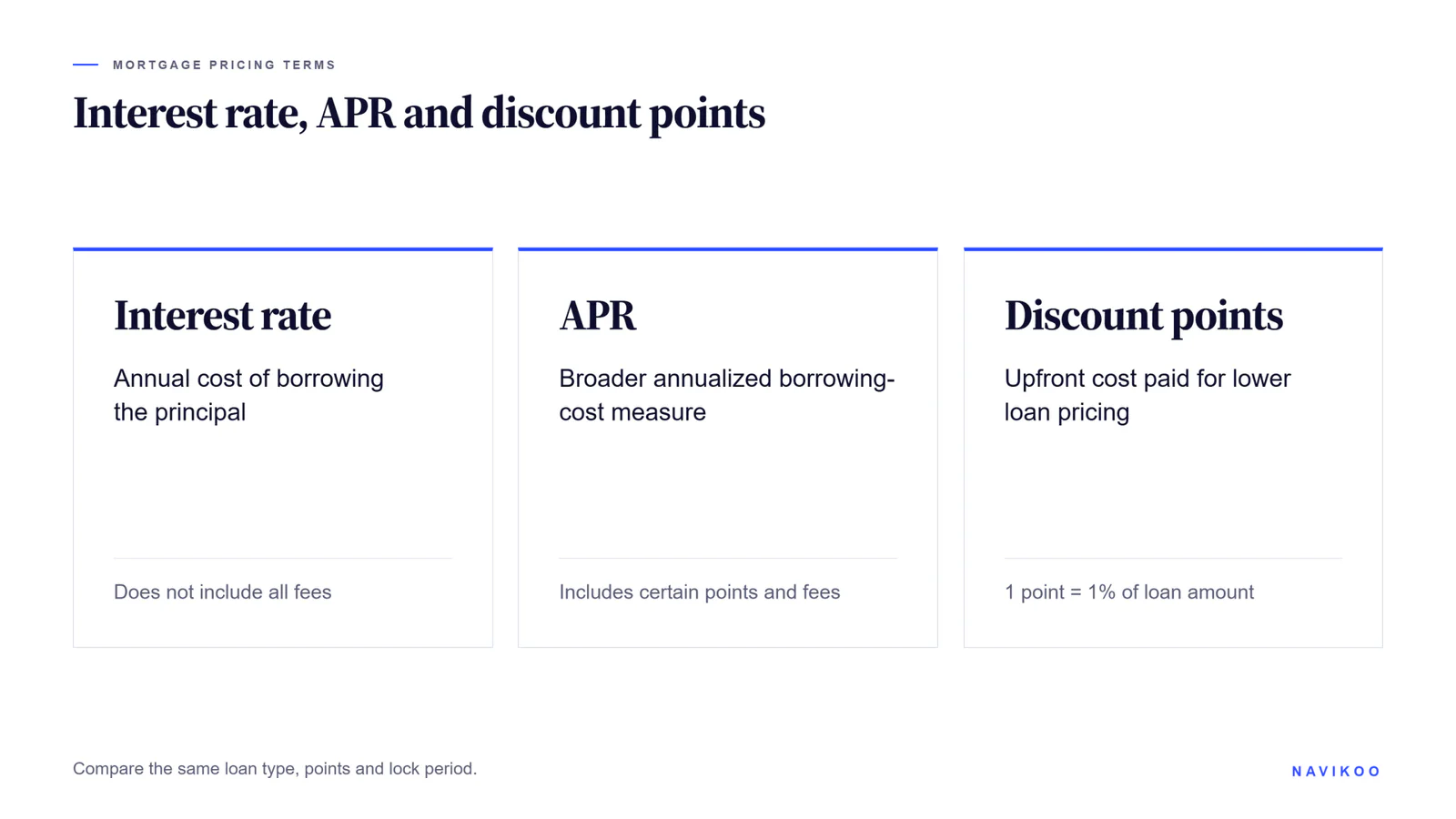
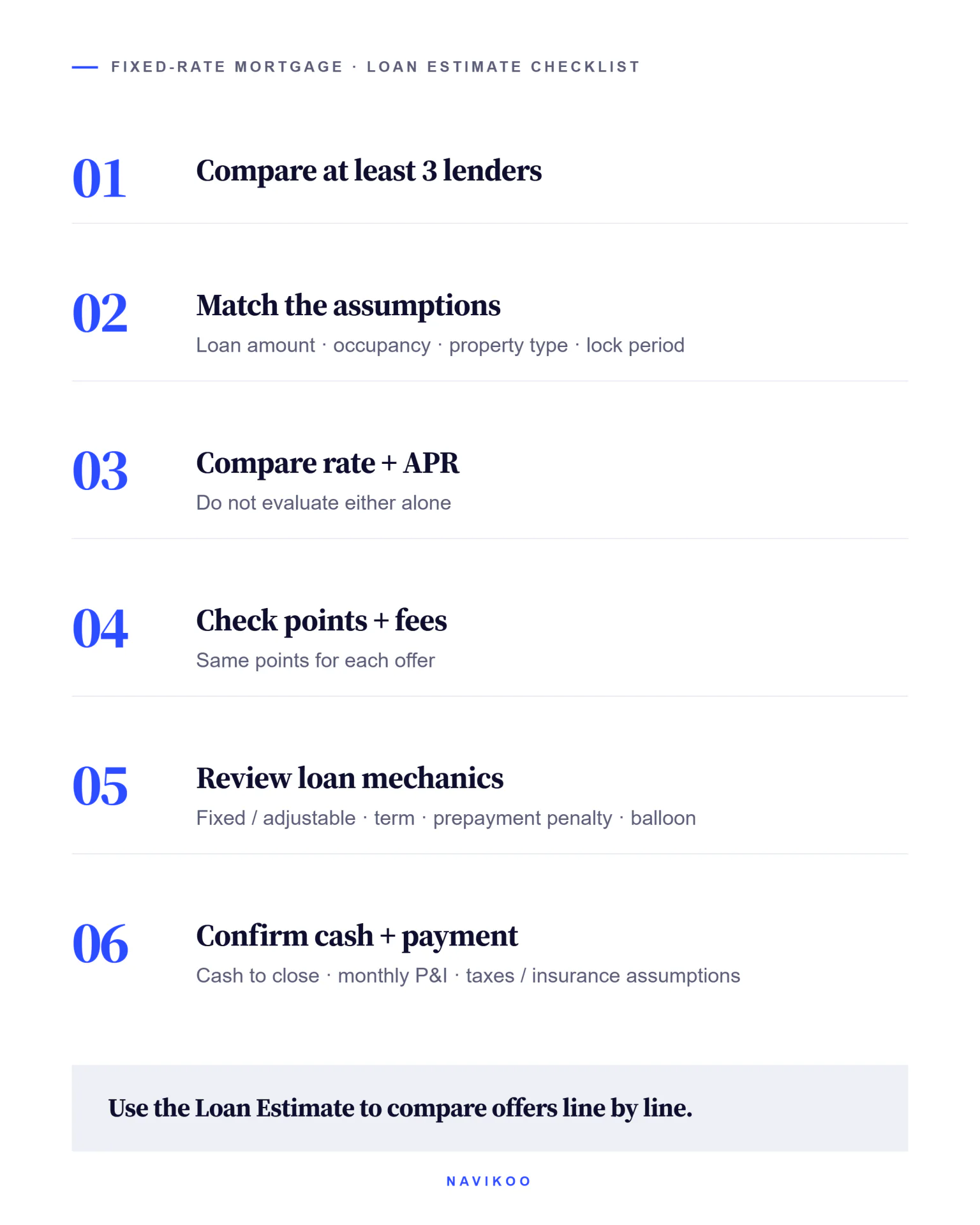
Each borrower should compare rates from multiple lenders using the same loan amount, occupancy, property type, down payment, and lock period. Shopping loans on inconsistent assumptions can make one mortgage appear cheaper simply because the lender used different points, fees, or lock details. The CFPB recommends obtaining Loan Estimates from at least three lenders. Compare the interest rate with the APR calculation because APR includes the rate plus certain points, broker fees, and other charges, although APR alone does not capture every decision factor.
Discount points exchange more upfront cash for a reduction in interest rate. This is one of the clearest mortgage trade-offs between cash paid today and interest paid later. One point equals 1% of the loan amount, but there is no universal rule that one point buys a specific rate reduction. Compare rates with the same number of points and calculate how long the lower monthly payments take to recover the upfront cost.
Review the loan term, monthly payments, loan type, whether the rate is fixed or adjustable, prepayment penalties, balloon features, cash to close, and the lender's assumptions. For a home purchase, also confirm that the mortgage amount plus the cash contribution reconciles to the purchase price and that the quoted terms match the Loan Estimate. The application process can also review income, assets, current debts, payment history, reserves, and, for an investment property, rental income and property-level information. General mortgage advice is useful for understanding the structure, but property-specific tax, legal, and financing guidance should come from qualified professionals reviewing the actual transaction.
A fixed-rate mortgage solves one problem: uncertainty about the loan's scheduled interest rate. It gives the owner a stable mortgage obligation while leaving the rest of the home or investment economics exposed to the market. It does not freeze property taxes, insurance, maintenance, rent, or property value. For an investor, the financing choice is strongest when it is evaluated inside the full property analysis rather than treated as a standalone bet on where mortgage rates go next. Independent advice can be especially useful when points, prepayment terms, or an ARM make two loans difficult to compare.
Investors managing several financed properties can use Navikoo's free portfolio tracker to monitor property-level debt, income, expenses, and performance in one place.
Explore more real estate investing guides from Navikoo.