House Hacking: How It Works, Pros, Cons, FHA Loans, and a Duplex Example
House hacking lets you live in a property while rental income from another unit or room helps offset your housing costs. Learn how FHA, VA, and conventional financing can work, what house hacking really costs, and why every deal should pass two separate tests: whether it makes sense as your home today and whether it can perform as a rental after you move out.

House hacking means buying a home, living in part of it, and renting out another part so rental income offsets some of your housing cost.
The classic version uses a duplex, triplex, or fourplex: the owner occupies one unit and rents the others. But house hacking can also mean renting a bedroom, a permitted lower-level apartment, or an accessory dwelling unit.
The financing is part of the appeal. Because the property is genuinely owner-occupied, buyers may qualify for financing options that require less upfront equity than financing the same property strictly as an investment.
But house hacking needs two separate analyses.
First: Does it reduce what you pay to live?
Second: Will the property work as a rental after you eventually move out?
A property can perform well on the first test and poorly on the second.
What Is House Hacking?
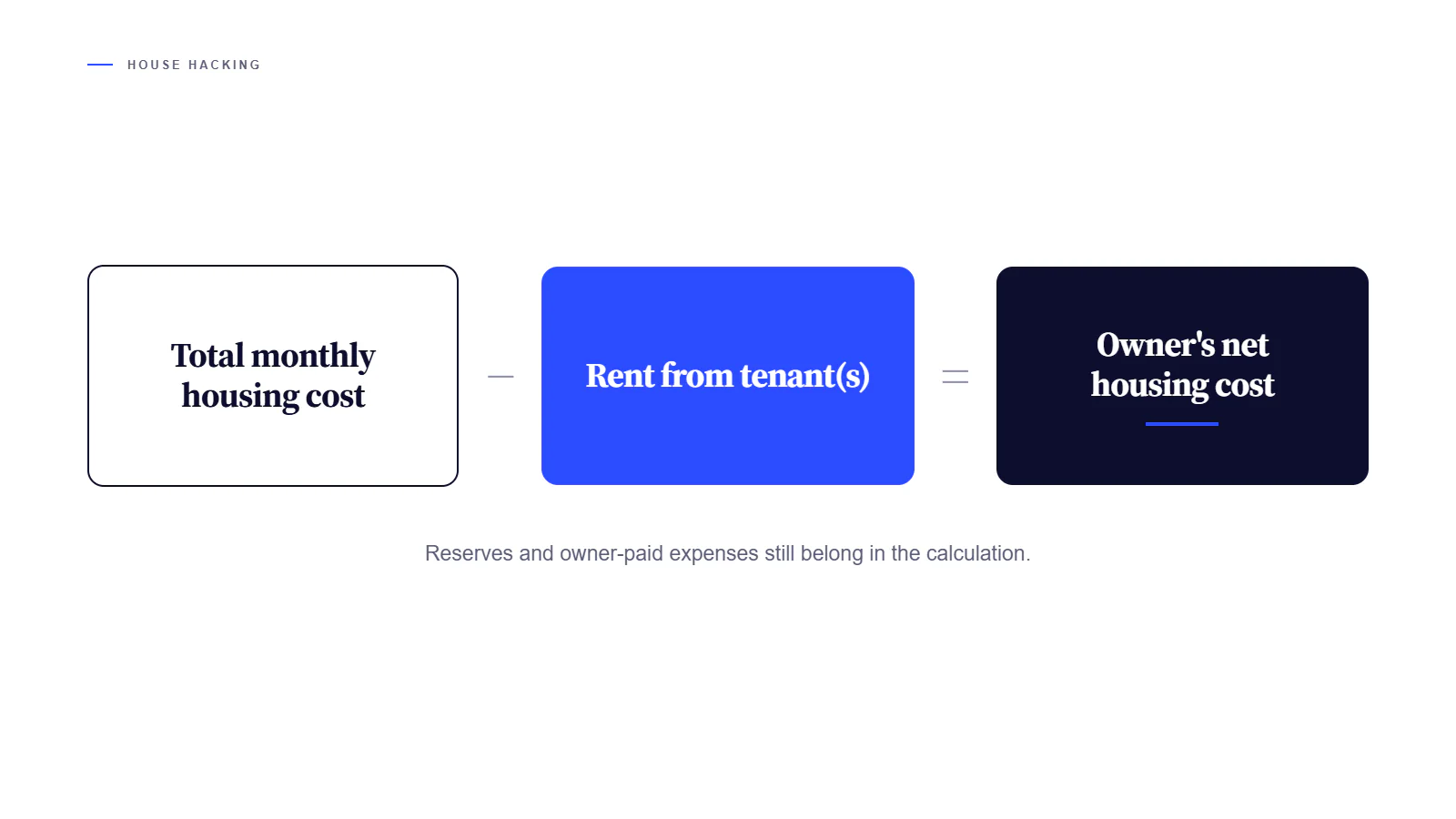
House hacking is an owner-occupied real estate strategy in which income from tenants helps offset the owner's mortgage payment and other housing costs.
You are simultaneously a homeowner and a landlord.
Instead of paying the entire cost of the property from household income, part of the expense is supported by rent from another unit or portion of the home.
That can reduce the owner's net housing cost while principal repayment gradually builds equity.
Property appreciation may provide additional value over time, but appreciation should not be assumed when deciding whether the numbers work.
Common House Hacking Strategies
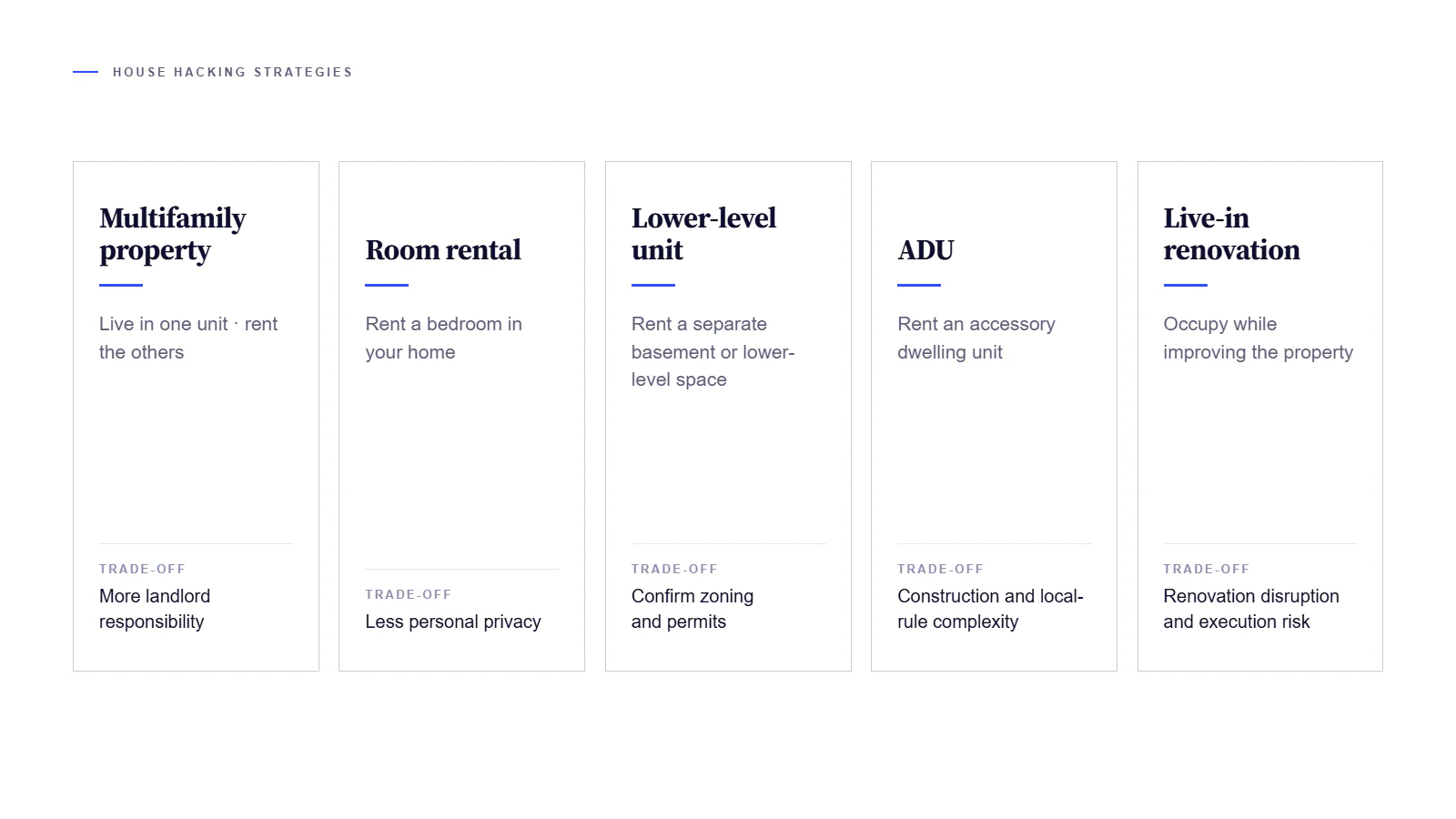
There is no single house hacking setup.
Strategy | How it works | Main trade-off |
|---|---|---|
Multifamily property | Live in one unit of a duplex, triplex, or fourplex and rent the others | More rental income potential, more landlord responsibility |
Room rental | Rent one or more bedrooms in your home | Low barrier to entry, less privacy |
Lower-level unit | Rent a legal basement or lower-level apartment | More separation, zoning and permit questions |
ADU | Rent a permitted backyard, garage, or accessory dwelling unit | More privacy, possible construction and regulatory cost |
Live-in renovation | Occupy a property while improving it before refinancing, renting, or selling | Potential equity creation, disruption and renovation risk |
These arrangements create very different living experiences.
Sharing a kitchen with a roommate is not equivalent to living in one side of a duplex with a separate entrance.
For that reason, the best house hacking strategy is not simply the one producing the most rent. It also has to fit the owner's privacy, location, management capacity, and long-term plan.
What Are the Advantages/Pros of House Hacking?
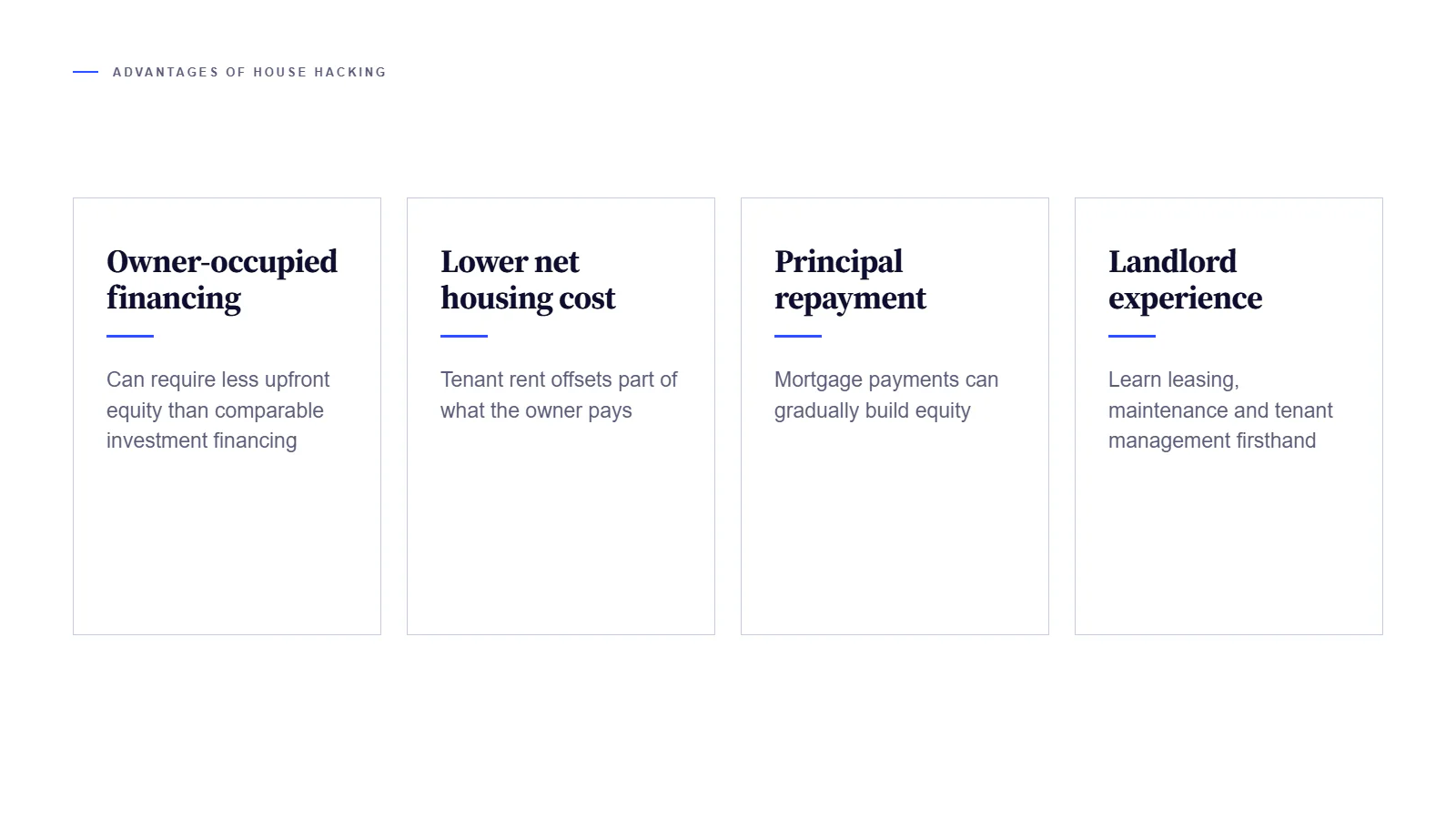
One major advantage is access to owner-occupied financing.
Eligible borrowers may be able to purchase an owner-occupied property with substantially less equity than the same borrower would need for a comparable non-owner-occupied investment property.
That can make a two- to four-unit property accessible earlier in an investor's career.
Rental income can also reduce the owner's monthly housing cost.
If the property costs $3,500 per month to own and another unit generates $2,000 of rent, the owner is economically in a very different position from someone paying the full $3,500 alone.
House hacking also gives a new investor direct experience with:
tenant screening
leases
rent collection
maintenance
contractor coordination
That experience can be useful before expanding into a larger rental portfolio.
Is House Hacking Actually Cheaper Than Renting?
House hacking is often marketed as a way to “live for free,” but that is not the right test.
The more useful comparison is the owner’s net housing cost after rental income versus what the same person would otherwise spend to rent or own a comparable home.
Start with:
Mortgage payment + taxes + insurance + mortgage insurance + maintenance reserve + vacancy reserve − rent received
Then compare the result with the cost of the realistic alternative.
A house hack does not have to reduce housing cost to zero to be useful. If it lowers monthly housing expense while the owner builds equity and the property still works as a future rental, the economics may be attractive.
Conversely, a property that requires substantially more cash every month than renting elsewhere is not automatically a good deal simply because a tenant is helping with the mortgage.
What Are the Disadvantages/Cons of House Hacking?
House hacking also combines personal housing with a small rental business.
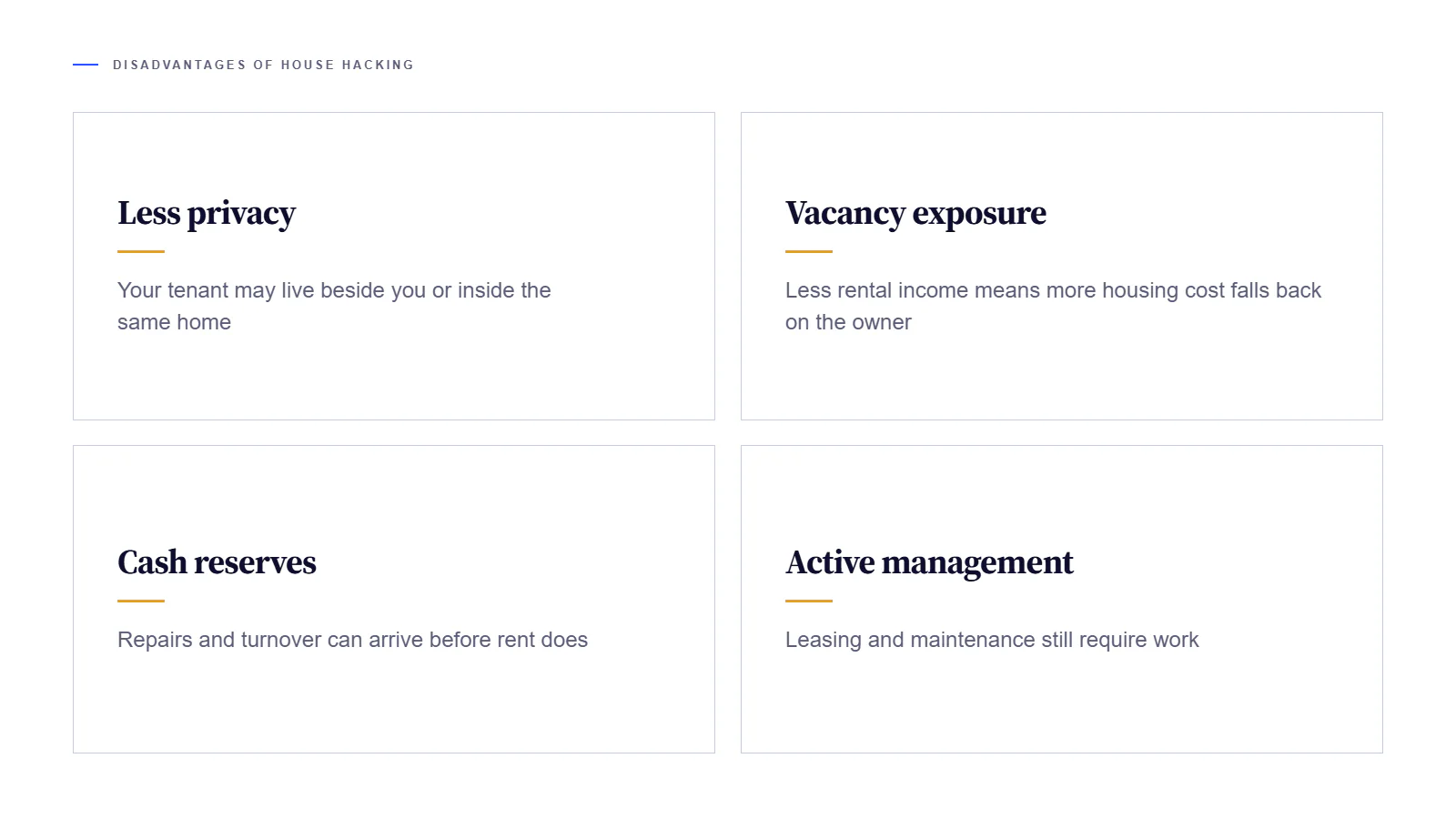
Privacy is the most obvious trade-off.
Depending on the setup, tenants may share walls, outdoor areas, parking, laundry, or parts of the home with the owner.
Vacancy also affects the owner's personal housing budget.
If expected tenant rent disappears for two months, the mortgage does not disappear with it.
The owner must also maintain enough liquidity for repairs and turnover costs rather than assuming rental income will arrive every month without interruption.
Location can become another compromise. A property that works well as a house hack may not be the exact home or neighborhood the buyer would otherwise choose.
Finally, house hacking is not automatically passive income. Especially at the beginning, the owner may be handling leasing, maintenance, tenant communication, and bookkeeping directly.
How Much Money Do You Need to House Hack?
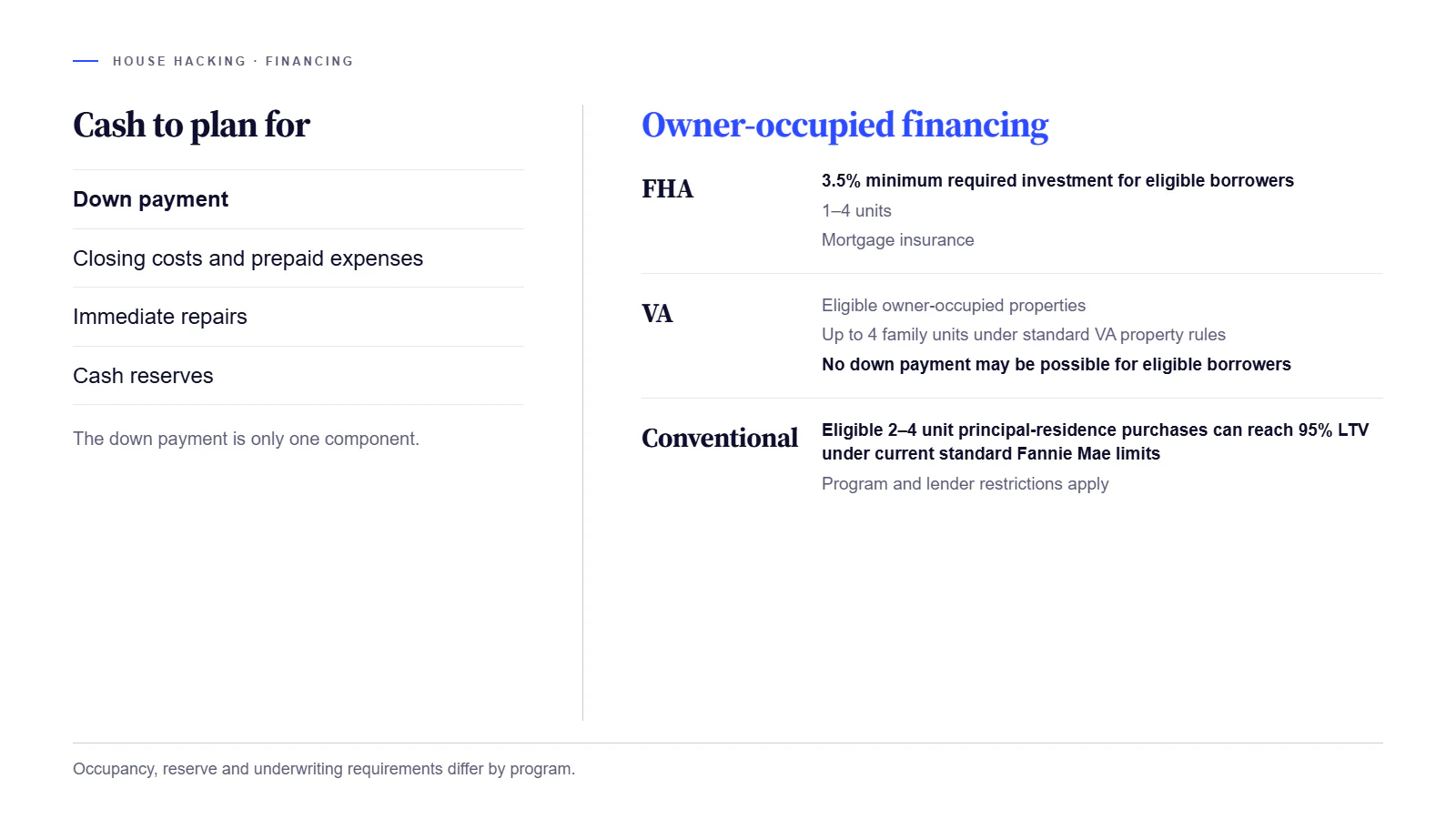
The down payment is only one part of the cash required.
A house hacking purchase can require money for:
the down payment
closing costs and prepaid expenses
inspections or immediate repairs
reserves for vacancy and maintenance
That matters because advertisements often emphasize the minimum down payment while saying much less about the cash needed after closing.
Owner-Occupied Financing Options
Several financing structures can potentially support a house hack.
FHA financing
The FHA 203(b) program covers qualifying owner-occupied properties with one to four units.
Eligible borrowers can finance approximately 96.5% of the purchase price or adjusted value, meaning a minimum required investment of 3.5% under standard FHA rules.
FHA loans also include upfront and annual mortgage insurance.
For a principal residence, FHA currently requires at least one borrower to occupy the property within the required post-closing period and intend to continue occupancy for at least one year, subject to applicable program exceptions.
VA financing
Eligible Veterans and other qualifying borrowers may be able to use VA financing for an owner-occupied property containing up to four family units, subject to VA eligibility, entitlement, appraisal, income, credit, and lender requirements.
A down payment may not be required when the borrower has sufficient entitlement and otherwise qualifies.
VA requires the borrower using the benefit to intend to occupy the property as a home. Its occupancy rules are not identical to FHA's one-year intent requirement.
Conventional financing
Conventional owner-occupied financing can also support house hacking.
Under current standard Fannie Mae eligibility, qualifying two- to four-unit principal-residence purchases can reach up to 95% loan-to-value in eligible transactions, although high-balance loans and particular programs can have more restrictive limits.
Loan availability, reserve requirements, mortgage insurance, borrower contribution rules, and use of rental income should be confirmed for the specific transaction.
Can You House Hack With an FHA Loan?
Yes.
FHA financing is particularly relevant to house hacking because eligible properties can contain up to four units while still being treated under FHA's single-family mortgage program when the borrower occupies the property as a principal residence.
Lenders may also be able to consider qualifying rental income from the other units, subject to FHA documentation and underwriting rules.
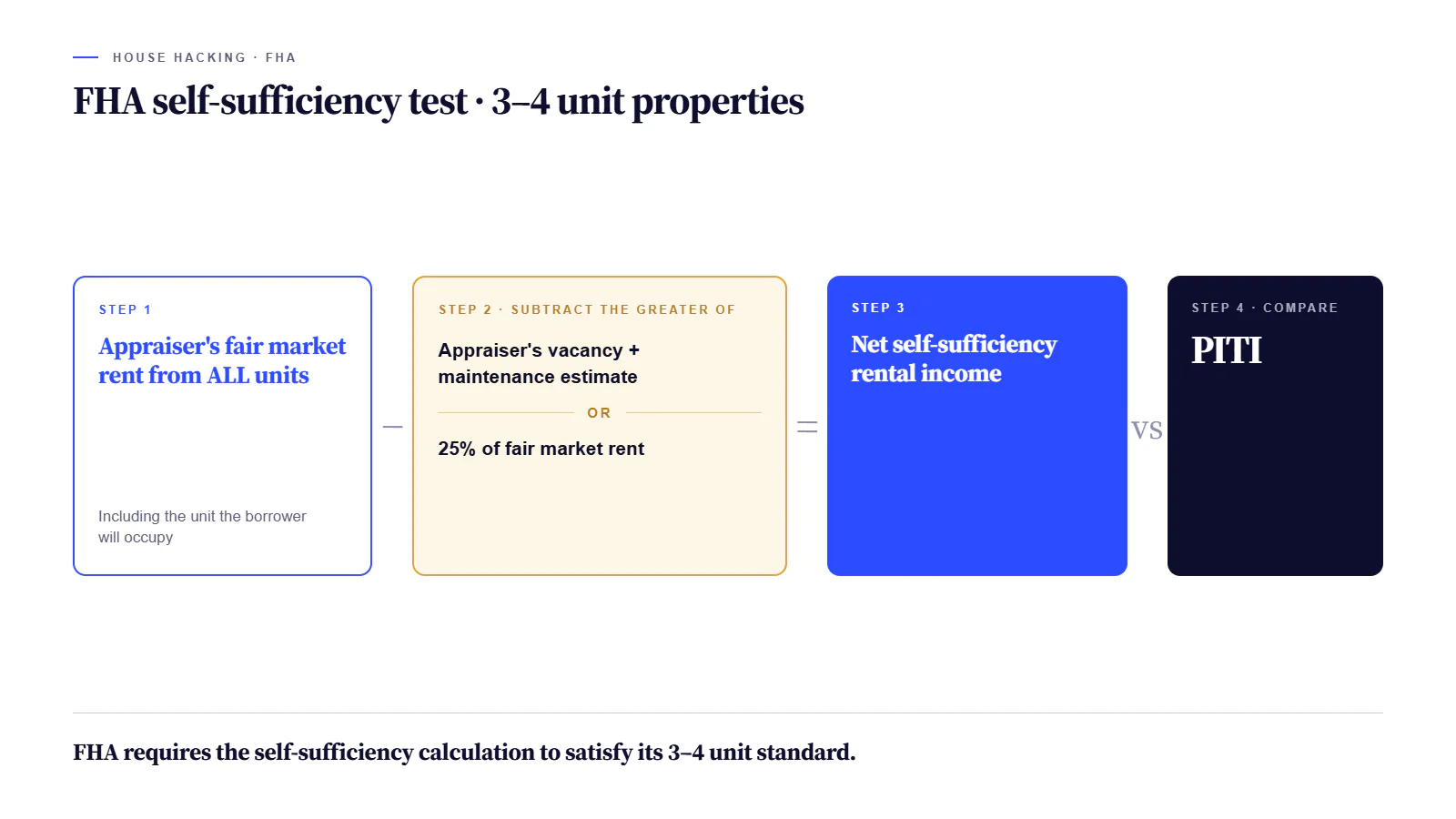
Three- and four-unit FHA properties have an additional rule that duplexes do not: the self-sufficiency test.
Under the current FHA framework, the calculation starts with the appraiser's estimated fair market rent from all units, including the unit the borrower will occupy.
From that amount, the lender subtracts the greater of:
the appraiser's estimate for vacancies and maintenance, or
25% of fair market rent
The resulting net self-sufficiency rental income must be sufficient under FHA's PITI test.
That additional underwriting requirement can make a three- or four-unit FHA purchase harder to qualify than a duplex even when the borrower otherwise qualifies for the mortgage.
House Hacking Example: Buying a Duplex With an FHA Loan
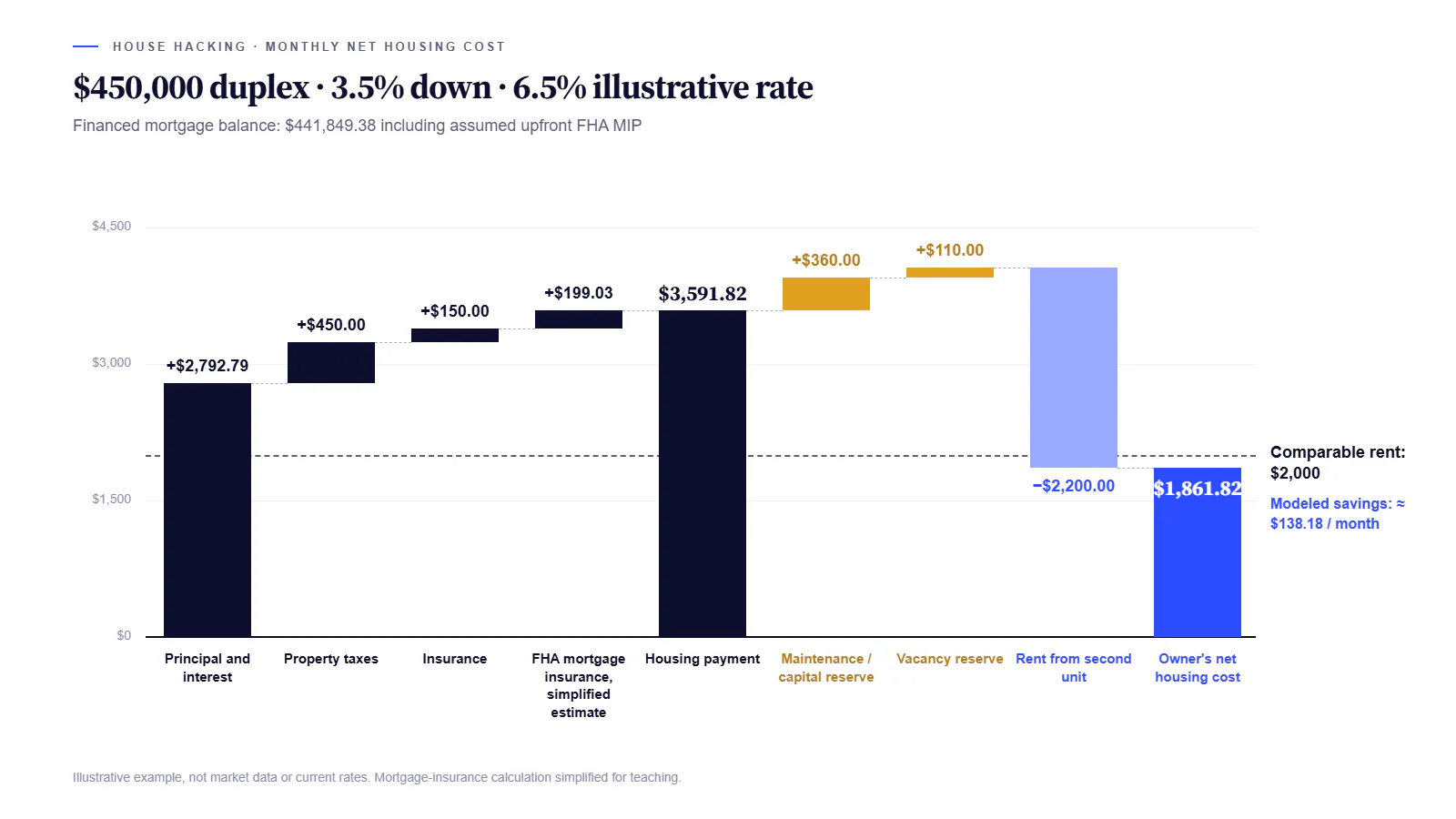
The following figures are illustrative teaching assumptions rather than current market rates or loan quotes.
Assume a buyer purchases a duplex for:
$450,000
The buyer makes a 3.5% down payment:
$15,750
The FHA base loan is therefore:
$434,250
Assume upfront FHA mortgage insurance of 1.75% is financed into the loan:
$434,250 × 1.75% = $7,599.38
Total financed mortgage balance:
$441,849.38
Assume a 30-year mortgage at 6.5%.
Monthly principal and interest is approximately:
$2,792.79
The owner occupies one unit and rents the second for:
$2,200 per month
Monthly Cost to House Hack the Duplex
Use the following illustrative monthly assumptions:
Monthly Item | Amount |
|---|---|
Principal and interest | $2,792.79 |
Property taxes | $450.00 |
Insurance | $150.00 |
FHA mortgage insurance, simplified estimate | $199.03 |
Housing payment | $3,591.82 |
Property maintenance / capital reserve | $360.00 |
Vacancy reserve on rented unit | $110.00 |
Rent from second unit | −$2,200.00 |
Owner's net housing cost | $1,861.82 |
The mortgage-insurance figure is a simplified teaching estimate based on a 0.55% annual premium on the original base balance. Actual FHA monthly mortgage insurance is calculated under FHA rules and changes as the balance amortizes.
If a comparable apartment would cost the buyer $2,000 per month, living in the duplex reduces the modeled housing cost by approximately:
$2,000 − $1,861.82 = $138.18 per month
or approximately:
$1,658 per year
That is not a dramatic windfall.
It is still a reduction in housing cost while the buyer owns an asset and repays mortgage principal.
The House Hacking Move-Out Test
Now test the same property after the owner moves out.
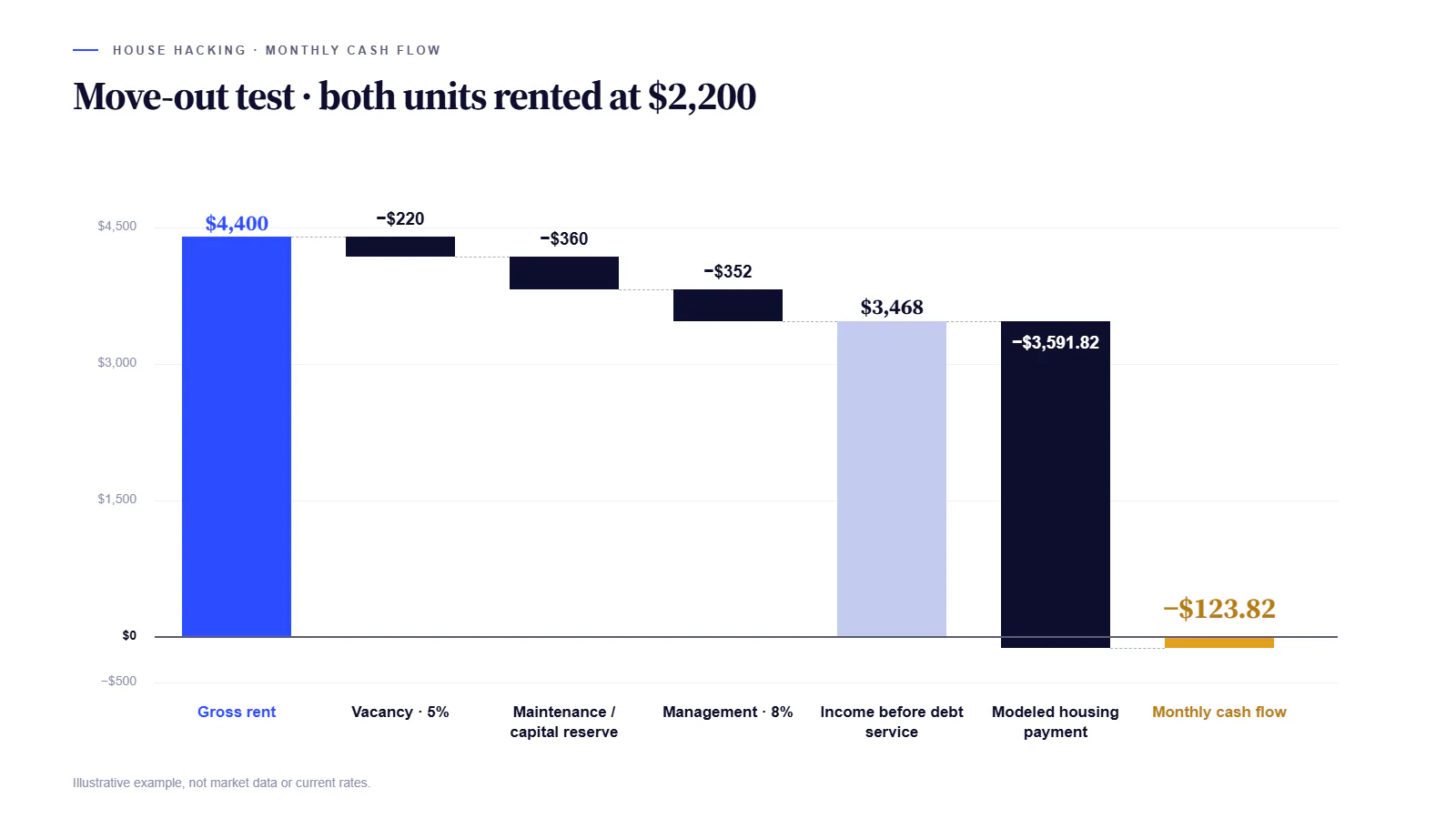
Assume both units can rent for:
$2,200 per month
Gross monthly rent becomes:
$4,400
Use the following assumptions:
vacancy allowance: 5% = $220
maintenance / capital reserve = $360
property management: 8% of gross rent = $352
Income remaining before debt service:
$4,400 − $220 − $360 − $352 = $3,468
Compare that with the modeled monthly housing payment:
$3,591.82
Monthly cash flow becomes:
$3,468 − $3,591.82 = −$123.82
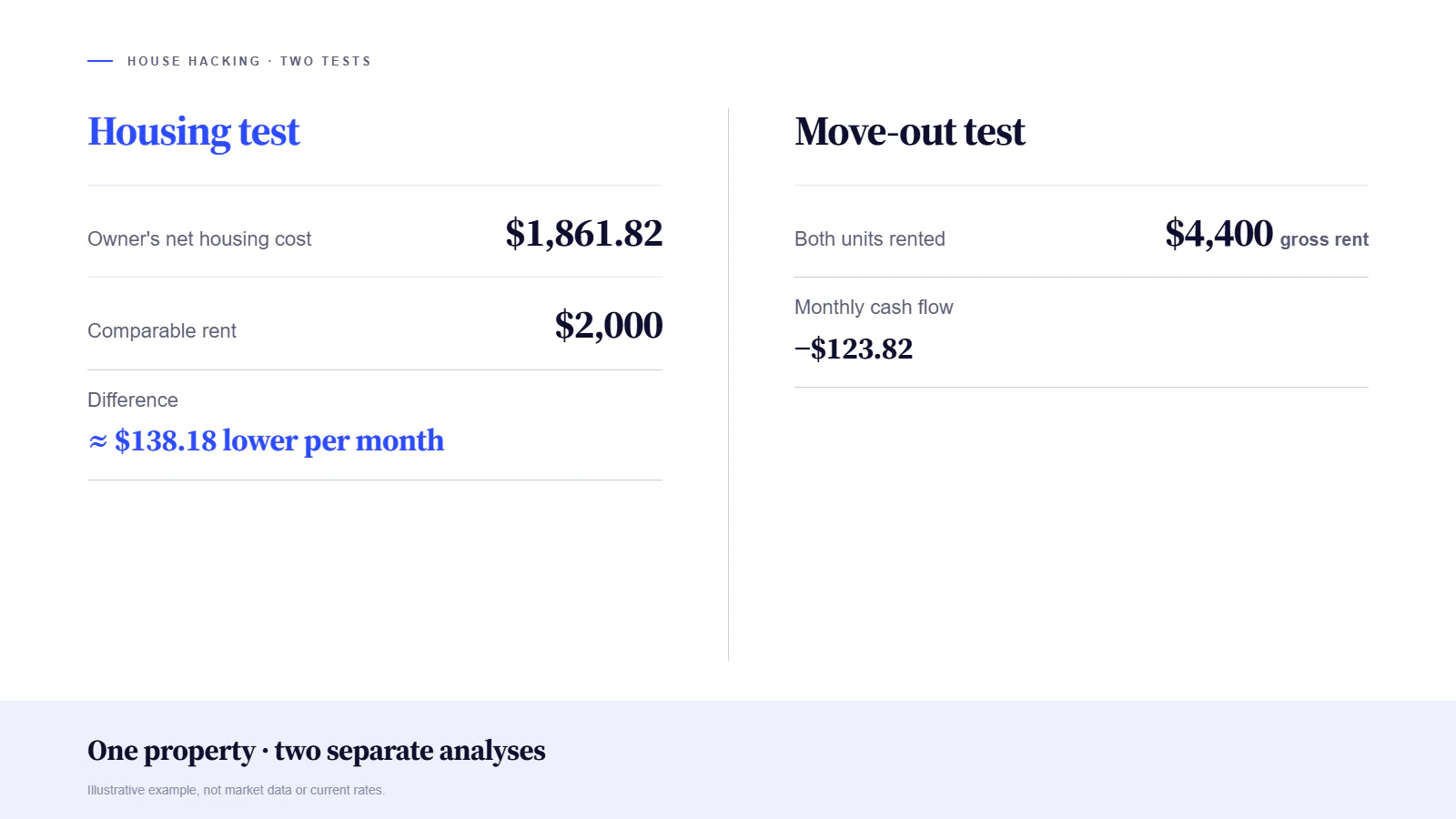
The property reduced the owner's cost of living while occupied.
Under these assumptions, it does not yet support itself as a fully rented investment.
Those are two different results.
How Rent and Mortgage Rates Change the Result
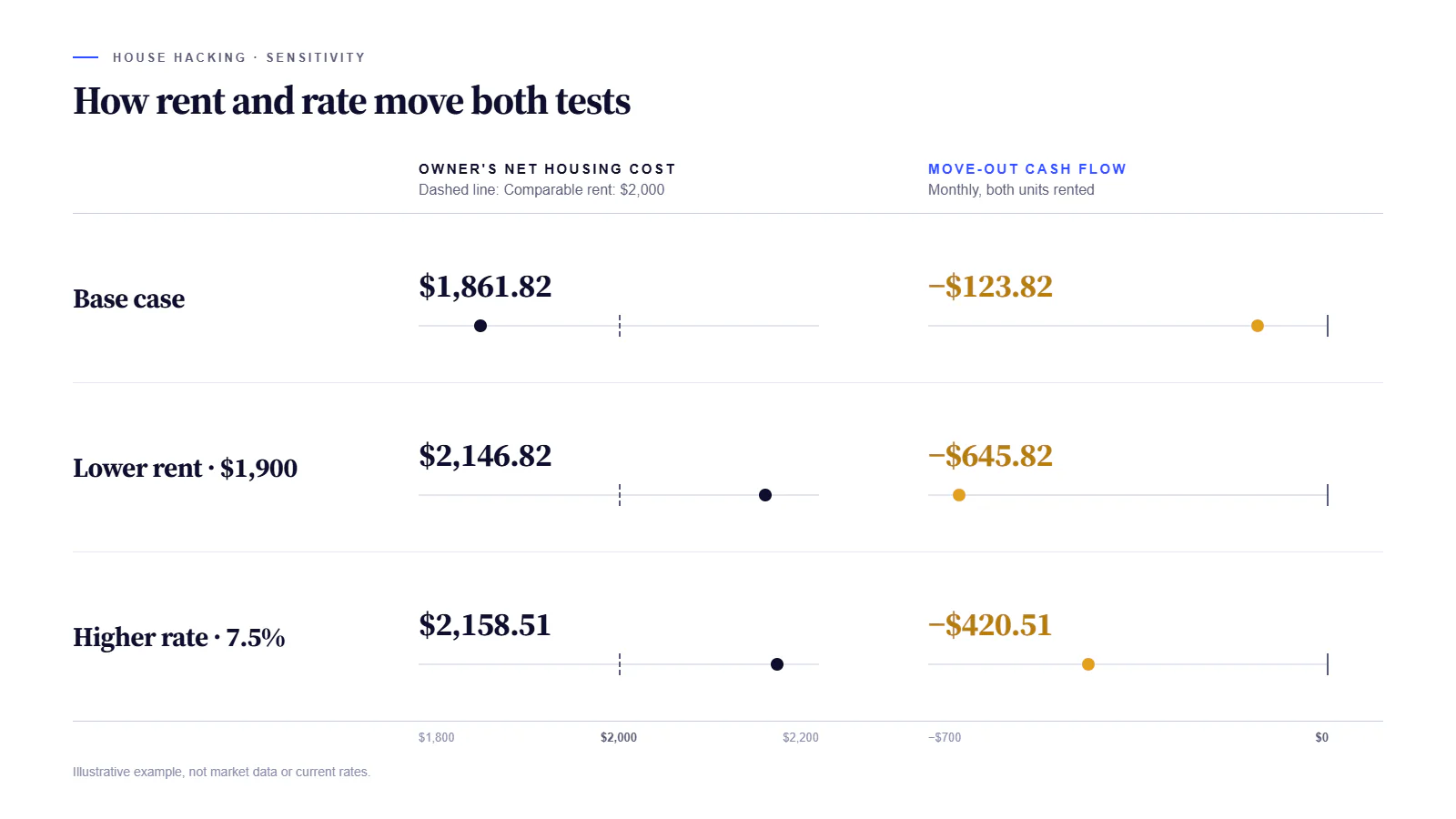
Small assumption changes affect both the housing decision and the eventual rental.
Scenario | Owner's Net Housing Cost | Cash Flow After Moving Out |
|---|---|---|
Base case | $1,861.82 | −$123.82 |
Other unit rents for $1,900 | $2,146.82 | −$645.82 |
Mortgage rate is 7.5% instead of 6.5% | $2,158.51 | −$420.51 |
The rent scenario assumes a 5% vacancy reserve on the $1,900 occupied-side rent while the owner lives there, and both units at $1,900 after move-out.
The interest-rate scenario keeps the other assumptions unchanged and recalculates principal and interest using the higher rate.
A $300 rent miss has a large effect because rent influences both stages of the strategy.
That is why claimed rents should be checked against comparable units rather than accepted from a listing or seller pro forma. Navikoo's Rental estimator can provide a starting point for that comparison.
Is House Hacking Legal?
There is no general prohibition on living in part of a property while renting another part.
The specific arrangement still has to comply with the rules that apply to that property and location.
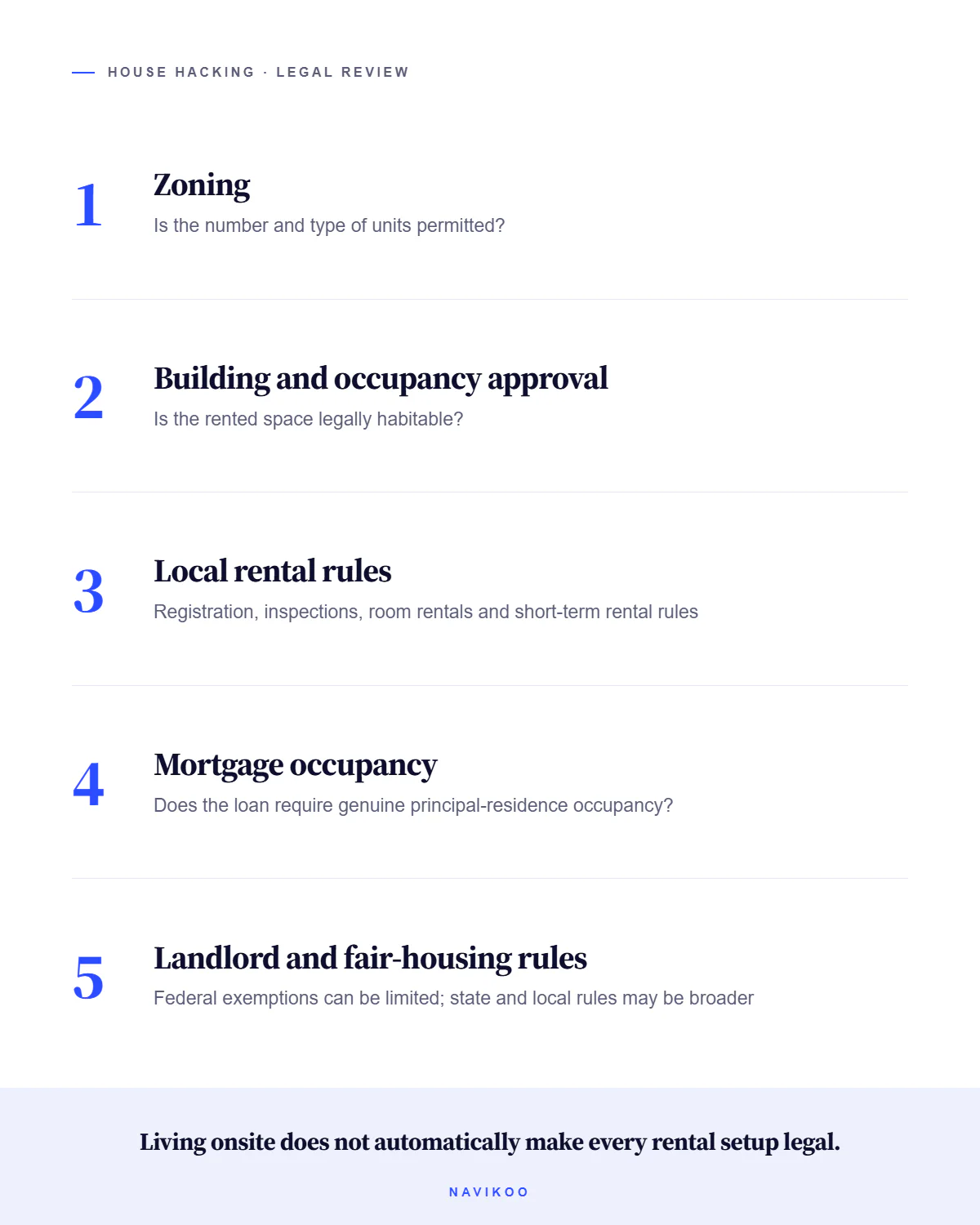
Important checks can include:
zoning
legal number of dwelling units
building and occupancy permits
rental registration
inspections
rooming-house rules
short-term rental restrictions
HOA or condominium restrictions
mortgage occupancy requirements
A lower-level apartment or garage conversion should not be treated as a legal rental simply because it contains a kitchen and bathroom.
Accessory dwelling units are another area where local rules differ significantly. Accessory Dwelling Units is a useful educational starting point, but the city or county code governing the property controls what is permitted.
Fair-housing and landlord-tenant rules also require care.
Federal Fair Housing law contains limited exemptions for certain owner-occupied buildings containing four or fewer families, but those exemptions are not unlimited, discriminatory advertising remains restricted, and state or local law may provide broader tenant protections.
Owners should therefore confirm the rules that apply where the property is located rather than assuming that living onsite eliminates landlord obligations.
Can You House Hack With a Partner or Spouse?
Yes, but the financing and ownership structure should be evaluated separately.
Two borrowers may be able to combine qualifying income and assets, potentially increasing purchasing power.
The exact treatment depends on the loan program, whether both borrowers occupy the property, and whether a borrower is eligible for a particular program.
Rules for non-occupant co-borrowers are not identical across FHA, VA, conventional, and other mortgage products.
For unmarried co-owners, it is also useful to document:
ownership percentages
responsibility for the down payment
mortgage-payment contributions
repair obligations
rental income allocation
what happens if one person wants to sell
how a buyout would be calculated
If a room or unit is rented to another person, a written lease or roommate agreement can also clarify rent, shared expenses, access, and house rules.
How Do Taxes Work When House Hacking?
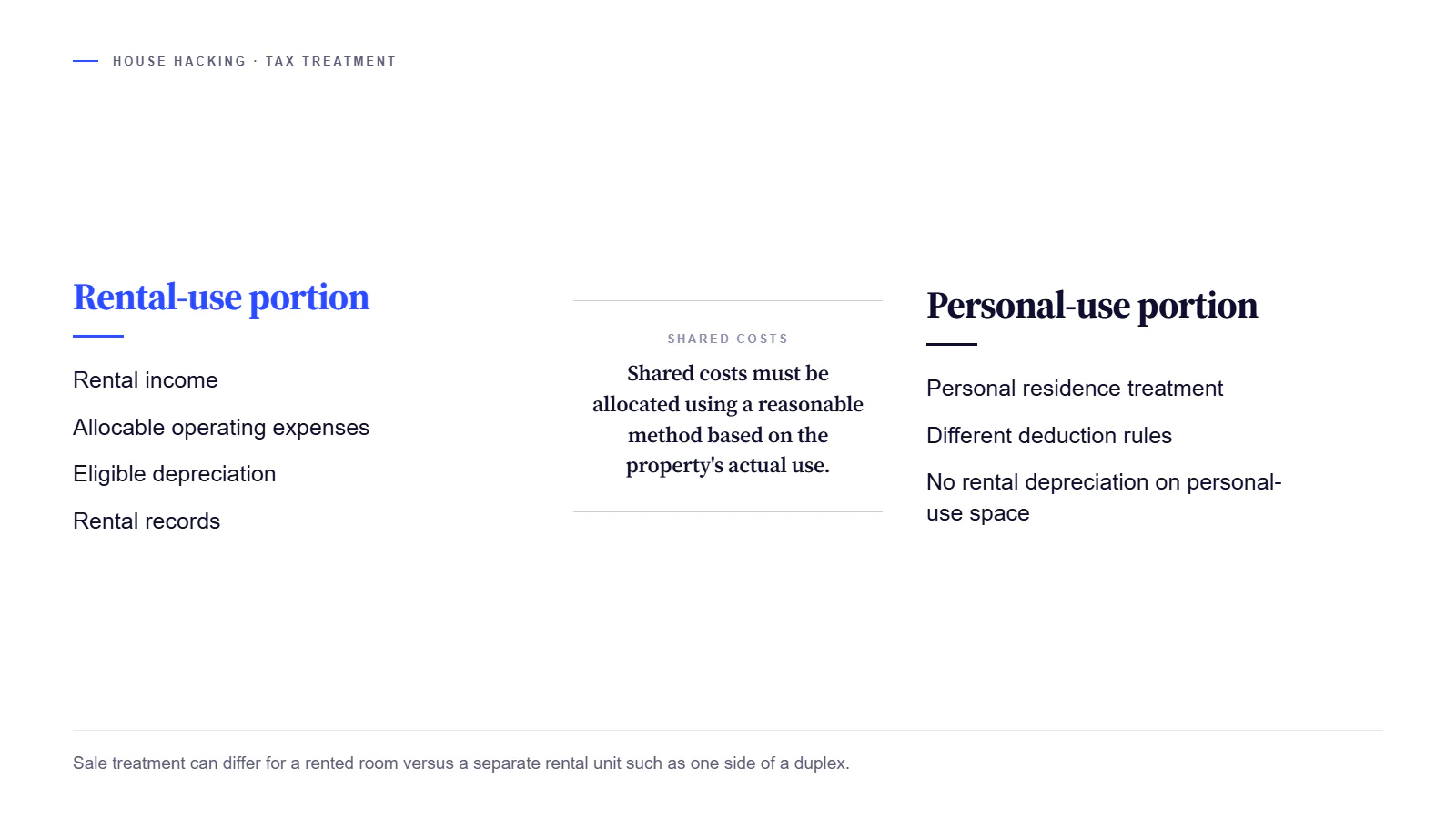
A house hack can have both personal-use and rental-use portions for federal tax purposes.
Rental income is generally reportable.
Expenses attributable to the rented portion may be deductible, and some shared property expenses must be allocated between personal and rental use.
Depreciation generally applies only to the qualifying rental portion of the building, not the personal-use portion or land.
The exact allocation depends on the physical arrangement.
A rented bedroom inside the owner's living space can be treated differently from a duplex in which the owner occupies one self-contained unit and rents the other.
Sale treatment can also become more complicated.
For a separately identifiable rental portion, such as the other unit of a duplex, gain may need to be allocated between the residence and rental portions. Depreciation allowed or allowable on rental use can also affect the taxable gain even when the owner otherwise qualifies for the home-sale exclusion.
Because the tax result depends on the layout, period of rental use, depreciation history, and eventual sale, owners should establish an allocation method and recordkeeping system with a qualified tax professional rather than waiting until the property is sold.
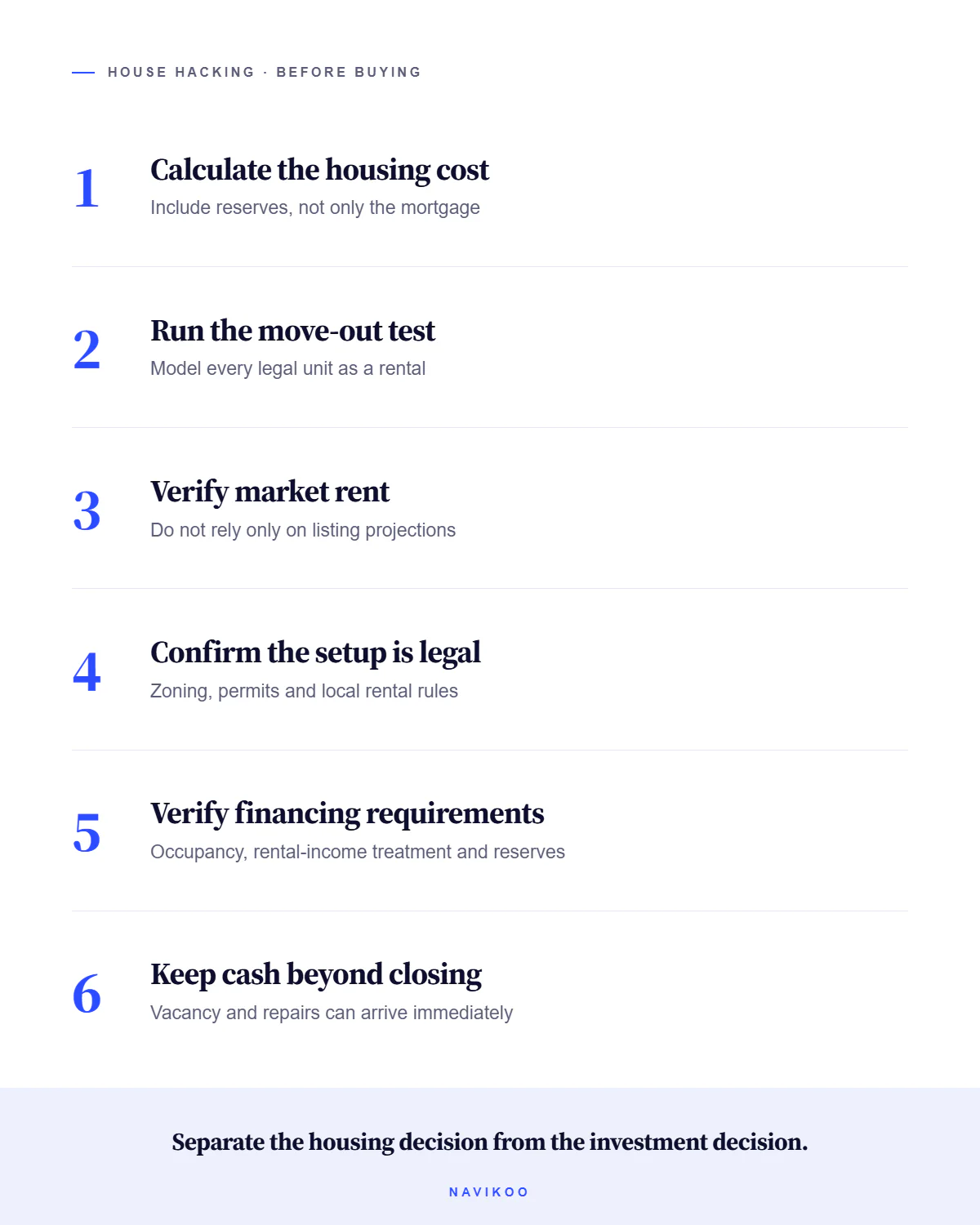
House Hacking Checklist: What to Verify Before You Buy
A house hacking candidate should pass more than one test.
1. Calculate Your Net Housing Cost
Include:
mortgage principal and interest
property taxes
insurance
mortgage insurance
maintenance reserves
vacancy reserves
rent from other occupants
Compare the resulting cost with what you would otherwise pay to rent or own a home.
2. Run the Move-Out Test
Assume you no longer occupy the property.
Rent every legal unit at a supportable market rent and include:
vacancy
maintenance
management
utilities paid by the owner
other recurring operating costs
full debt service
Determine whether the property still supports itself.
3. Verify the Rent
Check actual comparable units.
A house hack that works only because the seller's rent estimate is $300 above the market is not the deal shown in the spreadsheet. You can use free tools to estimate market rent.
4. Confirm the Rental Setup Is Legal
Verify the permitted unit count, zoning, occupancy approval, and applicable local rental rules.
5. Verify the Financing Rules
Confirm:
owner-occupancy requirements
use of projected rental income
required reserves
mortgage insurance
three- or four-unit underwriting requirements
borrower contribution requirements
Do this with the lender before assuming a financing structure works.
6. Keep Cash Beyond Closing
The minimum down payment is not the minimum amount of money required to own the property safely.
Vacancy, repairs, insurance deductibles, and tenant turnover can occur shortly after closing.
The most useful way to evaluate house hacking is therefore to separate the benefit of living in the property from the economics of owning it after you leave. A deal that works under both sets of assumptions has a different long-term profile from one that depends permanently on the owner's occupancy.