Cash Flow in Real Estate: How to Calculate It and Know What's Good
How much money does a rental property really make? Learn how to calculate real estate cash flow, compare financing options, account for hidden expenses, and determine whether a property's monthly income is worth the investment.

Cash flow in real estate is the money a rental property generates after paying operating expenses, mortgage payments, and other cash costs. Positive cash flow means the property brings in more money than it spends. Negative cash flow means the owner must cover the difference.
For rental property investors, cash flow is one of the most important numbers to understand. A property might collect thousands of dollars in rent every month and still leave very little money in your pocket.
The basic formula is:
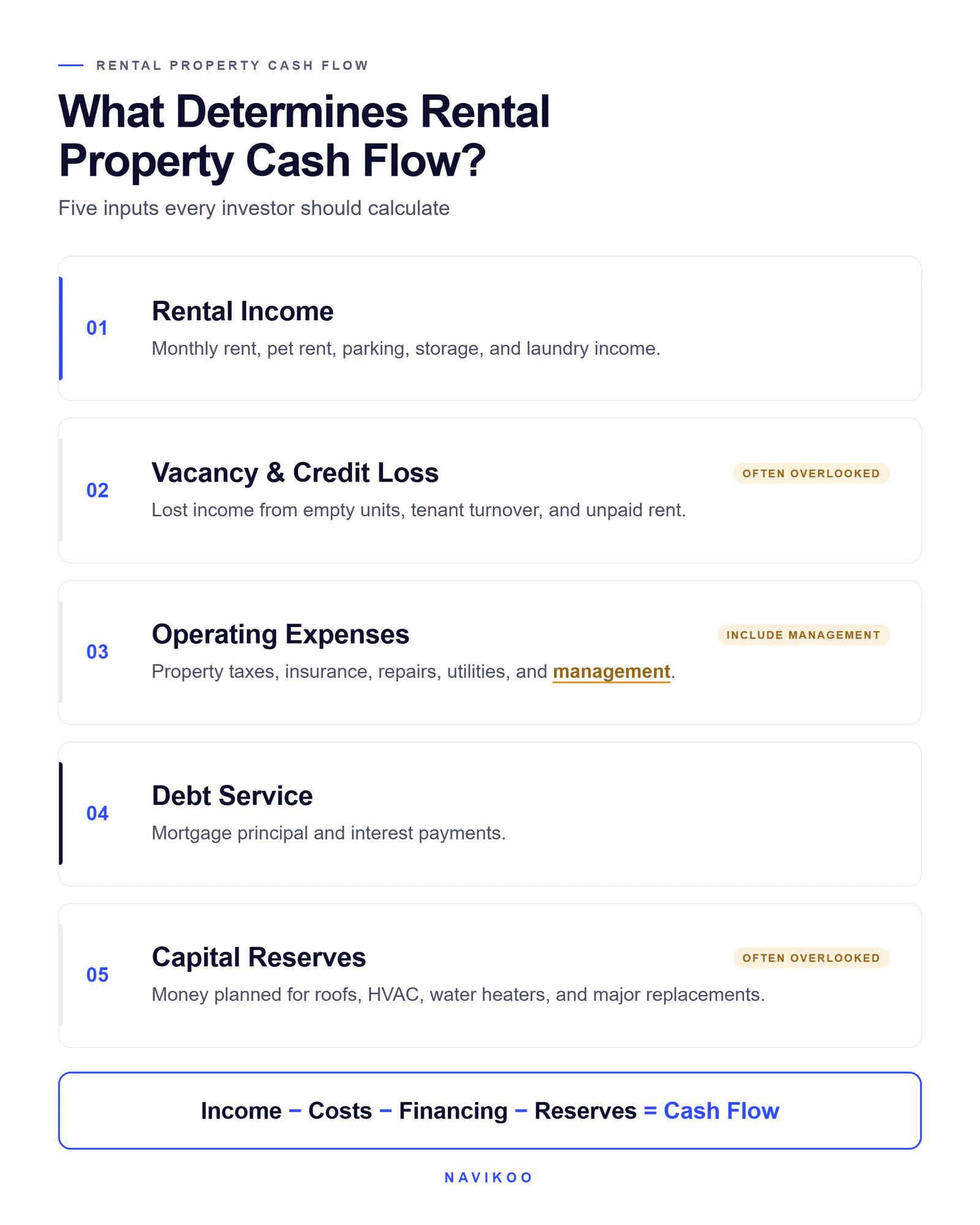
Rental property cash flow = Rental income + other income − vacancy losses − operating expenses − debt service − capital reserves
But calculating the number is only the beginning. A useful real estate investment analysis must also test whether the assumptions are realistic and what happens when expenses rise or tenants move out.
What Is Cash Flow in Real Estate?
Cash flow is the money remaining from a rental property after its income is reduced by the cash costs of owning and operating it.
For example, if a rental collects $2,500 a month and its expenses, mortgage payment, and planned reserves total $2,100, the property produces $400 in monthly cash flow.
That is $4,800 a year before income taxes.
Cash flow can be positive, negative, or break-even. The result depends on rent, vacancy, operating costs, financing, and how much money you reserve for future repairs.
Positive vs. Negative Cash Flow
Positive cash flow occurs when a property's income exceeds its cash expenses. The remaining money can be distributed, saved, or reinvested.
Negative cash flow occurs when expenses exceed income. The owner must contribute additional money to cover the shortfall.
Negative cash flow does not automatically mean an investment will lose money overall. A property might gain value or build equity through mortgage principal payments. However, relying on future appreciation while losing money each month creates additional financial risk.
Why Cash Flow Matters to Real Estate Investors
Appreciation and mortgage principal paydown can build wealth, but neither automatically provides spendable income each month.
Cash flow helps an investor:
Cover unexpected repairs and temporary vacancies.
Maintain a property without constantly adding personal funds.
Build reserves for future purchases.
Hold an investment through weaker market conditions.
Compare income-producing properties with different financing structures.
For investors focused on long-term rental income, cash flow is particularly important because it measures whether the property can support its ongoing financial obligations.
How to Calculate Rental Property Cash Flow
The best approach is to calculate each part of the formula separately rather than relying on the monthly rent alone.
1. Calculate Rental Income and Other Income
Start with the property's scheduled rental income.
If three units rent for $1,650 each, their combined monthly scheduled rent is $4,950, or $59,400 annually.
Then include other recurring income, where applicable:
Pet rent.
Parking fees.
Storage rentals.
Laundry income.
Other permitted tenant charges.
Avoid counting income that is uncertain or unlikely to continue. If property is not rented, you can check what's the potential rent estimate.
2. Subtract Vacancy and Credit Loss
Rental properties rarely collect every dollar of scheduled rent.
Vacancy can result from tenant turnover, renovations, or difficulty finding qualified tenants. Credit loss occurs when rent is owed but not collected.
A vacancy allowance accounts for these risks.
For example:
$59,400 scheduled annual rent × 6% vacancy allowance = $3,564
The appropriate assumption depends on local rental demand, property condition, tenant history, and management quality.
A zero-vacancy assumption may make an investment look attractive on paper without reflecting its actual risk.
3. Subtract Operating Expenses
Operating expenses are the recurring costs of running the rental property.
Typical examples include property taxes, insurance, repairs, maintenance, management fees, owner-paid utilities, landscaping, and common-area expenses.
Be particularly careful with property taxes and insurance. The seller's current costs may not reflect what you will pay after purchasing the property.
Even if you plan to manage the property yourself, including a management allowance can help you evaluate whether the investment remains viable if you eventually hire a property manager.
4. Subtract Mortgage Payments
Debt service is the amount paid toward financing, typically including mortgage principal and interest.
For a property with a fixed-rate, fully amortizing mortgage, the scheduled principal and interest payment remains constant during the fixed-rate period.
However, other ownership costs, such as taxes and insurance, can change even when they are collected through the lender's escrow account.
Important: Mortgage payments are not operating expenses when calculating net operating income. They are deducted afterward when calculating leveraged cash flow.
5. Account for Capital Expenditures
Capital expenditures, often called CapEx, include major replacements and improvements such as roofs, HVAC systems, water heaters, and substantial building components.
These expenses do not occur every month, but they can significantly affect an investor's finances.
A capital reserve is money planned or set aside for these future costs.
For investment analysis, subtracting a planned reserve produces a more conservative measure of cash available to the owner. Actual cash flow will depend on when the money is set aside and when repairs are paid.
Rental Property Cash Flow Example: A $420,000 Triplex
Let's compare two ways to analyze the same investment property.
Imagine a triplex listed for $420,000 with three units renting for $1,650 per month.
The investor plans to put 25% down and finance the remaining $315,000 with a 30-year mortgage at 7% interest.
The property also generates $1,200 annually from pet rent and laundry.
All figures below are hypothetical.
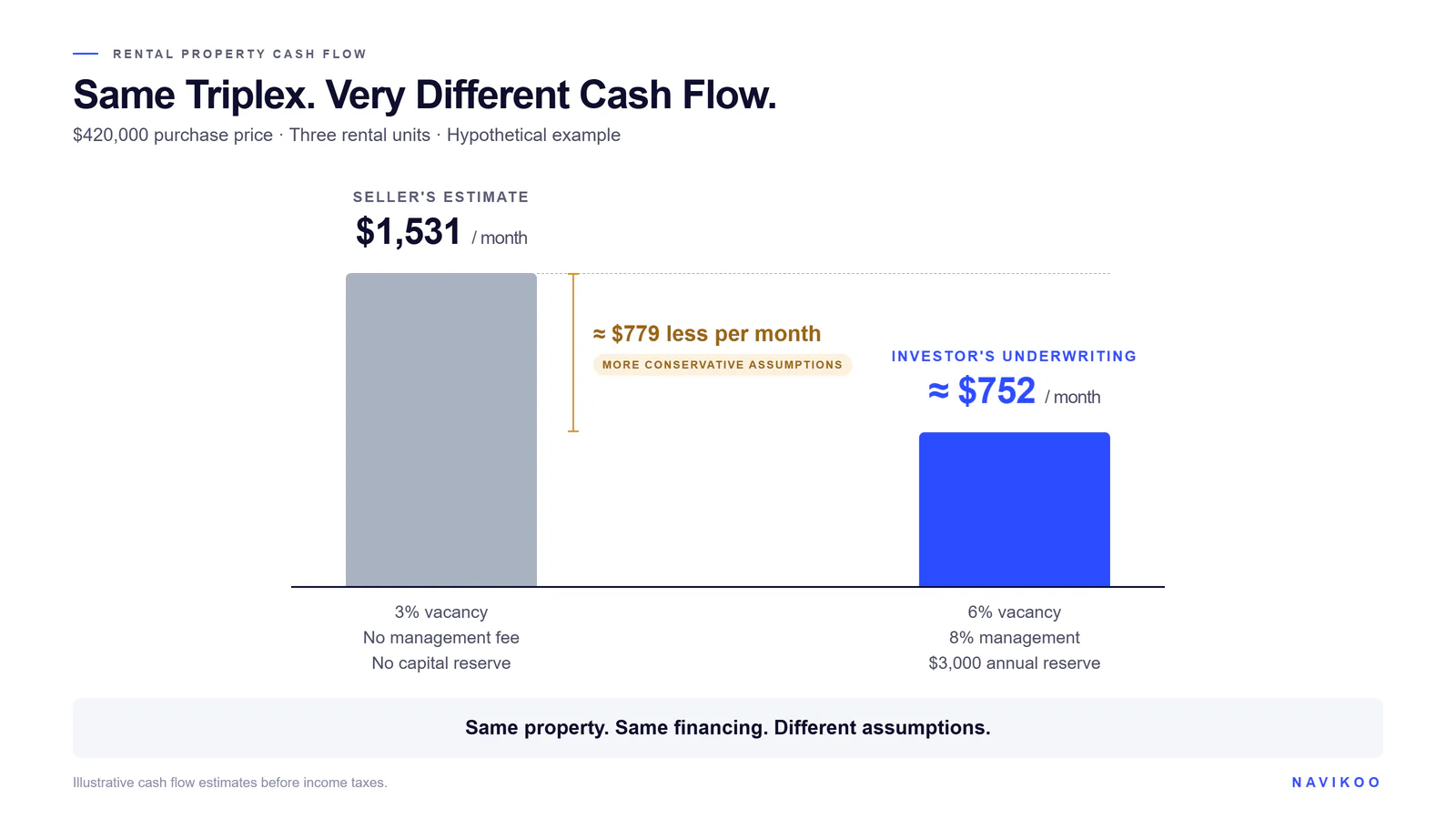
The Seller's Optimistic Estimate
Suppose the seller's presentation assumes:
Only 3% vacancy.
No property management fee.
No allowance for future capital replacements.
Using the same underlying property expenses, these assumptions produce approximately $43,518 in annual net operating income.
After roughly $25,148 in annual mortgage payments, the estimated cash flow before capital reserves is:
$43,518 − $25,148 = $18,370 per year
That is approximately $1,531 per month.
At first glance, the property looks like a strong income-producing investment.
But the estimate leaves out costs that a future owner may realistically face.
The Investor's Underwritten Estimate
Now let's analyze the same property using a higher vacancy allowance, professional management, and a capital reserve.
Annual income and expenses | Amount |
|---|---|
Scheduled rent: 3 × $1,650 × 12 | $59,400 |
Pet rent and laundry | $1,200 |
Vacancy: 6% of scheduled rent | −$3,564 |
Effective income | $57,036 |
Property taxes | −$6,300 |
Insurance | −$3,600 |
Repairs and maintenance | −$3,000 |
Management: 8% of effective income | −$4,563 |
Owner-paid utilities | −$2,400 |
Net operating income | $37,173 |
Mortgage principal and interest | −$25,148 |
Capital reserve | −$3,000 |
Annual cash flow after planned reserve | $9,025 |
Monthly cash flow | Approximately $752 |
The property still produces positive cash flow, but much less than the seller's estimate.
The operating expense ratio is approximately 34.8% of effective income. Whether that is appropriate depends on the building, its condition, and the local market.
Why the Two Estimates Are So Different
The seller's estimate excludes management and capital reserves and assumes less vacancy.
Those choices make the projected monthly result look stronger without changing the building itself.
This is why investors should verify rent rolls, leases, operating expenses, tax bills, and insurance costs before relying on a listing's projected returns.
The purpose of underwriting is not to make every deal look bad. It is to understand how much income the property can realistically produce.
What Is a Good Monthly Cash Flow for a Rental Property?
There is no universal dollar amount that makes a rental property a good investment.
Some investors look for a fixed amount of monthly cash flow per unit. That can be a useful initial screening rule, but it ignores how much capital was invested, the property's condition, and the risks involved.
A better approach uses three tests.
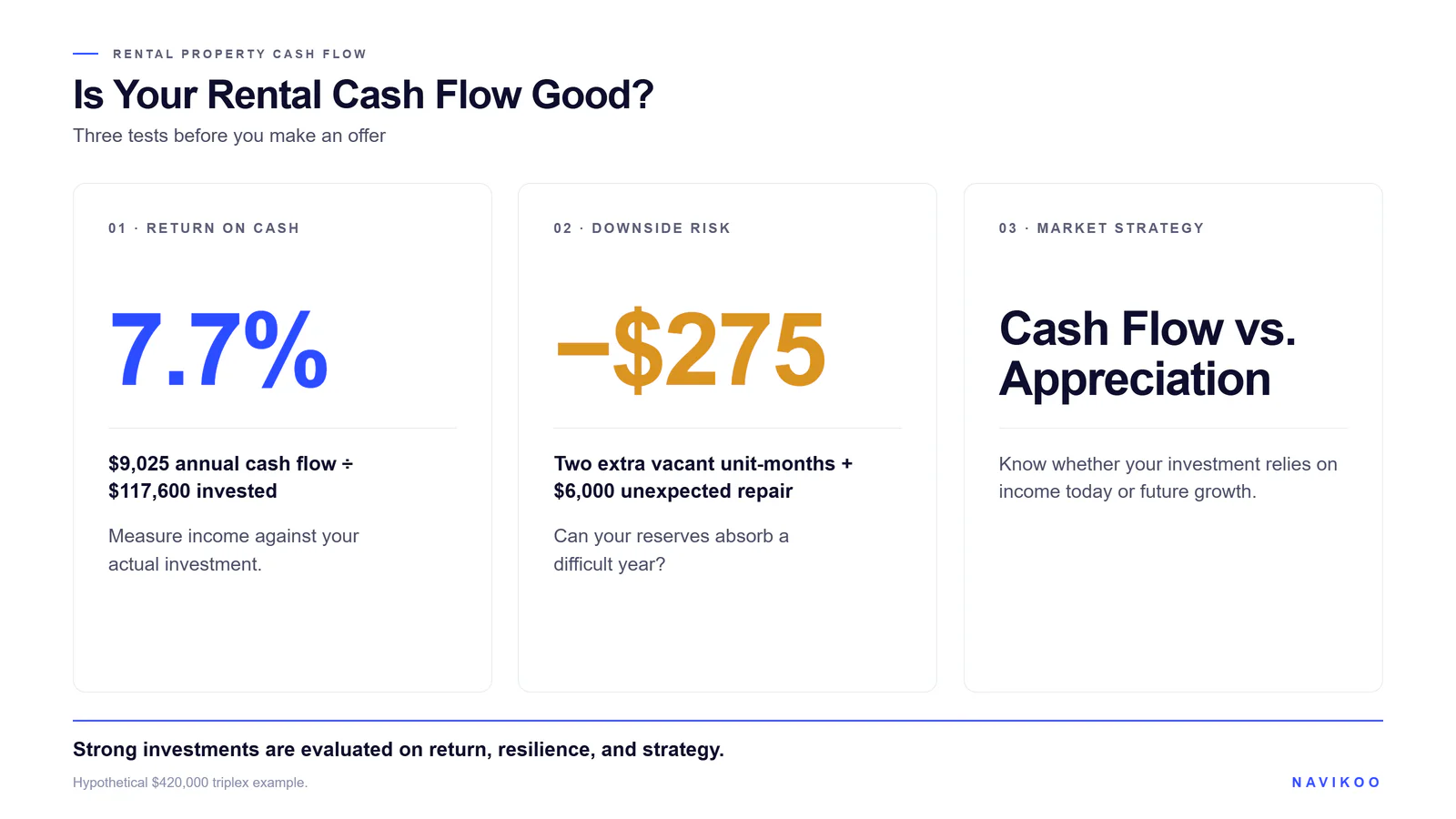
Test 1: Calculate Cash-on-Cash Return
Cash-on-cash return compares annual pre-tax cash flow with the cash invested in the property.
Cash-on-cash return = Annual pre-tax cash flow ÷ Total initial cash invested × 100
For the triplex:
Down payment: $105,000.
Closing costs: $12,600.
Total initial cash invested: $117,600.
Annual cash flow after planned reserve: $9,025.
The resulting cash-on-cash return is approximately 7.7%.
This helps compare properties with different purchase prices and financing arrangements.
However, cash-on-cash return is only as reliable as the income and expense assumptions used to calculate it.
Test 2: Stress-Test a Bad Year
A property producing positive monthly cash flow under normal conditions may still need additional funds during a difficult year.
Suppose the triplex experiences two additional vacant unit-months, reducing rent by $3,300, and a $6,000 unexpected repair that is not already covered by the planned reserve.
The simplified stress test becomes:
$9,025 − $3,300 − $6,000 = −$275
The property would need approximately $275 in additional funds for that year, before considering any associated expense savings or other changes.
That does not necessarily make it a poor investment. It demonstrates why cash reserves matter even when projected monthly cash flow is positive.
Test 3: Consider the Market and Your Strategy
Some markets offer relatively high rents compared with property prices, making positive cash flow easier to achieve.
Other markets have higher purchase prices relative to rent, so investors may rely more heavily on appreciation or future income growth.
Neither strategy guarantees better returns.
A cash-flow-focused investor should prioritize sustainable rental income, while an appreciation-focused investor must be comfortable with greater dependence on future property values.
How Financing Changes Real Estate Cash Flow
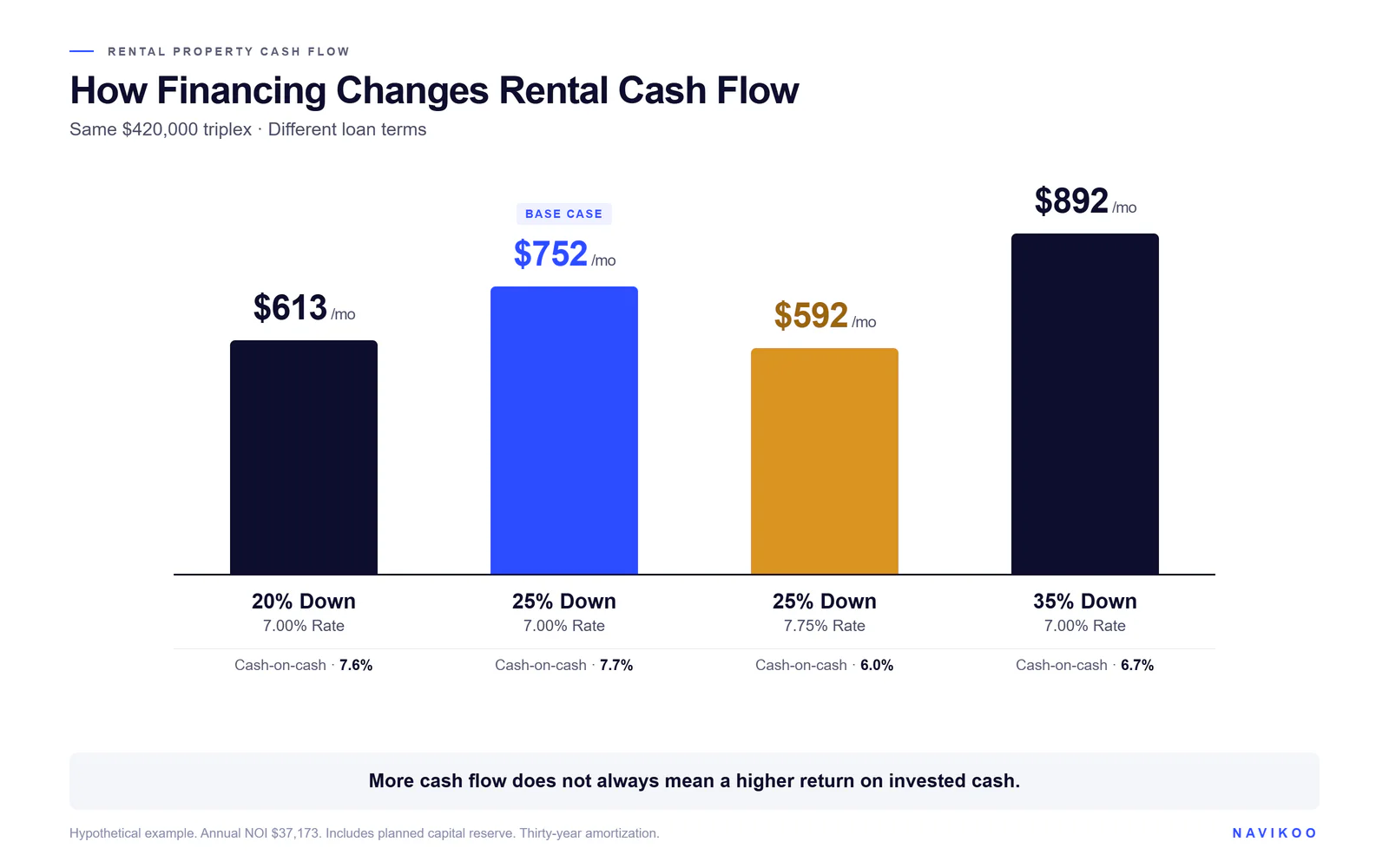
Two investors can purchase identical rental properties and receive different monthly cash flow because of their financing choices.
A larger down payment generally reduces the loan balance and monthly debt service. A higher interest rate generally increases the mortgage payment.
Consider the same triplex under four hypothetical financing arrangements.
Financing scenario | Monthly cash flow* | Approx. cash-on-cash return |
|---|---|---|
20% down, 7% interest | $613 | 7.6% |
25% down, 7% interest | $752 | 7.7% |
25% down, 7.75% interest | $592 | 6.0% |
35% down, 7% interest | $892 | 6.7% |
Illustrative figures using a $420,000 purchase price, 30-year amortization, $37,173 annual NOI, $3,000 annual capital reserve, and $12,600 closing costs. Excludes loan fees and other financing differences.
The comparison highlights an important point: more monthly cash flow does not automatically mean a higher return on the cash invested.
A larger down payment reduces debt payments but also requires more capital upfront.
Similarly, a higher interest rate can reduce cash flow even when the property's rental income and operating expenses remain unchanged.
What About DSCR Loans?
A debt service coverage ratio (DSCR) compares property income with required debt payments.
A simplified property-level formula is:
DSCR = Net operating income ÷ Annual debt service
Lenders may use different income adjustments and underwriting rules, so the qualifying DSCR for a loan can differ from an investor's calculation.
A stronger DSCR generally indicates more income available to cover debt payments.
Investors should evaluate both DSCR and cash flow before choosing financing.
You can compare different down payments, mortgage rates, and rental assumptions with Rental Property Calculators.
Cash Flow vs. Net Operating Income
Cash flow and net operating income are related, but they answer different questions.
Net operating income (NOI) measures income remaining after property operating expenses, before financing costs and income taxes.
Cash flow measures the cash remaining after financing and other cash outlays included in the analysis.
For the triplex:
Net operating income: approximately $37,173.
Annual mortgage payments: approximately $25,148.
Planned capital reserve: $3,000.
Annual cash flow after reserve: approximately $9,025.
NOI helps compare a property's operating performance independently of its financing.
Cash flow helps determine how much money the investment may leave available to its owner.
This is why a property can have positive NOI but negative cash flow.
Cash Flow vs. Profit: Are They the Same?
Not exactly.
Cash flow measures money moving into and out of an investment.
Accounting profit can include noncash items such as depreciation and may treat mortgage principal differently.
Real estate investment returns can also include appreciation, mortgage principal paydown, and tax effects.
For example, an investor might receive relatively little cash flow while building equity through scheduled loan payments.
That equity can contribute to long-term wealth, but it is not the same as spendable rental income.
When evaluating investment opportunities, look at cash flow, cash-on-cash return, NOI, and total expected returns together.
What Is Discounted Cash Flow in Real Estate?
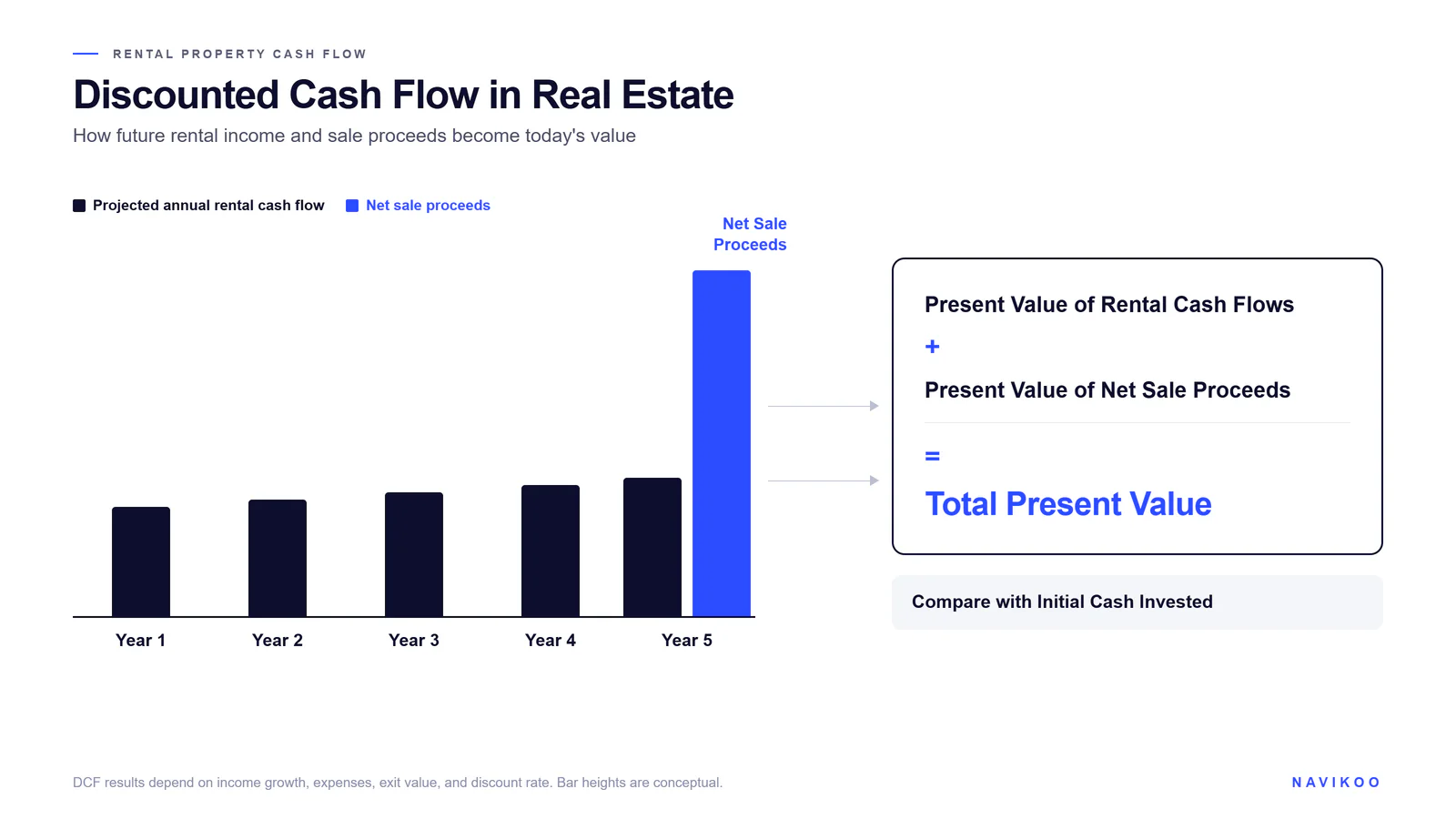
Discounted cash flow (DCF) is a valuation method that estimates what future investment cash flows are worth today.
It considers projected rental income, expenses, financing, and eventual sale proceeds.
Because money received in the future is generally worth less than money received today, future amounts are discounted using a required rate of return.
A Simple Five-Year Example
Suppose an investor projects five years of rental cash flow and plans to sell the property at the end of year five.
The model includes:
Annual cash flow during ownership.
Expected income and expense growth.
The property's estimated sale value.
Selling expenses and remaining loan balance.
A discount rate reflecting the investor's required return.
The present value of the projected rental cash flows and net sale proceeds is then compared with the cash invested.
An internal rate of return (IRR) can also be calculated from the timing and size of those cash flows.
The most important limitation is that a DCF is based on assumptions.
A higher exit capitalization rate, lower rental growth, or larger future expenses can significantly reduce the estimated investment value.
How to Improve Cash Flow on a Rental Property
There are several ways to improve a property's financial performance without relying entirely on appreciation.
Increase Rental Income Carefully
Review comparable rents before renewing leases or listing vacant units.
Parking, storage, pet rent, and laundry may create additional income where demand and applicable rules support those charges.
The goal is sustainable income, not simply charging the highest possible rent.
Reduce Vacancy and Turnover
Vacant units produce no rent but still create many ownership costs.
Responsive maintenance, competitive pricing, and efficient leasing can reduce unnecessary turnover and lost income.
Review Operating Expenses
Compare insurance quotes, verify property tax assessments, and review recurring vendor expenses.
Reducing unnecessary costs improves NOI and can increase cash flow without raising rents.
Plan Major Repairs
Preventive maintenance and realistic capital reserves help reduce unexpected financial pressure.
Skipping necessary maintenance may improve short-term cash flow but create larger expenses later.
Refinance Only When the Numbers Work
A lower interest rate or longer amortization period may reduce monthly payments.
However, refinancing can involve closing costs, new loan terms, and additional risks. Evaluate the total cost, not only the new monthly payment.
Common Cash Flow Mistakes Investors Should Avoid
The most common mistakes involve overly optimistic assumptions rather than complicated formulas.
Investors should be careful about:
Assuming every unit will remain occupied.
Using the seller's property taxes without checking possible reassessment.
Ignoring management expenses because they plan to self-manage.
Confusing NOI with cash flow.
Forgetting major repairs and capital reserves.
Comparing monthly cash flow without considering the cash invested.
Assuming future rent increases will automatically offset rising expenses.
These errors can turn a seemingly profitable rental into a property that regularly needs additional funding.
Frequently Asked Questions
What Is a Good Cash Flow for a Rental Property?
A good cash flow depends on the property's purchase price, financing, condition, market, and investor goals. Evaluate monthly cash flow alongside cash-on-cash return, expected repairs, and the property's ability to survive vacancies or unexpected expenses.
How Do You Calculate Monthly Rental Cash Flow?
Start with monthly rental and other income, subtract vacancy losses and operating expenses, then subtract mortgage payments and any planned capital reserve. The result is the projected monthly cash flow after those allowances.
Can a Rental Property Have Positive NOI and Negative Cash Flow?
Yes. NOI excludes financing costs, so a property may earn money from operations but have mortgage payments and other cash requirements that exceed its operating income.
Does Cash Flow Include Mortgage Payments?
Yes. Leveraged rental property cash flow accounts for mortgage debt service. NOI, by contrast, is calculated before mortgage principal and interest payments.
Is Cash Flow the Same as Cash-on-Cash Return?
No. Cash flow is a dollar amount. Cash-on-cash return expresses annual pre-tax cash flow as a percentage of the initial cash invested.
Is Positive Cash Flow Guaranteed With a Fixed-Rate Mortgage?
No. A fixed-rate mortgage can stabilize principal and interest payments, but rents, vacancy, property taxes, insurance, repairs, and other expenses can change.
Final Thoughts
Cash flow in real estate is one of the clearest ways to understand whether a rental property can support itself financially.
But the most useful number is not the one shown in the listing. It is the number that remains after realistic vacancy, operating expenses, financing, and future repair allowances.
Before making an offer, verify the property's income and expenses, compare financing scenarios, and stress-test the investment.
Use Rental Property Calculators to estimate cash flow, NOI, cash-on-cash return, and other key metrics using your own assumptions.