Rent Roll: What the Document Shows and What It Conceals
A rent roll shows who occupies each unit, what they pay, and when their lease ends—but the total rent only tells part of the story. Learn how to analyze loss to lease, lease expirations, economic occupancy, collections, and market rent to understand the income and risks behind a rental property.

A rent roll lists every unit in a property, who occupies it, what they pay, and when their lease ends. It is one of the first documents buyers and lenders request in a real estate transaction involving income property, and it is often read too quickly.
The first number many investors look for is the total rent. They annualize it, compare it with the asking price, and move on. But the total says little about how durable that rental income is.
The more useful information sits in the rows above it: lease expirations, below-market units, vacancies, concessions, security deposits, and the difference between contracted rent and what tenants actually pay. Those details are what turn a rent roll from a summary into an underwriting tool.
What is a Rent Roll in Real Estate?
A rent roll is a unit-by-unit snapshot of a property's contractual rental income at a specific point in time. Apartment buildings, commercial property, and small rental property portfolios can all use the same basic document.
For landlords, the rent roll supports financial planning and lease management across a property. For buyers and lenders, the rent roll helps explain where current rental income comes from and how stable it may be in a real estate investment.
The rent roll records what each current tenant is obligated to pay. It does not, by itself, prove what was actually collected. That requires payment history or a tenant ledger.
What Information Should a Rent Roll Include?
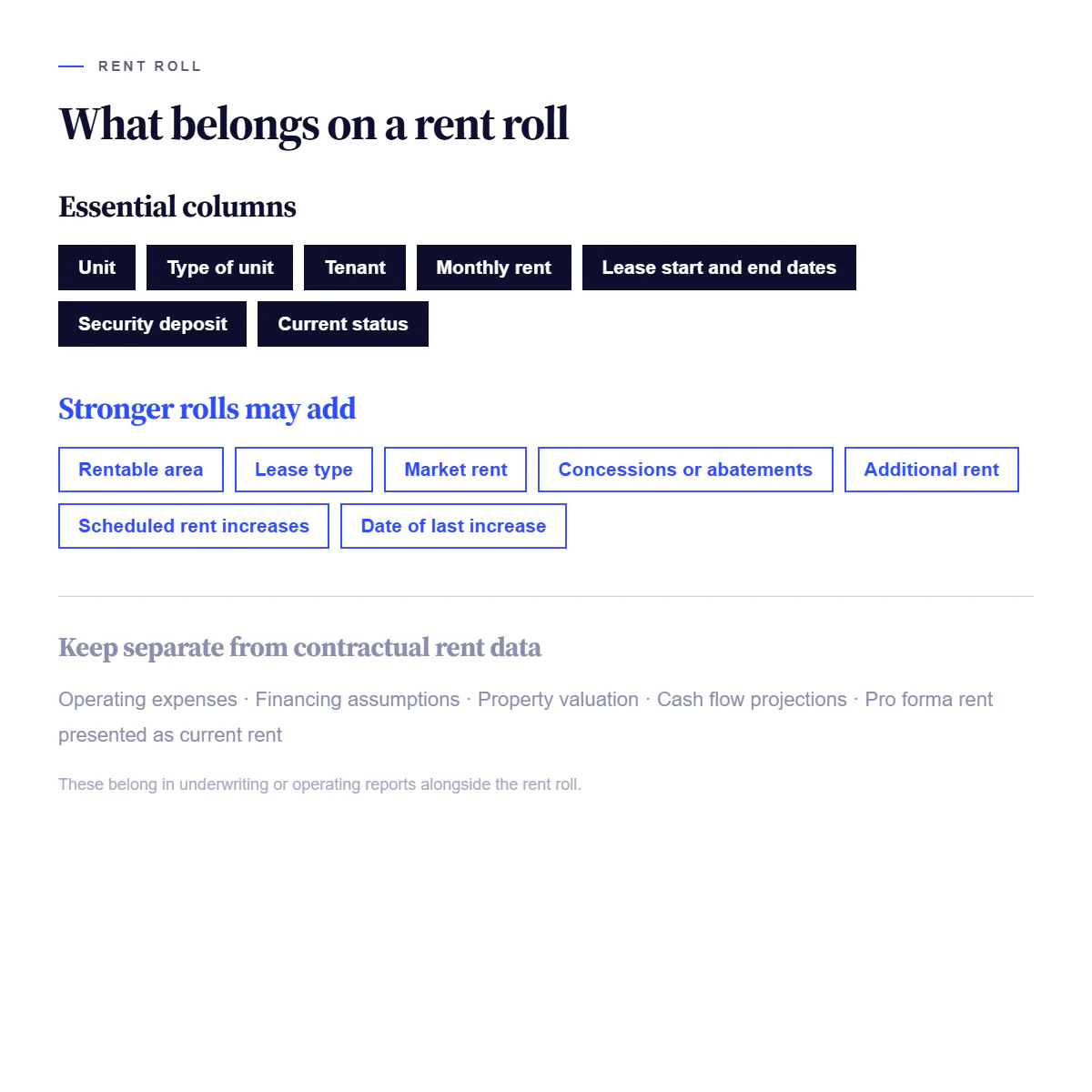
A usable rent roll should identify the unit, type of unit, tenant, monthly rent, lease start and end dates, security deposit, and current status.
Stronger versions may also include rentable area, lease type, market rent, concessions or abatements, additional rent such as parking or appliance fees, scheduled rent escalations, and the date of the last increase.
For commercial property, the lease structure may also matter. A gross lease and a net lease can show similar headline revenue while creating very different economics for the owner.
What a Rent Roll Does Not Show
The cleanest rent roll keeps contractual lease data separate from underwriting assumptions.
Operating expenses, financing assumptions, property valuation estimates, and cash flow projections belong in other reports. Summary rent totals can appear on the rent roll, but projected rent should not be presented as though it were currently contracted.
Potential rent is useful. Mixing it into the current rent column is not.
A Sample Rent Roll in Real Estate
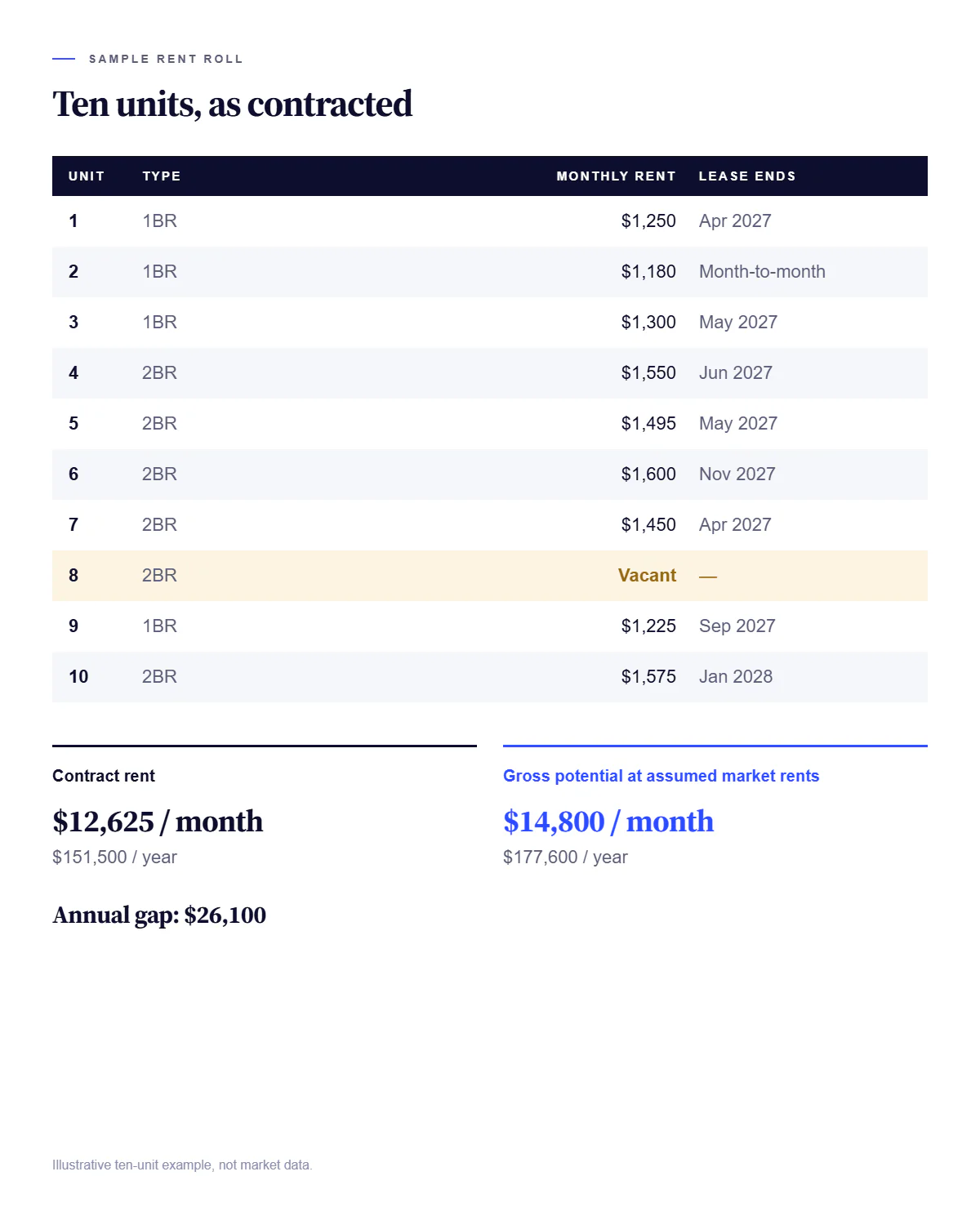
The figures below describe a hypothetical ten-unit building and are illustrative teaching assumptions rather than market data.
Unit | Type | Monthly rent | Lease ends |
|---|---|---|---|
1 | 1BR | $1,250 | Apr 2027 |
2 | 1BR | $1,180 | Month-to-month |
3 | 1BR | $1,300 | May 2027 |
4 | 2BR | $1,550 | Jun 2027 |
5 | 2BR | $1,495 | May 2027 |
6 | 2BR | $1,600 | Nov 2027 |
7 | 2BR | $1,450 | Apr 2027 |
8 | 2BR | Vacant | — |
9 | 1BR | $1,225 | Sep 2027 |
10 | 2BR | $1,575 | Jan 2028 |
Reading the Total
Nine occupied rental units produce $12,625 in contracted rent each month, or $151,500 annually.
Now assume current market rent averages $1,300 for a one-bedroom and $1,600 for a two-bedroom. Gross potential rent across all ten units reaches $14,800 per month, or $177,600 a year.
That creates a $26,100 annual gap between current contracted rent and gross potential rent. The rent roll shows the size of the gap; underwriting has to explain what creates it.
The Three Things the Total Hides
Loss to Lease
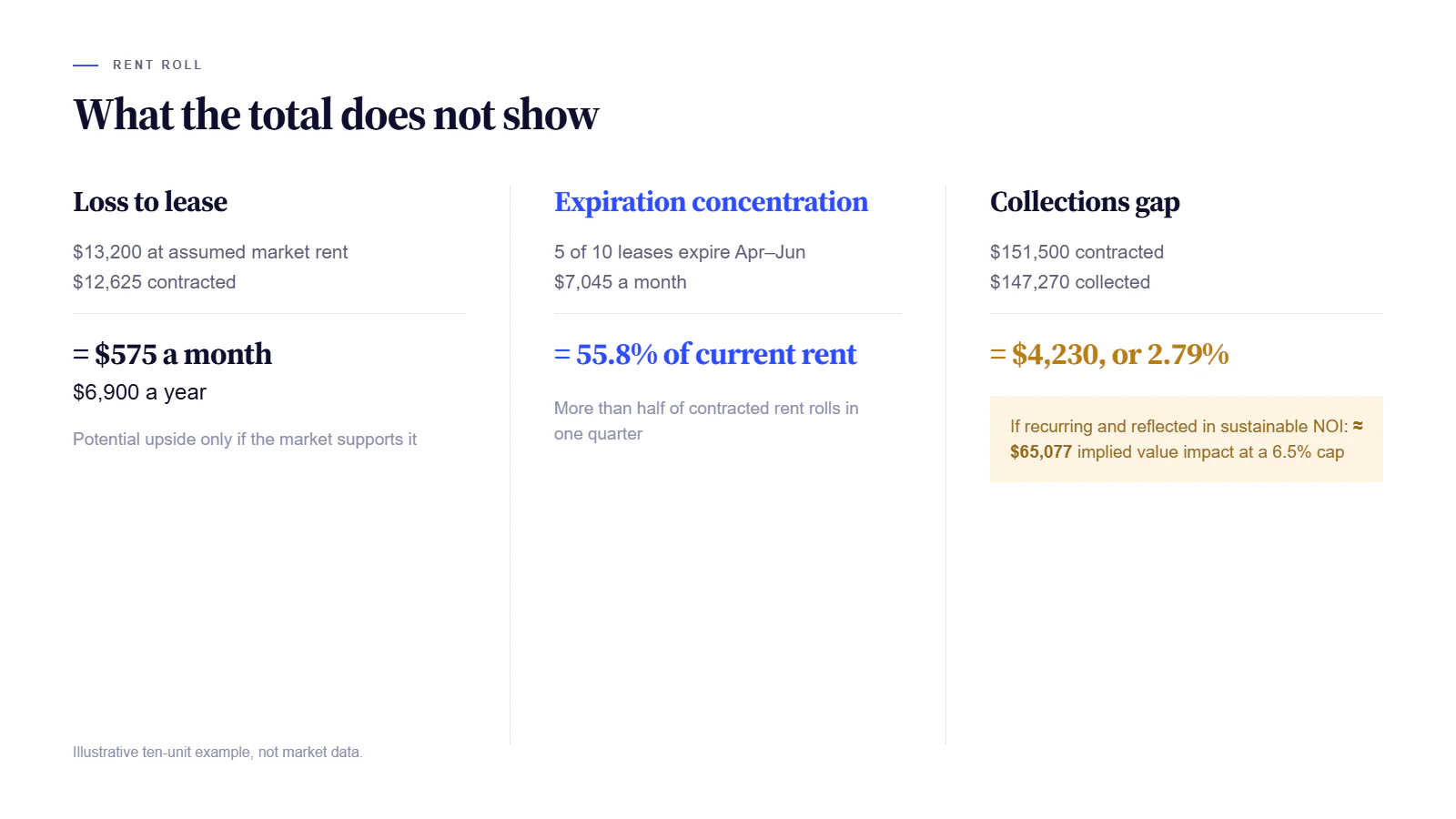
The nine occupied units would produce $13,200 per month if each were leased at the assumed market rent. They currently produce $12,625.
The difference is $575 per month, or $6,900 annually. On the rent roll, that is loss to lease.
For a buyer, it may represent mark-to-market upside if comparable units genuinely support the higher rent and the lease terms, local regulation, and tenant retention allow the increase.
It should not be treated as guaranteed future rental income. The market column needs independent support, and the executed leases determine when any increase can actually occur.
Below-market rents can be one source of upside in a value-add property, but the rent premium should be verified against actual comparable units.
Lease Expiration Concentration
Five of the ten leases expire between April and June.
Those units represent $7,045 per month, or 55.8% of the property's current rent.
A building with more than half of its contracted income rolling over in one quarter has a different risk profile from one with the same annual rental income and a more staggered schedule. A concentrated renewal period can create simultaneous vacancy exposure, make-ready costs, and leasing pressure.
Two rent rolls can show the same annual total while the lease-expiration schedules create very different risk.
The Collections Gap
The rent roll and the payment ledger answer different questions: contracted income and collected income.
Assume delinquency equals 2% of contracted annual rent and concessions total $1,200 for the year. Actual collections would fall to approximately $147,270 from $151,500 of contracted income.
That is a $4,230 annual shortfall, or about 2.79%.
If that shortfall were recurring and reduced sustainable net operating income (NOI), capitalizing $4,230 at a 6.5% rate would imply roughly $65,077 less property value.
The important qualification is recurring. A one-time concession or temporary delinquency should not automatically be treated as a permanent reduction in value.
Physical Occupancy Against Economic Occupancy
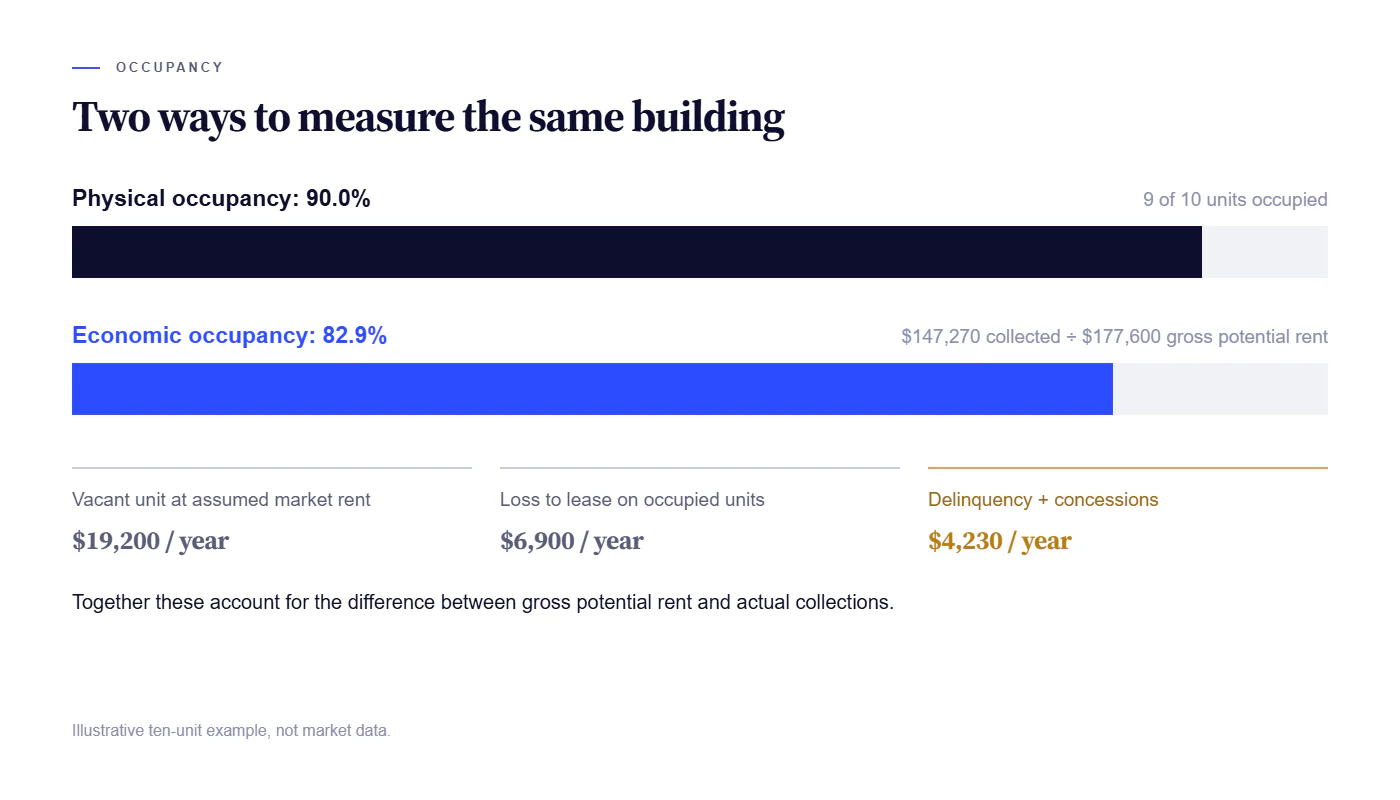
Nine of ten units are occupied, so physical occupancy is 90%.
Economic occupancy asks a different question: how much of the property's gross potential rent is actually being collected?
Using the assumptions above:
$147,270 collected ÷ $177,600 gross potential rent = 82.9% economic occupancy
The difference reflects several sources at once:
one vacant unit
loss to lease on occupied units
concessions
delinquency
Two buildings can both report 90% physical occupancy while producing materially different collection performance.
The physical figure tells you how many units have tenants. The economic measure shows how effectively the property converts potential income into collected revenue.
What Does a Certified Rent Roll Look Like?
Structurally, a certified rent roll may look much like an ordinary rent roll, with an added certification or signature from the owner or property manager stating that the information is accurate and complete as of a specified date.
What Certification Actually Means
Certification is an attestation or representation from the party signing the document.
It can give a buyer or lender a clearer basis for relying on the information and may be required by the purchase agreement or financing process.
The exact legal effect depends on the certification language, transaction documents, and applicable law.
What It Does Not Verify
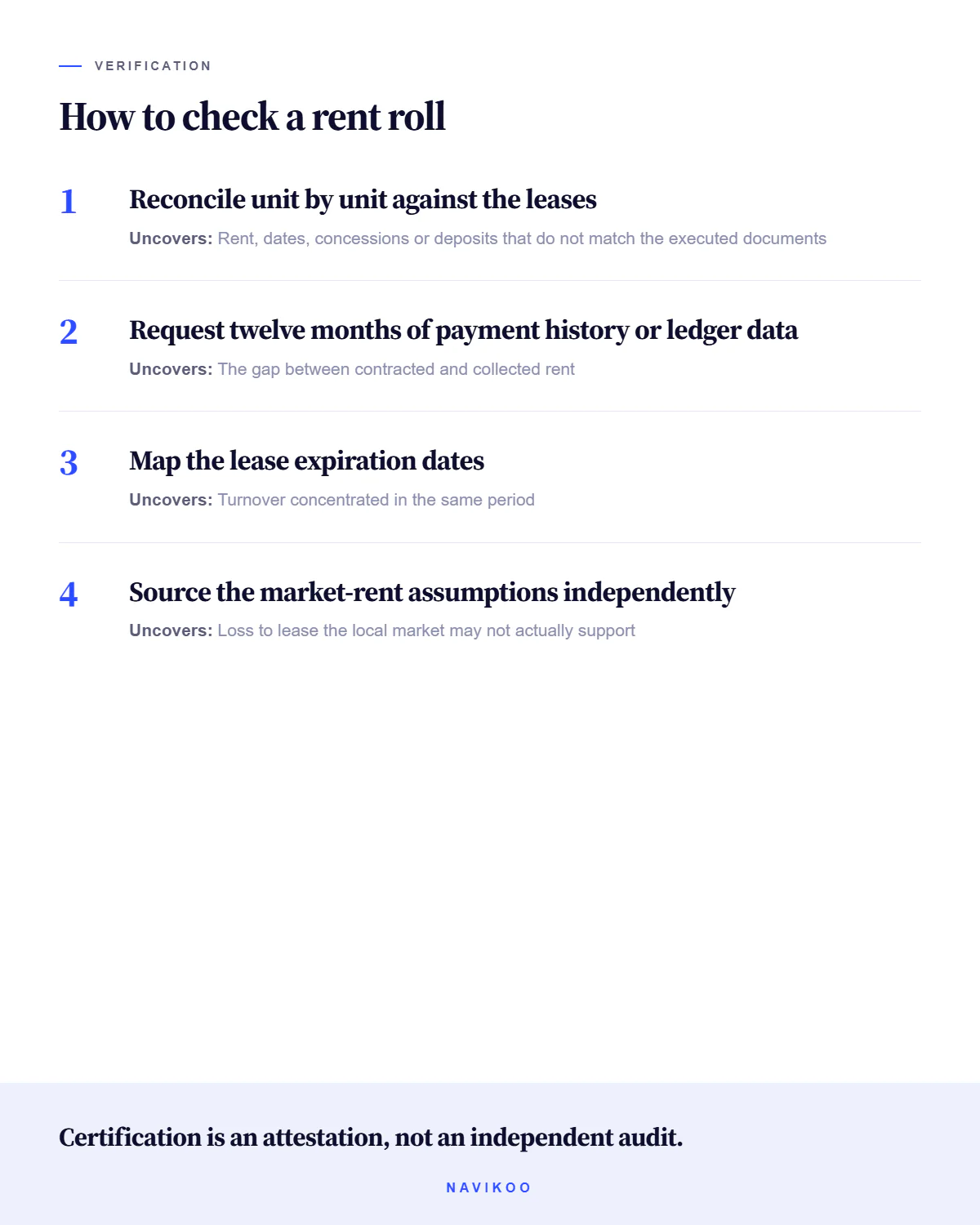
Certification is not an independent audit.
A signature does not prove that lease amounts reconcile to payment history, bank deposits, or tenant ledgers. Buyers and lenders may still perform their own diligence.
The useful approach is to treat certification as one layer of support rather than a substitute for verification.
What Are the Legal Requirements for Rent Rolls?
There is no single universal rent roll format that applies to every property and transaction.
Requirements vary by jurisdiction, property type, lender, and contract.
A lender may require specific fields or certification. A purchase agreement may require the seller to deliver an updated rent roll by a particular date. Rent-regulated jurisdictions can impose separate registration or reporting obligations on landlords, and partnership or operating agreements may require periodic income reporting.
When the property is subject to local rent regulation or a real estate transaction requires a specific certification, local counsel or the lender should confirm what information is required.
How Do I Make a Rent Roll?
Start With the Lease File
Build the rent roll from executed lease agreements and signed amendments.
For every unit, the stated rent and lease dates should trace back to the current legal document. If the tenant renewed, the renewal agreement should replace outdated terms from the original lease.
Building It in a Spreadsheet
For a landlord managing a small rental property, a spreadsheet can work well.
Useful columns include unit, type, tenant, lease amount, lease dates, deposit, status, and market rate. A comparison column can then calculate loss to lease by unit.
The risk is not the spreadsheet itself. It is version control. Once several people update different copies, the document can stop matching the lease file.
Using Property Management Software
As the number of rental units grows, live property management software can reduce version-control problems by generating the rent roll from current lease and tenant data.
Platforms such as TurboTenant and RentRedi combine lease administration with functions such as payment collection and tenant screening. A property management company may use similar systems to generate the roll directly from its operating records.
The advantage is consistency between the management system and the report, although the underlying data still needs to be accurate.
A Free Rent Roll Template
A rent roll template can provide a useful starting structure for a real estate owner.
It does not verify the inputs.
A clean sample can display inaccurate lease data just as easily as accurate data, so the value of the document depends more on the source than on the format.
For the market rent column, Navikoo estimates can help establish a starting point based on comparable units, which should still be checked against the specific property and market.
Who Reads a Rent Roll and Why
Lenders
Financial institutions use the rent roll to understand current rental income and support real estate underwriting.
In-place leases, unit status, rent levels, and expiration dates can affect how a lender evaluates the durability of the property's income. Depending on the loan, the lender may also require certification and supporting operating statements.
Because rental income ultimately feeds NOI, rent-roll quality can also affect the property's debt service coverage ratio (DSCR) during underwriting.
Buyers
Prospective buyers use the rent roll to test the seller's rental income claim and identify issues that a total alone cannot show.
A buyer can compare current rent with market rent, review lease expirations, identify vacancies, and decide which items need to be reconciled against leases and payment records in the real estate underwriting.
Property Managers
Property managers and leasing teams use the rent roll as an operating document.
It helps them track renewals, schedule rent reviews, plan turnovers, identify units below market, and monitor the mix of lease expiration dates across the property.
For them, the rent roll changes whenever a tenant signs, renews, moves out, or changes terms in the real estate operation.
What to Verify Before You Trust One
Reconcile Against the Leases
Compare the rent roll with the executed leases unit by unit.
Verify the lease amount, dates, deposits, concessions, and any additional charges. Where a renewal or amendment exists, confirm that the roll reflects the newest document. Each tenant record should trace to the current lease file.
Request the Payment Ledger
Request at least twelve months of payment history or tenant payment ledger data when available.
The rent roll shows what each tenant is expected to pay. The ledger shows what they actually paid. A rent roll is only one part of underwriting. Investors should combine it with expenses, financing, vacancy, market rent, and return metrics when learning how to analyze a rental property.
That comparison reveals delinquency, concessions, recurring late payments, and other differences between contracted income and actual collections.
Also map the lease expiration dates. A heavy concentration of renewals or move-outs in one period can create operational and cash flow pressure even when the building looks fully leased.
Fannie Mae multifamily underwriting guidance similarly calls for lenders to validate rent collections using supporting records rather than relying on the rent roll alone.
Confirm the Market Column
Verify market rent independently.
Loss to lease is only potential upside if comparable units genuinely support the higher rent. Check similar units by size, condition, location, amenities, and lease timing rather than accepting a seller's market-rent column at face value.
Freddie Mac's multifamily appraisal checklist also emphasizes supporting market rents with recent leasing evidence at the subject property.
Real estate investors modelling how in-place pricing, turnover timing, vacancy, and collections affect an investment can test those scenarios in Navikoo's rental calculator. Investors tracking several properties can also keep current rental and portfolio figures together through Portfolio Management.
A rent roll is a snapshot. Its value comes from showing which parts of the property's income are stable, which are temporary, and which assumptions still need to be verified before they enter a real estate underwriting model.
Frequently Asked Questions About Rent Rolls
What is a rent roll in real estate?
A rent roll is a unit-by-unit summary of a property's current lease information, typically including tenant, unit, monthly rent, lease dates, occupancy status, and sometimes deposits, concessions, and market rent.
What information should be included in a rent roll?
A useful rent roll typically includes unit number, unit type, tenant, monthly rent, lease start and end dates, occupancy status, and security deposit. More detailed versions may also include concessions, market rent, additional income, rent escalations, and rentable square footage.
Does a rent roll show actual rent collected?
Not necessarily. A rent roll usually shows contracted rent. Actual collections should be verified using tenant ledgers, payment history, bank deposits, or other supporting records.
What is loss to lease?
Loss to lease is the difference between current contracted rent and the rent the same occupied units could potentially achieve at supported market rates.
What is the difference between physical and economic occupancy?
Physical occupancy measures how many units are occupied. Economic occupancy measures how much of the property's potential rental income is actually collected.
What is a certified rent roll?
A certified rent roll includes an attestation from the owner or property manager that the information is accurate and complete as of a specific date. Certification does not replace independent verification.
Do lenders require a rent roll?
For many income-producing properties, yes. Lenders commonly review rent rolls alongside leases, financial statements, collection history, and other underwriting documents.
How do you verify a rent roll?
Compare it against executed leases, renewal agreements, tenant ledgers, payment history, deposits, concessions, and current market rent evidence. Lease-expiration concentration should also be reviewed.