NOI vs Cash Flow: Why a Property Can Earn Money and Still Cost You Money
NOI tells you how much a rental property earns before financing, while cash flow shows what you actually keep. Learn the difference with formulas and a real estate investment example comparing three financing scenarios.

Net operating income (NOI) tells you what a property earns from operations: revenue minus operating expenses. The owner's pre-tax cash shows what remains after paying the lender and setting aside money for major repairs. One describes the asset; the other describes your way of owning it.
Two investors can look at the same property and reach opposite conclusions. Under the same operating assumptions, the building's NOI is identical, yet one collects several thousand dollars while the other writes a check. Only the loan differs.
A common underwriting error in real estate is mixing the two: quoting a cap rate on a deal that only works with seller financing, or praising strong operating income on a property that never pays its owner.

What Is NOI in Real Estate?
Net operating income is the annual profit a rental property generates before mortgage payments, income taxes, depreciation, and capital expenditures. It asks what a year of operations would produce if the building were owned free and clear.
Start with gross scheduled rent, subtract vacancy and collection losses, and add ancillary income such as laundry, parking, storage, or pet fees. The result is effective gross income, sometimes called gross operating income, representing the property's total revenues. From that total income, subtract the operating expenses: real estate taxes, insurance, repairs, owner-paid utilities, and property management fees.
What stays out matters as much as what goes in. Mortgage principal and interest are excluded because they reflect the owner's loan structure, not the building's performance. Depreciation and amortization are noncash entries rather than property-level cash outlays. Capital expenditures such as a new roof are also usually outside NOI. Replacement-reserve conventions vary: some lender frameworks deduct a reserve after NOI to reach an underwritten cash measure rather than treating the reserve as an operating expense.
The analogy to operating companies is useful, but it is not an accounting identity. Public companies use earnings before interest and taxes to separate operations from capital structure; private companies often normalize earnings when comparing a business. Net operating income serves a similar role in real estate. It is a financial metric for the profitability of income-producing property, closer to operating profit than to net income.
What Is Owner Cash in Real Estate?
Pre-tax owner cash is what remains after a property's operating expenses and obligations are paid: net operating income minus every mortgage payment of principal and interest, minus a reserve for capital spending.
Unlike NOI, this figure belongs to the investor. In cash flow real estate analysis, it is the recurring pre-tax amount produced by the owner's loan structure. Change the down payment, interest rate, or loan term and it moves even when tenants, rents, and operating expenses stay unchanged. A property is cashflow positive when that figure remains above zero after every payment and reserve.
NOI vs Cash Flow: What's the Difference?
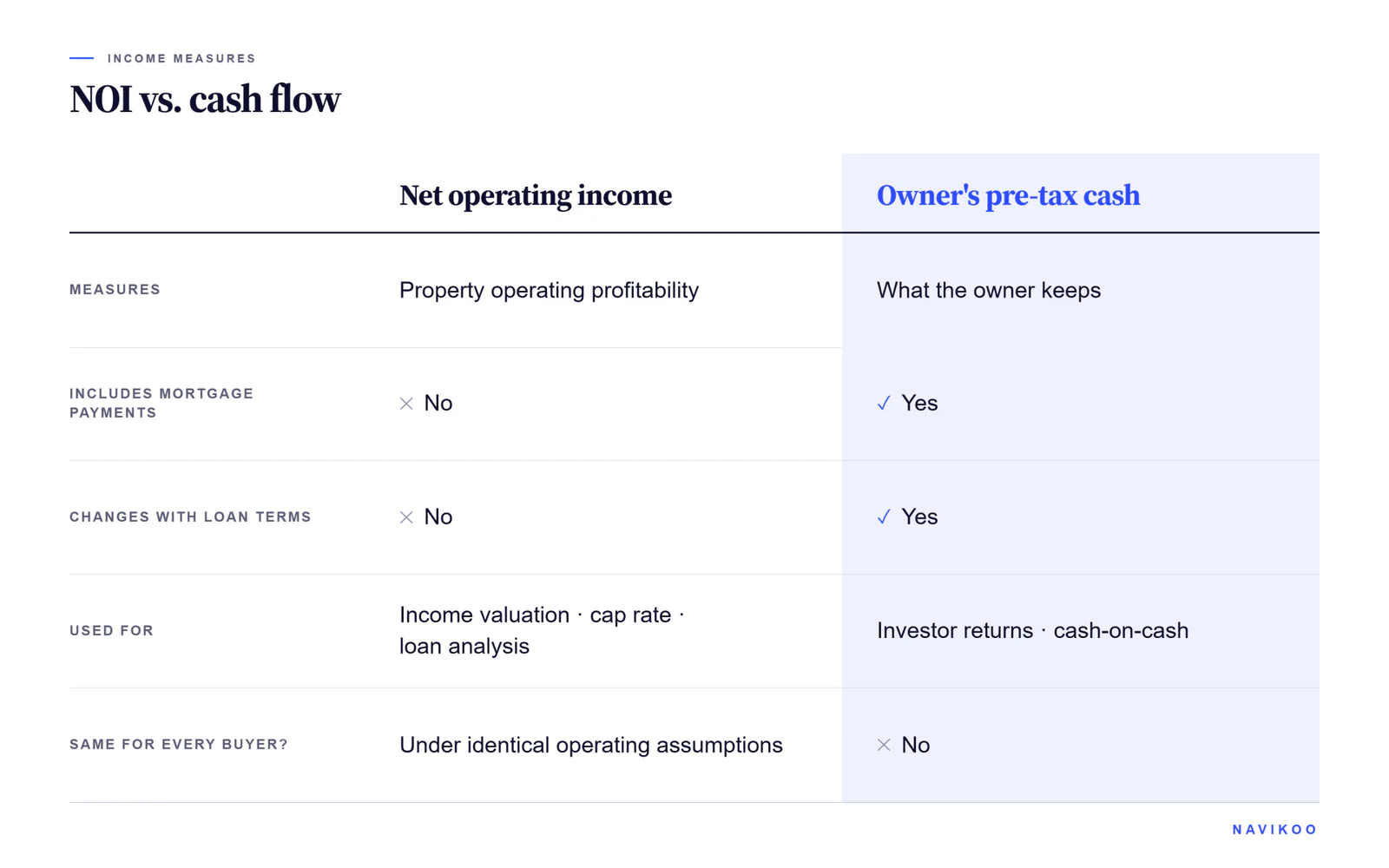
Ask whom each number describes. NOI describes the building's operational performance and operational efficiency. The owner's net cash describes what happens once a loan is layered on top.
Net operating income | Owner's pre-tax cash | |
|---|---|---|
Measures | Operating profitability of the property | What the owner keeps |
Includes mortgage payments | No | Yes |
Changes with loan terms | No | Yes |
Used for | Valuation, cap rates, loan sizing | Investor returns, cash-on-cash |
Same for every buyer? | Same under identical operating assumptions | No |
Under identical operating assumptions, net operating income measures profitability at the asset level. The owner's cash depends on debt terms, so it measures profitability after borrowing and helps determine whether the investment suits the investor.
NOI vs Cash Flow Formula
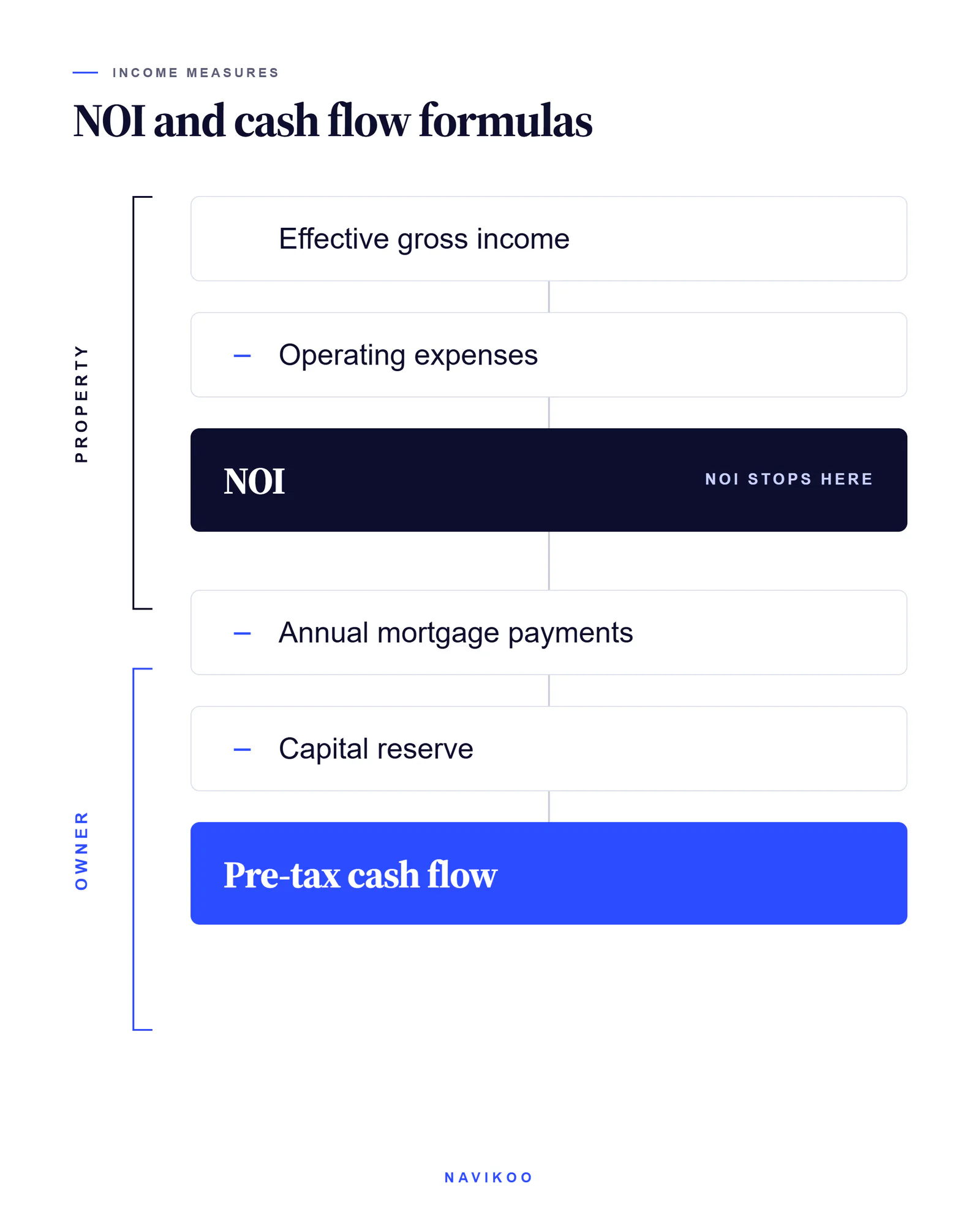
Both calculations share the same first steps and diverge only after operating expenses are paid.
Net operating income = Effective gross income − Total operating expenses
Pre-tax owner cash = Net operating income − Annual mortgage payments − Capital reserve
The NOI formula stops where the building's operations stop; the second continues through owner obligations. Most real estate investors compare deals before taxes so personal tax situations do not distort the result. Both formulas start with the same revenue and expenses.
Example: Same Property, Different Owner Outcomes
The figures below are illustrative teaching assumptions, not market data or current rates. A buyer is evaluating a $600,000 real estate investment: a fourplex with four units renting for $1,500 a month each.
Step 1: The Property's Net Operating Income
Line item | Annual amount |
|---|---|
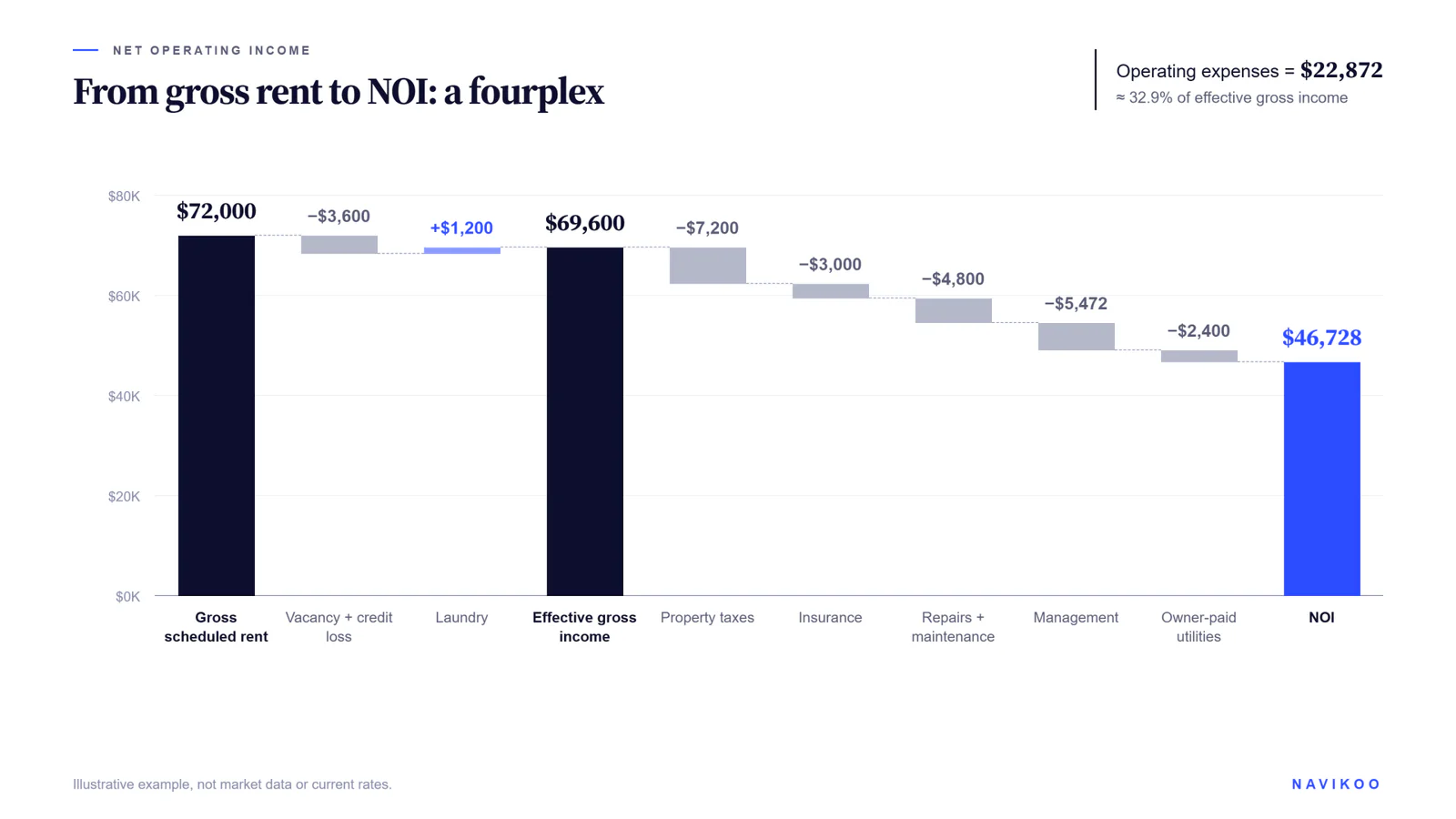
Gross scheduled rent (4 × $1,500 × 12) | $72,000 |
Vacancy and credit loss (5%) | −$3,600 |
Laundry revenue | +$1,200 |
Effective gross income | $69,600 |
Property taxes | −$7,200 |
Insurance | −$3,000 |
Repairs and maintenance | −$4,800 |
Management (8% of collected rent) | −$5,472 |
Owner-paid utilities | −$2,400 |
Total operating expenses | −$22,872 |
Net operating income | $46,728 |
That is a 7.79% cap rate on the $600,000 price. Operating expenses consume about 32.9% of revenue. Verify rental income and revenue against leases, tax records, insurance quotes, utility history, and repair records rather than relying on a seller's pro forma.
Step 2: Three Ways to Own the Same Building
Now hold the building's revenue and operating expenses constant and change only the financing. Each scenario reserves $2,400 a year for capital spending and assumes $18,000 in closing costs.
All cash | 25% down at 7.00% | 10% down at 7.50% | |
|---|---|---|---|
Net operating income | $46,728 | $46,728 | $46,728 |
Annual mortgage payments | $0 | $35,926 | $45,309 |
Capital reserve | $2,400 | $2,400 | $2,400 |
Owner's pre-tax cash | $44,328 | $8,402 | −$981 |
Cash invested | $618,000 | $168,000 | $78,000 |
Cash-on-cash return | 7.17% | 5.00% | −1.26% |
Simple NOI-based DSCR | — | 1.30 | 1.03 |
The building earns $46,728 in every column. For investors, the outcome ranges from $44,328 to a small loss solely because the loan changes.
Why Financing Changes Owner Cash but Not NOI
Net operating income is calculated before the mortgage exists. If two buyers use the same operating assumptions for rents, vacancy, tax bills, and repairs, operating income is identical. What differs is the lender's share.
Loan payments sit below NOI and above the owner's take, so every change in borrowing lands entirely on the owner's side. A larger balance, a higher rate, or a shorter amortization raises the payment and shrinks what is left.
When Leverage Works Against You
At 25% down and 7.00%, the annual payment of $35,926 on a $450,000 loan produces a loan constant of about 7.98%, slightly above the property's 7.79% cap rate. In this first-year comparison, debt therefore costs more than the unlevered yield. The result is negative leverage: borrowing lowers cash-on-cash return from 7.17% to 5.00%.
As a first-year screen, leverage is more favorable when the property's unlevered yield exceeds the loan constant. It does not capture appreciation, taxes, or future refinancing, but it shows how debt terms affect current performance.

Can Positive NOI Still Leave the Owner Losing Money?
Yes, and the 10%-down scenario shows how. The property produces healthy operating income, but $45,309 of mortgage payments plus the capital reserve consume all of it and $981 more. The building is profitable; the owner is not.
Rate Sensitivity
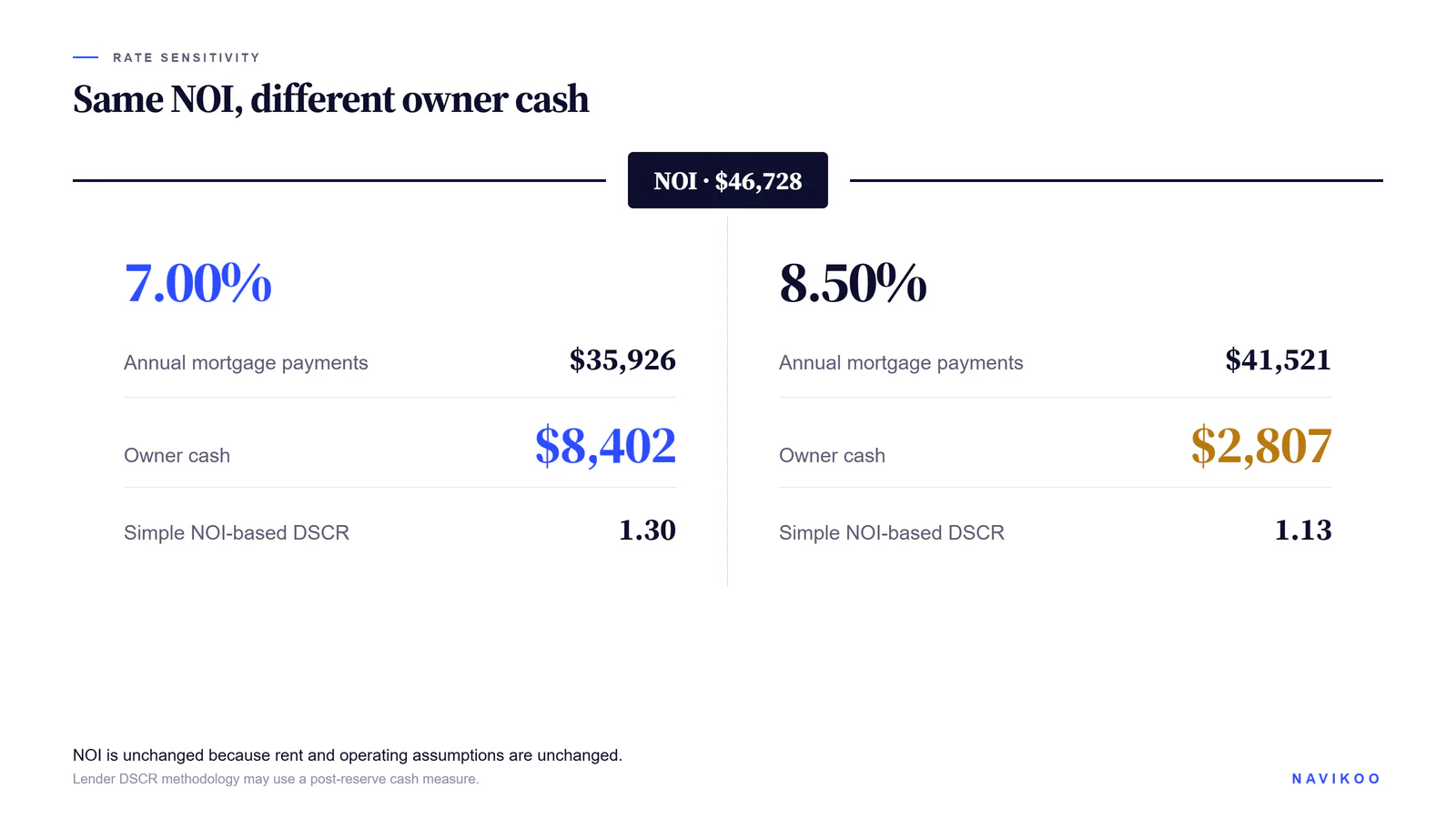
Interest rates can move an investment across that line quickly. Keep the 25%-down structure but raise the rate from 7.00% to 8.50%, and annual payments rise to $41,521. The owner's take falls from $8,402 to $2,807, and the simple NOI-based DSCR drops from 1.30 to 1.13. Net operating income has not changed because revenue and expenses are untouched.
Which Metric Matters More?
Neither in isolation, which is one of the key takeaways from the example. NOI is the better asset measure: it supports market comparisons and shows operating quality and profitability. The owner's net cash is the better investment measure: it shows whether the property can carry its loan and what the deal returns on the money invested.
Judge the property on operating income first and the loan on the leftover cash second. Weak NOI rarely becomes a good investment through clever borrowing, while strong NOI can still fail if the loan absorbs most of its revenue. Treat it as a business decision in two parts: is the business profitable, and is the capital structure sensible? Property-level profitability is necessary but not sufficient for investment profitability.
Longer-term tools, such as a discounted cash flow real estate model, layer projected annual cash, sale proceeds, and principal paydown over a full hold. They still begin with net operating income, so getting it right matters more than any return formula built on top.
How NOI Connects to Cap Rate and DSCR
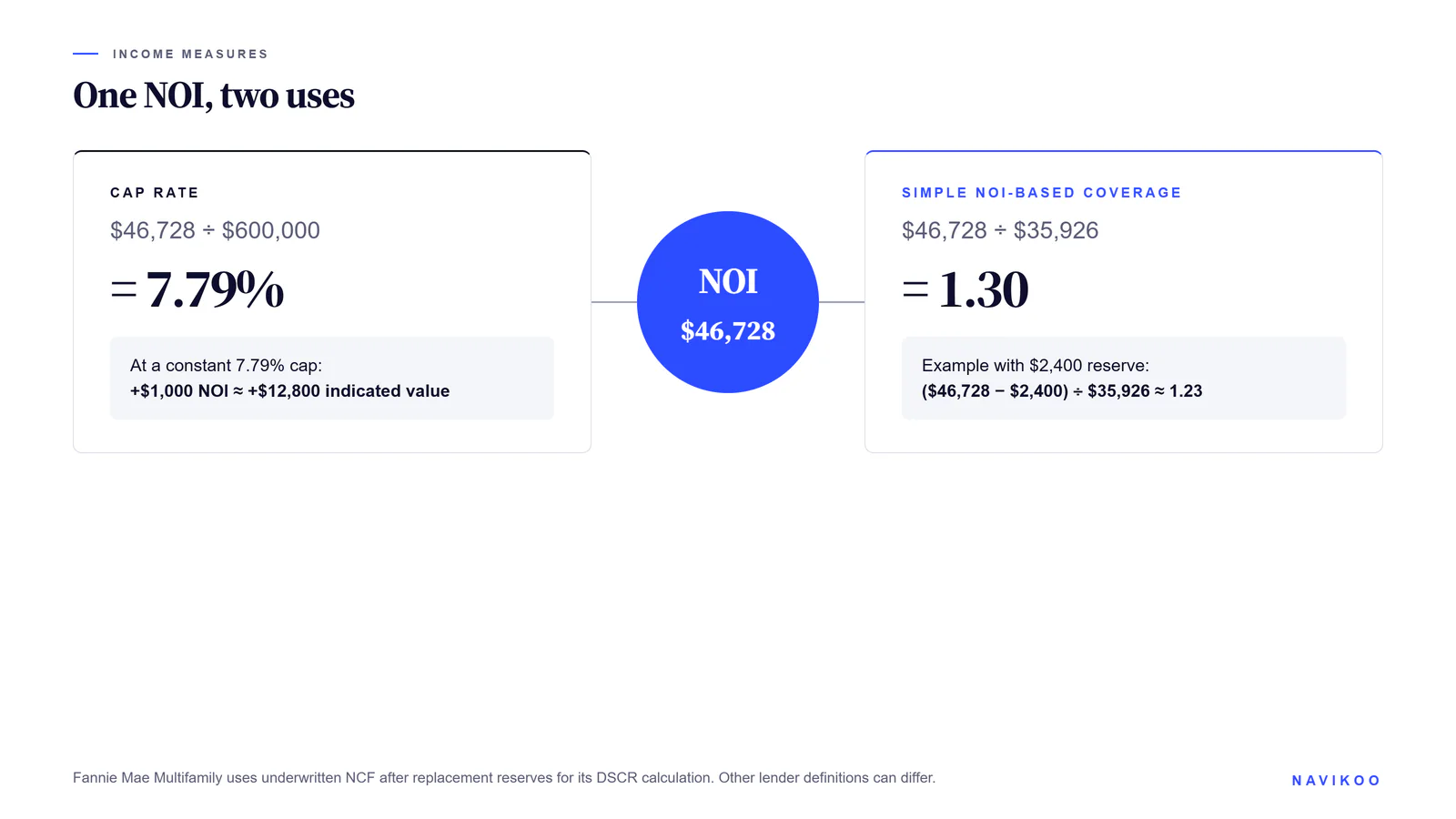
The capitalization rate divides net operating income by property value: $46,728 ÷ $600,000 = 7.79%. For investors, rearranging the formula shows the relationship between income and property value when the market cap is held constant. At 7.79%, another $1,000 of NOI implies roughly $12,800 of value.
The simple coverage ratio used in this example divides NOI by annual debt service, producing 1.30 for the 25%-down structure. Lender definitions can differ. Fannie Mae Multifamily, for example, deducts an underwritten replacement reserve from NOI to reach underwritten NCF before calculating DSCR; using this article's $2,400 reserve would produce about 1.23 instead. A bank or agency lender applies its own underwriting definition and minimum, so the actual loan documents control.
How Owner Cash Connects to Cash-on-Cash Return
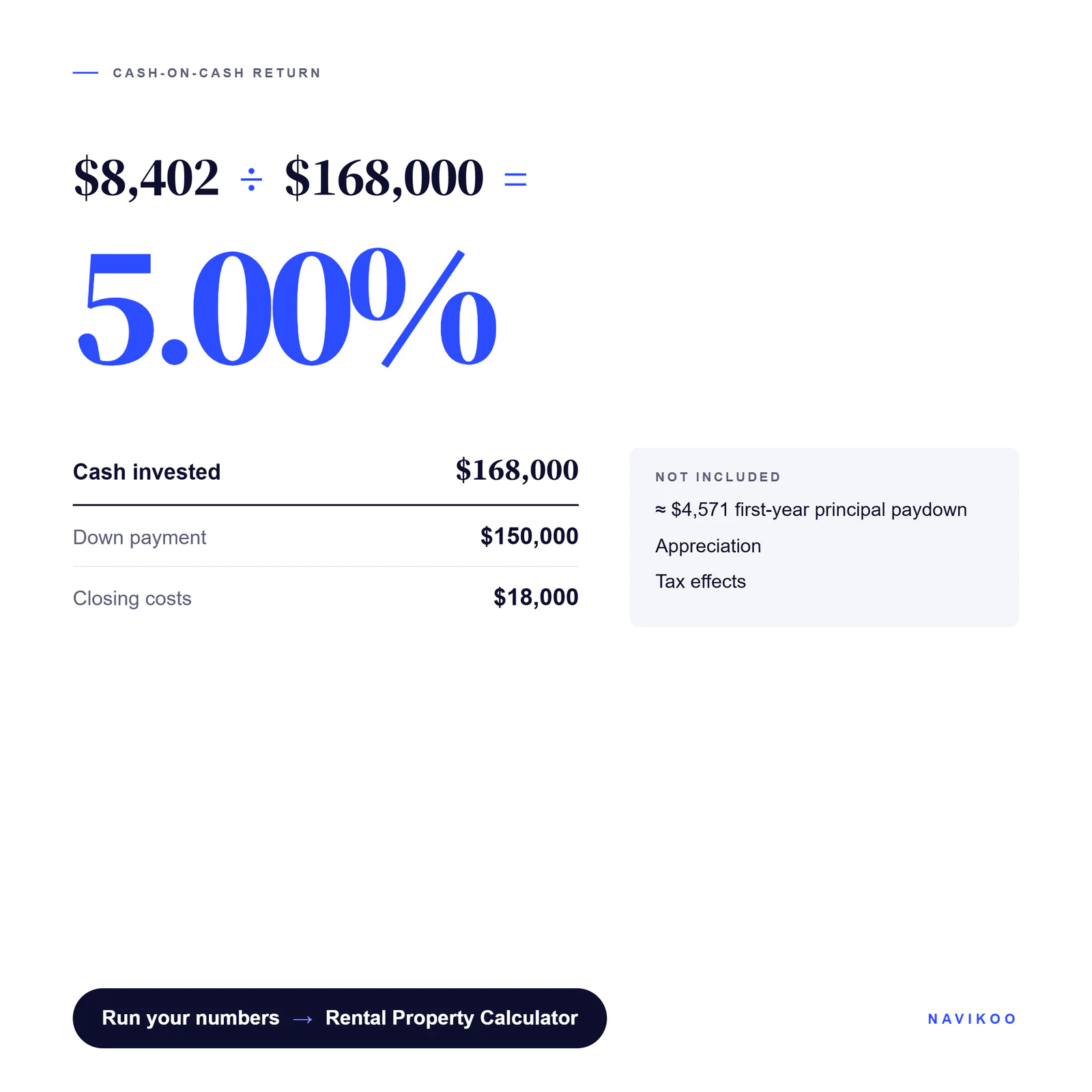
Cash-on-cash return divides annual pre-tax cash by total cash invested, including the down payment and closing costs. For the 25%-down buyer, $8,402 ÷ $168,000 = 5.00%.
It answers what investors often want to know: what are my funds earning? It excludes principal paydown—about $4,571 of equity in year one—plus appreciation and tax effects. Those belong in a total-return view. Cash-on-cash is useful for comparing loan structures on the same building and testing whether its revenue justifies tying up capital.
Investors who want to see how down payment, rate, rent, and operating expenses change both NOI and the owner's take can run these scenarios side by side in Navikoo's free rental property calculator.
Common Mistakes When Comparing NOI and Owner Cash
The costliest mistake is putting the mortgage in operating expenses. It understates net operating income, distorts property value, and makes properties impossible to compare across buyers and business plans.
The second is leaving capital spending out of both numbers. Roofs, HVAC systems, and appliances are real, if irregular, expenses. Excluding them from NOI is standard practice; excluding them from the owner's take too overstates returns and hides expenses that will arrive eventually.
The third is treating depreciation as cash expenses, or principal paydown as revenue. One lowers taxable income without costing cash; the other builds equity without putting money in hand. Both matter for accounting and taxes; neither belongs in pre-tax operating figures.
The fourth is trusting a seller's pro forma without rebuilding it. It can use optimistic vacancy, omit management, or rely on operating expenses from an unusually cheap year. Rebuild operating income from leases, tax bills, insurance quotes, and actual bills because it drives every ratio that follows.
The last is comparing measures that do not match. A property's 7.79% cap rate and another deal's 10% cash-on-cash return describe different things, so setting them side by side says nothing about which is better.
Before an offer, rebuild net operating income from verified rents and expenses, check the implied cap against comparable sales, then apply the actual loan terms. If the owner's take only works at a lower rate, higher rent, or thinner operating expenses than the evidence supports, the deal depends on the loan rather than the real estate.
A sound real estate business starts with operations, verifies the income, and tests the deal against the market.