Real Estate CRM for Investors: Use Cases, Time Savings, and What to Track
A real estate investor CRM keeps the contractors, lenders, agents, and property managers behind every deal in one searchable place, so the next repair or rehab starts with a phone call instead of a search. This guide covers how it differs from an agent CRM, practical use cases for flips, rentals, and financing, what to track in each contact, and how to start for free with Navikoo.
A real estate investor CRM is a contact-management system built around the people behind a deal: contractors, lenders, agents, property managers, insurance brokers, and vendors. Where a traditional real estate CRM tracks leads moving toward a sale, a CRM for real estate investors tracks the network an investor calls on again and again to buy, finance, renovate, and operate property.
That distinction matters because most investors don't lose time looking for customers. They lose it looking for people: the electrician who pulled permits on the last job, the lender who closed in ten days, the agent who sends off-market deals first. When that information lives across a phone, an inbox, and a notes app, every deal starts with a search.
A real estate investor CRM can also be thought of as relationship management software for real estate investors, because the goal is to preserve the network of people who help source, finance, renovate, and operate deals
This guide covers what an investor CRM does, where it saves time in practice, what to track in each contact, and how to choose one, including the free option inside Navikoo's real estate investor CRM.
What Is a Real Estate Investor CRM?
A real estate investor CRM organizes the relationships an investor depends on into one searchable place, with each contact labeled by role, status, and the details that make them useful on the next deal.
The name comes from customer relationship management, but in a real estate investment CRM the relationships are different. An agent's CRM follows buyers and sellers through a sales process. An investor's CRM follows the working network: who does the work, who funds it, who finds the deals, and who manages the property afterward. The goal isn't closing a contact. It's being able to call the right one in seconds.
Real Estate CRM for Agents vs. Real Estate Investors
Agent or brokerage CRM | Real estate investor CRM | |
|---|---|---|
Who's in it | Leads, buyers, sellers | Contractors, lenders, agents, property managers, vendors |
Main job | Move leads through a sales funnel | Keep a reusable deal network organized |
Key fields | Lead source, stage, next touch | Role, rates, service area, license, status |
Success looks like | More closed transactions | Faster, more reliable execution on every deal |
Much of the real estate software marketed as "real estate CRM" is built for the left column. Investors searching for relationship management software usually need the right one.
Why Spreadsheets and Phone Contacts Stop Working
A spreadsheet is a reasonable place to start, and many investors run one for years. The trouble shows up as the network grows past a few dozen people. Notes drift into text threads, rates live in old invoices, and the sheet stops reflecting who's actually reliable.
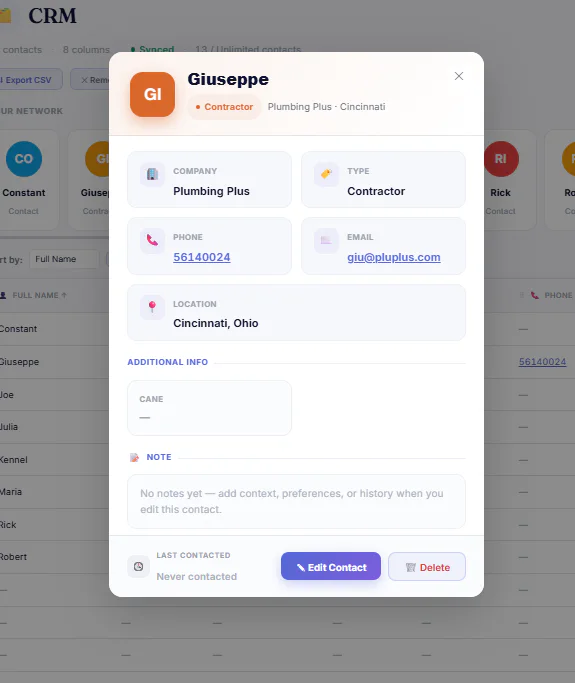
Phone contacts have the opposite problem. They're always with you, but they hold a name and a number, not the context. "Mike Plumber" doesn't tell you his hourly rate, whether he answers emergency calls, or which of your properties he knows.
An investor CRM keeps the name, the role, and the context together, and makes the whole network searchable by the things that matter when something breaks.
How a Real Estate Investor CRM Saves Time
The time savings come less from speed on any single lookup and more from not having to reconstruct information you already had.
The broader real estate industry shows the same preference for efficiency: the National Association of REALTORS® reported in its 2026 technology research that 81% of surveyed REALTORS® said saving time was a primary reason for adopting technology.
A Simple Illustration
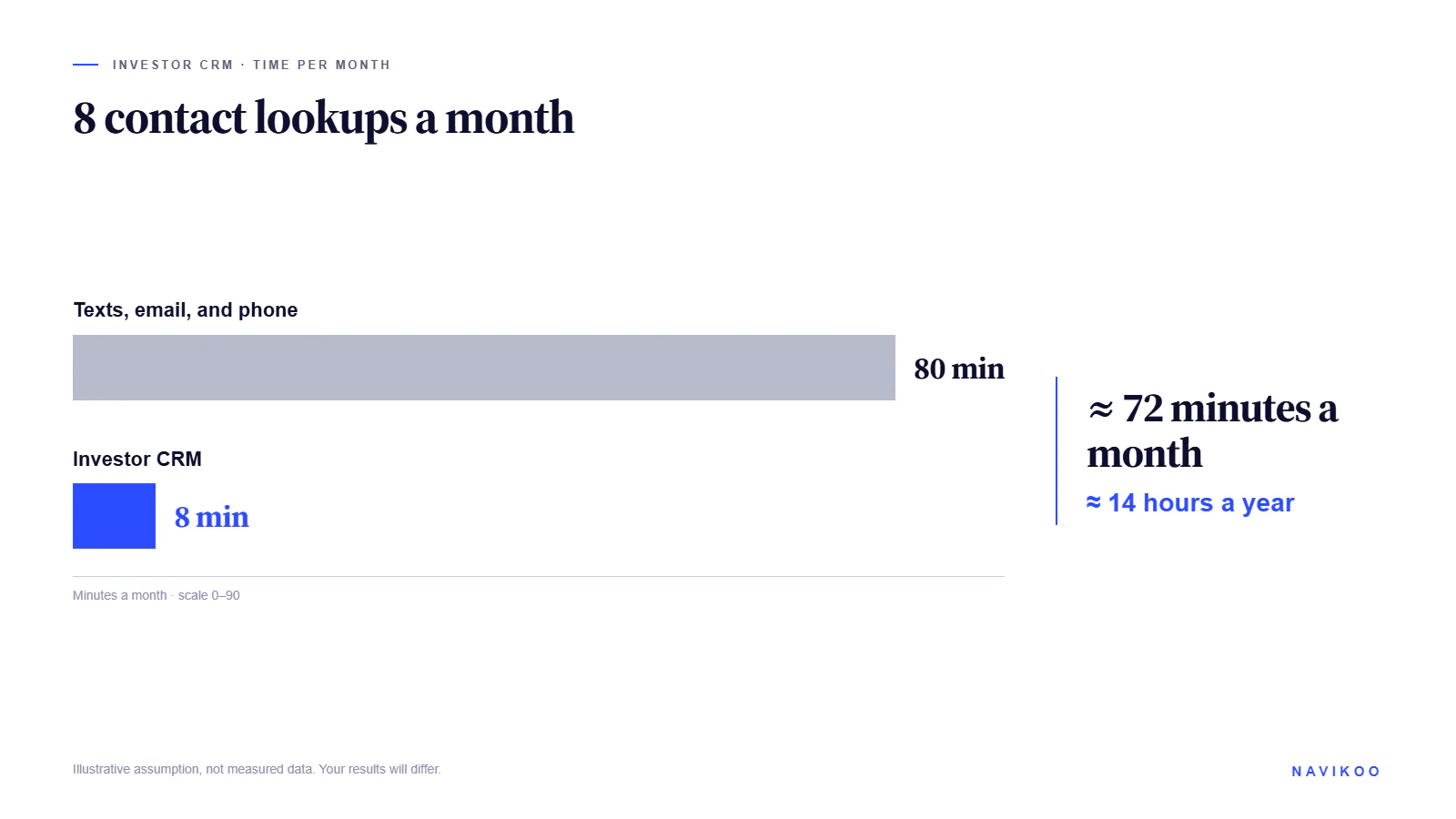
The figures below are an illustrative assumption, not measured data. Suppose an investor with a few rentals and one renovation a year looks up a contractor, lender, or vendor about eight times a month. Without a system, each lookup means scrolling texts, searching email, or calling someone to ask, call it ten minutes. With the contact, rate, and notes in one record, it's closer to one minute.
That's about 72 minutes a month, or roughly 14 hours a year, from lookups alone. Your own numbers will differ, and the estimate doesn't capture the larger cost: the day a repair waits because nobody remembered which plumber handled that building, or the week a rehab stalls while you find a licensed electrician in a market you haven't worked in recently.
Where the Real Time Goes
In practice, an investor CRM saves time in four places:
Emergency repairs. Filter by role and status to find a preferred plumber or electrician immediately.
Bids and pricing. Rates from the last job sit on the contact record, so you can sanity-check a new quote.
Financing. Lender terms from past deals are attached to each lender, so comparing options starts from real numbers.
Follow-ups. Status tags show who needs a call back, so relationships don't go quiet by accident.
Who Needs a Real Estate Investor CRM?
An investor does not need a CRM simply because they own a rental property.
The need usually appears when the number of relationships becomes harder to manage than the properties themselves.
A CRM becomes more useful when an investor:
owns property in multiple markets
works with several contractors or vendors
compares lenders across deals
renovates properties regularly
uses multiple agents or wholesalers for deal sourcing
has a partner or assistant who needs access to the same network
repeatedly searches old texts, emails, or invoices for contact information
A landlord with one property and three reliable vendors may be fine with a phone. An investor managing several properties, markets, or renovations benefits more from having the network organized in one system.
Real Estate Investor CRM Use Cases
Fix-and-Flip and Rehab Projects
A rehab depends on trades arriving in the right order. An investor CRM lets you tag contractors by trade, record license information for work that needs permits, and note turnaround times. When the painter can't start until the drywall is done, you can see who else you've used, in that area, before the schedule slips. Free CRM Tool
Once contractors are organized, the project itself still needs a realistic scope and budget. Investors can use Navikoo’s Rehab Cost Estimator to structure preliminary renovation costs before comparing contractor bids.
Buy-and-Hold Rentals
Landlords need a small group of dependable people on call: a plumber with fast emergency response, an electrician, a handyman, an insurance broker for landlord and umbrella policies, and often a property manager.
Storing each one's rates, response notes, and which properties they cover means a tenant call at 9 p.m. doesn't become a search project.
Financing and Lender Relationships
Lenders are easy to forget between deals and valuable when you need them fast. A record that holds each lender's typical rate, points, and closing speed from past loans, for example, a hard money lender noted as "12% / 2 points · 10-day close," turns the next financing decision into a comparison instead of a round of phone calls.
Financing relationships become especially valuable when comparing conventional debt, private lenders, or more flexible structures such as seller financing.
Deal Sourcing Through Agents and Wholesalers
Agents and wholesalers who send deals first are part of your competitive edge. Tagging them, noting what they send and how often, and marking who needs a follow-up keeps those relationships warm. For tracking the properties themselves, Navikoo keeps a separate Deal Pipeline, described below.
Investing Out of State
When you invest outside your home market, the network is the plan. A service-area field on each contact makes it clear who covers which city or neighborhood, which matters more than almost any other detail once you own property in more than one place.
Growing or Handing Off Work
A CRM makes the network transferable. A partner, assistant, or property manager can see who you use and why, instead of relying on what's in one person's phone.
What Features Should a Real Estate Investor CRM Have?
A real estate investor CRM does not need dozens of sales and marketing features. The useful features are the ones that help an investor find the right person, understand the relationship, and act quickly.
At minimum, look for:
contact roles such as contractor, lender, agent, property manager, insurance broker, and vendor
searchable service areas or markets
notes on rates, pricing, past jobs, and response times
license or credential information where relevant
contact status, such as preferred, active, or follow-up needed
search and filtering by role, market, or status
a history or notes field that preserves context from previous deals
Investors operating across multiple markets may also benefit from connecting the CRM with a deal pipeline and portfolio management system so contacts, active acquisitions, and owned properties remain part of the same workflow.
The goal is not to recreate an enterprise sales CRM. It is to make the investor’s operating network usable on the next deal.
What Should You Track in a Real Estate Investor CRM?
Track enough to make each contact useful on the next deal, and no more than you'll actually keep updated.
Field | Why it matters |
|---|---|
Name | The person you actually call, not only the company |
Role or trade | Plumber, electrician, lender, property manager, agent |
Company | For contacts who work under a firm |
Phone and email | So details don't live only on your phone |
Market or service area | Who covers which neighborhoods or cities |
Rates or pricing notes | From the last job, for comparing new quotes |
License information | Where the trade or role requires it |
Status | Preferred, active, or needs a follow-up |
Notes | Context you won't remember months later |
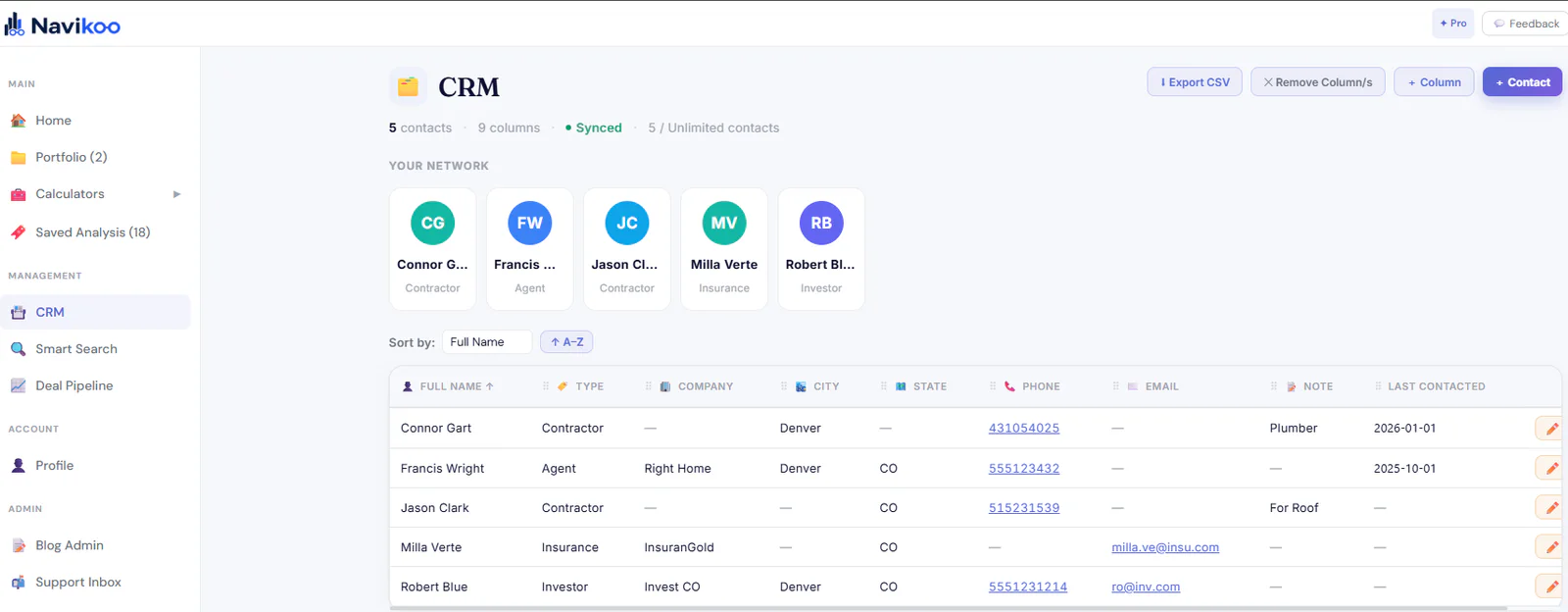
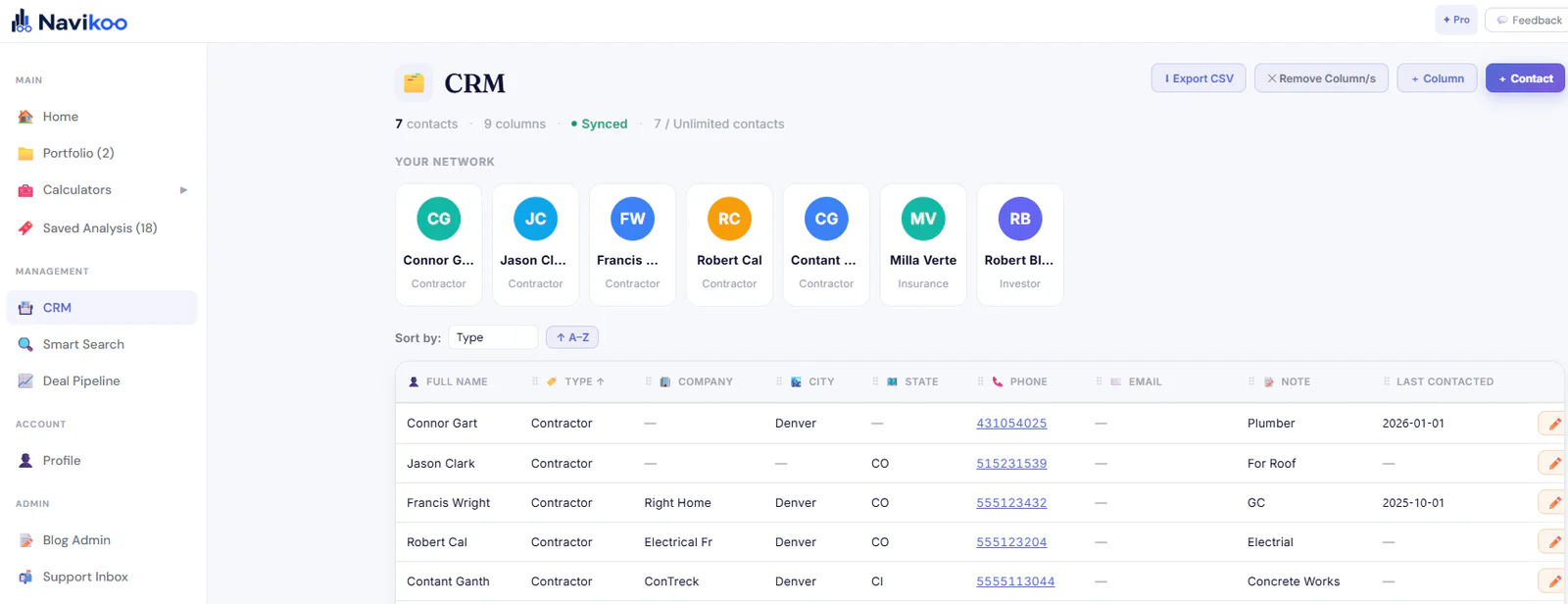
In Navikoo's Real Estate Investor CRM, these live as structured fields and notes on each contact, with roles and status you can search and filter.
Real Estate CRM vs. Deal Pipeline: What’s the Difference?
An investor CRM answers who you work with.
A deal pipeline answers which property opportunities you're working on and what stage each has reached.
The CRM changes slowly, because a good network is built over years. The pipeline turns over constantly as deals advance, stall, or fall away. Most active investors need both: the pipeline tells you which properties are still worth pursuing, and the CRM tells you who to call about them. In Navikoo, Deal Pipeline is part of the Pro plan alongside the CRM and portfolio tracking.
How to Choose the Best CRM for Real Estate Investors
The best CRM for real estate investors is the one you'll keep updated. Beyond that, check five things:
Built for investors, not only agents. Roles like lender, contractor, and property manager should be first-class, not squeezed into "lead."
Structured fields. Role, status, service area, rates, and license information, not only a free-text note.
Fast search and filtering. By role, status, and area, which is what you need during a repair or a rehab.
Connection to the rest of your work. A CRM that sits beside your deal analysis and portfolio tools gets used more than one in a separate app.
A free starting point. Try it with your real network before paying.
Is There a Free CRM for Real Estate Investors?
Yes. Navikoo's CRM includes a free tier that lets you manage a limited number of contacts, enough to organize a core network and see whether the workflow fits. Pro users get unlimited contacts plus Deal Pipeline and portfolio tracking. You can start building your investor network for free.
Real Estate Investor CRM vs. Property Management CRM
Not quite. CRM for property management usually centers on tenants, leases, and maintenance requests across many units. An investor CRM centers on the owner's network of partners and vendors. A property manager is a contact in your investor CRM, and the two tools serve different jobs.
How to Set Up an Investor CRM in an Afternoon
Start with the last five deals. List every person who worked on them: trades, lender, agent, property manager, insurance broker.
Add role and status first. Mark who's preferred, who's active, and who needs a follow-up.
Add the one detail you'd hate to lose. A rate, a license number, a closing speed, or a service area.
Add notes as you go. Every new job is a chance to update the record.
Review quarterly. Promote reliable contacts, retire unreliable ones, and follow up with anyone tagged for it.
Starting with recent deals builds the most useful part of the network first, rather than importing hundreds of contacts you'll never call.
Frequently Asked Questions
What is a real estate investor CRM?
A contact-management system for organizing the people in an investor's deal network, such as contractors, property managers, lenders, agents, and vendors, rather than tracking sales leads like a traditional CRM.
How is it different from a real estate agent CRM?
Agent CRMs manage leads and client transactions. An investor CRM manages the service providers and partners an investor uses across every deal.
Is it the same as investor relations software?
No. Investor relations software is used by fund managers to report to limited partners. A real estate investing CRM organizes the operational network behind your properties.
Can I track contractors and vendors?
Yes. In Navikoo you can store each contact's role, rates, service area, license information, notes, and status.
Is Navikoo's CRM free?
Yes, free users can manage a limited number of contacts. Pro adds unlimited contacts, Deal Pipeline, and portfolio tracking.
Your network is one of the few assets that improves every deal you do. Organizing it once, and keeping it current, is how the next rehab starts with a phone call instead of a search. Try Navikoo's real estate investor CRM free.