Co-Living Real Estate for Investors: When Renting by the Room Actually Pays
Coliving can produce substantially more gross rent than a standard lease, but the investor keeps far less of that premium after vacancy, utilities, cleaning, furnishing, and management. See when renting by the room actually makes financial sense.

Coliving is simple on the surface: instead of renting an entire home to one household, the owner rents private bedrooms separately and occupants share the kitchen, living area, laundry, and other common space. The rooms are usually furnished, utilities and internet are often included, and the operator handles the pieces that roommates would normally manage themselves.
For real estate investors, the question is not whether residents like the coliving lifestyle. It is whether extra room rent survives higher vacancy, utilities, cleaning, furnishing, management, and turnover. A five-bedroom house can collect much more gross rent as coliving housing and still produce only a small increase in net operating income.
There is a real affordability story behind the housing model. Harvard's Joint Center for Housing Studies reported that 49% of US renter households were cost-burdened in 2024, meaning they spent more than 30% of income on rent and utilities. A furnished private room can therefore sit in a useful gap between an expensive studio and a conventional roommate arrangement. For the owner, though, affordability can support leasing; it does not guarantee profitability.
What Coliving Is, in One Minute
A typical co-living space gives each resident a private bedroom under an individual agreement while sharing communal kitchens, living rooms, laundry, and sometimes coworking space. The operator usually supplies furniture, internet, utilities, cleaning of shared areas, and the systems needed to fill empty rooms. Some larger operators describe this as subscription housing because the resident is buying a ready-to-use living arrangement as much as square footage.
Coliving arrangements can be as small as a five-bedroom house or as large as purpose-built communities with dozens of rooms. The common thread in these coliving arrangements is that the operator manages the shared area and each bedroom as a separate revenue line. That is why coliving is not simply a normal lease with more roommates; it is a more active operating model layered on top of housing.
What Is the Difference Between Co-living and Shared Housing?
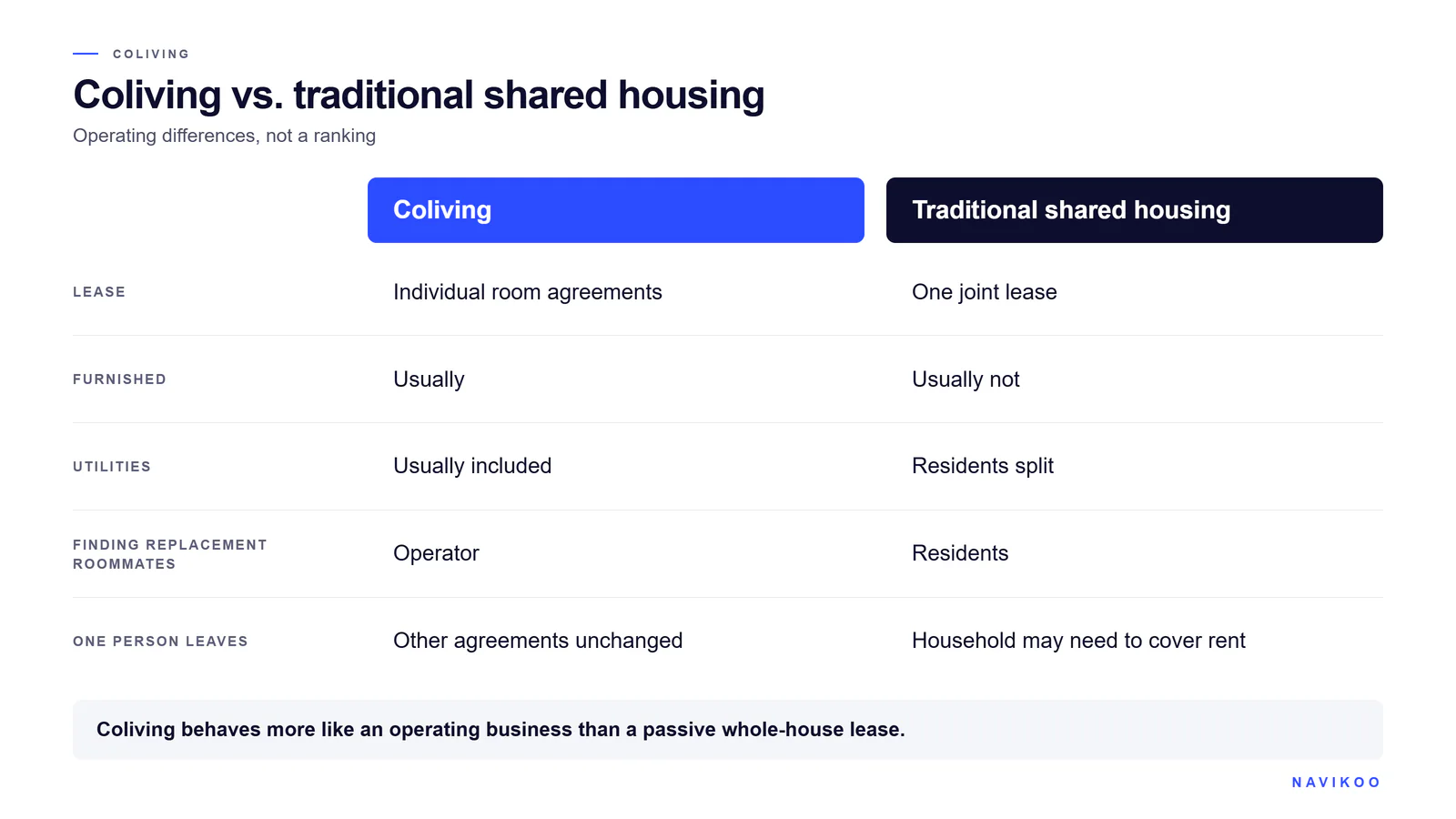
Traditional shared housing usually means several people sign one lease, split utilities, furnish the home themselves, and replace a roommate when someone leaves. In coliving, members generally have separate agreements, the operator fills vacancies, and one person leaving does not automatically change the rent owed by everyone else.
That difference is important for the owner. For occupants, the shared lifestyle is flexible renting; for the owner, it is a rental operating model. The coliving experience depends on convenience, a reliable shared environment, and management. The residents are paying for privacy inside a shared environment without having to build the household themselves. If the operator stops delivering that lifestyle, the premium over ordinary shared housing becomes harder to defend.
Why Investors Look at Coliving in the First Place
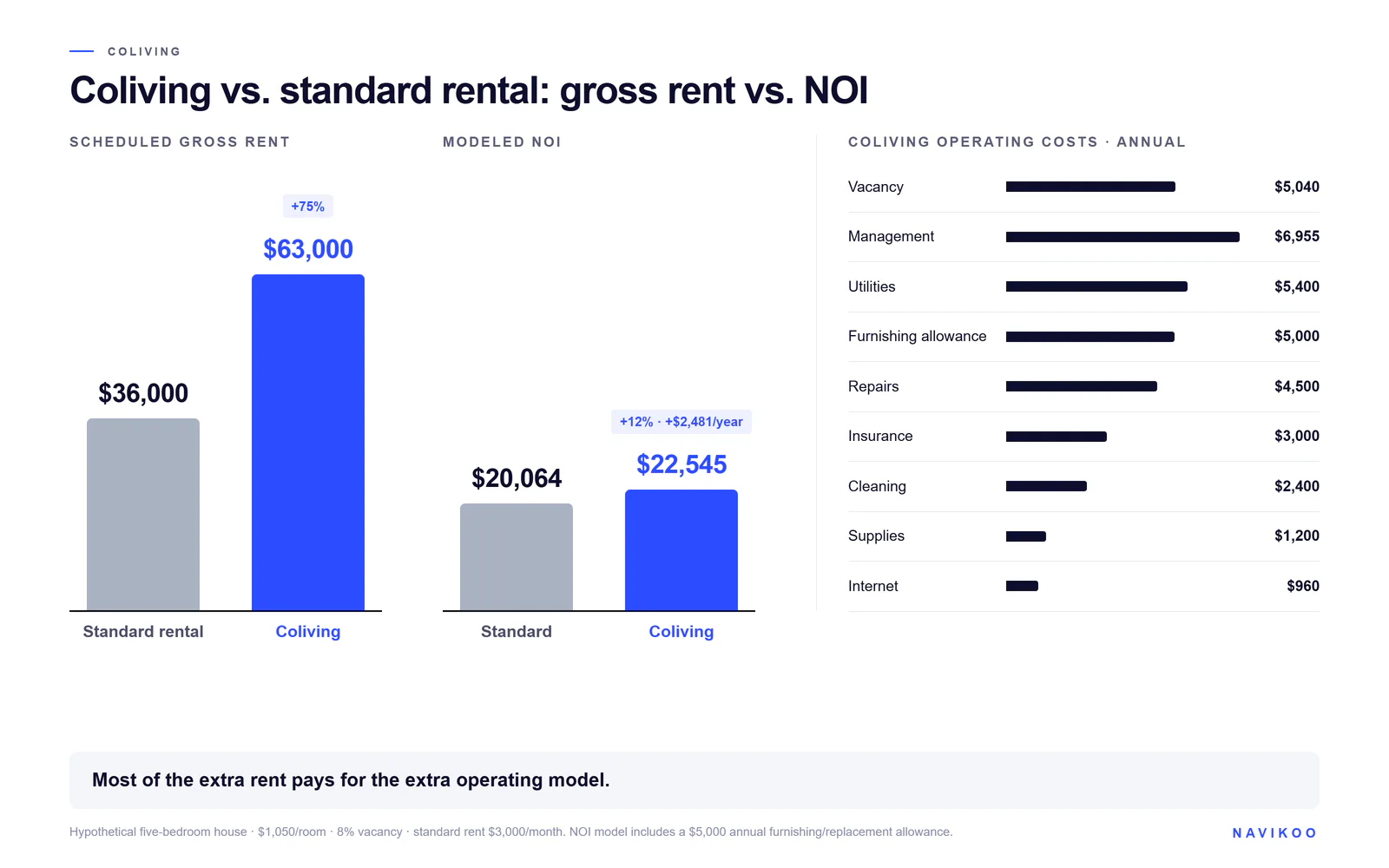
The appeal is obvious when you look at gross rent. A house that leases for $3,000 a month to one household might contain five legal bedrooms that can each rent for $1,050. On paper, that turns $36,000 of annual scheduled rent into $63,000.
This is where coliving can fool an investor. The 75% increase in gross rent is real, but the owner is also taking over expenses and work that a standard tenant normally absorbs. Utilities become the owner's problem. Internet becomes the owner's problem. Cleaning, furnishing, room-by-room marketing, supplies, and repeated tenant screening become part of the business. The extra income has to pay for all of that before it becomes profit.
Is Coliving Profitable? Start With the Same House
The cleanest way to evaluate a co-living rental model is to underwrite the same property twice: once as a standard rental and once as coliving. The example below is hypothetical and is meant to show the mechanics, not current market rents.
Assume a five-bedroom home rents for $3,000 a month to one household. As coliving housing, the five rooms rent for $1,050 each. This version carries higher vacancy, higher management, owner-paid utilities, internet, weekly cleaning, supplies, more repairs, higher insurance, and an annual furnishing replacement allowance.
Annual figures | Standard rental | Coliving by the room |
|---|---|---|
Gross scheduled rent | $36,000 | $63,000 |
Vacancy | 5%: −$1,800 | 8%: −$5,040 |
Collected rent | $34,200 | $57,960 |
Property taxes | −$6,000 | −$6,000 |
Insurance | −$2,400 | −$3,000 |
Repairs and maintenance | −$3,000 | −$4,500 |
Management | 8%: −$2,736 | 12%: −$6,955 |
Utilities | Tenant pays | −$5,400 |
Internet | Tenant pays | −$960 |
Cleaning of shared areas | — | −$2,400 |
Supplies and replacements | — | −$1,200 |
Furnishing replacement allowance | — | −$5,000 |
Modeled net operating income | $20,064 | $22,545 |
The headline is the whole article in one line: gross rent increases 75%, but modeled net operating income increases only about 12%, or $2,481 a year.
That is the reason to underwrite this carefully. Higher revenue pays for a more service-heavy lifestyle product. Strong room rents and controlled costs can create a useful premium; weak execution can create a harder job for nearly the same return.
Where the Profit Disappears
In this example, the biggest variables are occupancy rate and room price. Those two numbers move faster than property taxes or insurance and can erase the advantage surprisingly quickly.
Scenario | Coliving NOI | Difference vs. standard rental |
|---|---|---|
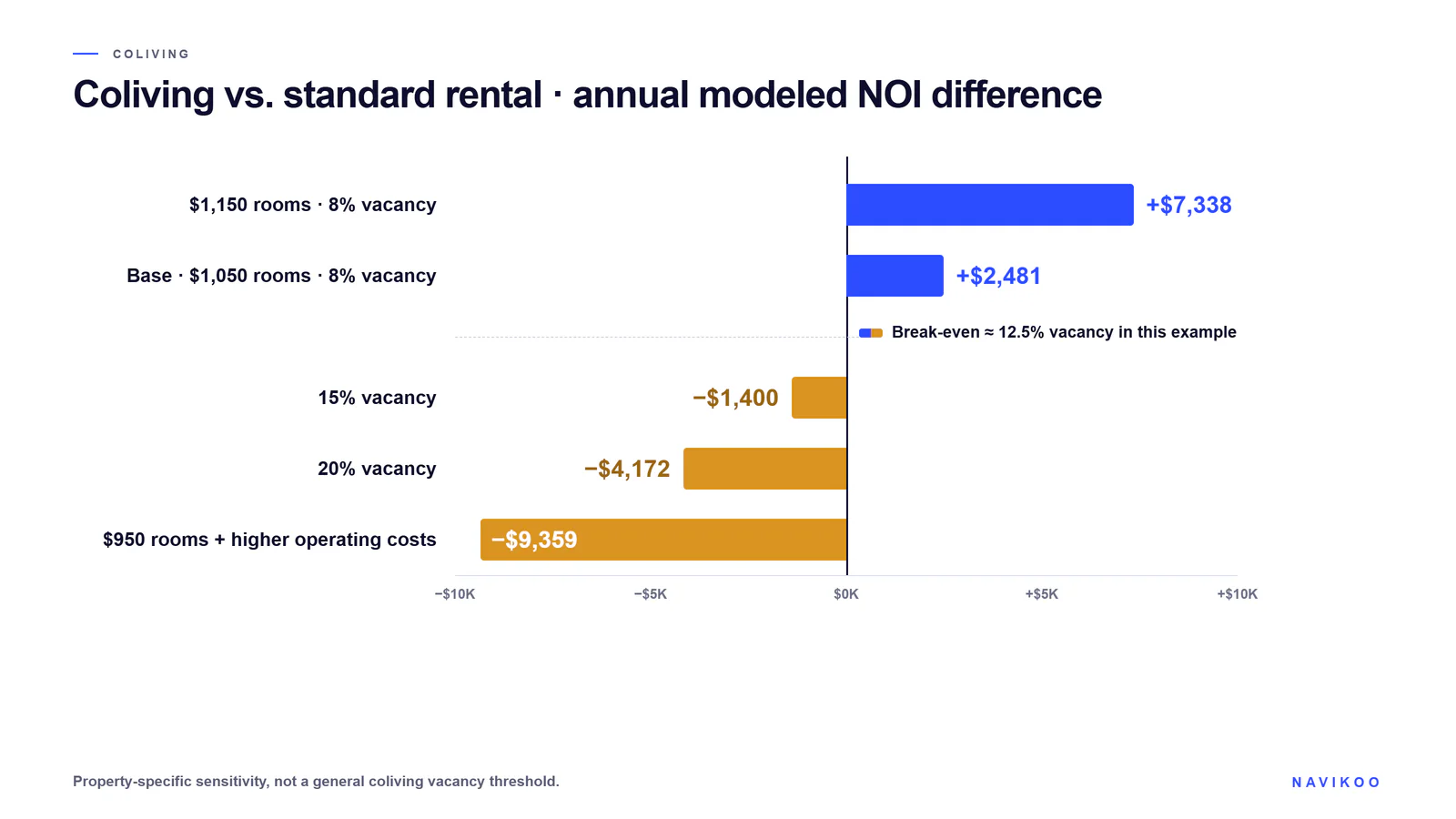
Base: $1,050 rooms, 8% vacancy | $22,545 | +$2,481 |
Vacancy rises to 15% | $18,664 | −$1,400 |
Vacancy rises to 20% | $15,892 | −$4,172 |
Rooms rent for $1,150, 8% vacancy | $27,402 | +$7,338 |
$950 rooms, 10% vacancy, 15% management, higher utilities and cleaning | $10,705 | −$9,359 |
The coliving break-even point in this model is roughly 12.5% vacancy. Above that, it produces less modeled NOI than the standard lease. A small increase in vacancy matters because every empty bedroom loses revenue while most shared-house expenses keep running.
Room rent has the opposite effect. If the market supports $1,150 without hurting occupancy, the extra NOI becomes meaningful. If the market only supports $950, a high-touch operating model can lose badly to a simple lease.
This is why the first coliving investing question should never be, “How many bedrooms can I create?” It should be, “What will legal, functional rooms actually rent for, and how often will they be empty?” Investors can stress-test room rents, vacancy, and operating costs against a standard lease in free Rental Property Calculators.
When Coliving Actually Makes Sense
Coliving works best when several advantages stack together. You want communities where a private studio or one-bedroom is expensive enough that a furnished room offers clear savings, but where room rents are still high enough to cover the extra operating package. That is a narrower target than simply choosing an expensive city.
Demand should be broad rather than dependent on one small group. In urban areas with a high cost of living and multiple jobs centers, coliving can attract residents whose jobs involve a new city move, remote workers leaving traditional office life, digital nomads, traveling professionals seeking furnished accommodation, and some travelers. It is not student dorms or assisted living with clinical care; residents are independent adults. These different types of residents can value flexible living arrangements, but the owner should underwrite the residents who actually rent in that submarket rather than a generic coliving lifestyle persona or lifestyle trend.
The rise of Airbnb also made furnished and flexible housing more familiar, but coliving is not a short-term rental with bedrooms. Stays are generally longer, coliving communities can be more stable, and the economics depend more on repeatable room-level renting than nightly pricing.
The Room-Rent Spread Has to Be Big Enough
The best coliving homes usually show a meaningful gap between whole-house rent and the sum of realistic room rents. If a house rents for $3,000 as a whole and five rooms can reliably collect $5,250 before vacancy, there is something to analyze. If those five rooms only collect $4,000, the additional operating extras may consume the entire spread.
For this strategy, do not use advertised room rents alone. Search actual rental comparables, talk with local operators, and track how long rooms stay listed. A strong coliving community cannot compensate for pricing rooms above what residents will pay.
Layout Matters More Than Investors Expect
A five-bedroom label does not automatically create a good coliving space. Residents need privacy, storage, enough bathrooms, and communal space that does not feel overcrowded. A common practical target is no more than roughly two people per bathroom, although the right layout depends on local rules, room sizes, and the property itself.
Adding a bathroom can therefore do more for the shared-house lifestyle than adding decorative amenities. Useful amenities such as good locks, sound control, reliable HVAC, a large kitchen, in-unit laundry, a functional coliving space, durable furniture, and enough refrigerator and pantry space can reduce complaints and turnover. Amenities should solve a resident problem before they become a line in the marketing copy.
Operations Are the Real Competitive Advantage
In coliving, two identical homes can produce different results if one operator fills rooms quickly and controls turnover while the other does not. Coliving is unusually sensitive to operational execution because five individual agreements create more leasing events than one annual household lease.
Self-management can preserve margin, but it also means responding to renter issues, handling cleaning, coordinating repairs, managing supplies, screening new residents, and resolving conflict inside shared space. A professional operator can take over those services, but the fee has to be included from day one rather than treated as something the future revenue will somehow cover.
When comparing operators, ask for the occupancy rate in comparable homes, actual collected room rents, average time to fill a room, included services, utility responsibility, concessions, and what happens if the operation underperforms.
Financing Can Be More Important Than the Pro Forma
A coliving property can produce attractive room income and still finance differently than expected. For conventional one- to four-unit real estate investment loans, Fannie Mae requires qualifying rental income to be supported by applicable appraisal or market-rent documentation; unsupported lease rents can require more justification or a lower amount.
That matters because an investor should not assume that five individual room agreements automatically translate into five rooms of qualifying income for every lender. A conventional appraisal may view a one-unit home through whole-property rental comparables rather than the operator's full coliving rent roll. Portfolio, DSCR, or specialized lenders may evaluate the model differently.
For coliving financing, ask the question before converting the property: How will this lender value the housing and how much of the room income will it actually recognize?
The answer can change leverage, refinancing options, and the return on the investment even if operations are going well.
Local Rules Can Kill a Good Spreadsheet
Coliving is highly local, and arrangements can cross legal categories quickly. US cities and counties can have occupancy limits, definitions of family or household, rooming-house rules, rental licensing, parking requirements, fire-code requirements, and building standards that change what is legal inside a single-family property. HOAs can add another layer.
HUD itself notes that municipalities may restrict how many unrelated people can share a unit and that shared housing can face local zoning barriers. That means the number of bedrooms on Zillow is not the same thing as the number of bedrooms an owner can legally rent separately.
Before buying a coliving property, verify zoning, occupancy, rental licensing, fire and egress rules, and whether individual room agreements change the property's classification. A deal that needs six people to work but can legally house four does not have an operations problem; it has a broken underwriting assumption.
Fair Housing and Tenant Screening Still Apply
Most coliving housing is still subject to the Fair Housing Act, and individual room agreements create repeated screening decisions. Written and consistently applied tenant screening criteria matter because a coliving operator will be making those decisions more often than a landlord with one household lease.
The lifestyle branding also deserves care. Marketing a community around convenience, furnished space, flexible terms, or services is different from expressing preferences for renters based on protected characteristics. Federal rules are only one layer; state and local protections can be broader.
Coliving vs. Mid-Term and Traditional Rentals
Coliving sits between several familiar renting strategies. It is usually more operationally intense than a traditional lease, less transient than nightly short-term renting, and more room-focused than a mid-term rental. That makes it attractive to owners who already understand furnished housing but want steadier occupancy than vacation-style stays.
Strategy | Typical structure | Furnished | Utilities | Operating intensity |
|---|---|---|---|---|
Coliving | Individual room agreements | Usually | Usually included | High |
Mid-term rental | Whole unit, often 1–6 months | Yes | Usually included | Medium |
Short-term rental | Nightly or weekly bookings | Yes | Included | Very high |
Traditional shared housing | Joint household lease | Usually not | Roommates split | Low |
For some types of properties, especially a large single-family property or small multifamily asset with several good bedrooms and multiple bathrooms, coliving can be the better use. Other properties are poor fits no matter how attractive the gross rent looks. Purpose-built communities can spread services and amenities over many members, while a small owner has to make the economics work with far fewer rooms.
What Are the Downsides of Coliving?
The first coliving downside is workload: more leasing, cleaning, messages, and resident conflict. Flexible terms can also mean more turnover.
The second is cost volatility. Utilities, cleaning, furnishing replacement, repairs, supplies, and management can rise while lease pricing stays flat. A standard rental pushes several of those costs to the tenant; coliving brings them back to the operator.
A third risk is concentration in the operator. A well-run operation can feel easy from the owner's perspective because the systems are working. If the operator weakens, occupancy falls, or service quality declines, the financial performance can change quickly.
The fourth is exit flexibility. A house that only works as coliving may appeal to a smaller buyer pool than a property that also functions well as ordinary rental housing. The safest conversions preserve a credible standard-rental fallback.
A Simple Investor Test Before You Buy
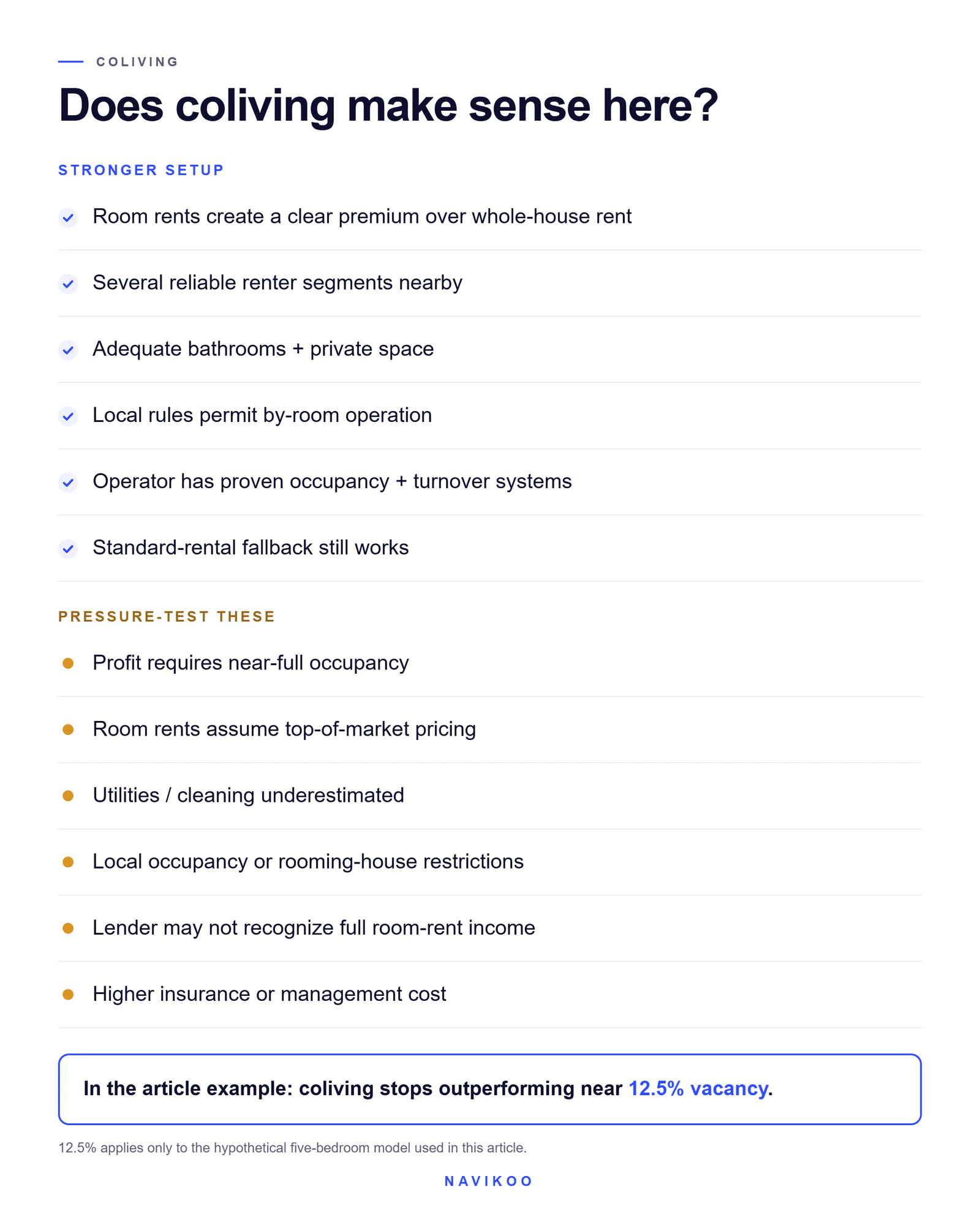
A coliving deal deserves a second look when room rents create a large enough premium over the whole-house lease, the area has recurring renter interest, the layout offers adequate bathrooms and private space, local rules clearly permit the use, and either you or an operator already has the systems to manage turnover.
It deserves skepticism when the projected return depends on nearly full occupancy, top-of-market room rents, unusually low utilities, cheap management, or a financing assumption the lender has not confirmed. If one vacant room turns the model negative, the operating cushion is probably too thin.
The strongest coliving underwriting exercise is still the simplest: model the same property as standard rental housing and as coliving housing. Use realistic vacancy for each. Include every service the coliving members are being promised. Include furnishing replacement and higher management. Then lower the room rent and raise vacancy before deciding which version you actually want to own.
The Investor's Bottom Line
Coliving can be profitable in the United States, but the case is not “five rooms make more money than one lease.” The real opportunity is finding housing where room-level leasing creates enough additional revenue to pay for a much more active operating model and still leave a meaningful premium afterward.
The best properties are usually not the ones with the maximum number of bedrooms. They are the ones where the spread between standard rent and realistic room rent is wide, the space works for occupants, the operator can keep occupancy high without constant discounts, and the legal and financing structure supports the plan.
If the deal only works because every room is full, every month, at the highest advertised rent, it probably does not work. If it still wins after conservative vacancy, the full operating package, and realistic management, then coliving may be one of the few ways to materially improve the income from the same piece of housing without buying a larger property.